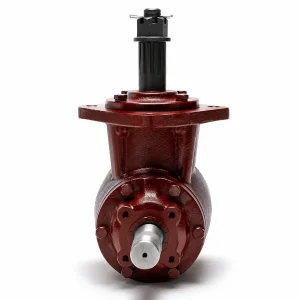
Manure Spreader Gearbox TB-19C — 28 HP Dual-Configuration Drive with 1:1.46 Ratio for Paddle and Beater Applications

The TB-19C manure spreader gearbox delivers 20.6 kW (28 HP) in speed-increasing mode and 16.9 kW (23 HP) in speed-reducing mode through a 1:1.46 gear ratio. Maximum output torque reaches 42.3 daNm (423 Nm), driving spreader paddles and beater mechanisms on trailer-mounted manure spreaders used in livestock farming.
TB-19C Manure Spreader Gearbox — Dual-Configuration 1:1.46 Ratio Drive
The TB-19C is a dual-configuration manure spreader gearbox that operates at a 1:1.46 gear ratio, delivering 20.6 kW (28 HP) in its speed-increasing arrangement and 16.9 kW (23 HP) in speed-reducing mode. Maximum output torque reaches 42.3 daNm (423 Nm) — sufficient to drive the paddle shafts and beater drums on trailer-type manure spreaders handling solid cattle and poultry manure, as well as composted material.
Manufactured as a direct replacement for the Comer Code TB-19C, this gearbox replicates the original housing dimensions, shaft profiles, and mounting geometry. Three shaft positions — designated X, Y, and Z — allow the operator or dealer to configure the gearbox as either a speed increaser (using gear arrangements 25, 26, 27, or 28) or a speed reducer (using arrangements 5 or 6). The Z-shaft accepts the standard 1-3/8 inch 6-spline PTO input, while the X and Y shafts use SW 36 (B-type) connections to the spreader mechanism.
Korean dairy farms, poultry operations, and compost producers in Chungcheongnam-do, Gangwon-do, and Jeolla provinces pair this pto gearbox with PTO-driven manure spreaders on 30-50 HP tractors. The cast iron housing withstands the corrosive environment created by manure acids and ammonia — a durability requirement that separates manure spreader gearboxes from those used in cleaner applications such as mowing or tilling.
Technical Specifications
All parameters per manufacturer test protocol. The TB-19C supports both increasing and reducing configurations through internal gear arrangement selection.
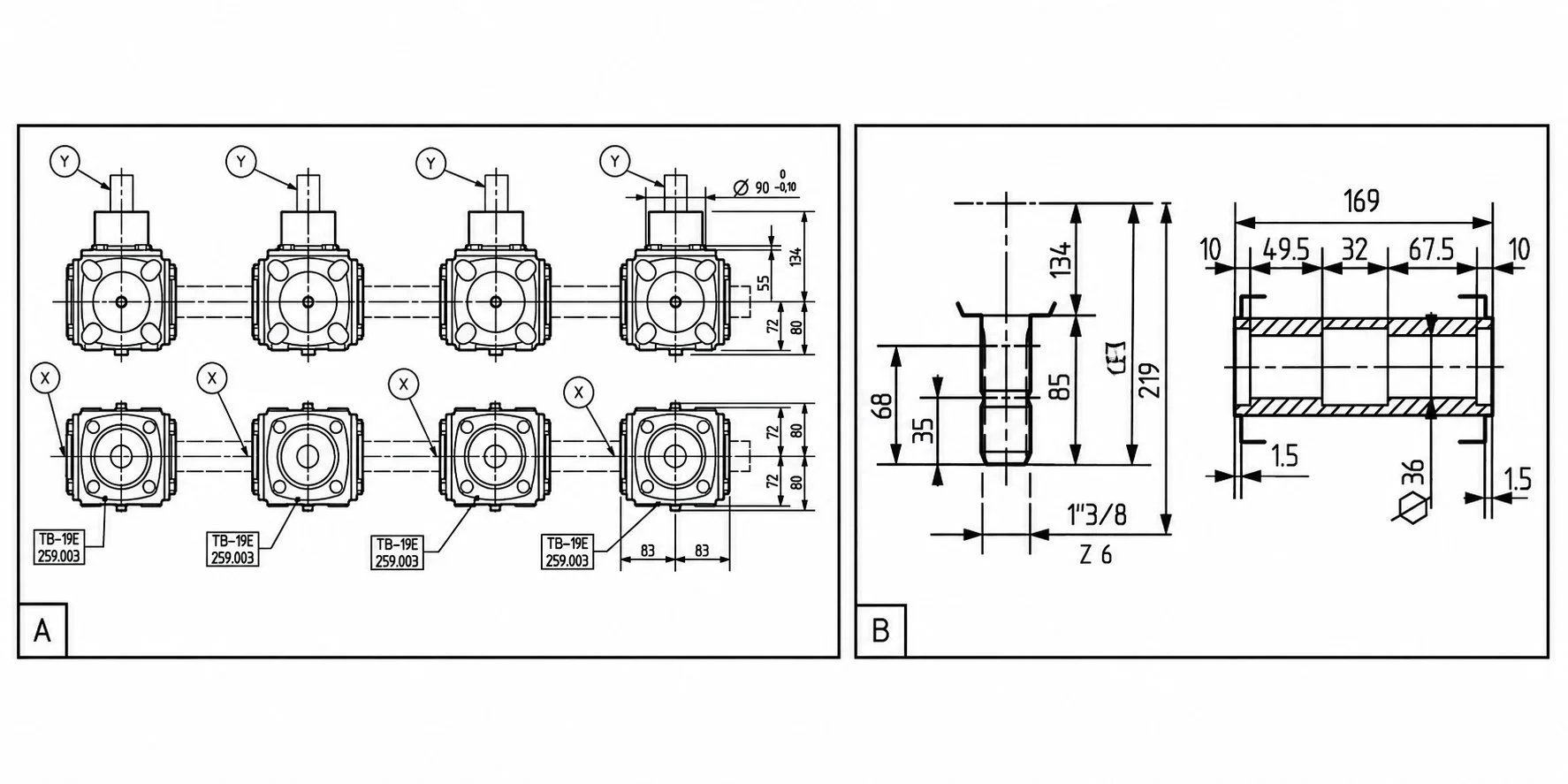
| Parameter | Value |
|---|---|
| Replacement For | Comer Code TB-19C |
| Gear Ratio | 1 : 1.46 |
| Max. Input Power (Increasing) | 20.6 kW / 28 HP |
| Max. Input Power (Reducing) | 16.9 kW / 23 HP |
| Max. Output Torque | 42.3 daNm (423 Nm) |
| Output Torque (Increasing Mode) | 24.1 daNm (241 Nm) |
| Gear Arrangement (Increasing) | Configurations 25, 26, 27, 28 |
| Gear Arrangement (Reducing) | Configurations 5, 6 |
| Shaft X | SW 36 (B) |
| Shaft Y | SW 36 (B) |
| Shaft Z (PTO Input) | 1-3/8" (6 spline) — Type A |
| Housing Material | Cast Iron |
| Contains Oil | No (ships dry, order oil separately) |
| Application Range | Various agricultural, manure spreaders |
How the TB-19C Drives a Manure Spreader
Power Flow Through the Gearbox
The tractor PTO shaft connects to the Z-shaft (1-3/8 inch 6-spline input) through a telescoping driveline. Inside the housing, a pair of gears converts rotational speed and torque according to the 1:1.46 ratio. In the speed-increasing configuration, 540 RPM PTO input becomes approximately 788 RPM at the output — a speed suited for vertical beater drums that need higher rotational velocity to fling manure outward in a wide arc. In speed-reducing mode, the same 540 RPM input drops to approximately 370 RPM — a range that matches the slower paddle shaft speeds used in horizontal floor-chain spreaders where controlled, even distribution matters more than throw distance.
Dual-Configuration Versatility
The TB-19C's six gear arrangements (25, 26, 27, 28 for increasing; 5, 6 for reducing) are determined by which shaft position serves as input and which serves as output. This configuration flexibility means a single gearbox model covers both vertical beater and horizontal paddle applications — Korean equipment dealers stock one part number instead of two, simplifying inventory and reducing lead time for emergency replacements during the spreading season.
Torque Multiplication in Reducing Mode
When operating as a speed reducer, the 1.46:1 ratio multiplies input torque by the same factor — at 540 RPM input, the output shaft delivers 423 Nm at 370 RPM. This torque level matches the resistance generated by paddle mechanisms working through heavy, wet cattle manure at full spreader loading. The moderate ratio keeps both input and output speeds within the bearing and seal speed ratings, avoiding the lubrication challenges that higher-ratio gearboxes face in continuous-duty applications.
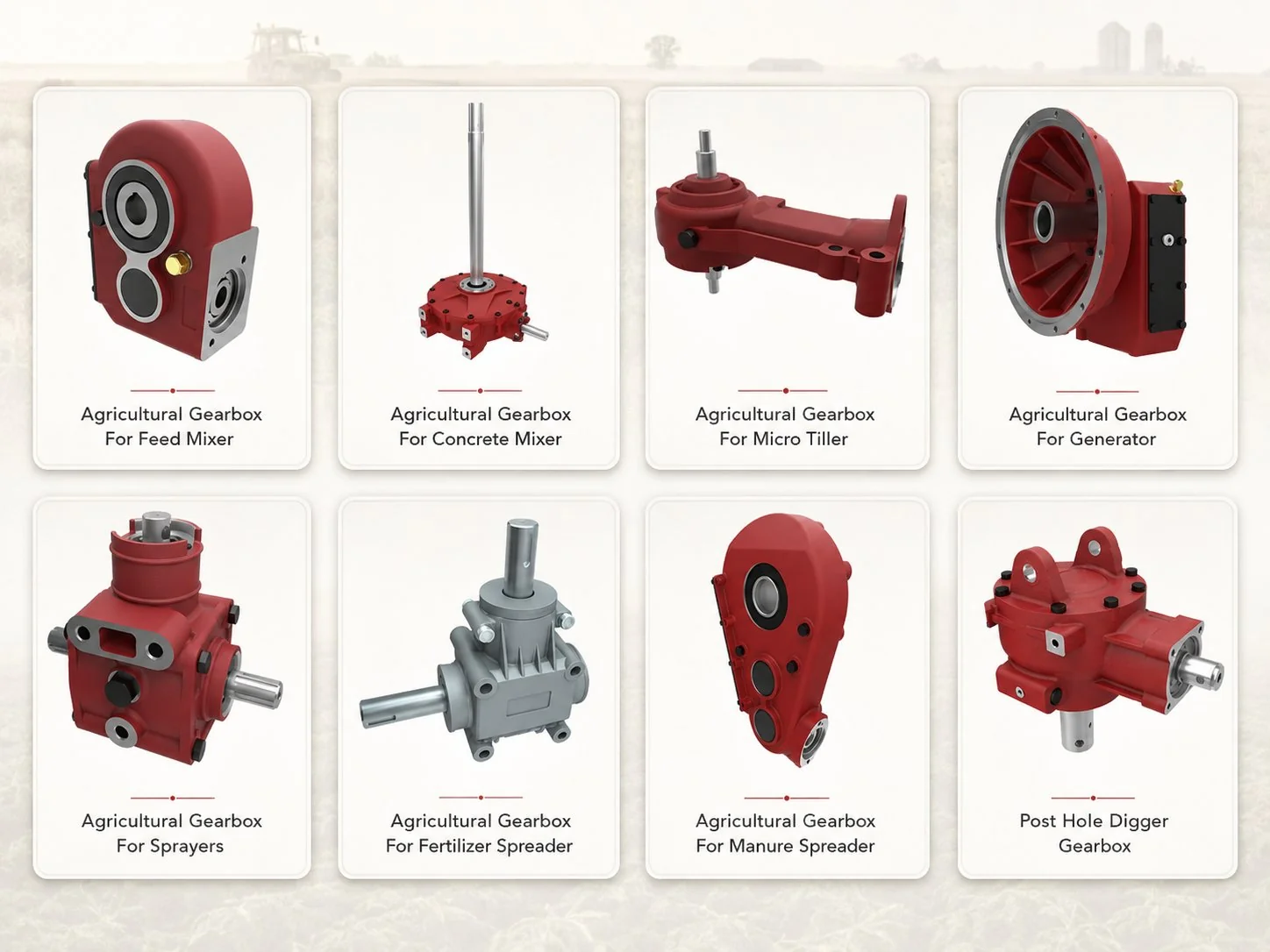
Speed Increasing vs. Speed Reducing — Matching the TB-19C to Your Spreader Type
The TB-19C serves both roles through internal gear arrangement selection. Choosing the wrong configuration results in either insufficient paddle speed (too slow to throw manure properly) or excessive beater speed (risking mechanical overload). The table below maps each mode to its target application.
| Characteristic | Increasing Mode (1:1.46) | Reducing Mode (1.46:1) |
|---|---|---|
| Output Speed (540 RPM input) | ~788 RPM | ~370 RPM |
| Max. Input Power | 20.6 kW (28 HP) | 16.9 kW (23 HP) |
| Output Torque | 24.1 daNm (241 Nm) | 42.3 daNm (423 Nm) |
| Gear Arrangements | 25, 26, 27, 28 | 5, 6 |
| Target Application | Vertical beater drums | Horizontal paddle shafts |
| Manure Type Suited | Composted, drier material | Fresh, wet, heavy manure |
| Spread Pattern | Wide throw arc (8-12 m) | Controlled, even distribution (4-6 m) |
For Korean dairy operations running trailer-type spreaders on hilly terrain in Gangwon and Chungcheong provinces, the reducing mode is the more common choice — it provides the higher torque needed to move heavy wet manure through the floor-chain delivery system and off the rear paddles at a controlled rate. Poultry farms spreading drier composted litter typically prefer the increasing mode, where higher beater speed breaks up clumps and achieves a finer, more uniform ground coverage.
Field Applications for the TB-19C
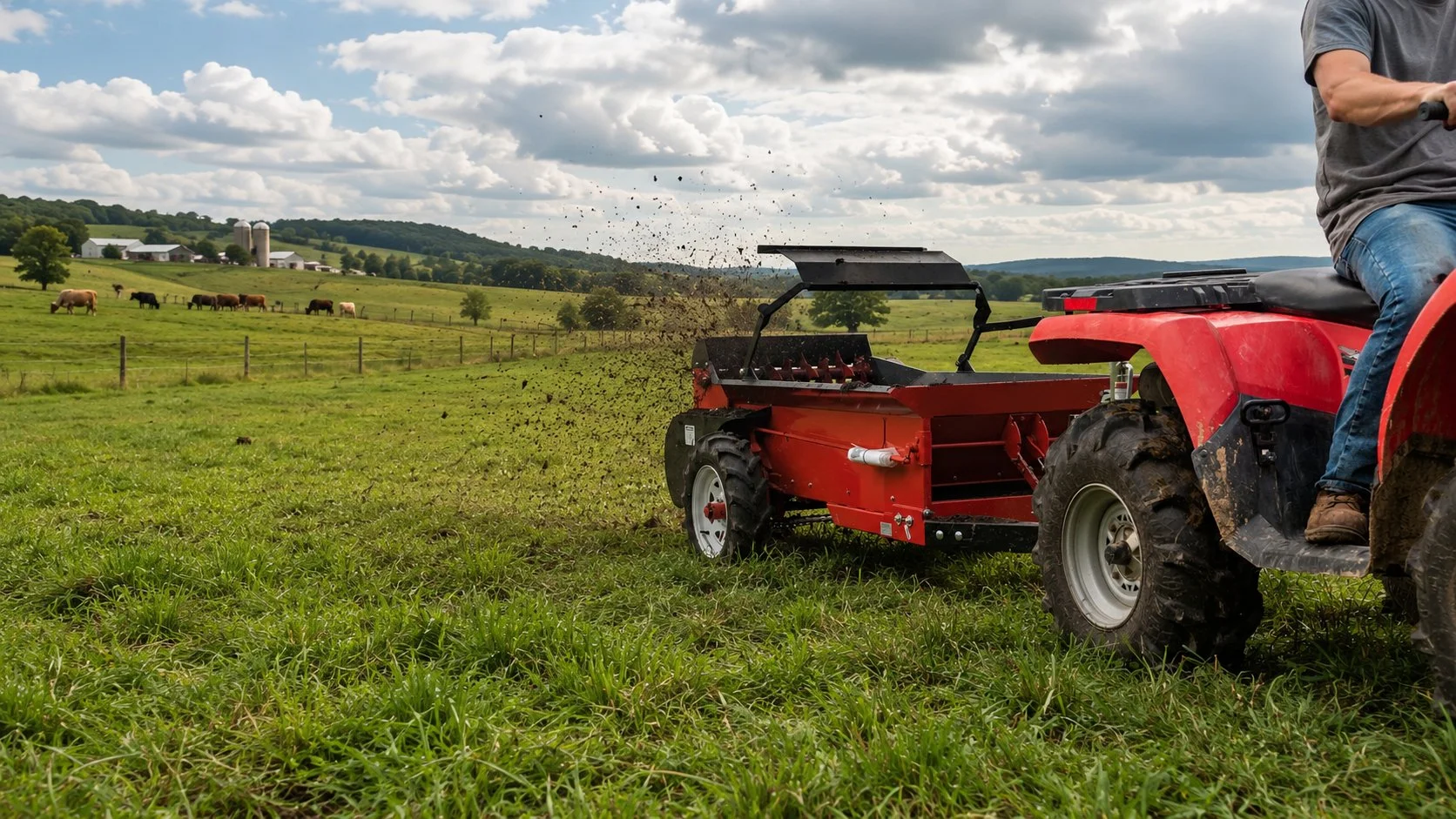
- ⚙ Dairy Farm Solid Manure Application — Korean Holstein dairy operations in Hongcheon, Hoengseong, and Pyeongchang generate 25-40 kg of manure per cow per day. Trailer-type spreaders fitted with this gearbox for manure spreaders apply aged solid manure to rice paddies after harvest and to forage corn fields before planting. The reducing mode handles the dense, moisture-heavy material that gravity-fed floor chains deliver to the rear beaters.
- ⚙ Poultry Litter Distribution — Broiler and layer operations in Chungcheong and Gyeonggi provinces spread composted poultry litter as a high-nitrogen soil amendment. The drier, lighter consistency of composted litter responds well to the increasing-mode configuration, where the higher beater speed breaks up compacted material and spreads it over an 8-12 meter swath. The 28 HP rating handles the sustained load of high-volume spreading at 6-8 km/h forward speed.
- ⚙ Composting Facility Distribution — Municipal and commercial composting operations in Jeolla and Gyeongsang provinces use PTO-driven spreaders to apply finished compost to agricultural fields under contract. The TB-19C's dual-configuration capability lets contractors adjust paddle speed between compost grades — coarser material at slower speed for even metering, fine-screened compost at higher speed for maximum throw distance on large fields.
Housing and Material Construction
Cast Iron Housing in Corrosive Environments
Manure spreader gearboxes face chemical exposure that other agricultural gearbox types do not encounter. Fresh manure produces ammonia, hydrogen sulfide, and organic acids that attack unpainted metal surfaces. The TB-19C's cast iron housing resists corrosion better than aluminum alloy housings — iron oxide (surface rust) forms a semi-protective layer that slows further corrosion, while aluminum in acidic conditions can develop pitting that eventually compromises structural integrity. An exterior coating of industrial enamel or epoxy paint applied before installation extends housing life significantly.
Shaft Seal Protection
The three shaft penetrations (X, Y, Z) each use spring-loaded lip seals designed for agricultural duty. On a manure spreader, the output shaft exits directly into the manure contact zone — seal failure allows manure particles to enter the gear housing, contaminating lubricant and accelerating gear and bearing wear. The TB-19C uses double-lip seals at the output positions: the inner lip retains gear oil, while the outer lip excludes manure slurry and debris. This dual-barrier design extends the interval between seal replacements from roughly 500 hours (single-lip) to approximately 1,200 hours under normal operating conditions.
Gear Material and Treatment
The internal gears are case-hardened alloy steel with carburized tooth surfaces. Carburizing creates a hard outer layer (HRC 58-62) that resists pitting and wear, while the softer core (HRC 30-35) absorbs impact energy from the sudden loading events that occur when manure chunks or foreign objects pass through the spreader mechanism. This hard-surface, tough-core combination is the standard metallurgical approach for agricultural gearboxes subjected to intermittent shock loads.
Maintenance Protocol for Manure Spreader Duty
Manure spreader gearboxes operate in harsher conditions than most other pto drive gearbox applications. The corrosive environment, high-moisture exposure, and intermittent shock loading demand a more rigorous maintenance schedule.
- ✔ Before first use — fill to level plug with 80W-90 GL-5 gear oil; verify all three shaft seals are seated correctly
- ✔ After 50 hours (break-in) — drain and refill oil; inspect drain plug magnet for abnormal metal particles
- ✔ Every 300 hours — change oil (shorter interval than cleaner applications due to seal exposure to manure contaminants)
- ✔ Every use — wash exterior with water after spreading to remove manure residue; inspect seals for debris intrusion
- ✔ End of season — full oil change even if hour interval not reached; apply corrosion inhibitor spray to exterior; store in covered area to prevent moisture accumulation inside the housing
Contamination Warning: If oil appears milky or grayish during routine checks, moisture has entered the housing — likely through a damaged seal. Drain immediately, replace affected seals, flush the housing with clean oil, and refill. Running on emulsified oil accelerates bearing corrosion and gear pitting beyond recovery.
Build a Complete Spreader Drive System
The TB-19C connects to the tractor through a pto shaft rated for at least 28 HP continuous duty. Manure spreader PTO shafts face a unique hazard — manure contamination accelerates universal joint wear and corrosion. Select a shaft with greaseable U-joints and inspect them at each oil change interval. Shielded-bearing U-joints resist manure infiltration significantly better than open-cup designs.
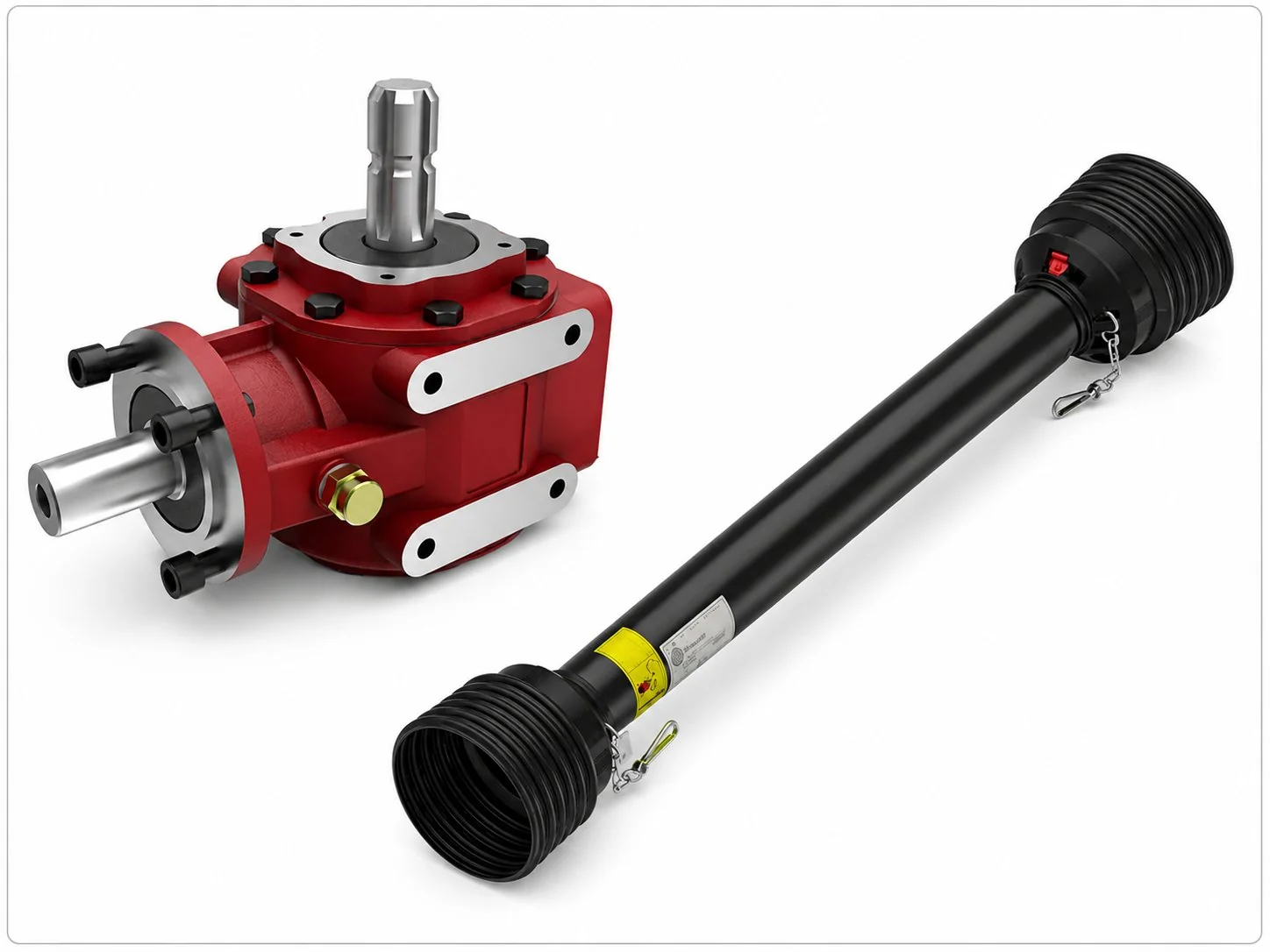
For operations running multiple implements, our agricultural gearbox catalog covers fertilizer spreaders, rotary tillers, balers, and other tractor pto gearbox applications — each available with factory-direct pricing and domestic Korean delivery.

Frequently Asked Questions
How do I determine whether to use increasing or reducing mode on my spreader?
Check your spreader's drive mechanism. Vertical beater drums that fling manure outward through a rear opening use increasing mode — they need higher RPM for adequate throw distance. Horizontal paddle-chain systems that push manure off a moving floor and over rear paddles use reducing mode — they need higher torque at lower RPM for controlled metering.
Can the configuration be changed in the field, or is it set at the factory?
The gear arrangement is determined by internal assembly — changing from increasing to reducing mode requires partial disassembly to reconfigure the gear train. This is a workshop-level task, not a field adjustment. Specify the correct configuration when ordering.
Why is the oil change interval shorter for manure spreader gearboxes than for mower gearboxes?
Manure contact with output shaft seals introduces corrosive gases and moisture into the housing at a higher rate than clean-air applications. The 300-hour interval (versus 500 hours for mowers) accounts for this accelerated contamination, maintaining oil film quality above the minimum needed to protect gear surfaces.
Is synthetic oil recommended for this gearbox?
Synthetic 80W-90 GL-5 improves cold-start protection during early spring spreading in northern Korean provinces where temperatures can drop below -10°C. It also resists water emulsification better than mineral oil — a meaningful advantage in the wet conditions around manure spreader output shafts. The cost premium is justified for operations that spread year-round or in extreme moisture conditions.
What is the expected service life of the TB-19C under typical Korean spreading conditions?
With proper lubrication and seal maintenance, expect 2,500 to 3,500 operating hours from the gear set and bearings. Seals are the most frequently replaced component — plan for seal replacement every 1,000-1,200 hours. Housing corrosion is the secondary life-limiting factor; post-use washing and corrosion inhibitor application extend housing life by 30-50%.
Operator Feedback
Ryu Seung-ho, Dairy Farm Manager — Hoengseong, Gangwon-do, April 2025
"120-head Holstein operation. Our Comer TB-19C failed mid-season — the importer quoted 5 weeks for a replacement. Found the Ever-Power version, received it in 4 days. Installed in the reducing configuration for our paddle-type spreader. 500 hours through fall and spring spreading with no problems. The price difference covered our fuel bill for a month."
Shin Eun-bi, Poultry Farm Owner — Eumseong, Chungcheongbuk-do, February 2025
"We spread composted broiler litter across 30 hectares of garlic and onion fields each spring. Running the TB-19C in increasing mode — the higher beater speed breaks up compacted litter into a fine spread pattern. Two seasons in, the gearbox runs smooth. We wash it off with a pressure hose after every use, which I think makes a real difference in how long the seals last."
Ahn Jae-min, Equipment Dealer — Cheonan, Chungcheongnam-do, November 2024
"The dual-configuration design is a strong selling point — I stock one SKU instead of two. Customers appreciate that the same gearbox serves both beater and paddle spreaders. Moved 22 units in 10 months with zero returns. The Comer replacement market in Korea is underserved, and this fills the gap."
Kwon Hye-jin, Organic Composting Cooperative — Naju, Jeollanam-do, August 2024
"Our cooperative serves 15 farms with contract spreading. The TB-19C handles everything from heavy wet dairy manure to screened compost. Switching the floor chain speed between loads by adjusting tractor RPM works well within the gearbox's operating range. Solid cast iron housing shrugs off the corrosive environment."
Nam Gi-tae, Beef Cattle Farmer — Yeongju, Gyeongsangbuk-do, May 2024
"Small operation — 40 Hanwoo cattle, one 3-tonne trailer spreader. The TB-19C on our old LS Mtron tractor runs without complaint. Simple, straightforward gearbox. I changed the oil once at 50 hours and again at 300. The drain plug magnet catches fine particles, which tells me the gears are wearing in normally."
Additional information
| Editor | Cxm |
|---|
Related products
-
Pull-behind Mower Gearbox EP-GC325 | 160HP Trailing PTO
-
Fertilizer Spreader Gearbox L-25J | Comer Replacement PTO
-
Agricultural Gearbox — Replacement of Bondioli & Pavesi
-
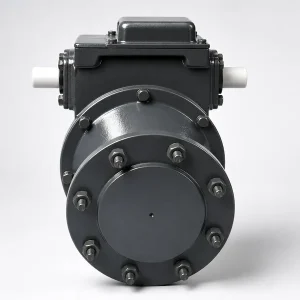
Irrigation Wheel Drive Gearbox AEP-1 Series — 50:1 and 52:1 Worm Gear Final Drive for Center Pivot and Linear Move Systems
-
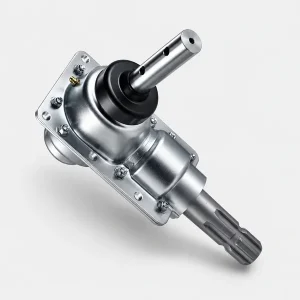
Snow Plow Gearbox EP-01-229 — Spiral Bevel 1:1.35 Ratio Drive for PTO-Powered Snow Plows and Salt Spreaders
-
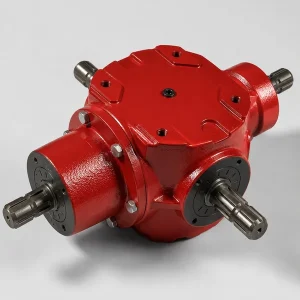
Round Baler Gearbox EP2100-T3 — 80 HP Helical Speed Reducer with 2.1:1 Ratio for Baling and Harvesting Equipment
-
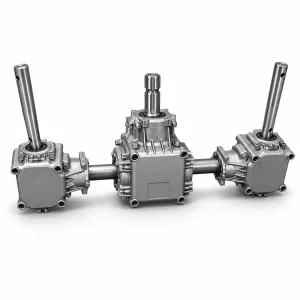
Fertilizer Spreader Gearbox L-150C — 9.9 kW Speed Increaser with 1:1.35 Ratio for Broadcast and Pendulum Spreaders
-
EP-RC-30 Rotary Cutter Gearbox — 40 HP Bevel Gear Speed Increaser for Agricultural Mowing