What Is a Hay Tedder Gearbox?
A caja de cambios de la henificadora is the central distribution gear unit — plus the individual rotor drive gearboxes — that power the spinning tine rotors on a hay tedder. After a mower cuts the standing grass or legume crop and leaves it lying in swaths, the tedder passes over the field and lifts the cut material into the air with spring-loaded tines mounted on rotating arms, scattering it loosely and evenly across the full working width. This thorough aeration dramatically accelerates drying — reducing the time from mowing to baling by 30 to 50 percent in typical conditions — and achieving uniform moisture content across the windrow that produces consistent bale quality and minimises the risk of mould development in stored hay or silage.
El caja de cambios de la henificadora system must distribute PTO power from a single input to 2, 4, 6, or 8+ individual rotors spread across working widths of 4 to 12+ metres. Each rotor carries 4 to 8 tine arms rotating at 400 to 600 RPM — fast enough to lift and throw the crop material 1 to 3 metres into the air. The central gearbox receives the 540 RPM PTO input and distributes it through driveshafts to each rotary tedder gearbox at each rotor position. The engineering challenge is maintaining equal speed at every rotor across the full width while the machine flexes and articulates over uneven ground — because speed variation between rotors produces uneven crop distribution that creates wet spots in the field, reducing the overall drying rate.
How the Tedder Drive System Works
El tractor Toma de fuerza drives the central caja de cambios de la henificadora at 540 RPM. This central unit — typically a multi-output right-angle bevel or spur gear distribution box — splits the power into two or more output shafts, each feeding a driveline that runs to a rotor gearbox at each rotor position. On a 4-rotor tedder, the central gearbox has two outputs (left and right), each driving a secondary cross-shaft that powers two rotors. On larger 6 to 8 rotor machines, cascading gearbox arrangements pass power from rotor to rotor across the full working width.
Each individual tedder rotor gearbox is a compact right-angle bevel unit that redirects the horizontal driveshaft rotation to vertical output, spinning the tine arm assembly at 400 to 600 RPM. The 1:1 ratio is most common (output speed equals input speed), though some designs use 1:1.2 to 1:1.5 speed reduction for wider rotors that need higher torque and lower tip speed. The rotor gearbox must be lightweight (2 to 5 kg) because it is mounted on the rotor frame that follows the ground contour on individual castor wheels — excess weight reduces the ground-following responsiveness and increases tyre wear.
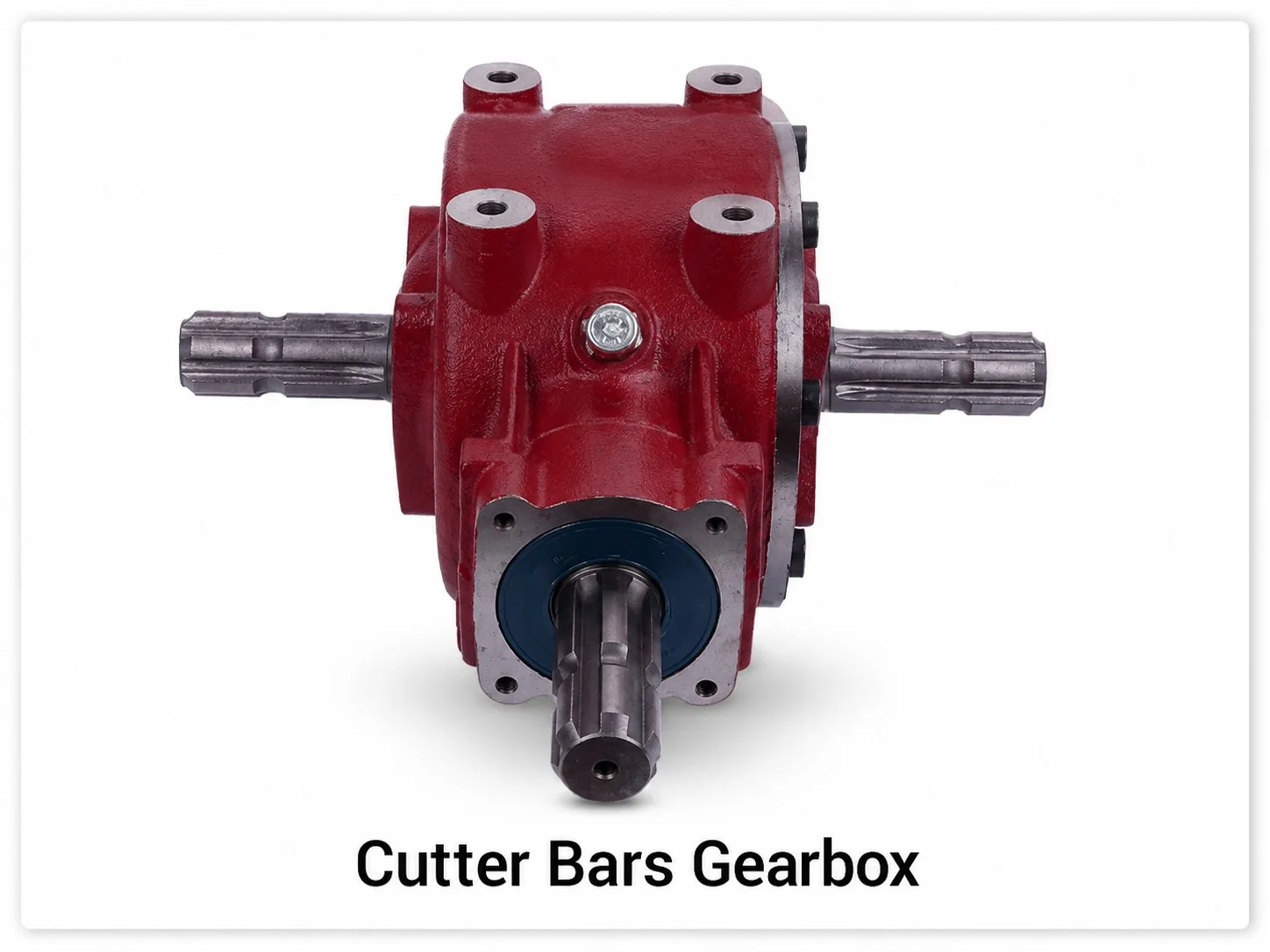
Hay tedder gearbox — compact right-angle bevel drive for high-speed tine rotor applications
Tedder Size and Gearbox Configuration
High-Speed Bearing Design for Tine Arm Rotation
Each tedder rotor gearbox output shaft operates at 400 to 600 RPM while carrying the centrifugal loads from 4 to 8 tine arms extending 0.6 to 1.0 metre from the rotor centre. At 500 RPM with 8 tine arms, the combined centrifugal force generated by the rotating tine mass produces a continuous radial load on the output bearing that is several times the static weight of the tine assembly. This centrifugal loading is the dominant force on the hay tedder gearbox bearing — not the torque from turning the tines through the crop (which is relatively light, as tedding requires only lifting and scattering loose cut material, not cutting or pulling).
Sealed deep-groove ball bearings with C3 internal clearance are the standard choice for tedder rotor gearbox output positions. The C3 clearance accommodates the centrifugal expansion of the inner ring at operating speed and the thermal expansion from the sustained high-speed rotation. Bearing seals must exclude the hay dust, soil particles, and moisture from dew-laden crop that the rotor tines throw in every direction during operation — making sealed-for-life bearings (no field re-greasing) the preferred configuration for the rotor gearbox positions where access is limited and maintenance is impractical during the time-sensitive haymaking window.
All rotors across the tedder width must operate at the same speed to produce uniform crop distribution. If one rotor runs 5 percent slower than its neighbours (from a worn gearbox, loose driveshaft coupling, or low oil level), that rotor leaves a denser crop layer at its position — creating a wet strip that dries more slowly than the surrounding area. On a 6-rotor tedder, a single underperforming rotor can delay the entire field from reaching target moisture content, extending the drying period and increasing weather-damage risk for the complete crop.
Ground-Following Articulation and Driveline Flexibility
Each tedder rotor is mounted on an independent frame section that follows the ground contour on its own castor wheel. On undulating terrain, adjacent rotors may operate at different heights — one on a hilltop, the next in a hollow — with vertical offsets of 200 to 500 mm between neighbouring rotor positions. The driveshafts connecting the rotors must accommodate this continuous angular variation through U-joints or constant-velocity joints while maintaining constant speed transmission to every caja de cambios de la henificadora at every rotor position.
Telescoping driveshafts between rotor gearboxes allow the effective shaft length to change as the machine articulates over ground contours. The telescoping joint must slide freely under the combined torque and angular misalignment conditions — if it binds (from corrosion, lack of grease, or debris contamination), the locked shaft forces the rotor frame to follow the adjacent frame rather than the ground contour, lifting the tines above the crop layer at one position and pushing them into the soil at another. This produces both ineffective tedding (missed crop) and accelerated tine and gearbox wear from sustained soil contact.
U-joint and telescoping-shaft greasing every 8 to 10 operating hours is essential for maintaining the tedder gearbox ground-following capability that uniform crop aeration requires. When inspecting the driveshaft joints during greasing, also check each U-joint for play — more than 0.5 mm of perceptible free play indicates developing joint wear that will produce speed pulsation at the affected rotor, degrading the tedding uniformity at that position before the joint fails completely.

Folding Transport and Driveline Disconnection
Large tedders (6 to 8+ rotors) fold hydraulically for transport — reducing the working width from 8 to 12+ metres to a road-legal 2.5 to 3.0 metre transport width. The folding action requires the inter-rotor driveshafts to disconnect and reconnect as the outer rotor sections fold upward. Most designs use clutch couplings or dog-tooth engagement mechanisms at the fold joints that automatically disconnect the driveline when the section folds and re-engage when it unfolds — eliminating the need for the operator to manually connect or disconnect driveshafts during the folding sequence.
The automatic driveline disconnection mechanism must engage positively under the full torque of the operating tedder — if it slips or fails to fully engage, the affected rotor section either runs at reduced speed (partial engagement) or does not run at all (failed engagement), both of which the operator may not notice from the tractor seat. Pre-season verification of the engagement mechanism at every fold joint — checking for full tooth meshing, proper spring tension, and absence of wear or corrosion on the engagement surfaces — is essential for ensuring that all rotor sections receive full drive when unfolded for operation. Worn engagement teeth produce an intermittent grinding noise during the first few seconds after unfolding — this noise is the warning signal that the coupling needs replacement before it fails completely in the field.
During transport, the folded caja de cambios de la henificadora units at the outer rotor positions are exposed to road vibration and spray from the tractor wheels. Protective covers over the gearbox housings prevent road grit and water from contaminating the seals and shaft surfaces during transport — a precaution that is particularly important for tedders that travel significant distances between fields on public roads where road salt (in regions that salt winter roads) can accelerate seal and fastener corrosion.
Especificaciones técnicas de un vistazo
Hay Tedder Gearbox Oil and Lubrication
EP gear oil SAE 80W-90 (ISO VG 220 equivalent) is the standard hay tedder gearbox oil for both the central distribution unit and the individual rotor gearboxes. The power per rotor is modest (3 to 8 HP per rotor on a 6-rotor machine) and operating temperatures remain moderate (45 to 65 degrees Celsius), so the thermal demands do not require synthetic oil — though synthetic VG 220 provides benefit for operations that ted in early morning when dew-laden crop creates a cold, wet environment and the gearbox must start at low ambient temperatures. The very small oil volume per rotor gearbox (0.15 to 0.4 litres) means that even a minor leak or seal failure can empty the gearbox within a few operating hours — making pre-season oil level verification at every rotor position a critical maintenance action.
Oil change intervals follow the standard 500-hour or annual schedule. For the central caja de cambios agrícola, which handles the full system power, synthetic VG 220 with a 500-hour interval provides adequate protection. For the individual rotor gearboxes, the modest power level and intermittent duty pattern (tedding is typically 2 to 6 hours per cutting cycle, with multiple cycles per season totalling 50 to 200 hours annually) mean that annual pre-season oil change is usually the binding maintenance interval rather than the hour-based limit.
Multi-output right-angle bevel. Handles full system power (15 to 50+ HP). Larger housing, higher oil volume (0.5 to 1.5 litres). Mounted on the main tedder frame. Standard agricultural gearbox maintenance schedule applies.
Compact single-output right-angle bevel. Low power per unit (3 to 8 HP). Lightweight (2 to 5 kg) for ground following. Tiny oil volume (0.15 to 0.4 litres). Sealed bearings — no field re-greasing. Critical: check oil level at every unit before tedding.
Programa de mantenimiento estacional
Oil change at central gearbox and every rotor unit. Rotate each rotor by hand to verify smooth bearing action. Inspect driveshaft U-joints and telescoping tubes — grease all fittings. Check tine arms and spring tine condition. Verify all rotor gearbox drain plugs are tight. Run the tedder unloaded for 5 minutes at operating speed, listening for bearing noise at each rotor.
Grease all driveshaft U-joints and telescoping spline tubes. Visual check for oil leaks at every rotor gearbox. Inspect tine arms for bent or missing tines (imbalanced rotors increase bearing vibration). Clear accumulated hay from around gearbox seals and driveshaft joints.
Clean all hay debris from every rotor, gearbox, and driveshaft. Top up oil at every rotor unit and central gearbox. Apply grease to exposed shaft surfaces and driveshaft joints. Store under cover (UV exposure degrades housing paint and seal materials). Record any rotors with noise, temperature change, or vibration for priority pre-season repair or replacement before the next cutting cycle.
Aftermarket Hay Tedder Gearbox Replacement
Hay tedder gearbox replacement is driven primarily by output bearing fatigue from the sustained centrifugal loading of the spinning tine arms and by seal degradation from the hay dust and moisture environment. A well-maintained rotor gearbox typically lasts 8 to 15 years (800 to 2,000 operating hours). When replacing gearboxes on a multi-rotor tedder gearbox system, replace all rotor units from the same production batch to maintain speed uniformity across the working width — mixing new and worn gearboxes with different friction characteristics produces the rotor speed variation that creates uneven crop distribution.
Cross-reference parameters include the input shaft configuration, output shaft size and coupling type, housing mounting bolt pattern, bevel ratio, and weight (critical for ground-following performance). Our engineering team maintains cross-reference data for major tedder brands and can supply aftermarket replacements with verified dimensional compatibility. Volume pricing for complete rotor sets (2 to 8+ units per set) ensures cost-effective matched-batch replacement for the entire tedder width, ensuring uniform performance from the first cut to the last.
Preguntas frecuentes
Ted Faster, Dry Sooner
From compact 2-rotor units to wide 8+ rotor systems — our hay tedder gearboxes deliver the lightweight precision, synchronised speed, and multi-season bearing life that efficient crop aeration demands.
Editor: Cxm