What Is a Flail Mower Gearbox?
A Caja de engranajes de la desbrozadora de martillos is the right-angle PTO-driven gear unit that powers the high-speed rotor of a flail mower — a rugged and versatile vegetation management machine that uses rows of freely-swinging Y-shaped or hammer-type flails to mulch grass, weeds, brush, crop residue, and light scrub into fine particles. Unlike rotary mowers that use rigid blades bolted to a fixed spindle, flail mowers mount each flail on an independent pivot pin — allowing it to swing backward on impact with stones, stumps, or other solid objects rather than transmitting the full impact force through the drivetrain. This pivot-and-swing design makes flail mowers the preferred choice for rough terrain and unimproved ground where buried hazards are common.
El Caja de engranajes de la desbrozadora de martillos converts horizontal PTO rotation (540 RPM) into the high-speed rotation (1,500 to 2,500 RPM at the rotor) needed to generate sufficient flail tip speed for effective mulching. This speed multiplication is achieved through a combination of the bevel gearbox ratio (1:1 to 1:1.5 at the gearbox stage) and a belt-drive secondary (typically 1:2 to 1:3 from the gearbox output pulley to the smaller-diameter rotor pulley, achieving the full speed multiplication). The two-stage architecture — bevel gearbox plus belt drive — is a deliberate engineering choice: the belt absorbs shock loading from flail impacts, slips under extreme overloads before gearbox damage occurs, and provides a convenient means to adjust rotor speed by changing pulley diameters.
How the Flail Drive System Works
El tractor Toma de fuerza drives the gearbox input shaft at 540 RPM through a driveline equipped with slip clutch or shear bolt protection. Inside the gearbox, a right-angle spiral bevel gear pair redirects the power 90 degrees — from horizontal PTO axis to the horizontal output shaft axis perpendicular to the direction of travel. The gearbox output shaft carries a V-belt pulley that drives the rotor shaft through one or two matched V-belts (or a single poly-V belt on larger machines). The belt reduction ratio of 1:2 to 1:3 multiplies the gearbox output speed from 540 RPM to the 1,500 to 2,500 RPM final rotor speed.
This belt-driven architecture provides three critical advantages for the Caja de engranajes de la desbrozadora de martillos system. First, the belt absorbs torsional vibration from the irregular flail-vegetation impacts — smoothing the torque pulsation before it reaches the bevel gears. Second, under extreme overload (a large stone or stump strike), the belt slips momentarily rather than transmitting the full impact to the gearbox — functioning as a continuous-reset torque limiter. Third, the belt tension can be adjusted to compensate for belt stretch over time, maintaining consistent rotor speed throughout the belt service life.

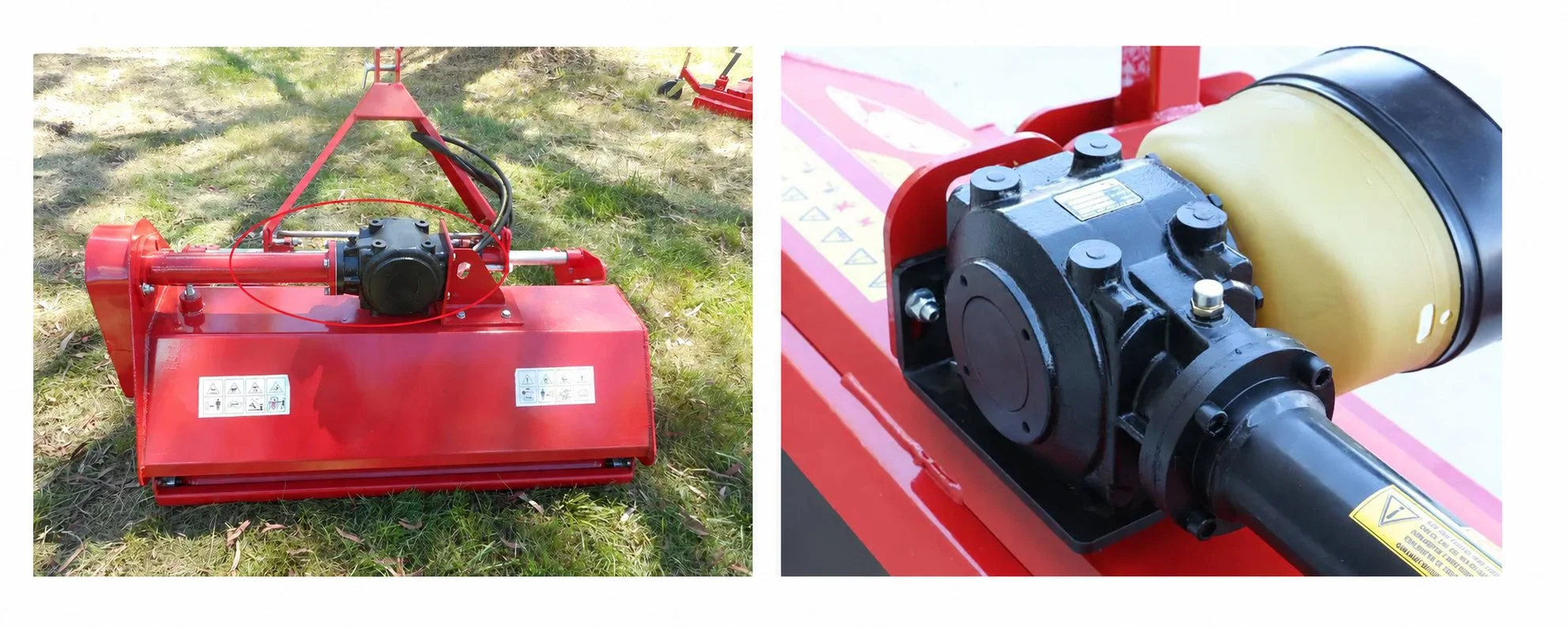
Flail mower gearbox — right-angle bevel drive with belt output to high-speed rotor
Flail Mower vs. Rotary Mower: Gearbox Engineering Comparison
Impact Loading: Three Layers of Shock Absorption
Flail mowers operate in the most unpredictable impact environment of any mowing application — roadside verges, overgrown fields, derelict land, and post-harvest stubble where buried stones, metal debris, concrete fragments, and tree roots are encountered without warning. The Caja de engranajes de la desbrozadora de martillos is protected from these impacts by three cascading shock-absorption layers that progressively reduce the impact energy reaching the bevel gears.
Each flail swings freely on its pivot pin. On impact, the flail deflects backward — converting impact energy to rotational deceleration of a single low-mass flail rather than a rigid blade attached to the entire rotor. Absorbs 70 to 90 percent of typical impact energy.
The V-belt between gearbox output and rotor slips under extreme torque overloads — absorbing energy as belt-pulley friction heat. Self-resetting: belt resumes drive as torque returns to normal. No parts replacement needed.
El línea de transmisión de la toma de fuerza slip clutch at 1.5 to 2.0 times rated torque. Protects the gearbox from gross overloads that exceed both flail-swing and belt-slip capacity. Self-resetting after each event.
A Caja de engranajes de la desbrozadora de martillos with direct gearbox-to-rotor coupling (no belt) transmits every impact and vibration pulse directly to the bevel gear mesh — accelerating tooth fatigue and bearing wear by 3 to 5 times compared to a belt-driven configuration. The belt functions as both a torsional damper (smoothing vibration) and a torque limiter (slipping on extreme overloads). Replacing a worn belt every 200 to 400 hours costs 20 to 40 dollars; replacing a gearbox damaged by undamped impacts costs 300 to 600 dollars. The belt is the most cost-effective gearbox protection component in the entire flail mower drive system.
Gear and Bearing Design for Sustained Mulching Duty
Case-carburised spiral bevel gears with 58 to 62 HRC surface hardness and 30 to 38 HRC core toughness are standard for the Caja de engranajes de la desbrozadora de martillos. Gear module 4 to 6 mm provides the tooth root strength to survive the residual impact loading that passes through the flail pivot and belt drive layers — typically 10 to 30 percent of the original stone-strike energy. Although this residual is substantially reduced from the initial impact, the high frequency of impacts (tens to hundreds per operating hour in rough terrain) accumulates fatigue damage that the gear design must accommodate over 1,000 to 5,000 operating hours of service life.
El flail mower gearbox bearing at the output position carries the combined radial load from the bevel gear mesh forces and the belt tension pulling the output pulley sideways. This belt tension creates a sustained unidirectional radial load on the output bearing (typically 500 to 2,000 N depending on belt type and tension) that is additional to the alternating gear mesh forces. Tapered roller bearings or deep-groove ball bearings with C3 clearance are specified for this combined loading pattern. The belt tension must be checked regularly — a loose belt reduces mulching performance, while an overtight belt overloads the output bearing and shortens both belt and bearing life. The correct tension produces 10 to 15 mm of belt deflection at mid-span under moderate finger pressure.
Flail Types and Gearbox Torque Profiles
The flail type fitted to the rotor directly affects the torque demand on the Caja de engranajes de la desbrozadora de martillos. Y-shaped flails (the most common type for grass and light vegetation) have two cutting edges per flail body — producing a clean cut with moderate torque demand per flail. Hammer flails (also called paddle or straight flails) are heavier, single-edge flails designed for heavy brush and woody material — generating higher cutting torque per impact but fewer cuts per revolution. Knife flails (thin, sharp-edged blades) produce the finest mulch quality but wear fastest and generate the highest torque spikes when striking woody stems because their thin cross-section concentrates the impact force.
The total number of flails on the rotor (typically 20 to 48 depending on rotor width) determines the torque pulsation frequency and the instantaneous power demand peaks. A rotor with 36 Y-flails at 2,000 RPM produces 72,000 flail-vegetation engagements per minute — a very high-frequency torque pulsation that the gearbox output bearing must endure as a continuous vibration load superimposed on the average torque. Higher flail counts produce finer mulch quality but increase the total power demand and bearing vibration. When upgrading from Y-flails to heavier hammer flails on an existing machine, verify that the Caja de engranajes de la desbrozadora de martillos power rating is adequate for the increased per-flail torque — the heavier flails can increase the peak gearbox loading by 30 to 50 percent compared to the original Y-flail specification.
Verge Mower and Boom-Mounted Applications
Roadside verge mowers and boom-mounted flail heads represent the most demanding Caja de engranajes de la desbrozadora de martillos application because the flail head operates at the end of a hydraulic boom — 3 to 8 metres from the tractor — where it encounters the full range of roadside hazards: buried kerb stones, drainage grates, guard rail foundations, discarded metal objects, and compacted soil at road edge. The gearbox at the boom-mounted flail head is typically smaller and lighter than a tractor-mounted unit (to reduce the boom payload and hydraulic demand) while handling the same or higher impact frequency from the more hazardous roadside environment.
Hydraulic drive (rather than PTO mechanical drive) is increasingly common for boom-mounted flail heads because it eliminates the need for mechanical driveshafts along the boom length and through the boom pivot joints. In hydraulic-drive flail heads, the gearbox is replaced by a hydraulic motor mounted directly on the rotor — but many operators still prefer PTO-driven mechanical flail heads for their superior efficiency (95 to 97 percent mechanical vs. 70 to 80 percent hydraulic) and lower operating temperature. For PTO-driven boom-mounted units, the driveline must include multiple U-joints at the boom pivot points, and the Caja de engranajes de la desbrozadora de martillos at the head must be compact enough to fit within the flail housing without interfering with the boom geometry or increasing the head weight beyond the boom capacity rating.
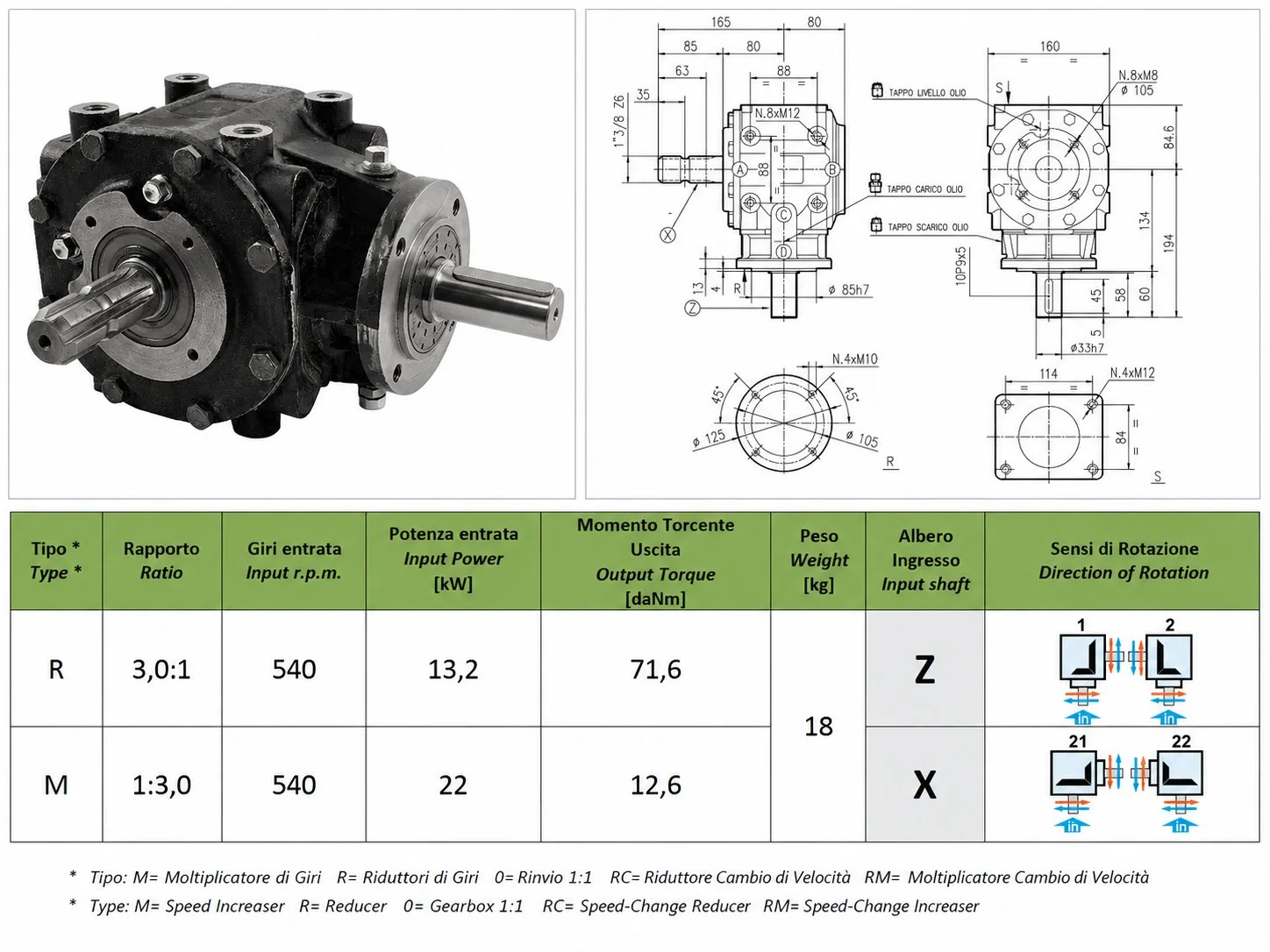
Especificaciones técnicas de un vistazo
Flail Mower Gearbox Oil and Lubrication
EP gear oil SAE 80W-90 (ISO VG 220) is the standard flail mower gearbox oil. Operating temperatures during flail mulching reach 60 to 80 degrees Celsius — moderate because the belt drive absorbs a significant portion of the total system energy (as belt flex and friction heat) that would otherwise pass through the gearbox. Synthetic VG 220 provides benefit for heavy-duty flail mower gearbox applications above 50 HP or for machines operating in sustained heavy scrub where gearbox temperatures approach 90 degrees Celsius. Oil volume is typically 0.5 to 1.5 litres.
Oil change intervals are 250 to 500 hours or annually (pre-season change). The high-vibration operating environment of flail mowing can accelerate seal wear — inspect the output shaft seal (at the belt pulley side) regularly for oil leakage, as the combined vibration from flail impacts and belt tension oscillation produces more seal flex than most caja de cambios agrícola applications. Vegetation debris (grass, leaves, fine mulch particles) that wraps around the output shaft near the seal can migrate under the seal lip if not removed — daily debris clearance around the gearbox output shaft extends seal life and prevents the contamination-related bearing failures that represent the majority of field gearbox returns.
Programa de mantenimiento
Oil change with EP VG 220 (or synthetic for heavy duty). Inspect belt for cracks, fraying, and glazing — replace if worn. Check belt tension (10 to 15 mm deflection at mid-span). Verify pulley alignment. Grease Toma de fuerza driveline U-joints. Verify slip clutch calibration. Inspect all flails for wear and pivot-pin freedom.
Re-check belt tension — new belts stretch during the first 20 to 50 hours. Oil level verification. Clear vegetation debris from around gearbox output shaft and belt guard area. Inspect belt for early signs of cracking or glazing. Re-grease PTO driveline U-joints. Check flail pivot pins for wear.
Clean all vegetation debris from gearbox, belt guard, and rotor. Release belt tension for storage (prevents belt set and premature cracking). Top up gearbox oil. Apply grease to exposed shaft surfaces. Store under cover. Record operating hours for belt replacement planning and gearbox service scheduling based on accumulated impact hours.
Aftermarket Flail Mower Gearbox Replacement
Flail mower gearbox replacement is driven primarily by output bearing fatigue from combined belt tension and residual impact loading, and by seal degradation from the high-vibration, debris-laden and high-vibration operating environment that characterises commercial flail mulching operations. A well-maintained gearbox typically lasts 3 to 10 years (1,000 to 5,000 operating hours) depending on terrain severity, vegetation type, and belt maintenance discipline. Heavy scrub and stone-rich terrain accelerate wear; maintained grassland extends life. Cross-reference parameters include the input shaft spline profile, the output pulley shaft size and keyway, the housing mounting bolt pattern, the bevel ratio, and the power rating. Comer code T-313J is one of the most commonly cross-referenced specifications in the flail mower aftermarket.
Our engineering team maintains cross-reference data for major flail mower brands and can supply aftermarket gearboxes with verified dimensional and performance compatibility. Both complete gearbox assemblies (with matched output pulley) and individual gear, bearing, and seal kits are available. For operators managing municipal verge contracts or large-scale pasture renovation programmes, we also supply complete gearbox-plus-belt-plus-pulley kits that ensure all drive components are matched from factory. Contact our engineering team with your flail mower model, cutting width, and working conditions — our agricultural gearbox cross-reference service ensures accurate specification matching and correct belt-pulley pairing.
Preguntas frecuentes
Mulch Tougher, Last Longer
From roadside verge management to heavy scrub clearance — our flail mower gearboxes deliver the impact-protected, belt-driven reliability that sustained vegetation mulching demands.
Editor: Cxm