What Is a Corn Header Gearbox?
A corn header gearbox is the compact right-angle bevel gear unit installed at each row unit of a corn head (also called a corn header or maize header) attached to a combine harvester. Each row unit processes one row of standing corn: a pair of counter-rotating stalk rolls (also called snapping rolls) grips the stalk and pulls it downward through the snapping plates, separating the ear from the stalk. Simultaneously, gathering chains guide the detached ears laterally into a central cross auger or gathering trough that feeds them into the combine feederhouse for threshing. The corn header gearbox drives these stalk rolls and gathering chains at each row position — and a modern corn head may have 4 to 24 row units, meaning a single header contains 4 to 24 individual gearboxes, all of which must function flawlessly throughout the corn harvest season.
The engineering challenge for the corn head gearbox is extreme compactness. The gearbox must fit within the narrow row spacing — typically 750 mm (30 inches) or 500 mm (20 inches) — while delivering sufficient torque to pull heavy corn stalks (each stalk weighing 0.5 to 1.5 kg) through the snapping plates at rates of 3 to 5 stalks per second per row. This combination of compact size, moderate speed, sustained loading, and the ever-present risk of stalk material wrapping around the output shafts defines the unique design requirements of the corn header gearbox.
How the Row Unit Drive System Works
Power flows from the combine engine through the header driveshaft to a central header gearbox that distributes drive to a horizontal cross-shaft running the full width of the corn head. From this cross-shaft, individual row unit gearbox units at each row position use right-angle spiral bevel gears (typically 1:1 to 1:1.5 ratio) to redirect the horizontal cross-shaft rotation downward to the vertical stalk roll shafts. The counter-rotation of the two stalk rolls in each row unit is achieved by meshing the output of the corn header gearbox with a secondary gear pair at the stalk roll level — one roll driven directly, the adjacent roll driven through an idler gear that reverses its direction.
The gathering chains are typically driven from the same stalk roll gearbox output through a chain or belt secondary drive, running at a lower speed (200 to 400 RPM) than the stalk rolls (800 to 1,200 RPM) to gently guide the separated ears toward the centre of the header without throwing or damaging them. The speed differential between the stalk rolls (fast, aggressive downward pulling) and the gathering chains (slow, gentle lateral guiding) is precisely calibrated through the gear and sprocket ratios to produce clean ear separation with minimal kernel loss or ear damage.
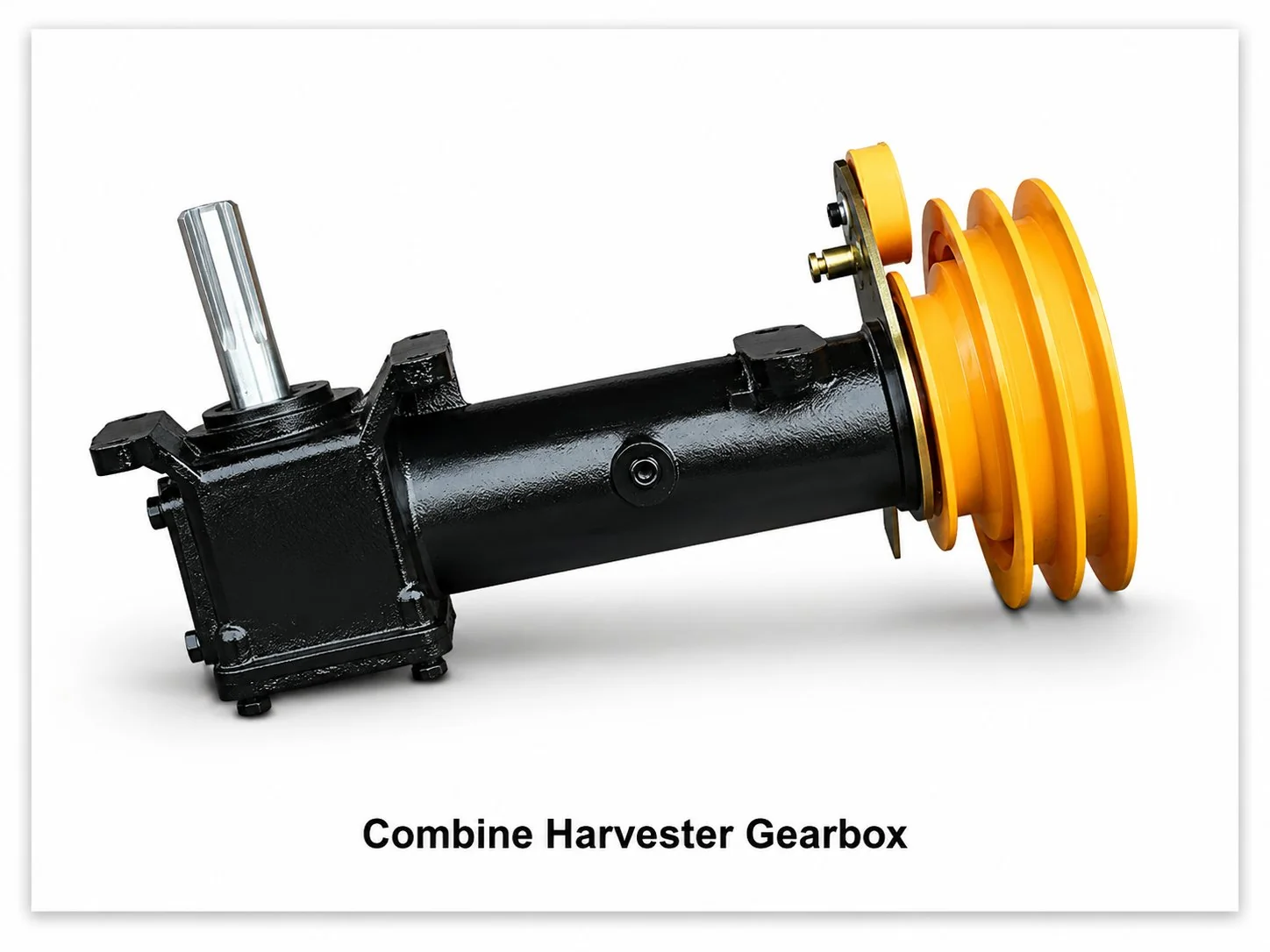
Corn header gearbox — compact right-angle bevel drive for row unit stalk roll systems
Compact Design: Engineering within 750 mm Row Spacing
The maximum envelope available for each corn header gearbox is constrained by the row spacing minus the physical width of the row unit structure (snapping plates, gathering chains, sheet metal housing). On a standard 750 mm (30-inch) row spacing, the gearbox housing must fit within approximately 150 to 200 mm of lateral space — requiring gear diameters, bearing sizes, and housing wall thicknesses that are significantly smaller than equivalent-power gearboxes in applications without space constraints. On narrow-row configurations (500 mm / 20-inch spacing used in some high-population corn production systems), the space constraint is even more severe, demanding the most compact bevel gear designs achievable at the required power and torque ratings.
All row units across the corn head must operate at the same stalk roll speed — if one row runs faster or slower than its neighbours, the harvesting rate varies across the header width, producing uneven stubble height, inconsistent ear separation, and increased kernel loss. The corn header gearbox ratio at every row position must be identical within manufacturing tolerance (plus or minus 0.5 percent of nominal ratio) to maintain this synchronisation. Worn gearboxes with increased backlash or bearing play produce speed variation that worsens progressively — a 12-row header with one worn gearbox producing 3 percent speed deviation at that position loses synchronisation with 11 correctly-functioning rows.
Standard vs. Chopping Corn Head: Gearbox Differences
Gear and Bearing Design for Row Unit Duty
The spiral bevel gears in a corn header gearbox use module 3 to 4 mm — smaller than most agricultural gearbox applications — because the compact housing constraint limits gear diameter. Case-carburised tooth surfaces (58 to 62 HRC surface, 30 to 35 HRC core) are mandatory despite the relatively modest power per row (3 to 8 HP), because the stalk-pulling action produces sharp torque spikes every time a stalk is snapped from its root — a high-frequency impact pattern (3 to 5 impacts per second at typical harvest speed) that accumulates fatigue damage far faster than the continuous loading of the same average power.
The corn header gearbox bearing arrangement must be extremely compact while providing adequate radial and thrust capacity for the bevel gear mesh forces. Sealed deep-groove ball bearings (6003 to 6006 series) are the standard choice — smaller than the 6200 series bearings used in larger agricultural gearboxes. The sealed-for-life bearing design eliminates field maintenance requirements (impractical to grease 24 individual gearboxes during harvest) and prevents the corn dust and stalk debris that fills every corner of the corn head from entering the bearing compartment. Bearing L10 life must be calculated for the high-frequency impact loading pattern rather than the average continuous load — standard L10 calculations based on average torque overestimate actual service life by 30 to 50 percent for corn header applications.

Stalk Wrap Prevention and Seal Protection
Corn stalk material — tough, fibrous, and often wet from morning dew or rain — has a persistent tendency to wrap around any exposed rotating shaft. When stalk material wraps around the corn header gearbox output shaft, it migrates along the shaft surface toward the housing seal, compressing against the seal lip with increasing force as the wrap builds. If the stalk wrap reaches sufficient thickness and tension, it can push the seal lip inward, opening a contamination path that allows corn dust, soil particles, and moisture to enter the bearing compartment — initiating bearing corrosion and abrasive wear that leads to premature gearbox failure.
Effective stalk-wrap prevention at the gearbox design level includes recessed shaft exits (minimising exposed shaft length), stalk deflector shields mounted ahead of the seal position, and spiral-groove shaft surfaces that tend to push fibrous material away from the seal rather than drawing it toward the housing. At the operator level, daily inspection of all corn head gearbox output shafts for stalk wrap buildup — and removal before the wrap reaches the seal — is the single most effective maintenance action for extending row unit gearbox service life during the corn harvest season.
Technical Specifications at a Glance
Cross-Shaft Distribution and Overload Protection
The central header driveshaft delivers engine power to a distribution gearbox mounted at the centre of the corn head frame. From this central unit, a horizontal cross-shaft extends across the full header width, passing through or adjacent to each corn header gearbox at every row position. On wide headers (12 to 24 rows), the cross-shaft may span 9 to 18 metres — a considerable torsional spring that stores rotational energy and can generate speed oscillation between the near and far row units under varying crop load conditions. Split-drive configurations (two cross-shafts driven from the centre, each serving half the header width) reduce this torsional wind-up by half, improving speed uniformity across the outermost rows.
Overload protection on corn headers typically uses shear bolts or slip clutches at the central distribution gearbox rather than at individual row units — because a jam event at one row (caused by a large stone, wire debris, or massive root crown) transmits overload torque through the cross-shaft to the central drive before the individual row unit gearbox can absorb it. The shear bolt at the central gearbox breaks at 2 to 3 times rated continuous torque, disconnecting all row units simultaneously and preventing the jam torque from damaging the cross-shaft, distribution gears, or multiple row unit gearboxes. After replacing the shear bolt (a 3 to 5 minute field operation), the operator clears the jammed row and resumes harvesting.
Some premium corn heads add individual slip clutches at each row unit as a secondary protection layer — allowing a jammed row to slip independently while the remaining rows continue operating. This row-level isolation prevents the productivity loss of stopping the entire header for a single-row jam event. However, the individual slip clutches add cost, weight, and maintenance complexity (each clutch requires periodic calibration), and are justified primarily on large high-value headers (16 to 24 rows) where the per-hour productivity of the combine makes even 5 to 10 minutes of unnecessary downtime economically significant.
Corn Header Gearbox Oil and Lubrication
Synthetic PAO EP ISO VG 220 is the recommended corn header gearbox oil for all row unit gearboxes. The very small oil volume (0.15 to 0.5 litres per unit) means the oil charge must provide maximum protection per millilitre — and synthetic base stock delivers superior film strength, oxidation resistance, and low-temperature fluidity compared to mineral oil in these compact, partially-filled housings where oil splash patterns are critical for ensuring all gear mesh and bearing positions receive adequate lubrication.
Oil change intervals for corn header gearbox units are typically 300 to 500 hours or annually (pre-harvest change is the standard practice). Given that a 12-row corn head has 12 gearboxes each requiring individual oil change, the total maintenance time for a complete header oil service is 30 to 60 minutes — a modest investment that protects 12 precision gearboxes from the contamination-related failures that dominate corn head gearbox warranty returns. Check oil level at every row unit before the start of harvest — a gearbox that has lost oil through a worn seal or loose drain plug will fail within hours of operation on empty.
Harvest-Season Maintenance Schedule
Oil change at every row unit gearbox with synthetic VG 220. Rotate each stalk roll by hand — check for bearing roughness or gear noise. Inspect all shaft seals for stalk-wrap damage from previous season. Check stalk deflector shields for damage. Verify gathering chain tension and sprocket condition.
Inspect every row unit output shaft for stalk wrap buildup — remove before wrap reaches the seal. Visual check for oil leaks at every gearbox. Listen for bearing noise at each row during the first 5 minutes of operation. Clear accumulated corn debris from around gearbox housings and seal areas.
Remove all stalk wrap from every shaft. Clean all corn debris from gearbox areas. Top up oil at every row unit. Apply grease to exposed shaft surfaces. Store header under cover. Note any row units that showed noise, vibration, or oil loss for pre-season replacement before next harvest.
Aftermarket Corn Header Gearbox Replacement
Corn header gearbox replacement is the most volume-intensive gearbox replacement in the combine aftermarket because each header contains multiple units and the high-frequency stalk-snapping impacts accelerate bearing fatigue faster than in most other agricultural gearbox applications. A well-maintained row unit gearbox typically lasts 5 to 12 harvest seasons (1,500 to 4,000 operating hours). When replacing gearboxes on a multi-row header, consider replacing all row units simultaneously or from the same production batch — mixing gearboxes with different wear levels produces speed variation between rows that degrades harvesting uniformity and increases kernel loss at the mismatched positions.
Cross-reference parameters include the input shaft configuration (spline or keyed from the cross-shaft), the output shaft size and stalk roll coupling type, the mounting bolt pattern, the bevel ratio, and the housing envelope dimensions (critical for row-spacing compatibility). Our engineering team maintains cross-reference data for major corn head brands and can supply dimensionally verified aftermarket replacements. Volume pricing for complete header sets (8, 12, 16, or 24 row unit gearboxes) ensures cost-effective system-wide replacement from matched production batches.
Frequently Asked Questions
Harvest Every Row, Every Kernel
From 4-row compact headers to 24-row high-capacity systems — our corn header gearboxes deliver the compact precision, synchronised speed, and stalk-wrap resistance that efficient corn harvesting demands.
Editor: Cxm