What Is a Disc Mower Gearbox?
EN disc mower gearbox is not a single gear unit but an integrated drive system consisting of a right-angle input gearbox (converting PTO rotation into the cutter bar axis) and an enclosed multi-disc gear train (distributing drive to 4 to 9 individual cutting discs across the mower width). Each disc carries 2 to 4 free-swinging hardened-steel knives that cut the standing crop by centrifugal impact at tip speeds of 60 to 90 metres per second — the fastest cutting action in any haymaking implement. The disc mower gearbox system must deliver this extreme speed reliably across every disc simultaneously while surviving the stone strikes, soil contact, and crop-debris contamination that field mowing produces.
Disc mowers are the dominant mowing technology for commercial hay and silage production worldwide, preferred over reciprocating cutter bars for their higher forward speed (8 to 15 km/h versus 5 to 8 km/h), cleaner cut in lodged or tangled crop, and superior tolerance of uneven ground. The disc mower gearbox is the enabling technology behind this performance advantage — the enclosed gear train delivers consistent, synchronised disc speed across the full cutting width, and the free-swinging knife design absorbs stone impacts that would shatter rigid reciprocating blades.
How the Cutter Bar Gear Train Works
Traktoren PTO drives the input gearbox at 540 RPM (or 1,000 RPM on high-speed models). This right-angle spiral bevel gearbox converts the horizontal PTO rotation to the horizontal cutter bar axis — perpendicular to the direction of travel — with a speed-increasing ratio of 1:1 to 1:1.5, producing a gear train input speed of 540 to 810 RPM. From this input point, a series of meshing spur gear pairs inside the sealed cutter bar gearbox housing transmit drive to each disc position along the bar length.
Each disc is driven by a spur gear pair that meshes with the adjacent disc gear — producing counter-rotation between neighbouring discs. This counter-rotation is essential for clean cutting: the overlapping cutting arcs of adjacent counter-rotating discs ensure that every stem within the cutting width is intercepted by at least one knife pass. The spur gear train also provides the final speed multiplication — from the 540 to 810 RPM gear train input to the 2,500 to 3,000+ RPM at each disc shaft. This speed multiplication is achieved through the cumulative effect of multiple gear pair ratios along the train, with each pair contributing a small speed increase that compounds across 4 to 9 stages.
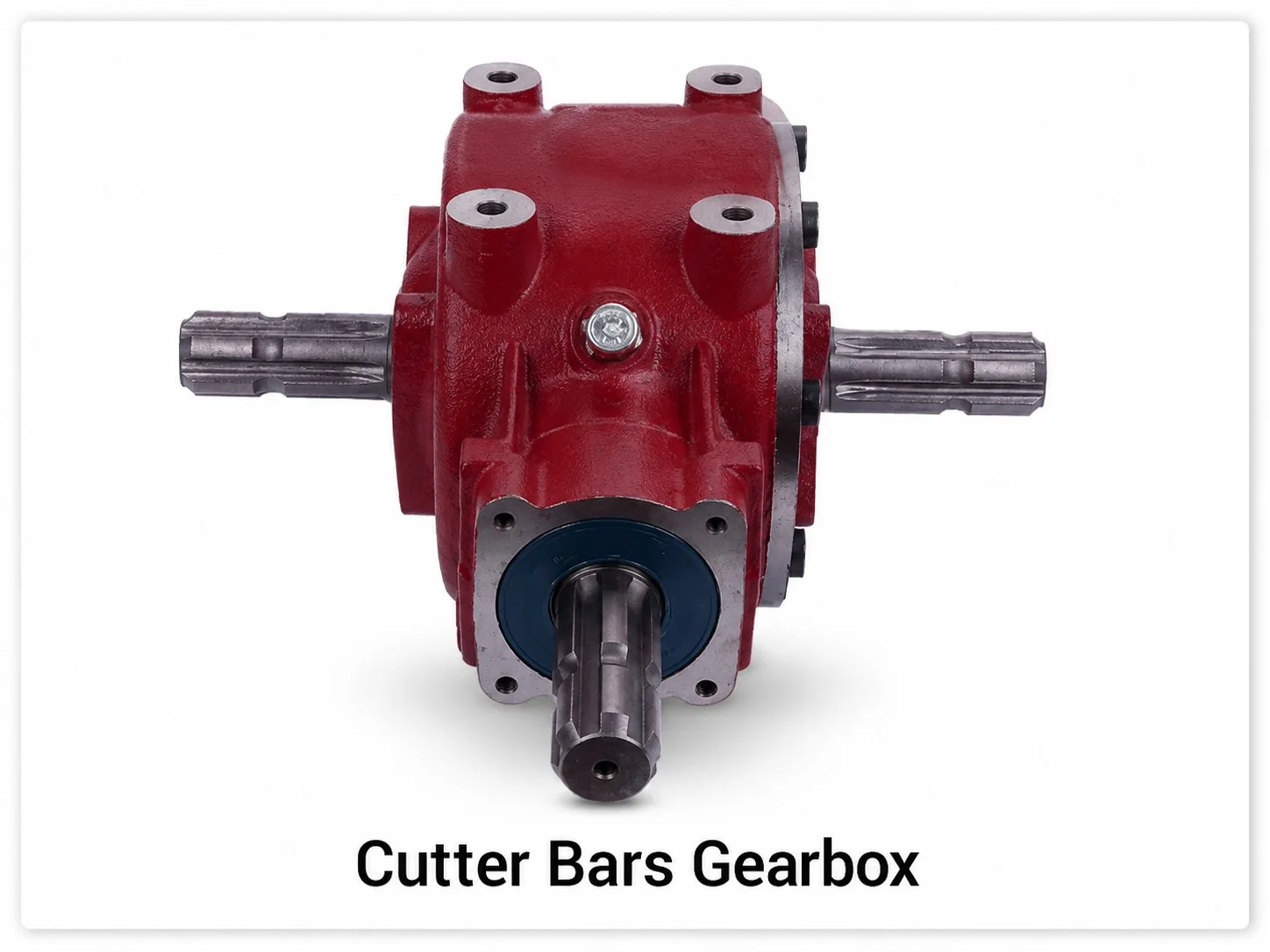
Disc mower cutter bar gearbox — enclosed spur gear train driving multiple cutting discs
Disc Mower vs. Drum Mower: Gearbox Architecture Comparison
High-Speed Gear and Bearing Design
Operating at 2,500 to 3,000+ RPM, the disc shaft bearings in a disc mower gearbox accumulate fatigue cycles faster than any other mowing application — 3 to 5 times faster than flail mower rotor bearings and 6 to 10 times faster than rotary mower blade spindle bearings at equivalent power. The disc mower gearbox bearing at each disc position is typically a sealed deep-groove ball bearing (6004 to 6008 series) with C3 internal clearance for thermal expansion accommodation and high-speed-rated synthetic grease fill. Bearing L10 life at 3,000 RPM must exceed 4,000 hours to provide the 5 to 10 year service life expected in commercial haymaking operations.
The spur gears in the cutter bar gearbox train use module 2.5 to 4 mm — compact to fit within the shallow cutter bar housing (typically 50 to 80 mm total height). Despite the small module, case-carburised tooth surfaces (58 to 62 HRC surface, 30 to 35 HRC core) are mandatory because the high rotational speed produces gear mesh frequencies of 3,000 to 15,000 tooth engagements per second per gear pair — a fatigue loading rate that would rapidly destroy through-hardened or unhardened gear teeth. The gear mesh noise at these speeds is substantial; precision grinding of the tooth flanks (AGMA quality 10 or above) minimises both noise and the dynamic tooth loading that rough tooth surfaces produce at high speed.
Every disc on the cutter bar must rotate at the same speed for the overlapping cutting arcs to produce a complete, clean cut across the full mowing width. A disc running 5 percent slower than its neighbours leaves a narrow uncut strip at the overlap zone with the adjacent disc — producing a visible row of standing stems in the stubble that reduces the visual quality of the mown field and can harbour pests and disease organisms in the uncut stems. Worn gear teeth or damaged bearings at a single disc position produce this speed reduction — making condition monitoring of the gear train across all disc positions an important maintenance discipline.

Stone-Strike Protection and Knife Design
Disc mowers operate with the cutting discs very close to the ground surface (15 to 25 mm stubble height) — closer than any other mower type. This low cut height produces the short, clean stubble that promotes rapid regrowth and maximises forage yield, but it also increases the frequency of stone and soil-clod contact. Each knife on each disc is mounted on a free-swinging pivot bolt — when the knife strikes a stone, it deflects backward against centrifugal force rather than transmitting the full impact through the disc shaft and gear train. This pivot mechanism absorbs 80 to 95 percent of stone-strike energy at the individual knife level.
The residual 5 to 20 percent of impact energy that reaches the disc mower gearbox gear train must be absorbed by the spur gear teeth and disc bearings. At 3,000 RPM, even a small residual impact produces high dynamic loading because the gear teeth are already operating at their maximum design speed. The PTO-drivlinje slip clutch provides a final overload protection layer — releasing at 1.5 to 2.0 times rated torque for massive impact events (large buried rocks, steel debris) that exceed both the knife-pivot absorption and the gear train impact capacity. Never substitute higher-strength shear bolts or tighten the slip clutch beyond the manufacturer calibration — the gear train is designed for a specific maximum transmitted impact, and exceeding it accelerates gear fatigue cracking that leads to tooth breakout and catastrophic gear train failure.
Tekniske specifikationer på et øjeblik
Disc Mower Gearbox Oil and Oil-Bath Lubrication
The enclosed disc mower gearbox cutter bar operates as an oil-bath system — the lower portion of each gear pair runs submerged in oil, and the rotation splashes oil upward to lubricate the upper gear meshes and disc bearings. This oil-bath architecture is critical at 3,000 RPM: at these speeds, the churning action generates a continuous oil mist inside the cutter bar housing that coats every internal surface with a protective lubricant film. Synthetic EP ISO VG 150 to VG 220 is the recommended disc mower gearbox oil — lighter viscosity than most landbrugsgearkasse applications because the high gear speed generates significant churning drag, and a heavier oil (VG 320) would waste power as churning heat and could cause the oil temperature to exceed the safe operating range.
Oil level is critical for the cutter bar gear train — too low and the lower gears do not submerge sufficiently for effective splash lubrication, starving the upper bearings; too high and the excessive oil volume increases churning drag, raises operating temperature, and can cause seal blowout from internal pressure buildup. Maintain the oil level at the exact position specified by the manufacturer sight glass or fill plug. Oil change intervals are 200 to 400 hours for synthetic and 100 to 200 hours for mineral oil. The first fill should be changed after 50 hours to remove break-in particles from the high-speed gear meshes — at 3,000 RPM, the initial break-in produces more fine metallic debris per hour than lower-speed gearboxes.
Separate oil chamber from the cutter bar. VG 220 synthetic standard. Oil volume 0.3 to 0.8 litres. Operating temperature 55 to 75 degrees Celsius. Standard 500-hour change interval. Spiral bevel gears at 540 to 810 RPM — moderate-speed, moderate-load duty.
Oil-bath lubrication at 3,000+ RPM. VG 150 to VG 220 synthetic (lighter for reduced churning). Oil volume 1.5 to 4.0 litres. Operating temperature 65 to 90 degrees. Change every 200 to 400 hours. Oil level precision critical for splash pattern.
Sæsonbestemt vedligeholdelsesplan
Full oil change at both the input gearbox and the cutter bar gear train. Rotate each disc by hand — check for bearing roughness or gear noise at every position. Inspect all knives for wear, cracking, or damaged pivot bolts. Verify PTO driveline slip clutch calibration. Check cutter bar housing for cracks, especially around disc bearing housings.
Cutter bar oil level check (verify through sight glass or fill plug). Replace worn or chipped knives — unbalanced discs increase bearing vibration. Inspect knife pivot bolts for tightness and wear. Clear accumulated crop debris from around disc shaft seals and cutter bar housing joints. Grease PTO driveline U-joints.
Clean entire cutter bar — remove all crop debris and soil. Change cutter bar oil if approaching 400 hours. Top up oil at both input gearbox and cutter bar. Apply grease to exposed shaft surfaces. Store under cover — UV exposure degrades cutter bar housing seals. Note any discs with noise or vibration for pre-season bearing replacement.
Mower-Conditioner Integration and Additional Drive Demands
Many modern disc mowers are equipped with an integrated conditioner — a set of rubber or steel rollers (or intermeshing tine rotors) mounted behind the cutter bar that crush or crimp the freshly cut stems to accelerate drying. The conditioner is typically driven from the same disc mower gearbox input through a secondary belt or gear drive, adding 10 to 25 HP of additional power demand to the gearbox system. This combined mower-conditioner power requirement must be accommodated by the input bevel gearbox — a unit originally designed for 20 to 40 HP of mowing-only power may need upgrading to 30 to 60 HP when a conditioner is added.
The conditioner drive also introduces different loading characteristics into the gearbox system. Rubber roller conditioners produce a relatively smooth, constant torque demand as crop passes between the rollers. Steel tine conditioners (also called impellers) produce a more aggressive, pulsating torque as individual tine groups engage and release crop material. The disc mower gearbox must handle both the high-speed, low-torque cutting disc load and the moderate-speed, higher-torque conditioner load simultaneously — a combined loading pattern that produces higher total power throughput and elevated operating temperatures compared to disc-only mowing. The oil change interval should be shortened by 20 to 30 percent when a conditioner is fitted, to account for the increased thermal loading on the lubricant.
Aftermarket Disc Mower Gearbox Replacement
Disc mower gearbox replacement most commonly involves either the input bevel gearbox (damaged by accumulated stone-strike impacts transmitted through the gear train) or individual disc bearing and gear assemblies within the cutter bar (worn from the extreme high-speed duty). Complete cutter bar replacement is less common but may be necessary if housing cracks propagate from disc bearing housings or if multiple gear positions show simultaneous wear. A well-maintained disc mower cutter bar gear train typically lasts 5 to 12 seasons (1,500 to 5,000 operating hours); the input bevel gearbox typically lasts 8 to 15 seasons with proper overload protection.
Cross-reference parameters for the input gearbox include the PTO input spline, the cutter bar drive output configuration, the bevel ratio, and the housing mounting arrangement. For cutter bar disc assemblies, the disc shaft diameter, gear tooth count, bearing series, and housing bore dimensions must match precisely — the gear mesh pattern across the entire train depends on consistent tooth geometry at every position. Our agricultural gearbox engineering team maintains cross-reference data for major disc mower brands and can supply both input gearboxes and individual disc gear-and-bearing assemblies with verified dimensional and metallurgical compatibility.
Ofte stillede spørgsmål
Cut Cleaner, Mow Faster
From compact 4-disc units to wide 9-disc cutter bars — our disc mower gearboxes deliver the high-speed precision, stone-strike resilience, and season-after-season durability that productive haymaking demands.
Redaktør: Cxm