What Is a Combine Harvester Gearbox?
A combine harvester gearbox is not a single component but a family of 5 to 8 specialised gear units distributed throughout the machine, each driving a different stage of the harvesting process. From the header that cuts the standing crop, through the feederhouse that conveys it into the threshing mechanism, to the separation system that extracts the grain, the cleaning shoe that removes chaff, and the unloading auger that transfers grain to transport — every function relies on its own gearbox with specific speed, torque, and duty requirements precisely matched to that stage of crop processing.
The combine harvester gearbox family must function as a perfectly synchronised system. If the header cuts faster than the feederhouse can convey, the crop plugs at the intake. If the threshing rotor runs too fast, grain is damaged; too slow, and grain is not separated from the straw. If the unloading auger is too slow, the grain tank fills before the truck returns, forcing the combine to stop harvesting. Every gearbox ratio in the system is calibrated to maintain this throughput balance — and a single gearbox failure at any position stops the entire harvesting operation during the most time-critical window of the farming year.
Five Critical Gearbox Positions in the Combine
The header drive gearbox is a right-angle bevel unit mounted at the centre or side of the header platform, converting engine-driven input into horizontal cutter bar reciprocation (through a wobble box or knife drive mechanism) and reel rotation. Header widths of 6 to 12 metres require 30 to 60 HP of drive power distributed across the cutter bar, reel, and auger or draper feed. The combine harvester gearbox at this position operates at 1:1 to 1:1.5 ratio with output speeds of 400 to 600 RPM, and must survive the impact loading from the cutter bar striking stones, soil clods, or lodged crop stems.
The feederhouse gearbox drives the chain conveyor that moves cut crop from the header into the threshing mechanism. Operating at 300 to 500 RPM with moderate torque, this gearbox must handle the variable and often slugging load pattern that occurs when heavy, wet crop enters the feederhouse in uneven waves — a loading that produces torque spikes of 2 to 3 times continuous as each slug of crop is compressed and accelerated up the feeder elevator.
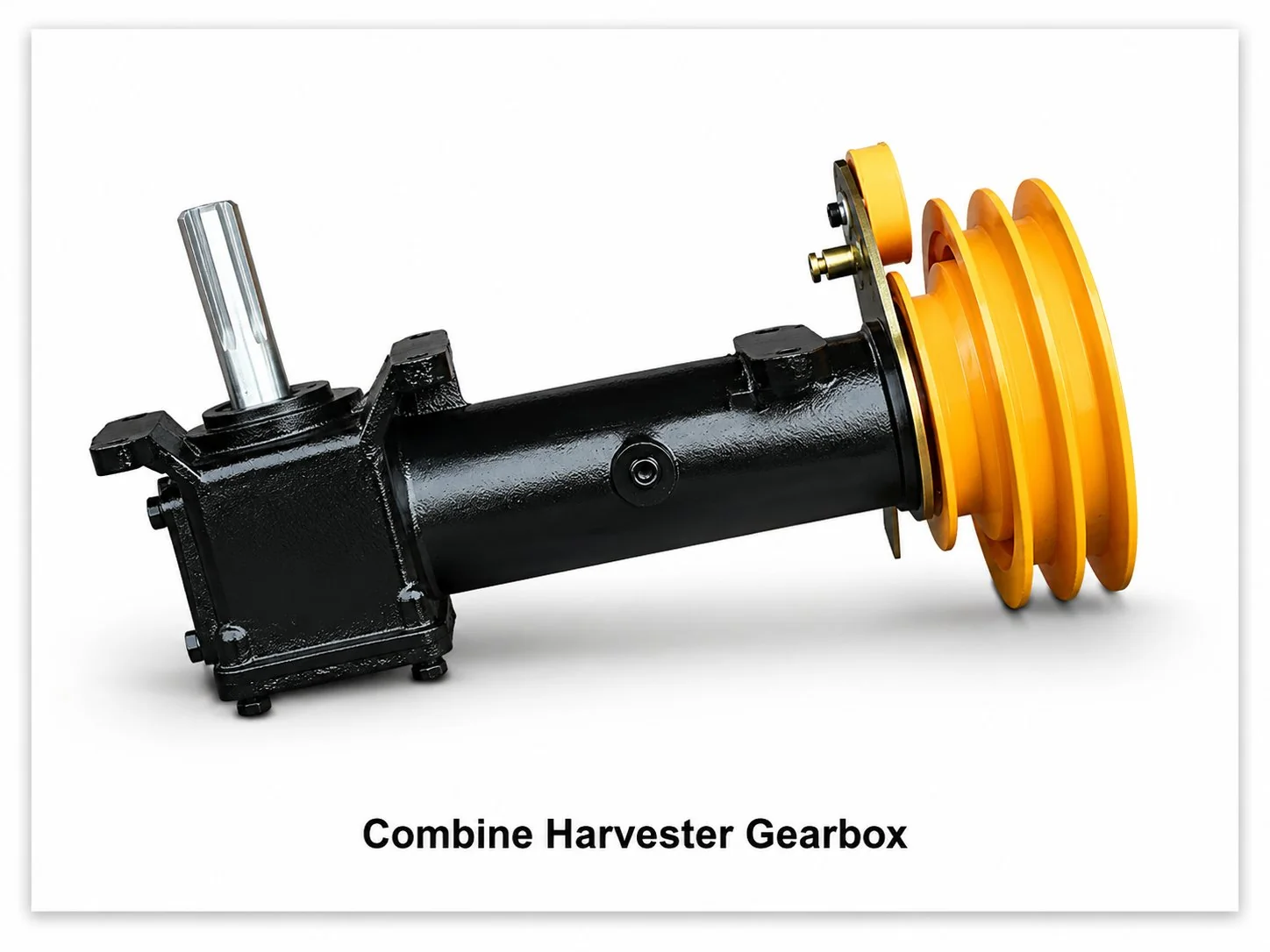
Combine harvester gearbox — right-angle drive for header and processing systems
The threshing gearbox (or rotor drive) powers the main separation mechanism — either a conventional cylinder-and-concave system or an axial-flow rotor. This is the highest-power gearbox position on the combine (50 to 150+ HP), operating at 800 to 1,500 RPM to generate the centrifugal impact force that separates grain kernels from the straw and chaff. The grain unloading gearbox drives the cross auger and vertical unloading tube at 300 to 500 RPM, transferring grain from the tank to the transport vehicle at rates of 100 to 200 litres per second on modern high-capacity combines. The straw chopper gearbox at the rear drives counter-rotating blades at 2,000 to 3,000 RPM to chop the discharged straw into short lengths for even field distribution.
Gearbox Position, Speed, and Power Requirements
Gear and Bearing Design for Harvest-Duty Loading
Every combine harvester gearbox operates during the most time-critical period of the farming year — harvest typically lasts 2 to 6 weeks, and the combine runs 14 to 20 hours per day throughout this window. At 300 to 600 operating hours per harvest season, the gears and bearings accumulate fatigue cycles at rates comparable to industrial machinery running multiple shifts. Case-carburised spiral bevel gears with 58 to 62 HRC surface hardness and 30 to 38 HRC core toughness are standard across all combine gearbox positions — providing both the surface wear resistance for sustained high-speed operation and the core toughness to survive the impact events from stones, foreign objects, and crop slugs that are inevitable during field harvesting.
The combine feederhouse gearbox bearing arrangement must accommodate the slug-load torque pattern unique to combine operation. As uneven crop enters the feederhouse, the conveyor chain tension surges by 2 to 3 times the average — producing a pulsating bearing load at irregular intervals. Tapered roller bearings with controlled preload (0.05 to 0.10 mm axial compression) maintain consistent gear mesh alignment through these torque surges while providing the combined radial and thrust load capacity that the bevel gear mesh forces demand. For the threshing rotor position — the highest-speed, highest-power gearbox in the system — the output bearings must be specifically rated for sustained operation at 800 to 1,500 RPM under the heavy continuous loading from the threshing action.
A single gearbox failure at any position stops the entire combine — and every hour of combine downtime during harvest represents 20 to 50 hectares of unharvested crop exposure to weather risk. In a typical grain operation, one day of harvest delay from a gearbox failure can cost thousands of dollars in reduced grain quality (weather-damaged grain is downgraded) and thousands more in expedited repair parts and labour. Pre-season gearbox inspection and proactive replacement of worn components before harvest begins is the most cost-effective risk-management measure available.
Crop Debris Contamination and Sealing Strategy
Combine harvesters operate in a cloud of chaff, dust, and fine crop debris that coats every component. The combine harvester gearbox at each position is exposed to this contamination throughout every operating hour — with the header and feederhouse gearboxes receiving the heaviest debris exposure (they are located directly in the crop flow path) and the threshing and cleaning system gearboxes exposed to the fine grain dust and chaff that the processing action generates.
Double-lip shaft seals with grease-purged intermediate chambers are the minimum sealing standard for all combine gearbox positions. The outer seal lip deflects coarse chaff and straw fragments; the pressurised grease in the intermediate chamber traps fine dust particles; and the inner lip maintains the oil seal boundary. V-ring or labyrinth dust excluders ahead of the main seal provide an additional barrier at the most contamination-exposed positions (header and feederhouse). Sealed breather valves prevent the thermal breathing cycle from drawing chaff-laden air into the gearbox — a standard open breather on a combine gearbox will ingest crop dust within the first hour of harvest operation.
Technical Specifications at a Glance
Reversing Gearbox and Variable-Speed Applications
Several combine harvester gearbox positions require reversing capability — the ability to run the driven mechanism in both forward and reverse directions. The feederhouse chain must reverse to clear crop jams (the most common field stoppage on any combine), and some header designs require reverse reel capability for specific crop conditions. Reversing gearboxes use either a sliding-gear mechanism (where an intermediate idler gear is engaged or disengaged to reverse the output direction) or a dedicated forward/reverse gear set with a selector mechanism. The reversing action must be quick (under 3 seconds from forward to reverse) and reliable under load — because feederhouse blockages typically occur under heavy crop conditions where the chain is already under significant tension.
Modern high-capacity combines increasingly use variable-speed gearboxes or gearbox-plus-variator combinations to adjust processing speeds to match crop conditions in real time. A wet, heavy wheat crop may need slower rotor speed and higher concave clearance to avoid grain damage, while a dry, brittle canola crop may need faster rotor speed and tighter clearance for thorough threshing. Variable-speed agricultural gearbox systems — using either mechanical variators (belt-and-sheave) or hydrostatic drives in combination with fixed-ratio gearboxes — allow the operator to optimise the threshing, cleaning, and unloading functions independently for each crop type and moisture condition encountered during the harvest season.
The grain unloading gearbox on modern combines must handle the increasing throughput demands of large-capacity grain tanks (10,000 to 14,000 litres on current high-end models). Unloading rates of 100 to 200 litres per second require the cross-auger and vertical unloading tube to operate at high speed (400 to 500 RPM) with substantial grain column weight — producing sustained torque loads that approach the continuous rating of the right-angle bevel gearbox driving the system. The start-stop loading from beginning and ending each unloading cycle adds fatigue cycling that must be accounted for in the bearing life calculation, particularly for combines that unload on-the-go (without stopping) where the unloading gearbox cycles every 5 to 10 minutes throughout the harvest shift.
The cleaning fan gearbox drives the high-speed centrifugal fan (800 to 1,200 RPM) that generates the airflow for separating grain from chaff on the cleaning shoe. This gearbox position requires precise speed control because fan speed directly determines the air velocity through the sieve — and incorrect air velocity either blows grain out with the chaff (too high) or fails to remove chaff from the grain sample (too low), both of which reduce the harvested grain quality and grade.
Combine Harvester Gearbox Oil and Lubrication
Synthetic PAO EP ISO VG 220 is the recommended combine harvester gearbox oil for all positions. The extended harvest duty cycle (14 to 20 hours per day for 2 to 6 weeks) produces sustained oil temperatures of 60 to 85 degrees Celsius at the header and feederhouse positions, and 70 to 95 degrees at the threshing rotor position — temperatures where synthetic base stock provides superior oxidation resistance and viscosity stability compared to mineral oil. The threshing rotor gearbox — the highest-power, highest-speed unit in the system — benefits most from synthetic oil because the elevated temperature and sustained heavy loading would degrade mineral oil within 150 to 200 hours while synthetic maintains its protective properties for 300 to 500 hours.
VG 220 synthetic. Operating temp 60 to 85 degrees. Oil change: pre-harvest annually plus mid-season if harvest exceeds 400 hours. Oil volume 0.5 to 1.5 litres per gearbox. Inspect magnetic drain plug for stone-strike debris.
VG 220 synthetic mandatory. Operating temp 70 to 95 degrees. Oil change: pre-harvest annually. Higher-power rotor gearboxes (above 100 HP) may need VG 320 for superior film strength at elevated contact pressures. Monitor temperature during heavy crop conditions.
Pre-Harvest and Post-Harvest Maintenance
Oil change at every gearbox position with fresh synthetic VG 220. Inspect all shaft seals and dust excluders — replace any showing wear. Rotate each driven shaft by hand to verify smooth bearing action. Check header gearbox for stone-strike damage from previous season. Run the combine unloaded for 10 minutes, monitoring every gearbox for noise, vibration, and temperature.
Oil level check at accessible gearbox positions before each shift. Listen for bearing noise changes during the first 5 minutes. Touch-test gearbox temperatures during mid-shift breaks. Clean accumulated chaff from around gearbox seals and breathers. Re-grease seal intermediate chambers every 100 hours.
Blow out all crop debris from the entire combine including gearbox areas. Top up oil at every position. Apply grease to exposed shafts. Record total harvest hours. Note any gearboxes that showed temperature increase, noise change, or oil contamination for pre-season replacement before next harvest.
Aftermarket Combine Gearbox Replacement
Combine gearbox replacement is driven by bearing fatigue from the extended harvest-duty cycle and crop debris contamination. A well-maintained combine harvester gearbox typically lasts 5 to 15 harvest seasons (1,500 to 6,000 operating hours) depending on the gearbox position, crop type, and field conditions. Header gearboxes (frequent stone-strike impacts) tend toward the shorter end; threshing and unloading gearboxes (sustained heavy loading but fewer impacts) tend toward the longer end. Cross-reference parameters include the input/output shaft configuration, gear ratio, mounting bolt pattern, and power rating — plus the specific position on the combine, as header gearboxes are not interchangeable with feederhouse or threshing gearboxes.
Our engineering team maintains cross-reference data for major combine brands and can supply aftermarket gearboxes with verified dimensional and performance compatibility for each agricultural gearbox position. Both complete assemblies and individual gear, bearing, and seal kits are available. For harvest-critical replacements, stocked inventory of commonly specified header and feederhouse gearboxes enables rapid delivery — because every hour of combine downtime during harvest represents a direct crop-value loss that far exceeds the cost of the gearbox itself.
Frequently Asked Questions
Harvest without Hesitation
From header to unloading auger — our combine harvester gearboxes deliver the harvest-duty endurance, crop-debris resistance, and position-specific performance that uninterrupted grain harvesting demands.
Editor: Cxm