What Is a Manure Spreader Gearbox?
A manure spreader gearbox is the right-angle PTO-driven gear unit that powers the beater, spinner, or flail mechanism at the rear of a solid-manure spreader. As the spreader box conveys manure rearward (driven by floor chains or a moving floor), the beater or spinner mechanism at the discharge end breaks up the compacted material and throws it outward across the field in a controlled pattern. The manure spreader gearbox converts horizontal PTO rotation into the vertical or horizontal beater rotation needed for this spreading action — and it must do so in the most chemically hostile environment that any agricultural gearbox routinely encounters.
Livestock manure — cattle, pig, poultry, or mixed — is a complex, biologically active, chemically aggressive material. It contains ammonia, organic acids (acetic, butyric, propionic), hydrogen sulphide, moisture (60 to 85 percent water content in solid manure), abrasive mineral particles (bedding material, soil, grit from housing floors), and an active bacterial population that accelerates corrosion through microbiological mechanisms. This combination of chemical corrosion, biological attack, moisture saturation, and abrasive particle loading makes the manure spreader gearbox operating environment significantly more destructive than the fertilizer salt exposure that challenges fertilizer spreader gearboxes — because manure corrosion attacks continuously from the moment the spreader is loaded, not only when moisture activates dried chemical residues.
Three Spreader Architectures, Three Gearbox Profiles
Horizontal beater spreaders use one to four horizontal-axis beaters mounted at the rear of the spreader box. The PTO gearbox drives the top beater at 300 to 500 RPM, and additional beaters are driven through gear or chain secondaries. This is the most common architecture for medium to large box spreaders (3 to 20 tonne capacity). The gearbox uses a 1:1 to 1:1.5 ratio right-angle spiral bevel pair to redirect the horizontal PTO drive to the horizontal beater axis (perpendicular to the direction of travel).
Vertical beater (also called gate-type or side-discharge) spreaders use one or two vertical-axis beaters that throw manure sideways. The manure spreader gearbox redirects PTO rotation 90 degrees from horizontal to vertical at 1:1 ratio, producing beater speeds of 400 to 600 RPM. Spinner-disc spreaders use one or two horizontal spinning discs (similar to fertilizer spreaders but with heavier construction) to distribute finely processed manure. The muck spreader gearbox for spinner configurations is functionally similar to a fertilizer spreader gearbox but with heavier duty components and enhanced corrosion protection.
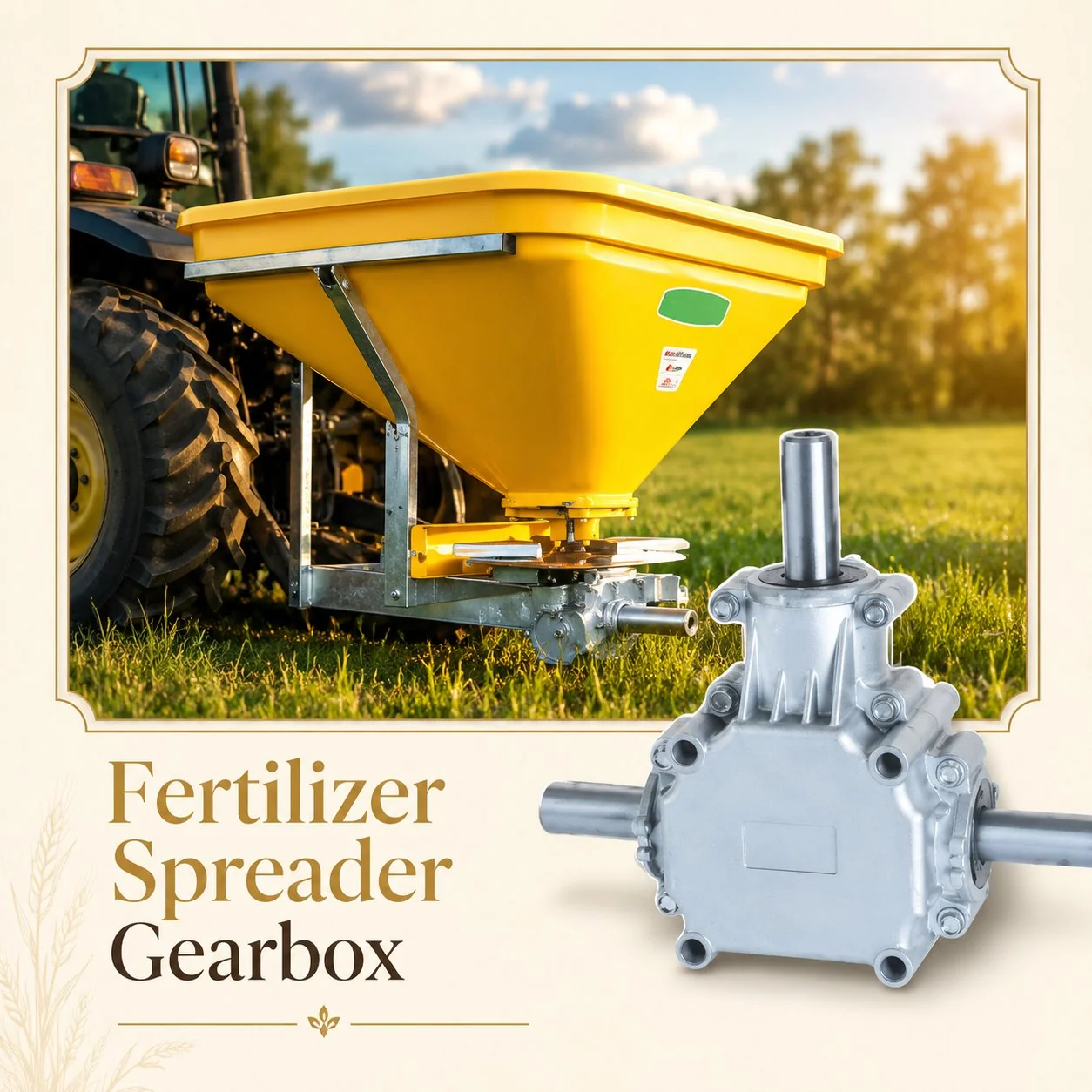
Manure spreader gearbox — right-angle bevel drive with corrosion-resistant specification
Corrosion: The Dominant Failure Mechanism
The chemical environment inside a manure spreader is one of the most aggressive that any agricultural gearbox encounters. Fresh manure produces ammonia gas (NH3) at concentrations of 50 to 200 ppm in the headspace above the loaded spreader box — a level sufficient to attack exposed steel surfaces and degrade standard NBR rubber seals within 1 to 2 seasons. The moisture content (60 to 85 percent water by mass) ensures that all corrosion mechanisms are electrochemically active — unlike dry-environment corrosion where the absence of an electrolyte slows the process. Organic acids (pH 5.5 to 8.5 depending on manure type and age) further accelerate metal dissolution at any surface where the protective coating or seal has been compromised.
A standard agricultural gearbox — designed for field crop implements — typically uses NBR seals, zinc-plated steel fasteners, and 60 micrometre standard paint coating. In manure spreader service, the NBR seals harden and crack from ammonia exposure within 2 seasons, the zinc plating dissolves in the acidic environment within 1 season, and the thin paint coating is abraded through by grit-laden manure splatter within months. The result is a gearbox that corrodes from the outside in (housing, fasteners) and from the inside out (contaminated oil attacking bearings and gears) — leading to complete failure in 2 to 4 seasons regardless of the mechanical quality of the gear and bearing components.
FKM (fluoroelastomer) shaft seals — ammonia and organic acid resistant. Double-lip with grease-purged chamber. Stainless steel garter springs. Sealed breather valve. Housing O-rings in FKM or EPDM (not NBR). A corrosion-resistant spreader gearbox specification is essential for any multi-season service.
Epoxy powder coating at 150+ micrometres (2.5 times the standard agricultural specification). Stainless steel A4-80 external fasteners and drain plug. Electroless nickel plating on exposed shaft surfaces. Sealed check-valve breather preventing ammonia-laden air ingestion during thermal breathing.

Impact Loading from Heavy, Uneven Material
Solid manure is not a uniform material — it contains dense clumps, frozen lumps (in winter spreading), bedding material (straw, sawdust, sand), stones from livestock yards, and occasionally foreign objects (broken fence wire, bucket fragments, baler twine tangles). As this heterogeneous material reaches the beater mechanism, each impact from a dense clump or hard object produces a torque spike of 2 to 5 times the average continuous torque. The manure spreader gearbox must survive thousands of these random impact events per spreading session without gear tooth fatigue cracking or bearing brinelling.
Case-carburised spiral bevel gears with 58 to 62 HRC surface hardness and 30 to 38 HRC core toughness — the same metallurgical specification used across heavy-duty agricultural gearbox applications — provide the surface hardness and core toughness needed to withstand both the sustained spreading torque and the superimposed impact loading. Gear module 4 to 6 mm provides the tooth root strength for impact survival. Tapered roller bearings at the output position handle the combined radial load from the bevel mesh and any axial thrust from the beater shaft — particularly important for vertical beater configurations where the weight of the beater assembly creates a sustained downward thrust on the manure spreader gearbox bearing.
Technical Specifications at a Glance
PTO Driveline and Overload Protection
The PTO driveline for a manure spreader must withstand the same corrosive environment as the gearbox — manure splatter coats the driveline during operation, and residual material continues corroding the U-joints, telescoping tube, and safety shield during storage. Stainless steel or epoxy-coated driveline components extend service life in manure-spreader applications. Series 4 to Series 6 drivelines (depending on power level) with slip clutch protection are standard — the slip clutch releases at 1.5 to 2.0 times rated torque, preventing the extreme impact overloads from frozen lumps, wire tangles, or beater jams from reaching the manure spreader gearbox.
For large spreaders with multiple beaters driven from a single gearbox through chain or gear secondaries, the overload protection hierarchy is critical. The slip clutch on the PTO driveline protects the entire system from gross overloads; individual shear bolts or frangible couplings at each secondary beater shaft protect the distribution mechanism from single-beater jams. This layered approach ensures that a jam on one beater does not destroy the gearbox or damage the remaining beaters — the localised overload is contained at the single-beater level through the sacrificial coupling while the gearbox and remaining beaters continue operating until the operator stops to clear the jam.
Winter Spreading and Cold-Start Challenges
In many livestock regions, manure spreading occurs year-round — including winter months when ambient temperatures regularly fall below freezing. Manure loaded from outdoor storage in winter contains frozen lumps that can be the size and hardness of small rocks, and the beater must break these lumps apart to achieve acceptable spread uniformity. Each frozen lump impact produces the same torque spike magnitude as a stone strike — 3 to 5 times continuous torque — but at much higher frequency during winter spreading because a significant percentage of the material may be partially or fully frozen. The manure spreader gearbox for year-round operations must be rated for this elevated winter-impact loading, and synthetic oil is mandatory for cold-start fluidity at minus 20 to minus 30 degrees Celsius where mineral VG 220 becomes too viscous for adequate splash lubrication.
The cold ambient temperature also introduces thermal-shock risk when the gearbox transitions from cold storage to full-load operation within minutes. The housing, gears, and bearings warm at different rates (the oil warms fastest, the housing slowest), producing temporary thermal distortion that can shift the gear mesh alignment by 0.05 to 0.10 mm until the components reach thermal equilibrium. This thermal distortion is accommodated by the bearing preload range — properly set tapered roller bearing preload maintains acceptable mesh alignment through the full temperature range from minus 30 to plus 80 degrees Celsius operating temperature.
Floor Chain Drive Integration
While the beater gearbox handles the high-speed, high-impact spreading function, the floor chain (or moving floor) that conveys manure rearward toward the beaters is typically driven separately — either through a hydraulic motor (on modern spreaders) or through a secondary mechanical drive from the same PTO input via a separate low-ratio gearbox or chain-and-sprocket reduction. When a mechanical floor drive is used, the floor-chain gearbox operates at very low output speed (1 to 5 RPM at the floor chain) and very high torque — essentially a worm gear or multi-stage reducer that must move a 5 to 20 tonne manure load along the spreader box length. The floor chain and beater must be synchronised so that the rate of manure arriving at the beaters matches the beater capacity — too fast produces overloading and plugging; too slow produces intermittent thin spreading with poor uniformity.
Manure Spreader Gearbox Oil and Lubrication
Synthetic PAO EP ISO VG 220 is the recommended manure spreader gearbox oil. The primary lubrication concern is contamination from the manure environment rather than thermal degradation — operating temperatures during spreading are typically moderate (50 to 70 degrees Celsius) because the duty cycle is intermittent (loading, spreading, returning for next load) and individual spreading sessions are relatively short (10 to 30 minutes per load at typical application rates). However, if manure liquids penetrate a worn seal or degraded breather, the water content and organic acids in the oil accelerate both corrosion of internal metal surfaces and breakdown of the lubricant additive package.
Change oil every 200 to 300 hours or at the end of each spreading season — whichever comes first. Inspect the drain plug for the distinctive dark-brown, foul-smelling contamination that indicates manure ingress (versus the grey metallic paste of normal gear wear). If manure contamination is detected, change the oil immediately, inspect and replace any compromised seals before resuming operation, and reduce the oil-change interval to 100 to 150 hours until the contamination source is verified as sealed.
Seasonal Maintenance Schedule
Full oil change with synthetic VG 220. Inspect all FKM seals for ammonia damage (hardening, cracking, discolouration). Check housing coating for chips or abrasion damage — repair with epoxy touch-up. Verify stainless fastener integrity. Spin beater by hand to verify bearing smoothness. Grease PTO driveline U-joints with corrosion-resistant grease.
Wash the entire spreader including gearbox exterior with clean water — identical to fertilizer spreader discipline. Manure left on surfaces overnight accelerates corrosion aggressively. Pay particular attention to the seal areas and housing joints where manure splatter accumulates in crevices that are difficult to see but highly corrosive.
Thorough final wash — every trace of manure must be removed. Oil change if approaching 300 hours. Apply corrosion-inhibiting grease to all exposed metal surfaces. Store under cover away from livestock housing (ammonia from housed livestock creates a corrosive atmosphere even for equipment stored nearby).
Aftermarket Manure Spreader Gearbox Replacement
Manure spreader gearbox replacement frequency is dominated by corrosion rather than mechanical wear. A gearbox with full corrosion-resistant specification (FKM seals, stainless fasteners, 150+ micrometre epoxy coating) and disciplined wash-after-every-use maintenance typically lasts 8 to 15 years. A standard-specification gearbox without corrosion protection in the same application may fail in 2 to 4 years. Cross-reference parameters include the input shaft spline profile, the output shaft configuration (horizontal or vertical, diameter, and coupling type), the mounting bolt pattern, and the bevel ratio. Comer code TB-19C is one of the most commonly cross-referenced manure spreader gearbox specifications in the aftermarket.
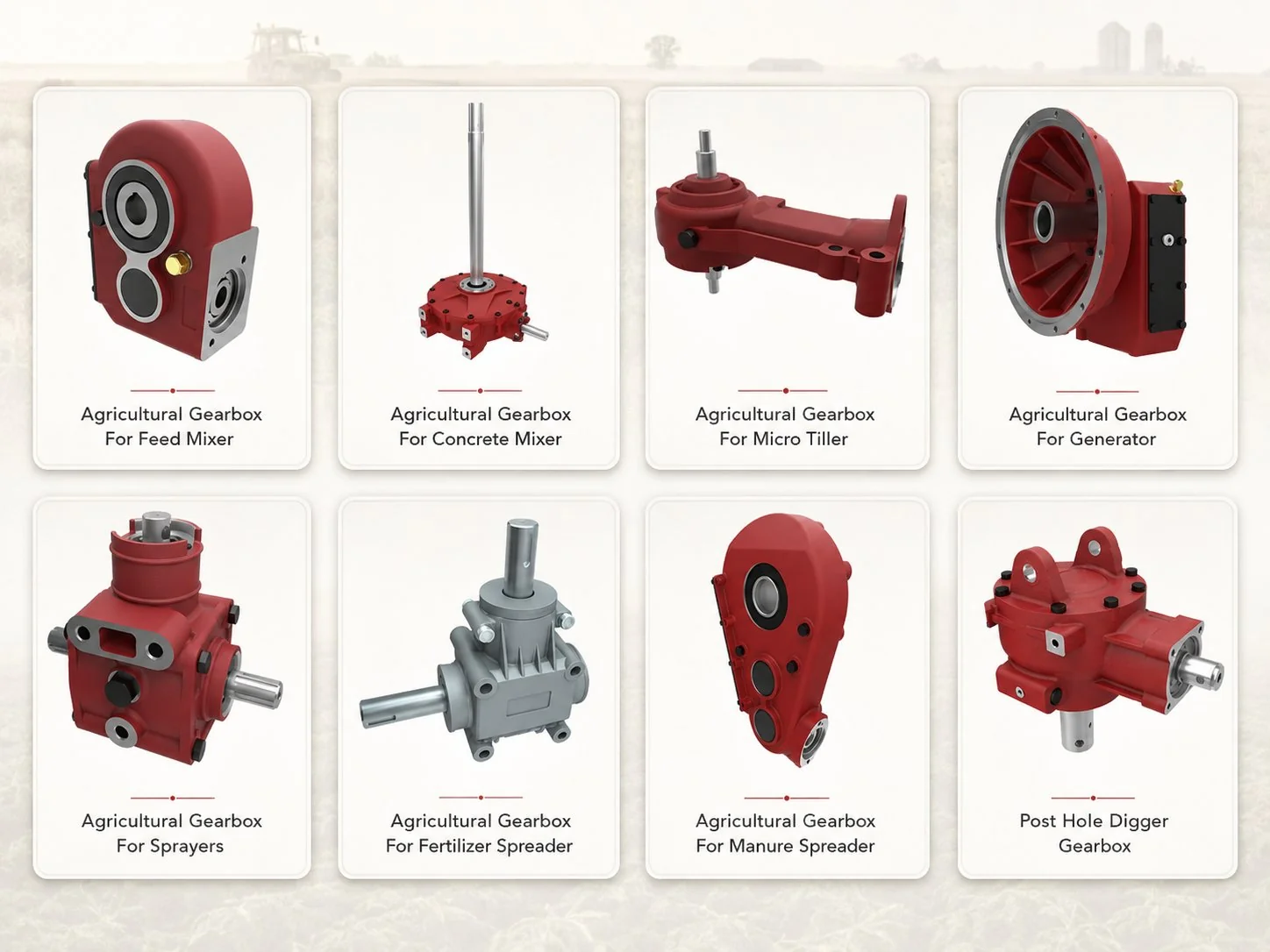
Our engineering team supplies all manure spreader gearboxes with the full corrosion-resistant package as standard — because the operating environment makes standard-specification components economically unviable. Contact us with your spreader model and beater configuration for precise cross-reference verification and specification matching.
Frequently Asked Questions
Spread Manure, Not Corrosion
Corrosion-proof manure spreader gearboxes with ammonia-resistant seals, stainless fasteners, and heavy-duty epoxy protection — engineered to survive the most chemically aggressive environment in agriculture.
Editor: Cxm