Rotary Mower Gearbox LF-199A — 45 CV Dual-Output Speed Increaser for Agricultural Blade Drives at 540 RPM

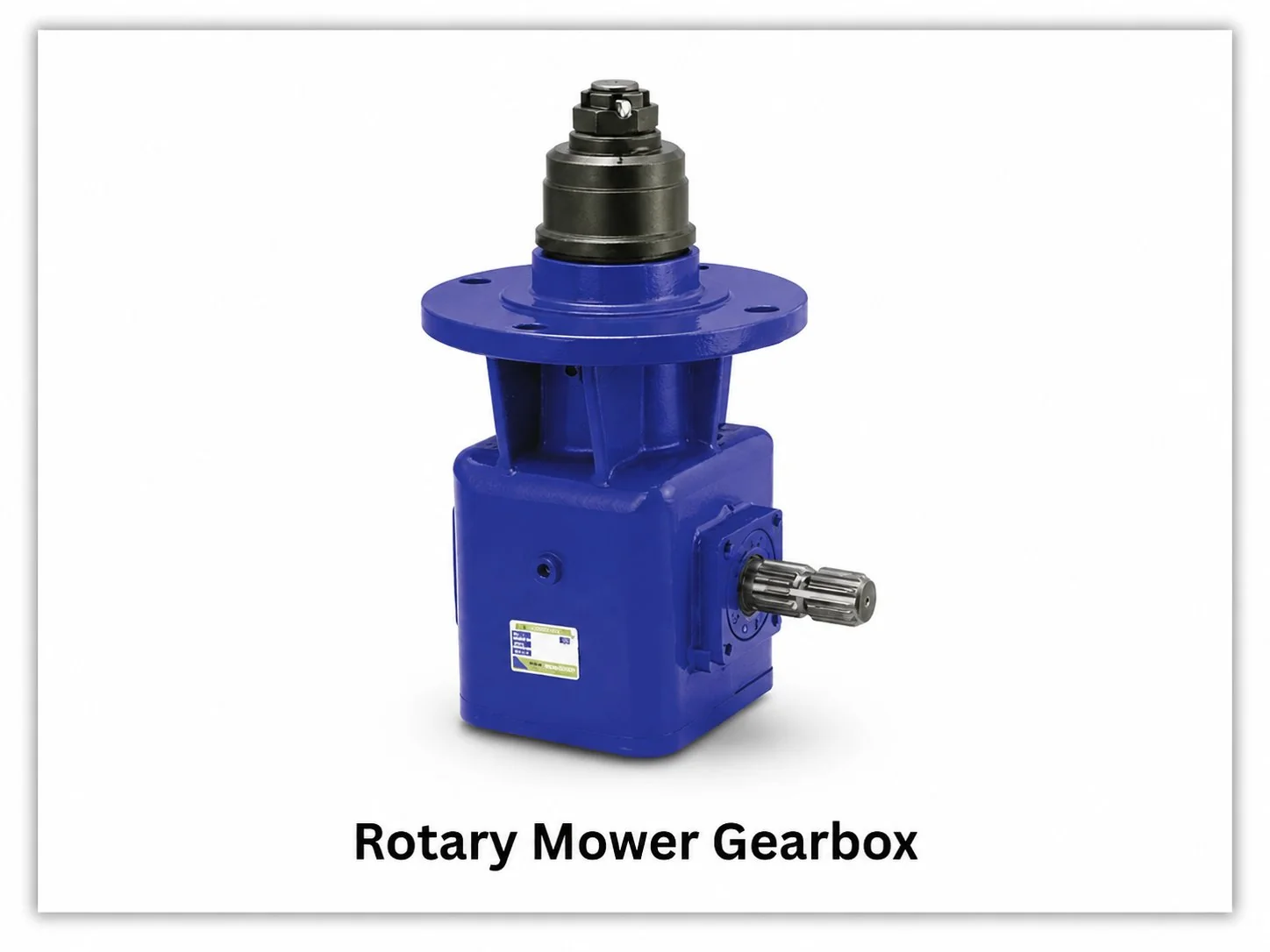
The LF-199A rotary mower gearbox is a 45 CV (33 kW) speed increaser that converts 540 RPM PTO input into 1,620 RPM blade output through a 1:3 ratio. Two output shafts drive a pair of counter-rotating blades from a single input, eliminating the need for a secondary gearbox or belt transfer in twin-blade mower configurations.
LF-199A Rotary Mower Gearbox — 45 CV Dual-Output Speed Increaser
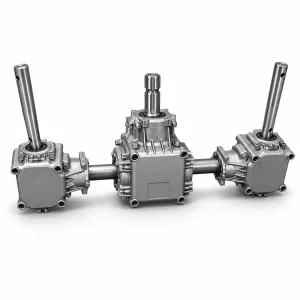
The LF-199A is a 45 CV (33 kW) rotary mower gearbox that multiplies 540 RPM tractor PTO input to 1,620 RPM through a 1:3 speed-up ratio. What sets this unit apart from single-output mower gearboxes is its twin output shaft configuration — two shafts exit the housing to drive a pair of counter-rotating blades from a single PTO input, removing the need for a secondary gearbox, idler pulleys, or belt transfers in twin-blade rotary mower designs.
Manufactured as a direct replacement for the Comer Code LF-199A, this gearbox matches every critical dimension of the original: mounting flange geometry, input spline profile (1-3/8 inch 6-spline), and both output shaft locations. Korean and Southeast Asian operators can swap the unit on existing mower frames in under 40 minutes with standard hand tools. The cast iron housing weighs 27.5 kg dry and ships without lubricant — operators add gear oil before first use.
Farms running Daedong, LS Mtron, TYM, Kubota, and John Deere tractors between 45 and 60 HP pair this pto gearbox with 1.5 to 2.5 meter rotary mowers for pasture management, park and sports field grooming, and roadside vegetation control. A reduction gear variant is also available on request for applications that need slower output with higher torque — contact our technical team for alternate configurations.
Technical Specifications
Parameters measured per SAE J744 test protocol. Cross-reference against your tractor PTO output and mower blade requirements.
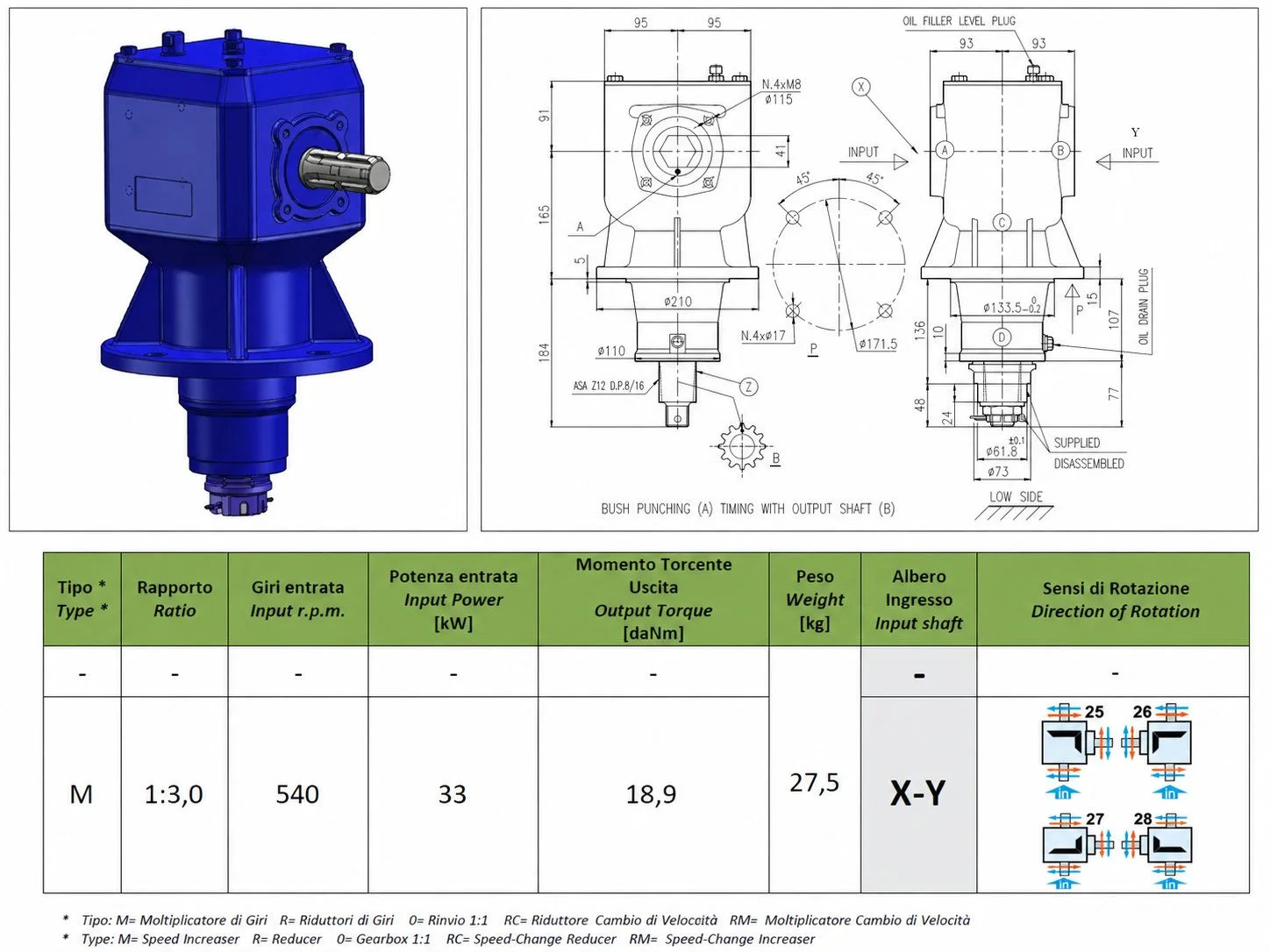
| Parameter | Value |
|---|---|
| Replacement For | Comer Code LF-199A |
| Application Type | Speed Increasing Unit |
| Input Power Rating | 45 CV — 33 kW (at 540 RPM) |
| Gear Ratio | 1 : 3 (speed increaser) |
| Input Speed | 540 RPM |
| Output Speed | 1,620 RPM |
| Number of Outputs | 2 (dual output) |
| Input Shaft | 1-3/8" — 6 spline |
| Housing Material | Cast Iron |
| Dry Weight | 27.5 kg |
| Supplied With Oil | No (ships dry) |
| Reduction Option | Available on request |
Both clockwise and counter-clockwise shaft rotations available. Contact our technical department for specific rotation configurations and reduction gear options.
Why the LF-199A Stands Out for Twin-Blade Mowers
★ Dual Output From Single Input
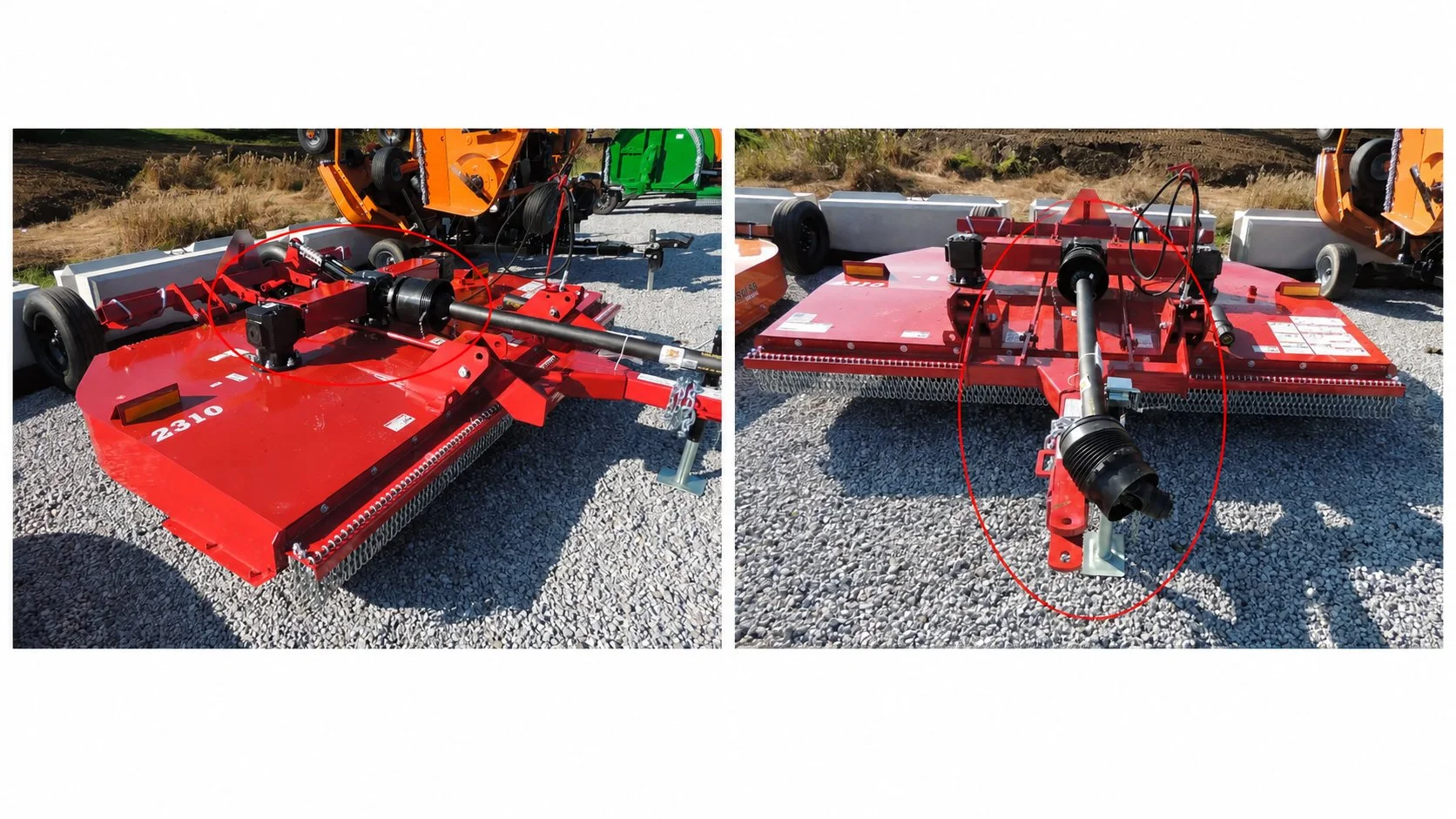
Two output shafts drive a pair of counter-rotating blades from one PTO connection. This eliminates belt transfers, idler pulleys, and secondary gearboxes — removing three potential failure points from the drivetrain while keeping the mower deck lighter and mechanically simpler.
★ 1,620 RPM Blade Speed
The 1:3 speed-up ratio converts 540 RPM to 1,620 RPM at the blade tips. At this output speed on a standard 500 mm blade, the cutting edge travels at approximately 42 m/s — well above the 30 m/s threshold needed for clean shearing of established grass without tearing.
★ 33 kW Power Throughput
At 45 CV (33 kW) rated input, the LF-199A handles the sustained power demand of twin-blade mowing at forward speeds of 8-12 km/h. This rating leaves a 15-20% power reserve on a 50 HP tractor — enough to maintain blade speed through thick patches without bogging.
★ Configurable Rotation Direction
Both output shafts can be configured for clockwise or counter-clockwise rotation, matching the blade overlap pattern specified by the mower manufacturer. Counter-rotating blades on twin-blade mowers push cut grass toward the center for a clean discharge stripe.
Matching the LF-199A to Korean Mowing Operations
Pasture Topping on Livestock Farms
Dairy and beef operations in Chungcheong and Gangwon provinces mow pasture between grazing rotations to control weed height and promote uniform regrowth. The dual-blade configuration cuts a wider swath per pass — typically 2.0 to 2.5 meters — reducing the number of passes needed on large paddocks. At 1,620 RPM, the blades produce a clean cut that heals faster than the torn edges left by slower rotary cutters, reducing plant stress during the recovery period before the next grazing cycle.
Municipal Park and Sports Field Maintenance
Korean municipal crews maintaining public parks, school fields, and sports grounds near Seoul, Daejeon, and Busan use twin-blade rotary mowers for finish-quality cuts on amenity grass. The counter-rotating blade pattern distributes clippings evenly rather than windowing them to one side. The LF-199A's 33 kW rating handles the sustained load of weekly close-mowing on dense Korean turf grass varieties including bentgrass and bermudagrass.
Roadside and Embankment Vegetation Control
Provincial road departments across Gyeonggi-do and Jeolla provinces mount rear-discharge rotary mowers on 50-60 HP tractors for seasonal roadside cutting. The two-blade overlap eliminates the uncut strip that single-blade mowers leave along the center of the swath — important for clean results on road shoulders visible to public traffic.
540 RPM vs. 1000 RPM PTO Input — Choosing the Right Speed Standard
The LF-199A is designed for 540 RPM PTO input. Operators considering a 1000 RPM tractor for mowing should understand how the PTO speed standard affects gearbox selection, output speed, and blade performance.
| Characteristic | 540 RPM PTO (LF-199A) | 1000 RPM PTO |
|---|---|---|
| Tractor Engine RPM at Rated PTO | Lower (less fuel consumption) | Higher |
| Output Speed (1:3 ratio) | 1,620 RPM | 3,000 RPM (too fast for most blades) |
| Gearbox Bearing Load | Within rated range | Exceeds bearing speed rating |
| PTO Shaft Size | 1-3/8" (6 spline) — larger, stronger | 1-3/8" (21 spline) — different profile |
| Available Input Torque | Higher at same power | Lower (speed up, torque down) |
| Tractor Compatibility (Korea) | Most 25-60 HP compact tractors | Primarily 80+ HP tractors |
| Noise Level | Lower | Higher |
For Korean mowing applications on 45-60 HP tractors, the 540 RPM standard is the correct choice. The 1,620 RPM output from the 1:3 ratio already delivers the blade speed needed for clean cuts. Running this same gearbox on a 1000 RPM PTO would push output to 3,000 RPM — well above safe operating limits for standard mower blades and beyond the gearbox bearing speed rating. Farms with 1000 RPM tractors need a pto speed increaser gearboxes variant with a lower ratio (1:1.5 or 1:2) to achieve the same output range.
Transmission Efficiency and Operating Cost Analysis
The LF-199A's helical gear speed increaser operates at 96-98% mechanical efficiency under normal load — meaning only 2-4% of the 33 kW input power is lost as heat in the gear mesh and bearing friction. Compare this to alternative mower drive methods:
- ☑ Helical gear drive (this unit): 96-98% efficiency — 0.7-1.3 kW lost as heat. The enclosed, oil-lubricated gear mesh maintains this efficiency level throughout the service life with minimal degradation.
- ☑ V-belt transfer: 90-95% when new, dropping to 85-90% as belt wears — 1.7-5.0 kW lost. Belt tension must be re-adjusted every 50-100 hours. Replacement belts cost less than gear service, but the frequency of replacement (every 300-600 hours) accumulates.
- ☑ Chain drive: 95-97% when properly tensioned — similar to gear drive, but chain stretch requires periodic adjustment. Exposed chain and sprocket assemblies on mower decks are vulnerable to grass-wrapping and corrosion.
Over a 3,000-hour agricultural gearbox service life, the gear drive's consistent efficiency and minimal maintenance translate to lower total cost of ownership than belt systems — typically 15-25% less when factoring in belt replacement costs, tension adjustment labor, and the fuel penalty from belt slip losses.
Field Report: Municipal Mowing Fleet in Gyeonggi-do
Operation: Gyeonggi Provincial Road Management Division, 4 mowing units
Equipment: 2.0 m twin-blade rear-discharge rotary mowers on John Deere 5075E tractors (75 HP)
Gearbox: LF-199A (1:3 ratio, 540 RPM input, dual output)
Coverage: 320 km of provincial road shoulders, mowed 6 times per season (April–October)
The division previously used single-blade mowers with individual gearboxes on each blade. Switching to twin-blade mowers with the LF-199A dual-output unit reduced the number of gearboxes per mower from two to one, cutting spare parts inventory by half. The counter-rotating blade pattern eliminated the uncut center strip that required a cleanup pass on the single-blade machines — saving approximately 15 minutes per kilometer of road shoulder.
After 18 months of operation (approximately 1,400 hours per unit across the fleet), oil analysis showed normal iron particle counts and no bearing anomalies. The division reports zero unplanned downtime from gearbox failure. The 33 kW rating leaves enough power reserve on the 75 HP tractors to maintain blade speed when hitting heavy vegetation patches at the standard 10 km/h forward speed — the previous single-output gearbox required operators to slow to 6-7 km/h in thick growth.
Complete Your Mower Drive System
The LF-199A connects to the tractor through a pto shaft rated for at least 33 kW (45 CV) continuous power with a 1-3/8 inch 6-spline yoke. For twin-blade mower installations where the PTO shaft operates at steep angles during transport position, a wide-angle or constant-velocity joint shaft prevents drivetrain binding and extends universal joint life.
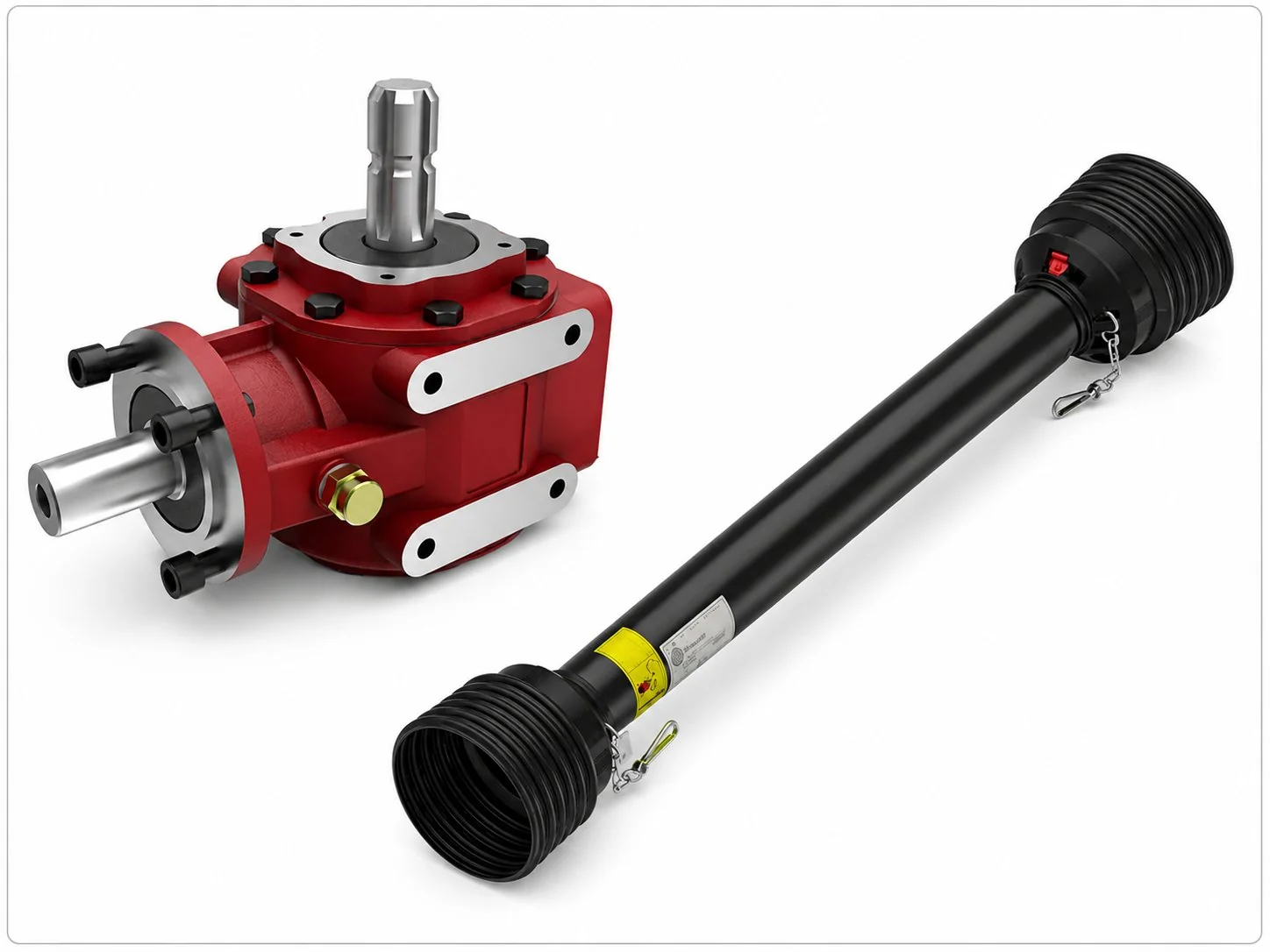
For farms running other implements alongside rotary mowers, our agricultural gearbox catalog includes units for flail mowers, rotary tillers, balers, and feed mixers — all available as pto gearbox for sale with factory-direct pricing.
Frequently Asked Questions
What makes a dual-output mower gearbox better than two separate single-output units?
A single dual-output gearbox eliminates the weight, cost, and maintenance burden of a second gearbox. It also keeps both blades synchronized through a common gear train — if one blade loads up, both blades share the torque spike rather than one gearbox absorbing the full shock alone.
Can I use only one output shaft if my mower has a single blade?
Technically possible, but not recommended. Running one output unloaded while the other carries full blade torque creates an asymmetric load on the internal gears. For single-blade mowers, a dedicated single-output rotary mower gearbox with matched bearing sizing is the better choice.
What oil type and volume does the LF-199A require?
Fill with 80W-90 GL-5 gear oil. The exact volume depends on the mounting angle — fill until oil reaches the check plug level with the gearbox in its installed operating position. First change at 50 hours; subsequent changes every 500 hours or annually.
Is the reduction gear variant interchangeable with the speed increaser version?
Both versions share the same housing and mounting dimensions, so they physically fit the same mower frame. The internal gear set differs — the reduction variant outputs approximately 180 RPM from 540 RPM input. Contact our team to confirm the correct variant for your application before ordering.
How do I determine which output shaft rotation my mower requires?
Rotation is defined by looking into the shaft end from outside the gearbox. Your mower manual specifies the required rotation for each blade position. If the documentation is unavailable, spin the existing gearbox output by hand and note the direction — the Ever-Power replacement will be configured to match.
What is the expected service life of the gear set?
With proper lubrication and the maintenance schedule above, the helical gear pair and bearings are rated for over 4,000 operating hours at rated load. Proactively replace seals at 2,000 hours to prevent oil migration — seal replacement is the most common planned service item.
What Mowing Professionals Report
Im Dong-geun, Provincial Road Crew Leader — Suwon, Gyeonggi-do, March 2025
"Four LF-199A units running on our road shoulder mowing fleet. Bolt pattern matched our existing Comer-equipped frames. After 1,400 hours across the fleet, zero gearbox failures. The twin-blade overlap eliminated our cleanup pass — saves about 2 hours per day on long routes."
Kang Min-su, Landscaping Contractor — Daejeon, Chungcheongnam-do, January 2025
"We maintain 14 public parks and 3 sports fields. The 1,620 RPM output gives us a finish cut that satisfies the parks department quality standard. Previous belt-driven mowers needed tension adjustment every week — the gear-driven LF-199A just runs. Oil change every 500 hours is the only service."
Yang Ji-hwan, Dairy Farmer — Hongcheon, Gangwon-do, October 2024
"160 hectares of pasture mowed 4 times per season. The dual-output design lets our 2.2 meter mower cut clean in one pass. 800 hours on the gearbox with no issues. Paid about 38% less than the Comer replacement through our European supplier."
Bae Yeon-hee, University Grounds Manager — Cheonan, Chungcheongnam-do, August 2024
"Our campus has 22 hectares of maintained turf. The counter-rotating blade pattern leaves clippings distributed evenly — no windrows to clean up. Student complaints about grass clumps on walkways dropped to zero after switching from single-blade to twin-blade mowing with this gearbox."
Yoo Sang-hoon, Agricultural Equipment Dealer — Cheongju, Chungcheongbuk-do, June 2024
"Carrying the LF-199A as a Comer alternative for my rotary mower customers. The dual-output configuration is the key selling point — most competitors only offer single-output units at this price level. Strong demand from landscaping companies and municipal buyers."
Additional information
| Editor | Cxm |
|---|
Related products
-
Replacement of Comer T-311J — Flail Mower Gearbox with Freewheel
-
Manure Spreader Gearbox TB-19C — 28 HP Dual-Configuration Drive with 1:1.46 Ratio for Paddle and Beater Applications
-
75 HP Heavy Duty Post Hole Digger Gearbox — 3:1 Speed Reducer for 3-Point Auger Systems on Agricultural and Fencing Operations
-
Irrigation Wheel Drive Gearbox AEP-1 Series — 50:1 and 52:1 Worm Gear Final Drive for Center Pivot and Linear Move Systems
-
Snow Plow Gearbox EP-01-229 — Spiral Bevel 1:1.35 Ratio Drive for PTO-Powered Snow Plows and Salt Spreaders
-
Angular Gearbox T-19A — 28 HP Multi-Application Right-Angle Drive with 1.46:1 Ratio for Tillers, Mowers, and Spreaders
-
Flail Mower Gearbox T-310A — 22.1 kW Speed Reducer with 1:3 Ratio for Heavy-Duty Vegetation Shredding
-
Fertilizer Spreader Gearbox L-150C — 9.9 kW Speed Increaser with 1:1.35 Ratio for Broadcast and Pendulum Spreaders