Silage Blower Fan Drive: Launching Forage Into the Silo
Tower silos (upright concrete or glass-lined steel structures 6 to 25 metres tall) are filled by blowing chopped forage upward through a fill pipe using a PTO-driven centrifugal fan. The fan must generate sufficient air velocity (30 to 45 m/s in the fill pipe) to suspend and carry chopped forage particles — which vary in density from 100 kg/m³ (dry grass) to 350 kg/m³ (wet corn silage) — from ground level to the top of the silo against gravity. The fan operates at 1,500 to 3,000 RPM depending on the silo height and forage density, requiring a PTO мењач speed increase of 1:2.8 to 1:5.5 from a 540 RPM input. This places the blower gearbox in the same ratio range as boom sprayer centrifugal pump drives — but at substantially higher continuous power (30 to 80 HP for a blower vs. 15 to 40 HP for most spray pumps) and for longer uninterrupted operating periods (8 to 14 hours per day during the 2 to 6 week silage-making season).
The blower fan handles wet, acidic crop material that is far more aggressive than air or clean water. Chopped forage at 30 to 40 percent dry matter content (60 to 70 percent moisture) releases plant juice that is mildly acidic (pH 5.5 to 6.5 for fresh forage, dropping to pH 3.5 to 4.5 as fermentation begins) and contains organic acids (lactic, acetic, and butyric) that corrode standard steel surfaces and degrade standard NBR shaft seals. Wet forage particles also impact the fan blades and housing at high velocity, causing abrasive wear that increases with forward feed rate. The blower silage equipment gearbox must be sealed against the acidic mist that saturates the air around the blower intake — FKM shaft seals and epoxy powder-coated housings are the minimum specification for this chemically hostile environment.
Defacer and Facer Units: Precision Silage Face Management
A silage defacer (also called a facer, face cutter, or block cutter) removes silage from the exposed face of a bunker or clamp silo by shaving a thin, uniform layer across the entire face width. The cutting mechanism is typically a rotating drum (400 to 600 mm diameter) fitted with hardened steel knives or a chain-flail assembly, operating at 400 to 800 RPM. The drum sweeps across the face on a hydraulic or mechanically driven traversing frame, removing 50 to 150 mm depth per pass. The gearbox driving the cutting drum requires a ratio close to 1:1 from a 540 RPM PTO (producing 400 to 540 RPM drum speed) or a modest 1:1.5 ratio increase for higher-speed chain-flail configurations operating at 800 RPM.
The quality of the cut face directly affects silage stability. A smooth, cleanly and evenly shaved face minimises the exposed surface area where oxygen can penetrate the silage mass — limiting aerobic spoilage to a thin layer (10 to 20 mm) at the face surface that is removed at each feeding event. A rough, torn, or disturbed face (produced by a bucket loader, which is the alternative to a dedicated defacer) allows oxygen to penetrate 100 to 300 mm into the silage mass, creating a deep spoilage zone that wastes 5 to 15 percent of the available dry matter. The PTO gearbox driving the defacer drum must deliver smooth, stable output speed to produce this clean cut — speed fluctuation causes the cutting knives to chatter against the silage face, tearing rather than shaving the material. For information on how the upstream forage chopping and processing equipment interfaces with the silage storage system, see our engineering guide on мењач за комбајн за крму апликације.
Winter operation adds a frozen-silage challenge. In cold climates (Northern Europe, Canada, northern US), the exposed silage face freezes to depths of 50 to 200 mm during overnight temperatures of minus 10 to minus 20 degrees Celsius. Cutting frozen silage requires 3 to 5 times more torque than cutting unfrozen material at the same drum speed — a sudden load increase that the gearbox must absorb without stalling or damaging gear teeth. The silage equipment gearbox for cold-climate defacer applications should be rated for the frozen-material peak torque (not just the unfrozen continuous torque), and the slip clutch on the PTO driveline should be calibrated to release at 2.0 to 2.5 times the rated continuous torque rather than the 1.5 times typical for temperate-climate applications.

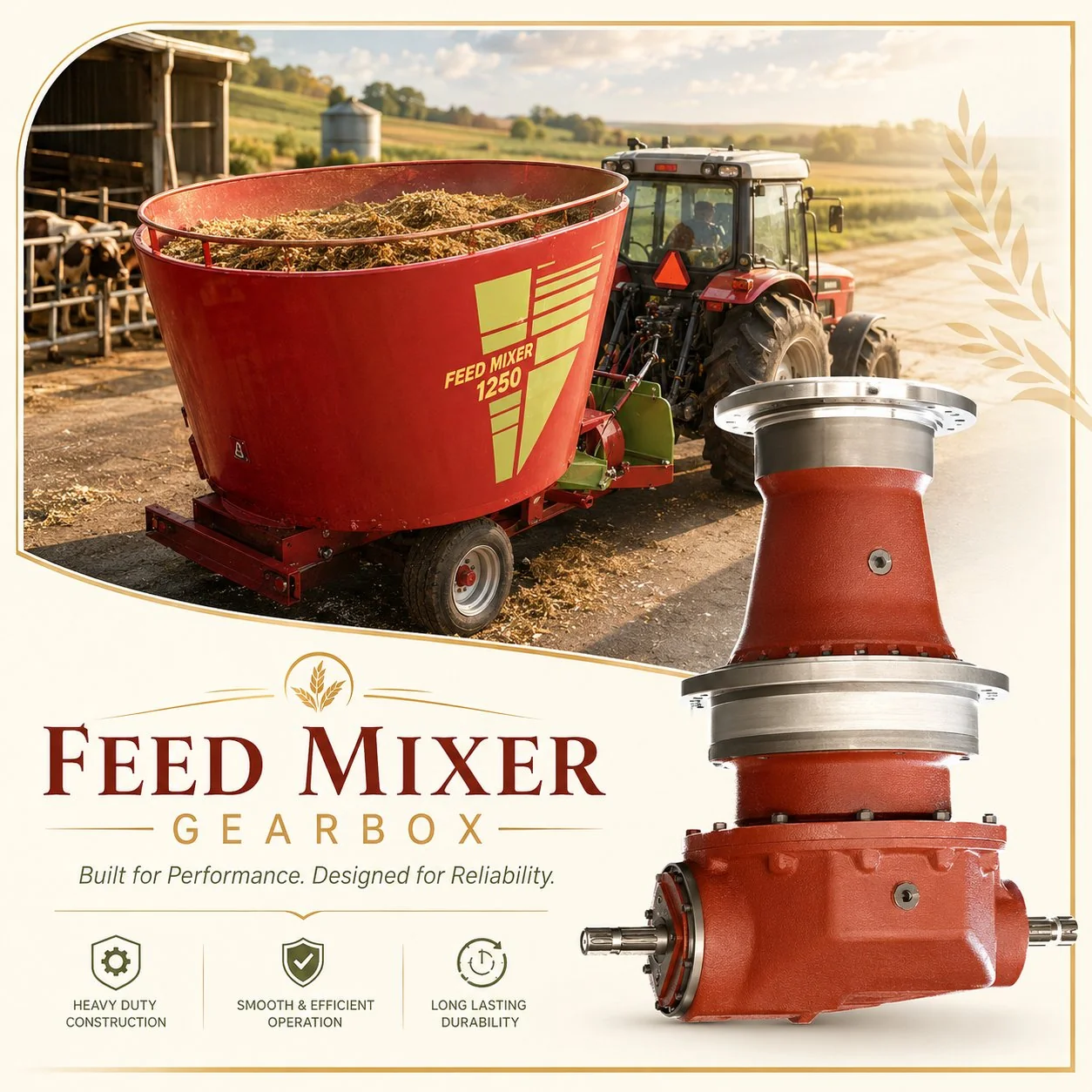
TMR Mixer Gearbox: Extreme Speed Reduction for Auger Drive
Total Mixed Ration (TMR) mixers blend silage with concentrates, minerals, and other feed ingredients into a uniform ration that is delivered to cattle feeding barriers. The mixing augers (vertical helical screws in vertical mixers, horizontal paddle or auger assemblies in horizontal mixers) rotate at 15 to 40 RPM — among the lowest output speeds of any PTO-driven agricultural gearbox. From a 540 RPM PTO input, this requires a speed reduction ratio of 1:13.5 to 1:36 — an extreme ratio that cannot be achieved in a conventional single-stage or two-stage bevel-and-helical design and instead requires multi-stage planetary gear trains, worm gear reducers, or a combination of bevel input with planetary output stages.
The torque at the auger output is correspondingly extreme. A 60 HP PTO input at 540 RPM produces 795 Nm of input torque. At a 1:27 reduction ratio (producing 20 RPM output), the output torque is 795 × 27 × 0.92 (accounting for 92 percent gearbox efficiency) = approximately 19,700 Nm — nearly 20,000 Nm of continuous torque at the auger shaft. This torque level demands output shaft diameters of 100 to 150 mm, planetary gear modules of 6 to 10 mm, and housing structures that can react the full torque load without deflecting the bearing alignment. TMR mixer gearboxes are the heaviest and most structurally demanding пољопривредни мењач application in livestock operations — a single vertical-auger mixer gearbox can weigh 150 to 350 kg.
TMR mixer gearboxes operate daily, year-round — 365 days per year, 1 to 3 hours per day, accumulating 400 to 1,000+ operating hours annually. This continuous daily duty at extreme torque levels makes bearing fatigue the life-limiting factor. The planetary bearings (which carry the full output torque distributed across 3 to 5 planet gears) experience the highest cumulative fatigue loading of any bearing position in the gearbox. Pre-loaded tapered roller bearings with L10 fatigue life calculated for 15,000+ hours (15 to 20 years of daily use) are the standard specification for quality TMR mixer gearboxes — and the actual achieved life depends heavily on the oil change discipline and the operator’s consistent habit of carefully avoiding shock-loading the mixer by dumping large feed batches onto a stationary auger.
Bale Wrapper Drive and Silage Loading Equipment
Baled silage — round or square bales wrapped in stretch plastic film — is an increasingly common alternative to bunker or tower storage, particularly on smaller livestock farms and for specialist high-value forages (lucerne, whole-crop cereals, crimped grain). The bale wrapper uses a PTO-driven wrapping arm that rotates around the bale at 20 to 40 RPM, applying 4 to 6 layers of plastic film under controlled tension. The gearbox driving the wrapping arm requires a substantial speed reduction (1:13.5 to 1:27 from a 540 RPM PTO) — placing it in a similar ratio range to TMR mixer gearboxes but at much lower power (5 to 15 HP compared to 40 to 120 HP for a mixer). The PTO мењач for a bale wrapper can therefore use a simpler worm gear reducer (rather than the multi-stage planetary design needed for a high-torque mixer), achieving the required ratio in a single compact stage with inherent self-locking capability that holds the wrapping arm stationary when the PTO is disengaged.
The wrapping arm speed must remain constant throughout each bale wrap cycle to ensure uniform film overlap. Variable speed produces uneven film layers — thick on one side and thin on the other — that create weak spots where oxygen penetrates the film barrier during storage, initiating localised spoilage that spreads through the bale. A worm gear reducer with a precision-ground worm and bronze wheel provides the inherent speed stability needed for consistent wrapping: the high reduction ratio and the sliding contact geometry of worm gears naturally damp speed fluctuations from the PTO input, delivering smoother output speed than a similarly-ratioed spur or helical gear train.
Silage loading equipment (grab forks, block cutters mounted on telehandlers, and conveyor belt loaders) may also incorporate PTO-driven hydraulic power packs that supply the hydraulic flow and pressure needed for the loading mechanism. These power packs use a gearbox-driven hydraulic gear pump operating at 1,500 to 2,500 RPM (1:2.8 to 1:4.6 speed increase from 540 RPM PTO) at 15 to 30 HP. The gearbox for a silage loading power pack operates in the same corrosive acidic, wet operating environment as the defacer and TMR mixer gearboxes, requiring the same FKM seal and acid-resistant coating specification. The intermittent duty cycle of loading equipment (operating 1 to 2 hours per day with frequent start-stop cycles) creates thermal cycling that accelerates condensation inside the gearbox housing — sealed check-valve breathers and regular oil monitoring are essential to prevent the moisture accumulation that causes internal corrosion during the long idle periods between loading events.
Acid-Resistant Design for Fermented Silage Contact
Well-fermented silage has a pH of 3.5 to 4.5 — more acidic than orange juice and comparable to vinegar. The organic acids responsible for this acidity (lactic acid at 60 to 80 g/kg dry matter, acetic acid at 10 to 30 g/kg, and smaller quantities of butyric and propionic acids) corrode standard carbon steel, degrade NBR rubber seals, and attack standard zinc-plated fasteners. Every gearbox component that contacts silage or silage juice directly (blower housing interior, defacer drum drive housing) must resist this chemical environment for 5 to 15 years of seasonal or daily exposure.
Housing coating specification for silage-contact gearboxes should be two-part epoxy or polyester powder coating at 100+ micrometre thickness — thicker and more chemically resistant than the 60 to 80 micrometre coating used on general-purpose agricultural gearboxes. External fasteners (bolts, drain plugs, inspection covers) should be stainless steel (A2 or A4 grade) rather than zinc-plated mild steel. Shaft seals should be FKM (fluoroelastomer) rather than NBR — FKM resists organic acids at the concentrations present in silage juice, while NBR softens and swells within 6 to 12 months of continuous acid exposure. The Карданско вратило driveline serving silage processing equipment should also use stainless or zinc-nickel-plated components for the yoke and cross-journal, because the daily acid exposure accelerates corrosion of standard zinc plating on driveline surfaces that are difficult to inspect and maintain.
Maintenance Across Three Equipment Duty Cycles
The three principal silage processing gearbox types have fundamentally different operational maintenance rhythms and service requirements. The blower gearbox operates intensively for 2 to 6 weeks during the silage-making season (200 to 500 hours), then sits idle for 10 to 11 months — requiring a pre-season oil change and post-season cleaning and corrosion protection. The defacer gearbox operates daily during the 6 to 9 month feeding season (200 to 600 hours), with oil change at mid-season and post-season storage preparation. The TMR mixer gearbox operates daily year-round (400 to 1,000+ hours annually), requiring oil changes every 500 hours or annually, whichever comes first — and continuous monitoring for the bearing noise that indicates the onset of planetary bearing fatigue.
Synthetic PAO-based EP gear oil (ISO VG 220 for blower and defacer, ISO VG 320 for TMR mixer) is recommended across all three applications. The blower benefits from synthetic oil’s thermal stability during high-speed summer operation. The defacer benefits from synthetic oil’s cold-temperature fluidity during winter morning start-ups at minus 10 to minus 20 degrees Celsius. The TMR mixer benefits from synthetic oil’s superior film strength at the extreme contact pressures generated by the low-speed, high-torque planetary gear mesh. In all three cases, the synthetic oil’s better water-separation characteristics help manage the moisture contamination that is inevitable in the silage processing environment.
Често постављана питања
Silage Processing Power on Demand
From high-speed blower fans to extreme-reduction TMR mixer planetary drives — our silage-specification gearboxes cover the full ratio spectrum that livestock feed processing demands. Acid-resistant coatings, FKM seals, and cold-climate thermal ratings included as standard on every unit.
Уредник: Cxm