What Is a Fertilizer Spreader Gearbox?
A fertilizer spreader gearbox is the right-angle PTO-driven gear unit that converts horizontal tractor PTO rotation into the high-speed vertical rotation needed to spin one or two spreading discs at 700 to 1,000 RPM. As fertilizer granules fall from the hopper onto the spinning disc, centrifugal force accelerates them outward along the vanes, launching them in a wide arc that covers 8 to 36 metres of spreading width depending on disc speed, vane geometry, and granule density. The fertilizer spreader gearbox is what controls this entire process — disc speed determines throw distance, and throw distance determines spread pattern uniformity. Even a 5 percent speed error produces a measurably uneven nutrient distribution across the field.
The fertilizer spreader gearbox also operates in one of the most corrosive environments in agriculture. Fertilizer salts — ammonium nitrate, urea, potassium chloride, diammonium phosphate — are hygroscopic: they absorb moisture from the air and form concentrated salt solutions that attack steel, aluminium, and standard sealing materials. Dust from granular fertilizer coats every surface of the spreader, and when moisture (rain, dew, or humidity) activates this dust, the resulting salt solution penetrates any gap or worn seal. Chemical-resistant design is not optional for a fertilizer spreader gearbox — it is the fundamental requirement that separates a multi-season gearbox from one that corrodes and fails within two to three seasons.
Single Disc vs. Double Disc: Two Gearbox Architectures
Single-disc spreaders use one spinning disc fed by a single drop point from the hopper. The PTO gearbox drives a single vertical output shaft through a right-angle spiral bevel pair at 1:1.5 to 1:1.9 ratio (producing 810 to 1,025 RPM from 540 PTO). Spreading widths of 8 to 18 metres are typical. Single-disc units are lighter, simpler, and less expensive — but the asymmetric spread pattern (wider on one side than the other due to the single drop point) requires careful bout-width overlap planning to achieve uniform coverage.
Double-disc spreaders use two counter-rotating discs, each fed by a separate drop point from a central hopper. The double disc spreader gearbox must drive two vertical output shafts — either through a single bevel input with an internal spur gear pair that splits and reverses the rotation, or through two separate bevel pairs driven from a common input shaft. Double-disc units produce a symmetric, wider spread pattern (18 to 36 metres) and are the standard choice for large-scale arable farming where spreading accuracy and working-width efficiency justify the higher gearbox cost and complexity.
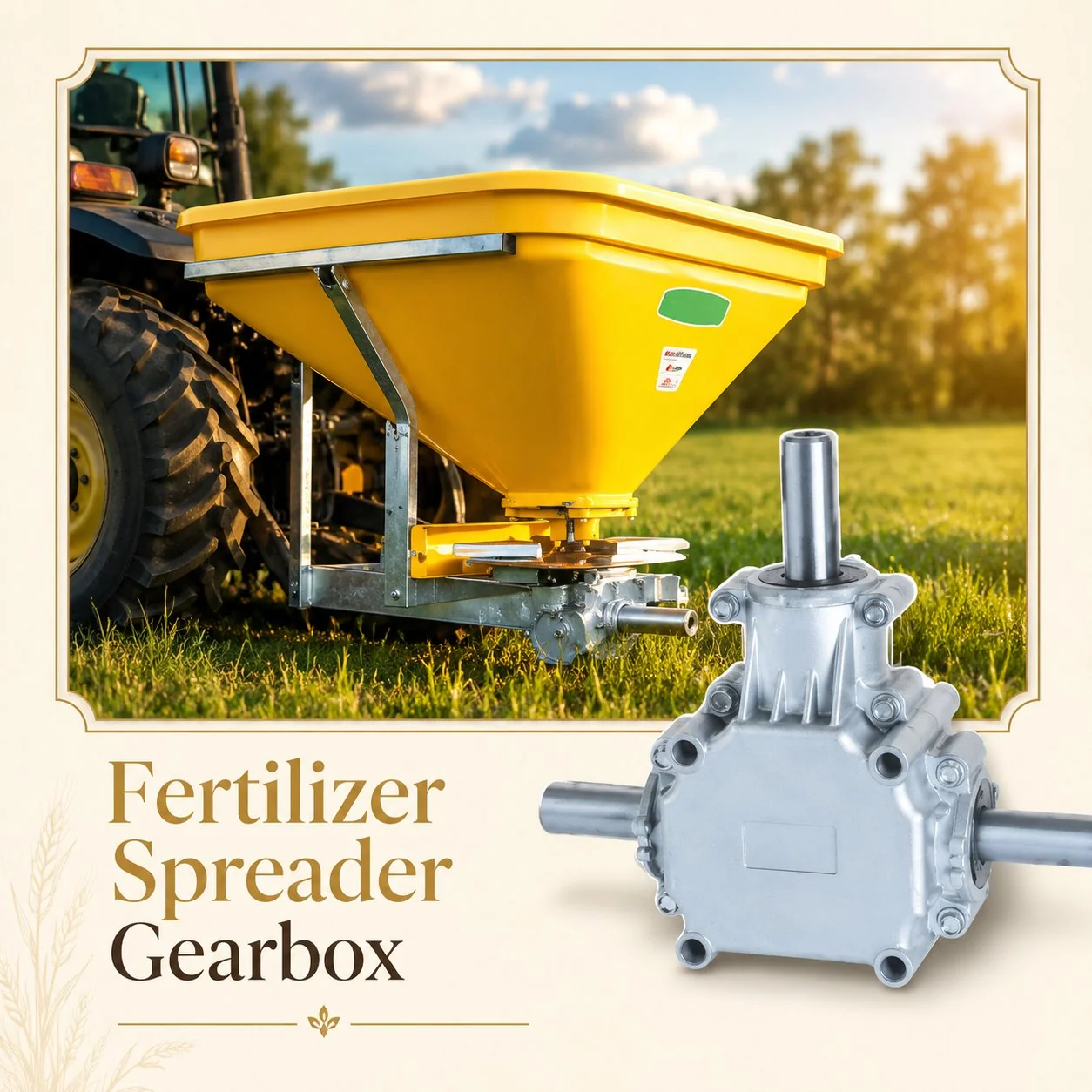
Fertilizer spreader gearbox — right-angle speed-increasing drive for centrifugal disc applications
Disc Speed and Spread Pattern: The Critical Relationship
The throw distance of a fertilizer granule is determined by its exit velocity from the disc edge — which is directly proportional to the disc speed and the disc radius. The fertilizer spreader gearbox ratio must produce the exact disc speed that launches each granule to the designed landing distance for the target bout width. A 5 percent speed error (caused by gearbox wear, incorrect ratio, or PTO speed variation) shifts the entire landing pattern by approximately 5 percent — producing a visible striping effect where overlap zones between adjacent passes receive either too much or too little fertilizer.
A coefficient of variation (CV) below 15 percent is the industry target for acceptable spread uniformity. A worn fertilizer spreader gearbox that produces inconsistent disc speed can push the CV above 20 to 25 percent — resulting in yield loss of 3 to 7 percent in under-fertilized zones and crop lodging or environmental nutrient runoff in over-fertilized zones. On a 500-hectare arable operation applying 200 kg/ha of compound fertilizer, a 5 percent yield loss from poor spread uniformity represents thousands of dollars per season — far exceeding the cost of maintaining or replacing the gearbox responsible for the uneven distribution.
For precision farming operations using variable-rate application (VRA), the PTO gearbox speed stability must be even higher: plus or minus 1 percent under all conditions. VRA systems vary the application rate by adjusting the hopper metering gate opening — but this only works correctly if the disc speed (and therefore the throw distance) remains constant. If the gearbox allows speed to vary with load (more granules on the disc at higher application rates slowing the disc), the throw pattern shifts at exactly the moments when precise dosing matters most, defeating the purpose of the variable-rate technology.

Corrosion Resistance: Engineering for the Harshest Chemical Environment
Fertilizer salts are among the most corrosive materials routinely handled in agriculture. Ammonium nitrate, urea, and potassium chloride are all hygroscopic — they absorb atmospheric moisture and form concentrated salt solutions on any surface where dust has settled. This salt solution attacks exposed steel at rates 10 to 50 times faster than clean rainwater, and it penetrates standard NBR shaft seals within 1 to 2 seasons through the combined mechanisms of chemical degradation of the seal lip material and capillary wicking along microscopic surface imperfections on the shaft.
FKM (fluoroelastomer) shaft seals resist fertilizer salt solutions and acidic adjuvants. Double-lip design with grease-purged intermediate chamber. Stainless steel garter springs (standard carbon steel springs corrode and lose tension within one season). Re-grease intermediate chambers every 25 to 50 operating hours.
Epoxy powder coating at 100+ micrometres (double the standard 60 micrometre agricultural specification). Stainless steel (A2-70 or A4-80) external fasteners, drain plugs, and inspection covers. Sealed check-valve breather preventing fertilizer-laden air ingestion. A corrosion-resistant spreader gearbox specification is essential for multi-season service.
Gear and Bearing Design for High-Speed Disc Drive
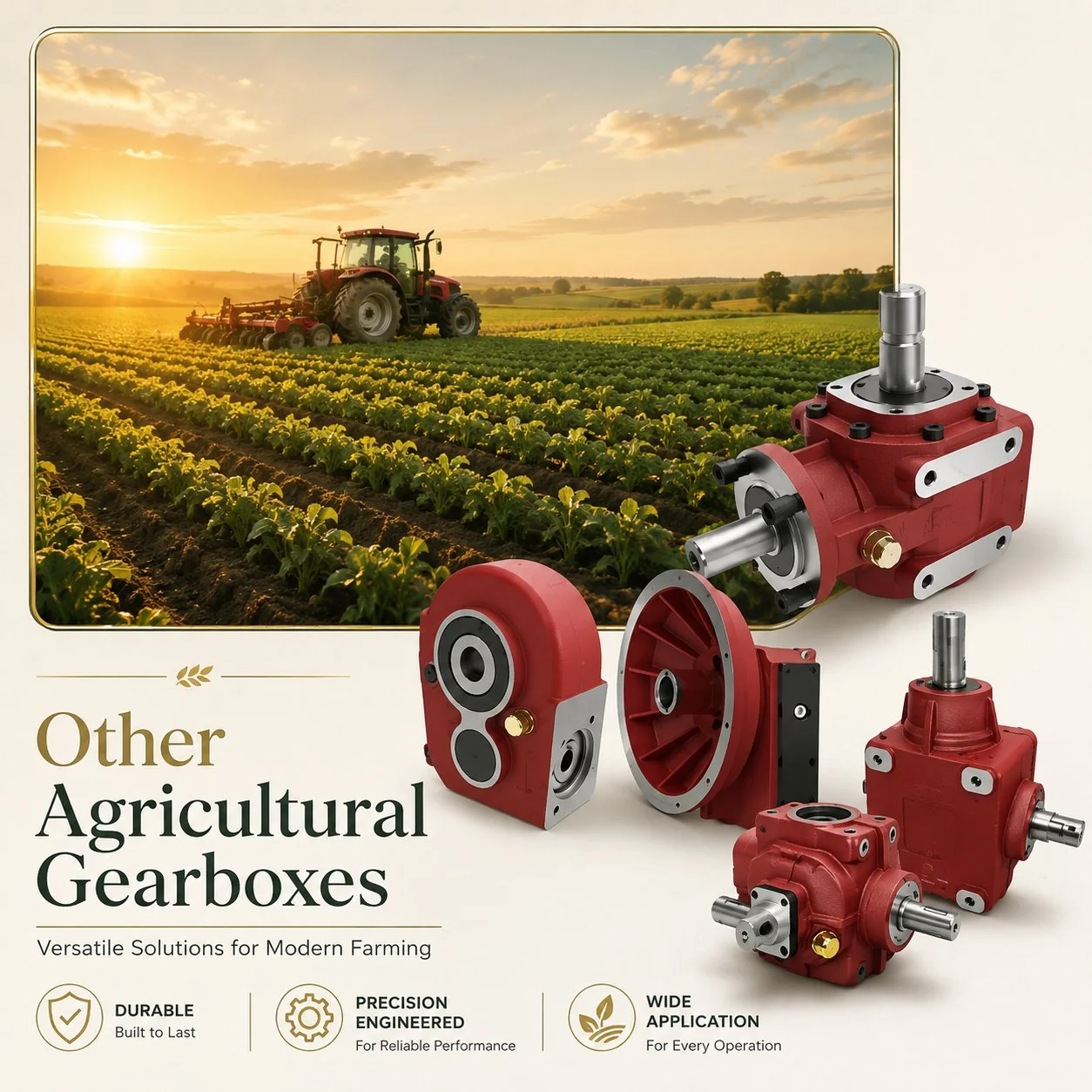
The fertilizer spreader gearbox operates as a speed increaser — the output shaft turns faster than the input, and the output torque is correspondingly lower than the input. A 1:1.9 ratio receiving 540 RPM at the PTO delivers 1,026 RPM at the disc shaft — nearly double the input speed. While the lower output torque (approximately half the input at 1:1.9 ratio) reduces gear tooth stress compared to a speed-reducing gearbox, the high output speed places the dominant engineering demand on the output bearings. At 700 to 1,000 RPM, the fertilizer spreader gearbox bearing at the disc shaft position accumulates fatigue cycles 1.3 to 1.9 times faster than the input bearing — making the output bearing the life-limiting component in the vast majority of spreader gearbox installations.
Deep-groove ball bearings with C3 internal clearance (accommodating thermal expansion at operating speed) are the standard choice for single-disc spreader gearbox output positions. For double disc spreader gearbox configurations where each shaft carries the combined radial load from gear mesh forces and the gyroscopic effect of a heavy fertilizer-loaded disc, angular contact bearings or tapered roller bearings may be specified for the additional axial load capacity. The bearing seal material must be compatible with the corrosive environment — standard steel shields corrode rapidly; stainless steel shields or non-metallic (PEEK or ceramic) shields are specified for agricultural gearbox applications in the fertilizer environment.
Technical Specifications at a Glance
PTO Driveline and Speed Stability
The PTO driveline for a fertilizer spreader must maintain consistent input speed to the gearbox under all operating conditions. Series 1 or Series 2 drivelines are adequate for the modest power levels (10 to 40 HP) — but the driveline must be properly phased (both U-joint yokes in the same rotational plane) to prevent twice-per-revolution speed pulsation that would modulate disc speed and produce visible striping in the spread pattern. At 540 RPM, a mis-phased driveline at 10 degrees operating angle produces approximately plus or minus 3 percent speed pulsation — enough to shift the fertilizer landing pattern by 0.5 to 1.0 metre on each revolution, creating a pulsating spread width that degrades uniformity.
For spreaders mounted on the tractor three-point hitch, the driveline angle changes as the hitch height is adjusted. Setting the hitch to maintain a near-horizontal driveline (operating angle below 8 degrees) minimises the speed pulsation effect. Trailed spreaders with longer drivelines and potentially higher operating angles benefit from constant-velocity PTO joints that eliminate speed pulsation entirely — a modest cost addition that directly improves spread pattern accuracy on undulating terrain.
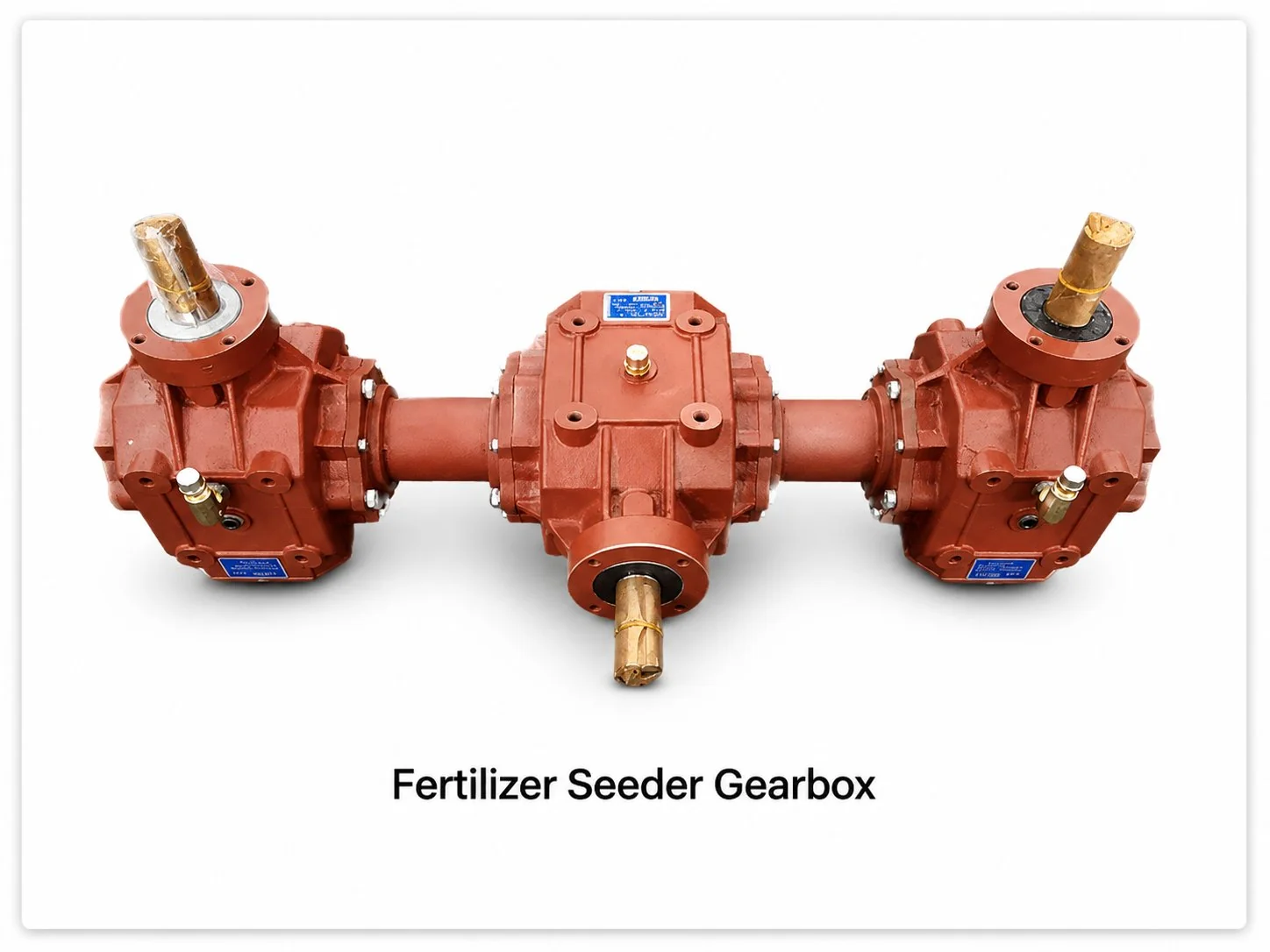
Fertilizer Spreader Gearbox Oil and Lubrication
The standard fertilizer spreader gearbox oil specification is EP gear oil SAE 80W-90 (ISO VG 220) — the same multi-purpose specification used across most agricultural gearboxes. Oil capacity is modest (0.35 to 1.5 litres depending on gearbox size), and operating temperatures during spreading are moderate (45 to 65 degrees Celsius) because the power level is relatively low. The first oil fill should always be changed after the initial 50 operating hours to remove break-in wear particles; subsequent changes follow the 500-hour or annual interval.
The primary lubrication concern for spreader gearboxes is not thermal degradation but moisture contamination. Fertilizer dust that penetrates the breather vent or a worn seal dissolves in the oil, forming a corrosive salt solution that attacks bearing surfaces and gear teeth from inside the gearbox. This internal corrosion is insidious because it occurs even when the gearbox appears externally clean and sealed. An annual oil change with fresh oil — combined with inspection of the magnetic drain plug for corrosion particles (orange-brown rust flakes rather than the grey metallic paste from normal gear wear) — is essential for detecting and preventing internal corrosion damage before it reaches the bearing fatigue surfaces.
Seasonal Maintenance Schedule
Full oil change with fresh EP 80W-90. Inspect all FKM seals for hardening, cracking, or salt deposit intrusion. Spin disc by hand — check for bearing roughness. Grease PTO driveline U-joints. Verify driveline phasing. Inspect disc vanes for wear that affects spread pattern.
Wash the entire spreader including gearbox exterior with clean water — this is the single most important fertilizer spreader gearbox maintenance action. Fertilizer salt left on surfaces overnight absorbs moisture and begins active corrosion. Pay particular attention to the output seal area where fertilizer dust accumulates around the disc shaft.
Thorough final wash — remove all fertilizer residue from every surface. Top up oil. Apply corrosion-inhibiting grease to exposed shaft surfaces and housing joints. Store in a dry, covered location away from fertilizer storage (fertilizer vapour is hygroscopic and creates a corrosive atmosphere even without direct contact).
Aftermarket Fertilizer Spreader Gearbox Replacement
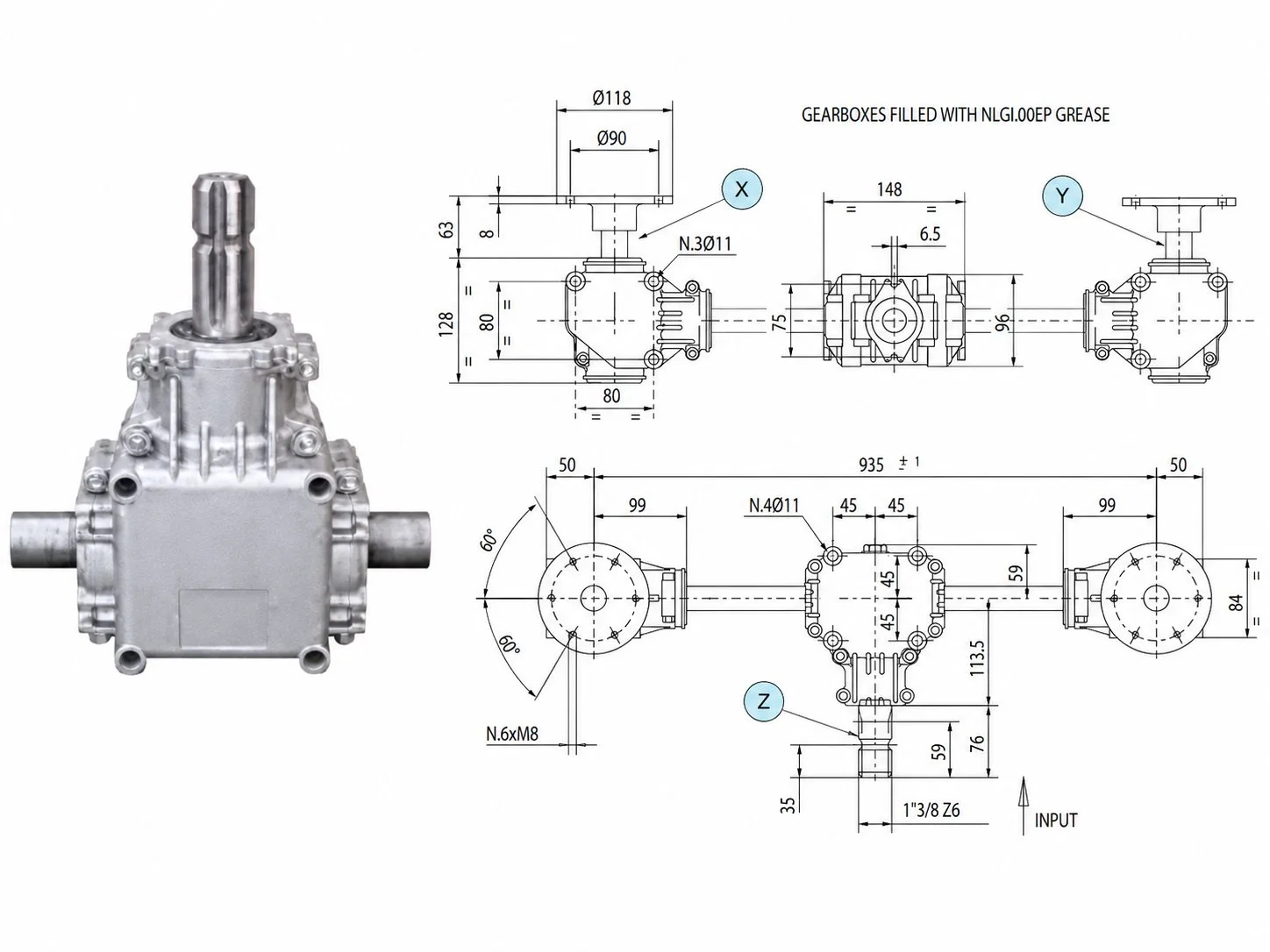
Fertilizer spreader gearbox replacement is driven primarily by corrosion — both external housing and internal bearing and gear corrosion from salt contamination. A well-maintained gearbox (washed after every use, oil changed annually, seals inspected regularly) can last 8 to 15 years. A neglected gearbox (fertilizer dust left unwashed, oil contaminated with dissolved salts, worn seals unaddressed) may fail in 2 to 4 years — making wash discipline the single biggest determinant of gearbox service life. Cross-reference parameters include the input shaft spline profile, the output shaft configuration (single or double, diameter, and coupling type), the mounting bolt pattern, and the gear ratio.
Our engineering team maintains cross-reference compatibility data for major spreader brands (including Comer code equivalents) and can supply aftermarket gearboxes with verified dimensional and performance compatibility. All spreader-specification gearboxes include the corrosion-resistant package as standard: FKM seals, stainless fasteners, 100+ micrometre epoxy coating, and sealed breather — because the operating environment does not permit standard-specification components to survive beyond one or two seasons.
For double-disc spreader gearbox replacements, both output shafts should ideally be replaced or rebuilt simultaneously. A gearbox with one new and one worn output bearing produces different disc speeds on the two sides — the worn bearing generates higher friction and slightly lower speed — which creates an asymmetric spread pattern that defeats the primary advantage of the double-disc design. Matching bearing condition across both outputs ensures the symmetric, uniform spread pattern that precision nutrient application requires. Our cross-reference service verifies bearing specification matching for both outputs when supplying double-disc replacements, ensuring that the replacement gearbox delivers the same spread-pattern symmetry as the original OEM unit.
Frequently Asked Questions
Spread with Precision, Season after Season
Corrosion-resistant fertilizer spreader gearboxes with precise disc speed output for uniform nutrient distribution — engineered to survive the harshest chemical environment in agriculture.
Editor: Cxm