PTO-Driven Rice Harvest Equipment: Where the Gearbox Matters
Rice harvesting equipment spans a wide range of mechanisation levels — from hand sickles through walk-behind reapers to full-size combine harvesters. The Скоростна кутия на ВОМ is the critical drive component in three categories of rice harvest machinery: PTO-driven reaper-binders that cut and bind rice into sheaves for field drying, PTO-driven stationary or semi-mobile threshers that separate grain from straw, and header drive gearboxes on combine harvesters that power the cutting and feeding mechanism. Each category presents distinct gearbox engineering requirements shaped by the operating speed, torque profile, and the wet paddy environment they share.
PTO-driven reaper-binders are the workhorse of mechanised rice harvesting in South and Southeast Asia, where smallholder plot sizes (0.2 to 2 hectares) and soft paddy soils favour compact, lightweight machines pulled by walking tractors or small 4-wheel tractors of 15 to 30 HP. The reaper cuts standing rice at 50 to 80 mm above the water surface using a reciprocating knife bar (operating at 400 to 540 strokes per minute) and feeds the cut crop onto a conveyor that delivers it to a binding mechanism. The entire cutting-conveying-binding cycle is driven from a single PTO input through a right-angle gearbox that converts the horizontal PTO shaft to the machine’s internal drive system at a 1:1 or 1:1.2 ratio.
PTO-driven threshers are stationary or semi-mobile machines positioned at the field edge that receive manually harvested or reaper-cut rice sheaves and thresh the grain from the straw using a rotating cylinder with rasp bars or wire loops. The threshing cylinder operates at 500 to 1,200 RPM depending on the design — axial-flow threshers run at 400 to 600 RPM (requiring a 1:1 ratio from 540 RPM PTO or a slight speed reduction), while conventional tangential-flow threshers run at 800 to 1,200 RPM (requiring a 1:1.5 to 1:2.2 speed increase from 540 RPM PTO). The gearbox on a thresher must handle the intermittent heavy loading as each sheaf enters the cylinder — a loading pattern that generates torque spikes of 2 to 3 times the running torque at each feed event.
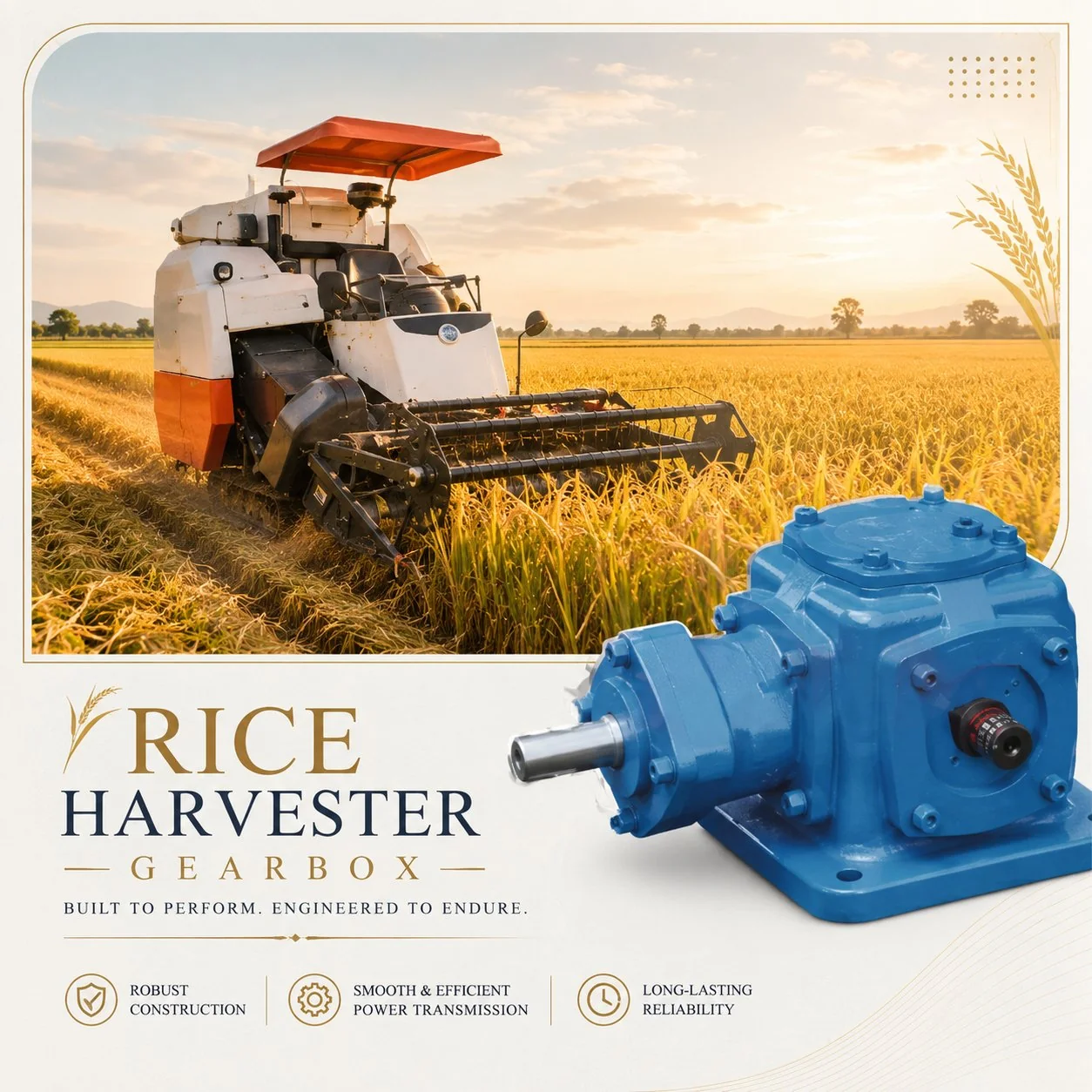
PTO gearbox for rice harvester applications — precision speed conversion and water-sealed housing for paddy field operating conditions
Combine Harvester Header Drive: The Aftermarket Gearbox Opportunity
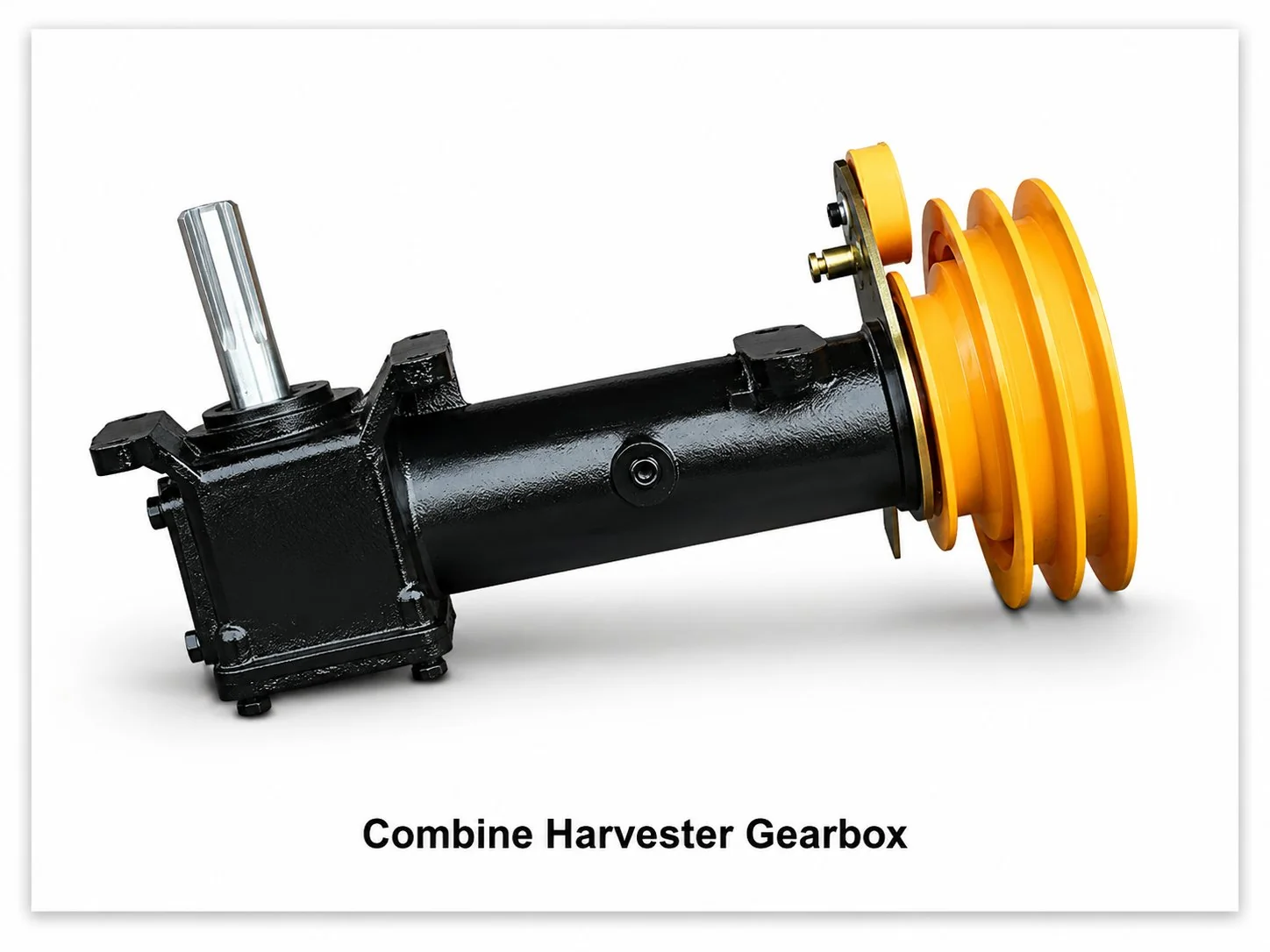
Combine harvesters used for rice — whether compact Asian models (Kubota, Yanmar, Daedong) or full-size Western models adapted for paddy (John Deere, New Holland, Claas) — use gearboxes in the header assembly to drive the cutting mechanism and crop feeder. These header gearboxes are not PTO-driven in the traditional sense (they receive power from the combine’s own engine through internal drive shafts), but they represent a significant aftermarket replacement market because they are the most failure-prone gearbox on a rice combine: operating at or below the crop canopy in direct contact with water, mud, and abrasive paddy soil throughout every hour of harvest operation.
A reciprocating-knife header gearbox converts rotary input from the combine drive shaft into reciprocating motion that drives the knife bar at 400 to 540 strokes per minute. The gearbox uses a crank-and-pitman mechanism — a rotating crank arm connected to a reciprocating pitman rod that pushes and pulls the knife bar through its cutting stroke. The bearings on the crank pin and the pitman connection experience continuous oscillating loads that combine radial force with reversing axial force at each stroke direction change. These bearings wear faster than any other bearing position in the combine, and their failure (manifested as increasing vibration and eventually a seized or broken pitman drive) is the single most common cause of header downtime during rice harvest.
Rotary disc headers, increasingly popular on rice combines in Japan and Korea, replace the reciprocating knife with spinning cutting discs similar to a disc mower cutter bar. The header gearbox for a rotary disc system must drive the discs at 2,500 to 3,000 RPM through a multi-stage gear train — the same basic architecture described in our disc mower gearbox article, but with the additional engineering challenge of operating in standing water and saturated soil rather than a dry hay field. Aftermarket replacement of these header gearboxes requires exact dimensional matching to the specific combine model and header configuration. A manufacturer like Скоростна кутия Ever-Power PTO with cross-reference capability for Asian and European combine header models can supply compatible replacements at a fraction of OEM pricing and often with shorter lead times.
Water-Sealed Housing: Engineering for Submerged Operation
Определящото инженерно предизвикателство за всеки rice harvester gearbox is water intrusion. Unlike dust contamination (which can be managed with standard double-lip seals and sealed breathers), water intrusion in a paddy field environment is driven by hydrostatic pressure — the gearbox housing sits in standing water that exerts continuous static pressure against every seal, joint, and breathing pathway. A standard agricultural gearbox seal designed to exclude airborne dust is overwhelmed by even 100 mm of standing water pressing against the seal lip from the outside.
Effective paddy-grade sealing requires a multi-barrier approach. Double or triple shaft seals with a pressurised grease chamber between the outermost and innermost seal lips create a positive pressure barrier that opposes the external water pressure — the grease pressure (maintained by periodic re-greasing through a dedicated grease nipple) must exceed the hydrostatic pressure of the standing water depth to prevent inward water migration. For a gearbox operating in 200 mm of standing water, the hydrostatic pressure is approximately 2 kPa (0.02 bar) — a modest pressure that standard lip seals cannot reliably exclude during continuous operation, but that a grease-pressurised multi-lip seal system resists effectively.
The housing breathing system requires particular attention. A standard open breather cap allows water to enter the housing whenever the gearbox is partially submerged — and even a brief submersion event during field entry or exit through a deep paddy bund can introduce enough water to contaminate the oil. Sealed check-valve breathers that open outward under positive internal pressure (allowing thermal expansion air to escape) but seal against inward flow (preventing water entry when the gearbox cools and internal pressure drops below atmospheric) are the minimum specification. Fully sealed, non-breathing housing designs (which accommodate thermal expansion through a flexible diaphragm or an internal air space) eliminate the breathing pathway entirely and provide the highest level of water exclusion for gearboxes that operate continuously in standing water.
Asian PTO Spline Standards: Matching Gearbox to Tractor
The PTO spline interface between the tractor and the rice harvester gearbox input shaft varies across Asian markets — a compatibility challenge that does not exist in European or North American agriculture where ISO 500 standardisation ensures universal interchangeability. Japanese compact tractors (Kubota, Yanmar, Iseki) predominantly use the JIS B 9209 standard with a 21-spline profile at 35 mm diameter — different from the ISO 6-spline profile at 35 mm diameter that is standard on European and Australian tractors at 540 RPM. Korean tractors (Daedong/KIOTI, TYM, LS) follow KS B 6320, which is largely JIS-harmonised for compact models but may offer ISO-compatible PTO stubs on larger export models.
For rice harvesting equipment operating across mixed-brand tractor fleets (common in agricultural cooperatives and contract harvesting operations in Southeast Asia), the gearbox input shaft specification must be verified against each individual tractor’s PTO stub rather than assumed from the tractor brand. A gearbox supplier serving the Asian rice harvest market must offer both JIS 21-spline and ISO 6-spline input shaft configurations — ideally as a field-interchangeable input shaft module that allows the same gearbox body to be adapted to different tractor PTO profiles by changing only the input shaft assembly. For a comprehensive guide to regional PTO spline standards across Japan, Korea, Australia, and ASEAN markets, see our detailed resource on PTO gearbox in Asia-Pacific.
Wet Crop Threshing: Higher Torque, Greater Gearbox Demand
Rice is typically harvested at 20 to 26 percent grain moisture content — significantly wetter than wheat (12 to 14 percent) or corn (15 to 20 percent) at harvest. This high moisture content increases the torque required for threshing by 30 to 50 percent compared to dry grain crops at the same throughput rate. The wet straw is tougher and more flexible, resisting the shearing action of the threshing cylinder’s rasp bars and requiring more mechanical energy to separate the grain from the panicle. The grain itself is softer at high moisture and more susceptible to cracking if the cylinder speed is too high — creating a narrow operating window between the minimum speed needed for effective threshing and the maximum speed that avoids grain damage.
The Скоростна кутия на ВОМ driving a rice thresher must be rated for the wet-crop torque demand, not the dry-crop figure that may appear in generic specifications. A thresher rated at 25 HP for dry rice may require 35 to 40 HP when processing freshly cut wet rice at the same throughput — an increase that pushes a marginally sized gearbox beyond its continuous rating and into the thermal and mechanical overload zone. The gearbox bearing arrangement must also accommodate the higher axial thrust loads generated by wet crop interaction with the threshing cylinder — wet straw wraps more readily around the cylinder, creating drag forces that the dry-crop engineering did not account for. Specifying an селскостопанска скоростна кутия one frame size larger than the dry-crop calculation indicates provides the thermal and mechanical margin needed for reliable wet-rice threshing through a full harvest season.
Maintenance Strategy for Paddy-Environment Gearboxes
The oil change interval for a rice harvester gearbox operating in paddy conditions should be the shortest of any agricultural gearbox application — every 50 to 100 operating hours, or immediately whenever the drained oil shows milky discolouration indicating water contamination. Even with properly functioning multi-lip seals and sealed breathers, trace quantities of water migrate past the seals during continuous paddy operation through capillary action, seal lip micro-wear, and thermal cycling condensation. This water accumulates at the bottom of the gearbox sump (water is denser than gear oil and settles below it), where it contacts the lowest bearing position and the lowest gear mesh zone — exactly the components that suffer the most from corrosion-initiated fatigue damage.
Daily seal inspection is essential during the rice harvest season. Check every shaft seal location for water weeping (visible moisture on the housing surface around the seal) and grease the multi-lip seal chambers every 8 to 10 operating hours to maintain the positive pressure barrier against external water. A Карданен вал driveline operating in paddy water requires greasing at least twice daily — the U-joint bearing seals are submerged during field operation, and water ingress into the needle bearings causes rapid corrosion pitting that develops into U-joint failure within 200 to 400 hours if the bearings are not kept continuously packed with fresh grease that displaces the water.
Post-harvest cleaning and storage preparation is critical in paddy environments. Paddy soil contains 60 to 80 percent silica (the highest silica content of any agricultural soil type), and dried paddy mud left on the gearbox housing acts as an abrasive reservoir that accelerates external corrosion, clogs cooling surfaces, and provides a moisture-retention layer that prevents the housing from drying between seasons. Pressure-wash all gearboxes immediately after the harvest season, drain and replace the oil (removing accumulated water and silica-contaminated sludge), apply fresh grease to all external seal chambers, and store the equipment under cover in a dry environment. A rice harvester gearbox that enters storage clean and dry retains 95 percent of its service life for the next season; one stored wet and mud-caked may lose 20 to 30 percent through corrosion damage alone.
Често задавани въпроси
Equip Your Rice Harvest Fleet
From PTO-driven reaper-binders to stationary threshers and combine header replacements — our paddy-specification gearboxes are engineered for the water, soil, and wet-crop conditions that standard agricultural gearboxes cannot survive. JIS and ISO spline configurations available, with worldwide shipping to all Asian rice-producing markets.
Редактор: Cxm