The Beet Harvest Sequence: Four Functions, One PTO Gearbox
A complete sugar beet harvest pass executes four sequential operations in a single forward travel of the machine. First, the topper removes the leafy crown from each standing beet at a precise height of 5 to 10 mm above the root shoulder — too high leaves sugar-bearing crown tissue in the field (reducing recoverable sugar yield by 0.5 to 1.5 percent per millimetre of excess crown), while too low cuts into the root body and exposes internal tissue to bacterial infection that causes rot during the 4 to 12 week storage period before factory processing. Second, the lifting mechanism extracts the topped root from the soil using counter-rotating lifting wheels, vibrating shares, or a combination of both. Third, the cleaning system (turbine wheels, roller screens, or star-wheel separators) removes adhering soil from the beet surface. Fourth, the elevator conveys the cleaned beets into the harvester’s hopper or directly into a trailing transport vehicle. Each function requires a different output speed and torque from the पीटीओ गियरबॉक्स, making the sugar beet harvester one of the most complex multi-output gearbox applications in agricultural equipment.
The topper mechanism uses rotating flails (rubber or polyurethane fingers that strip the crown by impact) operating at 800 to 1,500 RPM, or rotating discs (steel cutting discs that sever the crown cleanly) operating at 400 to 600 RPM. From a 540 RPM PTO, flail toppers require a 1:1.5 to 1:2.8 speed increase, while disc toppers operate at approximately 1:1 ratio. The lifting wheels rotate at 200 to 400 RPM — a speed reduction from the PTO input — and require the highest sustained torque of any function in the harvester because each wheel pair must grip and extract multiple beet roots simultaneously from soil that resists the extraction with frictional and adhesive forces proportional to the soil moisture and clay content. The cleaning turbine operates at 150 to 300 RPM at moderate torque, and the elevator at 50 to 150 RPM at the lowest torque of the four functions.
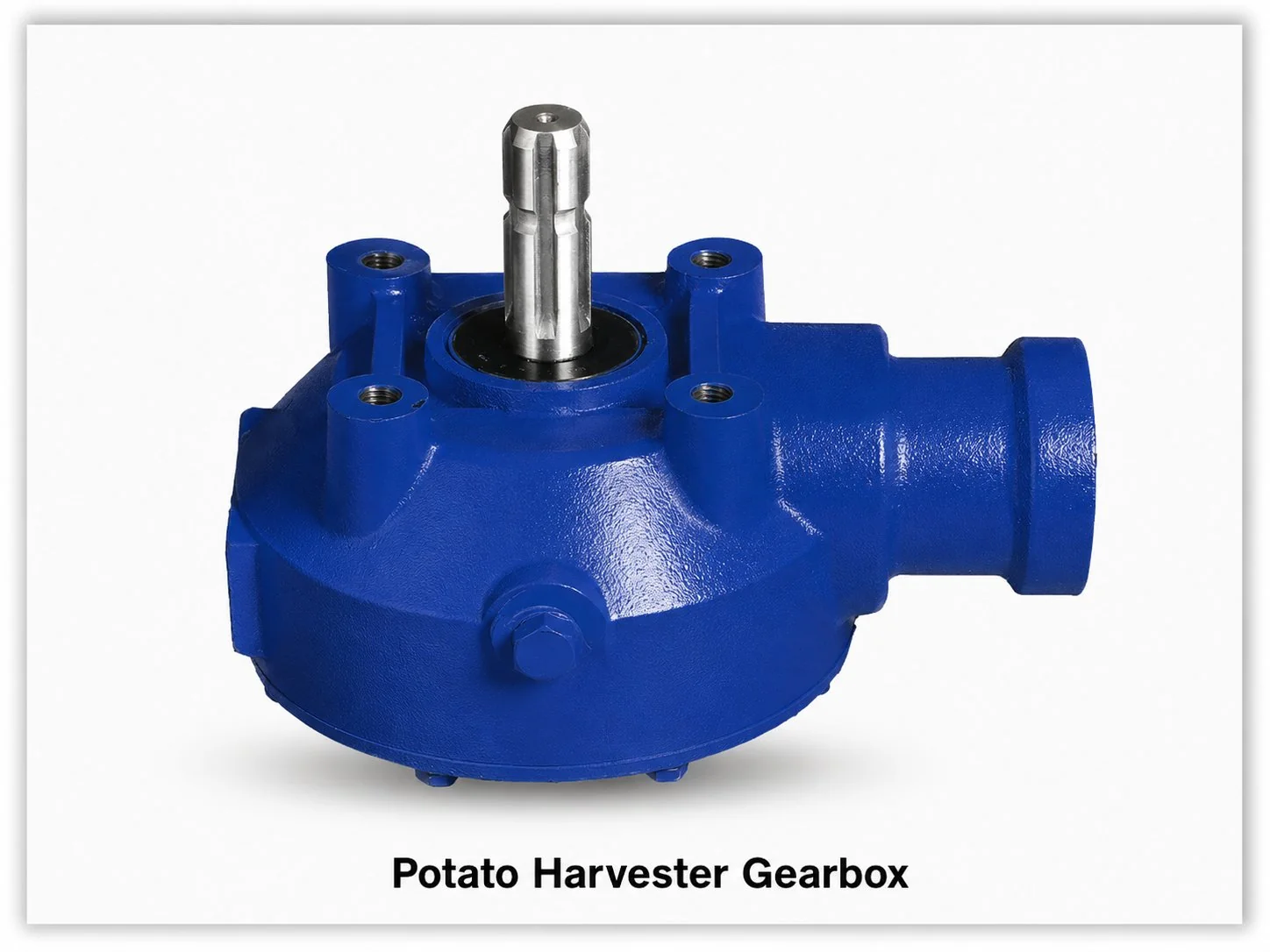
Multi-Output Gearbox Architecture for Beet Harvesters
The sugar beet harvester gearbox must provide simultaneous outputs at four different speeds from a single PTO input — a design challenge that exceeds the single-output or dual-output configurations used on most other agricultural gearboxes. The most common architecture uses a central bevel input stage (converting horizontal PTO rotation to vertical internal drive) that feeds a cluster gear arrangement with multiple take-off points, each geared to produce the required output speed for its respective function. The topper output is typically the highest speed (requiring a speed increase), the lifter output is moderate (requiring modest reduction), the cleaner is lower, and the elevator is the slowest (requiring the greatest reduction).
Each output shaft must be independently loaded without affecting the speed or torque of the other outputs. This independence requires the gear train to be designed with sufficient stiffness that the deflection caused by heavy loading on one output (such as a torque spike on the lifter from encountering compacted soil) does not shift the mesh alignment of the adjacent gear pairs. In practice, this means wider face-width gears, stiffer shaft diameters, and closely spaced bearing supports — all of which increase the पीटीओ गियरबॉक्स housing size and weight compared to a single-output unit of equivalent total power rating.
Power distribution across the four functions varies with soil conditions and forward speed but follows a general pattern: lifting mechanism 40 to 50 percent (the dominant load), cleaning 20 to 30 percent, topper 15 to 20 percent, and elevator 5 to 10 percent. A two-row PTO-driven beet harvester operating in medium clay soil at typical forward speed (4 to 6 km/h) requires 50 to 80 total PTO HP, while a three-row unit in heavy soil may demand 80 to 120 HP. The gearbox must be rated for the sum of all simultaneous peak loads — not just the average continuous load — because the lifting wheels encounter compacted soil zones, stones, and tangled root masses that generate instantaneous torque spikes of 2 to 3 times the average running torque.
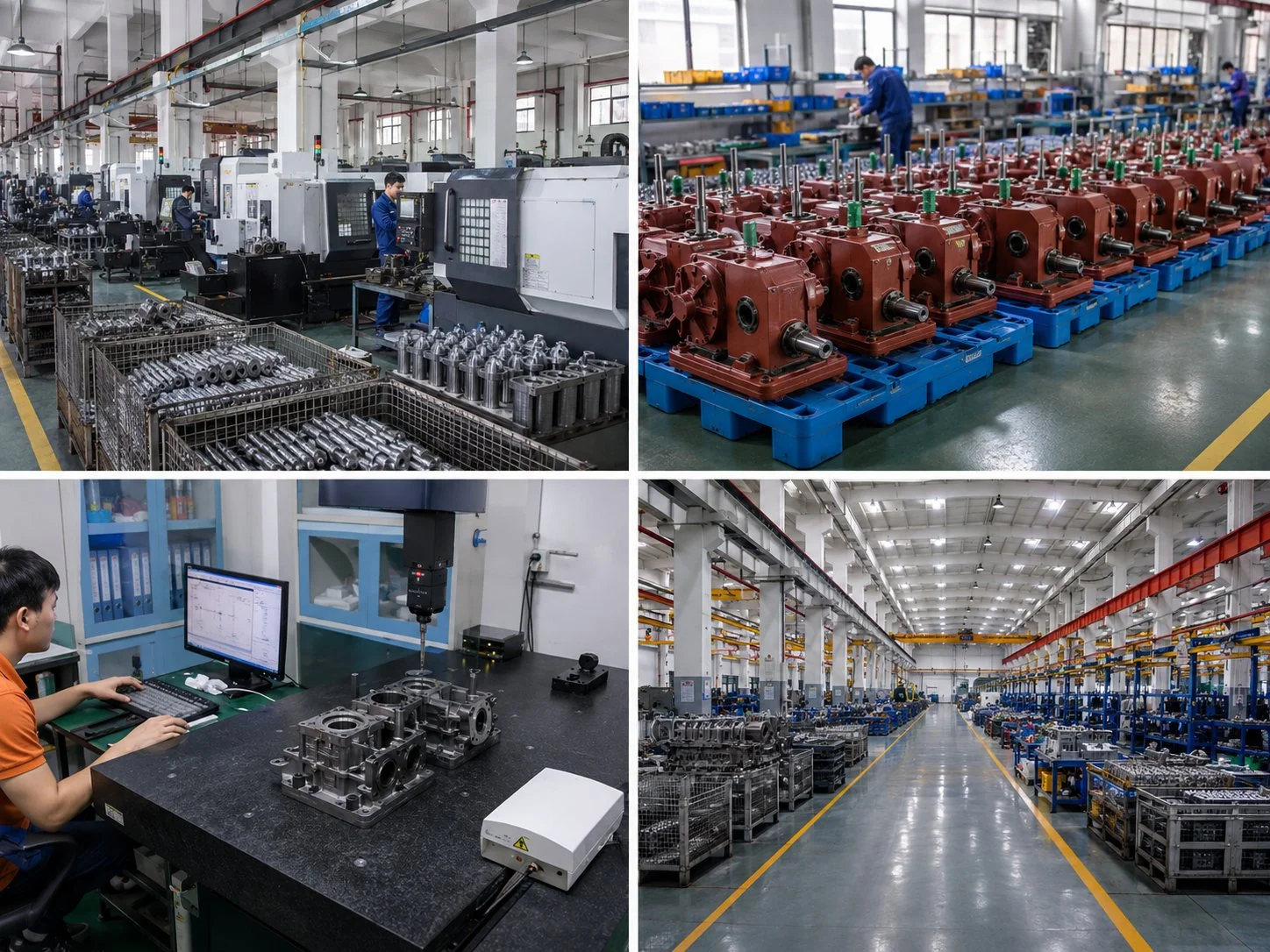
Beet vs. Potato: Root Geometry and Gearbox Load Differences
Sugar beet and potato harvesters share the fundamental challenge of extracting a root crop from the soil and cleaning it for storage — and many of the gearbox design principles are common to both applications. However, critical differences in root geometry, soil interaction, and harvest timing create distinct engineering requirements that make a beet harvester gearbox substantially different from a आलू हार्वेस्टर गियरबॉक्स in several important dimensions.
A sugar beet is conical — typically 200 to 400 mm long and 80 to 150 mm in diameter at the shoulder, tapering to a narrow root tip. This conical shape means the extraction force increases progressively as the root is pulled from the soil: the widest part of the root encounters the highest soil resistance as it passes through the extraction zone, creating a rising-torque loading profile on the lifting wheels. A potato, by contrast, is roughly spherical or ovoid (50 to 100 mm diameter), sits shallower in the soil (100 to 200 mm depth vs. 150 to 350 mm for beet), and presents a more uniform extraction force profile because its widest diameter is encountered early in the extraction stroke. The result is that a beet lifting mechanism experiences 40 to 60 percent higher peak torque per root than a potato lifter operating in comparable soil — requiring heavier-duty gears, larger bearings, and a more robust housing on the gearbox outputs that drive the lifting wheels.
The harvest season timing also differs significantly: potatoes are typically harvested in late summer to early autumn (August to October in the Northern Hemisphere) when soil moisture is moderate and air temperatures are mild. Sugar beet harvest extends from late September through December — the wettest, coldest part of the agricultural calendar in most beet-growing regions. The gearbox must operate reliably in ambient temperatures from minus 5 to plus 15 degrees Celsius (compared to 10 to 25 degrees for potato harvest), with soil moisture levels 30 to 50 percent higher than during potato season. This late-season operating environment demands cold-start oil viscosity management (synthetic gear oil with good low-temperature fluidity) and enhanced sealing against the saturated soil and standing water that characterise late-autumn beet fields.
Autumn Harvest Conditions: Sealing and Lubrication
The late-autumn operating environment of sugar beet harvest creates a unique combination of challenges for sugar beet harvester gearbox sealing and lubrication. Wet clay soil at 30 to 40 percent moisture content generates a slurry of fine abrasive particles mixed with water that coats every exposed surface of the harvester — including gearbox housings, shaft seal faces, and breather caps. This abrasive slurry is more damaging to shaft seals than either dry dust or clean water alone, because the water carries the abrasive particles into intimate contact with the seal lip surface while providing the lubrication that allows the particles to slide along the seal face and abrade the sealing edge.
Double-lip shaft seals with an intermediate grease chamber are the minimum specification for beet harvester gearboxes. The outer lip excludes the bulk of the soil slurry, the grease barrier captures particles that pass the outer lip, and the inner lip prevents contaminated grease from entering the कृषि गियरबॉक्स oil. Grease the intermediate chambers every 8 to 10 operating hours to maintain positive grease pressure that opposes the inward migration of contaminated soil water. Sealed check-valve breathers prevent slurry from being drawn into the gearbox housing during thermal breathing cycles — a standard open breather cap on a beet harvester gearbox will ingest soil-contaminated water within the first day of operation.
Lubricant selection for late-autumn operation must balance cold-start viscosity with high-temperature film strength. Synthetic PAO-based gear oil ISO VG 220 provides adequate film strength at the moderate operating temperatures of autumn beet harvesting (gearbox oil typically reaches 50 to 70 degrees Celsius, much lower than summer harvest equipment) while maintaining acceptable fluidity at the cold morning start temperatures of minus 5 to plus 5 degrees Celsius that are common during November and December harvest in northern Europe. Mineral gear oil of the same viscosity grade becomes excessively thick below 0 degrees Celsius, causing high starting torque, bearing starvation during the first minutes of operation, and accelerated seal wear from the increased viscous drag on cold shaft seals.
Stone Impact Protection and Sugar Quality Preservation
Stones, hardened soil clods, and metal debris (fence wire, lost tools, broken plough points) enter the cleaning system mixed with the beet flow. In the cleaning turbine — the highest-speed component of the cleaning system — these foreign objects impact the turbine blades and the gearbox-driven star wheels at velocities that generate instantaneous force spikes of 5 to 10 times the normal running load. Without adequate overload protection, a single large stone impact can crack a turbine blade mount, bend a star-wheel shaft, or fracture a gear tooth root in the cleaning output drive of the sugar beet harvester gearbox. Shear-bolt protection on each cleaning element is the standard approach: the shear bolt breaks at a calibrated torque threshold, disconnecting the cleaning element from the drive before the impact force reaches the gearbox, and a replacement bolt restores the drive in under 5 minutes.
The interaction between gearbox performance and sugar quality is often overlooked. The lifting wheel speed directly affects root damage — too fast and the wheels bruise or break the beet roots (exposing internal tissue to bacterial contamination that reduces sugar content during storage by 0.1 to 0.3 percent per week), while too slow risks incomplete extraction (leaving the root tip in the soil, which also reduces recoverable sugar). The cleaning turbine speed similarly affects the balance between soil removal efficiency and root surface damage — aggressive cleaning at high turbine speed removes more soil (reducing transport weight and factory processing costs) but strips the root skin and causes cell damage that accelerates sugar inversion during storage. These quality interactions mean that the gearbox output speeds are not merely engineering specifications but direct contributors to the economic value of the harvested crop.
In-Season Maintenance and Post-Harvest Storage
The beet harvest season runs 6 to 12 weeks of continuous daily operation — 300 to 600 operating hours concentrated into the shortest, wettest, coldest time of the agricultural year. Oil change intervals should be 150 to 200 hours (mid-season change recommended for a 400+ hour season), with immediate change if the oil shows milky discolouration (water contamination) or visible soil particle sediment at the drain plug. Every पीटीओ शाफ्ट U-joint should be greased daily — the wet soil environment accelerates corrosion pitting in needle bearings that are not kept continuously packed with fresh lubricant.
Post-harvest cleaning is critical. Beet soil is typically high in clay content and hardens to a concrete-like mass when it dries on the gearbox housing during winter storage. Pressure-wash the entire gearbox immediately after the last harvest day (while the soil is still wet and removable), drain and replace the oil (removing accumulated water and soil sediment), apply fresh grease to all external seal chambers, and store the harvester under cover. A gearbox that enters winter storage clean and dry will emerge in the following autumn with 95 percent of its potential service life intact; one stored with wet clay packed against the housing may lose 15 to 25 percent through seal degradation and surface corrosion during the 9 to 10 month off-season.

अक्सर पूछे जाने वाले प्रश्नों
Root Crop Performance Starts Here
From one-row mounted harvesters to three-row trailed units — our multi-output beet harvester gearboxes deliver the simultaneous topping, lifting, cleaning, and elevating power that late-autumn root crop extraction demands. Autumn-grade sealing, cold-start lubrication, and heavy-duty lifting outputs included as standard.
संपादक: सीएक्सएम