What a Hay Tedder Gearbox Does — and Why Low Speed Means High Torque
A hay tedder lifts, spreads, and aerates freshly cut forage so it dries uniformly before baling. Each rotor carries four to six spring-steel tine arms that sweep through the swath at ground level, tossing the hay into the air and spreading it across a wider area. The rotor speed must be precisely controlled — fast enough to lift the crop effectively (typically 180 to 350 RPM) but slow enough to avoid shattering dry leaf material or throwing the hay so far that it lands on adjacent swaths.
The tractor’s PTO delivers power at 540 RPM — significantly faster than the rotor needs to turn. The hay tedder gearbox reduces this speed through a gear train that typically provides a 2:1 to 3:1 reduction ratio, bringing the rotor speed into the 180–270 RPM range. This speed reduction simultaneously multiplies torque — a critical function because each rotor must overcome not only the resistance of the crop but also the intermittent shock loads from tine arms striking the ground, stones, and compacted hay in heavy swaths.
The torque demand varies enormously with crop conditions. Spreading a light, dry swath of ryegrass requires perhaps 15 N·m per rotor. Working through a heavy, damp alfalfa windrow with a tangled understory can demand 80 to 120 N·m per rotor — a 5 to 8× variation that the gearbox must accommodate continuously without overheating or exceeding its bearing load capacity. On a six-rotor tedder, the central gearbox distributes a total of 90 to 720 N·m across all rotors simultaneously, with the PTO gearbox input absorbing the sum of all individual rotor loads plus the mechanical losses in the gear train itself.

Counter-Rotation Gearing: Why Adjacent Rotors Must Spin Opposite
Effective tedding requires that adjacent rotors turn in opposite directions. When rotor 1 spins clockwise, its tines throw hay to the right. Rotor 2, spinning counterclockwise, throws hay to the left. The combined effect creates an overlapping spread pattern that aerates the entire swath width uniformly without leaving untreated strips or piling hay into ridges. If all rotors turned the same direction, the hay would accumulate on one side and leave bare ground on the other.
The gearbox achieves counter-rotation through one of two methods. The most common is a bevel gear distribution system where the PTO input drives a central cross-shaft through a bevel gear pair, and each rotor is driven from the cross-shaft through individual bevel gear pairs whose orientation alternates — rotor 1 drives from the top of the cross-shaft gear, rotor 2 from the bottom, and so on. This inherently reverses the rotation direction of every second rotor without requiring idler gears.
The alternative method — used on some lightweight tedders — drives all rotors from a single cross-shaft through spur gears with idler gears between alternate pairs (similar to a power harrow gear train but at lower speed and torque). This approach is simpler to manufacture but creates more mesh points, each adding friction loss and requiring its own bearing and seal. For hay tedder applications where power levels are moderate (15 to 40 HP total) and simplicity is valued, the bevel gear distribution system remains the dominant design. The underlying round baler gearbox engineering principles — high reduction ratio, continuous duty, shock absorption — share significant common ground with tedder gearbox design, though baler gearboxes operate at higher loads and tighter tolerances.
Rotary Rake Gearboxes: Similar Architecture, Different Demands
Rotary hay rakes perform a complementary function to tedders: instead of spreading hay to dry, they gather dried hay into uniform windrows for baling. The gearbox architecture is similar — PTO-driven central gearbox distributing power to multiple rotors — but the operating demands differ in important ways.
Higher ground contact forces — Rake tines work at ground level with more aggressive downward pressure than tedder tines, increasing the shock loading from stones and uneven terrain. Rake gearbox bearings must be rated for higher radial shock loads than equivalent tedder units.
Slower rotor speed — Rakes typically operate at 100 to 200 RPM (lower than tedder speed) because the gathering action requires gentle handling of dry, brittle leaf material. This means higher gear reduction ratios (3:1 to 4:1 from PTO speed) and correspondingly higher torque at the rotor output.
Larger rotor diameter — Rotary rakes use larger diameter rotors (2.5 to 4.5 meters across) than tedders (typically 1.5 to 2.5 meters). The larger rotor creates higher bending moment at the central shaft bearing, requiring heavier-duty bearing arrangements in the gearbox.
Dust and debris exposure — Raking dry hay generates significantly more dust than tedding, and the fine, abrasive chaff particles infiltrate gearbox seals faster. Rake gearboxes require higher-specification seals (double-lip with external dust excluder) compared to tedder units operating in less dusty conditions.
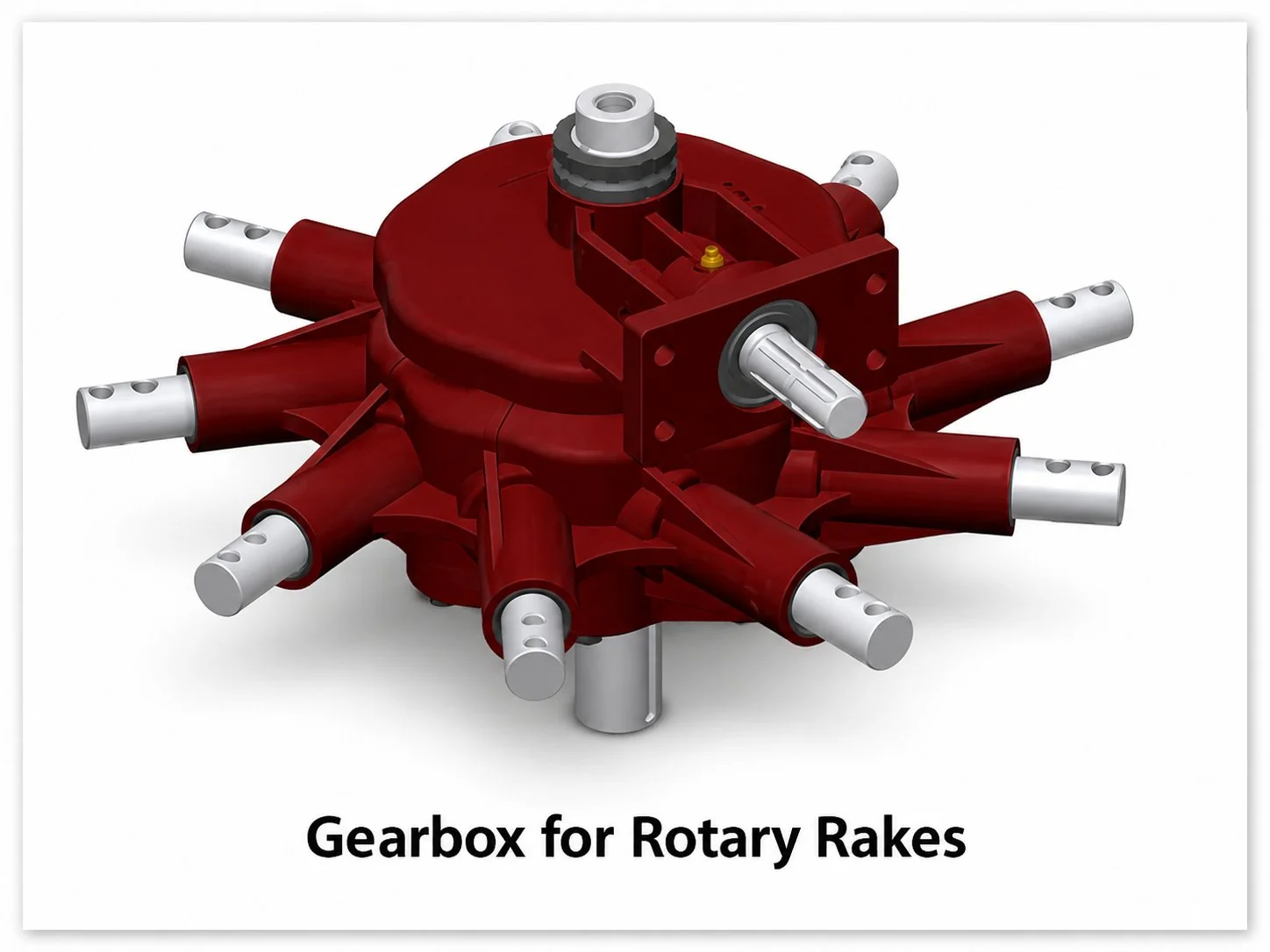
Rotary rake gearbox with bevel gear power distribution to multiple rotor output shafts — note the sealed bearing housings at each rotor station
Night-Mode Gearing: The 1/3 Speed Reduction Option
Some advanced hay tedder and rake gearboxes include a selectable “night mode” that reduces rotor speed to approximately one-third of normal operating speed. The purpose is specific: overnight, dew settles on hay left spread in the field, rewetting it and delaying the next day’s baling. Running the tedder at reduced speed during early morning or late evening gently gathers the hay into loose piles that present less surface area to dew, reducing moisture absorption by 20–40% compared to hay left fully spread.
The night-mode reduction is achieved by a second gear stage within the main gearbox — typically an additional spur gear pair with a sliding engagement collar that the operator selects via an external lever. When engaged, the auxiliary reduction stage inserts a 2.5:1 to 3:1 additional reduction between the PTO input and the rotor distribution gear train, dropping rotor speed from the normal 200+ RPM to approximately 70–90 RPM. At this speed, the tines gently consolidate the hay into rows rather than spreading it.
Night-Mode Speed Range
60–90 RPM
Approximately 1/3 of normal rotor operating speed · Gentle gathering action
Reduces overnight dew absorption by 20–40% compared to fully spread hay
The engineering consideration for the night-mode gear stage is that it must handle the full PTO input torque multiplied by the additional reduction ratio. If the main gearbox already reduces 540 RPM to 200 RPM (2.7:1 ratio), adding a 3:1 night-mode reduction creates a total ratio of approximately 8:1 — meaning the output torque is 8 times the input torque. The night-mode gear pair and its bearings must be rated for this higher torque level, even though the power transmitted is lower (because speed is proportionally reduced). Undersized night-mode gearing is a common failure point on budget tedders — the gears and bearings were dimensioned for the reduced power but not the multiplied torque, leading to rapid tooth surface fatigue and bearing overload.
Tedder and Rake Gearbox Selection Parameters
| Parameter | Compact Tedder (4 rotors) | Full-Size Tedder (6–8 rotors) | Twin-Rotor Rake |
|---|---|---|---|
| HP requirement | 15–25 HP | 25–50 HP | 30–60 HP |
| PTO speed | 540 RPM | 540 RPM | 540 or 1,000 RPM |
| Rotor output speed | 200–280 RPM | 180–350 RPM | 100–200 RPM |
| Reduction ratio | 1.9:1 to 2.7:1 | 1.5:1 to 3:1 | 2.7:1 to 5.4:1 |
| Night mode | Optional | Standard on premium models | Not applicable |
| Working width | 4.5–6.5 m | 6.5–13 m | 7–12 m (windrow width 1.2–2.5 m) |
When ordering a replacement gearbox, critical matching dimensions include the PTO input shaft size and spline count, the housing mounting bolt pattern, each rotor output shaft diameter, and the gear ratio (which determines rotor speed at the given PTO input). Supply your equipment brand, model, and original gearbox part number to our engineering team for cross-reference verification before ordering.
Maintenance Priorities for Tedder and Rake Gearboxes
Tedders and rakes operate in a high-dust environment that accelerates seal wear and oil contamination. The fine, abrasive hay dust generated during tedding and raking infiltrates seals far more aggressively than the coarser soil particles encountered by tillage gearboxes. A proactive maintenance program focused on oil quality and seal condition is the most effective strategy for maximizing service life.
Oil contamination from hay dust — Hay dust is extremely fine (sub-100 micron) and passes through worn seals easily. Contaminated oil accelerates bearing and gear surface wear exponentially. Check oil clarity weekly during operating season; replace immediately if the oil appears gritty or discolored.
Tine arm wrapping — Baling twine, fence wire, and long grass can wrap around the rotor shaft at the seal face, cutting through the seal lip and creating a direct contamination path. Inspect the base of each rotor shaft daily and remove any wrapped material before it damages the seal.
Breather vent blockage — Hay chaff accumulates rapidly on and around the gearbox housing, blocking the breather vent. A blocked vent creates internal pressure during thermal expansion that pushes oil past seals, and creates vacuum during cooling that draws in dust-laden air. Blow hay debris off the gearbox housing after each operating session.
Change gear oil every 150 operating hours or at the end of each season — whichever comes first. Use EP 80W-90 gear oil rated GL-4 or GL-5. For tedders with night-mode gearing, verify that the auxiliary gear stage is fully submerged in oil at the correct fill level — these gears may be positioned higher in the housing and can run dry if the oil level drops even slightly below specification. A responsible manufacturer like Ever-Power PTO Gearbox provides clear oil level indicators and filling instructions specific to each gearbox model, including night-mode-equipped variants.
For PTO shaft maintenance on tedder and rake applications, re-grease the universal joints and telescoping tubes every 8 to 10 operating hours. The constant vibration from tine arm ground contact accelerates U-joint needle bearing wear, and the frequent folding and unfolding of trailed tedders telescopes the PTO gearbox driveline repeatedly, wearing the spline fit if not adequately greased.
Tedder Gearbox vs. Rake Gearbox: Key Engineering Differences
Although tedders and rakes are often discussed as a single equipment category, their gearbox requirements differ in significant ways that affect selection, maintenance, and replacement sourcing. Understanding these differences helps operators and dealers specify the correct agricultural gearbox for each application rather than assuming interchangeability between the two.
A tedder gearbox drives rotors at moderate speed with relatively low individual torque — the tines flick through loose, freshly cut crop that offers minimal resistance per rotor. The engineering priority is even speed distribution across four to eight rotors to achieve uniform spread. A rotary rake gearbox, by contrast, drives one or two very large rotors (3 to 5 meters in diameter) at lower speed but substantially higher torque. The rake tines must grip heavy, partially dried windrows and pull them laterally across the ground into a consolidated row. Each tine arm encounters higher individual resistance, and the total torque per rotor can be 3 to 5 times higher than a tedder rotor of similar diameter. This torque difference drives larger gear module, heavier bearings, and thicker housing walls in rake gearboxes compared to tedder units of the same physical size.
The operating pattern also differs. Tedders typically run continuously for hours across a flat field at steady speed — a smooth duty cycle that is gentle on the agricultural gearbox. Rakes frequently operate in start-stop patterns, especially in irregularly shaped fields or when consolidating multiple windrows into one for a round baler gearbox pickup. Each start event loads the gearbox from zero to full operating torque in under one second, and the accumulated fatigue from thousands of start-stop cycles per season demands a higher gear tooth safety factor than the continuous steady-state loading of a tedder. Specify rake gearboxes with a minimum 2.5× safety factor on gear tooth bending stress to accommodate this cyclic loading pattern.
Replacement sourcing must account for these differences. A tedder gearbox cannot be substituted onto a rake without verifying that its torque rating, bearing capacity, and gear tooth strength meet the rake’s higher loading demands. Conversely, a rake gearbox can often physically fit a tedder but may have an unnecessarily high reduction ratio that over-reduces the rotor speed, resulting in poor tedding performance. Always cross-reference by equipment type, not just by physical dimensions, when sourcing aftermarket agricultural gearbox replacements for hay-making equipment.
Twin-rotor center-delivery rakes present an additional gearbox consideration: the two rotors must be synchronized precisely so that their windrow delivery points converge at the center of the machine. Any speed mismatch between the left and right rotor gearboxes — even 1–2% — causes the windrow to drift to one side, resulting in uneven baler pickup and crop loss. When replacing a single gearbox on a twin-rotor rake, verify that the replacement unit’s gear ratio matches the remaining original gearbox exactly, not just approximately. A 0.5% ratio mismatch compounds over thousands of rotor revolutions per hectare and produces visibly uneven windrows within the first pass.
Frequently Asked Questions
Talk to Our Gearbox Engineers
From compact four-rotor tedders to twin-rotor rakes with 12-meter working widths, our PTO gearbox engineering team delivers precision-matched replacement gearboxes — verified dimensionally against OEM originals and load-tested before shipment. Factory-direct pricing with worldwide delivery.
Editor: Cxm