Was ein Getriebe für Motorhacken tatsächlich bewirkt
A Fräsgetriebe Das Getriebe erfüllt drei mechanische Funktionen gleichzeitig. Erstens ändert es die Kraftachse: Die Zapfwelle des Traktors dreht sich um eine annähernd horizontale Längsachse, während die Rotorwelle der Bodenfräse um eine horizontale Querachse läuft – eine Richtungsänderung um 90 Grad. Zweitens verstärkt es das Drehmoment: Die meisten Bodenfräsen benötigen einen Rotor, der sich langsamer als die Zapfwelle dreht, aber mit deutlich mehr Kraft arbeitet. Daher reduziert das Getriebe die Drehzahl und erhöht das Drehmoment um ein bestimmtes Verhältnis. Drittens dämpft es Reaktionskräfte: Jedes Messer, das auf Erde, Steine oder Wurzeln trifft, sendet einen Stoßimpuls über die Rotorwelle, die Getriebelager und in das Gehäuse zurück. Das Getriebe muss Tausende dieser Mikrostöße pro Minute aushalten, ohne dass sich interne Bauteile lösen oder das Gehäuse reißt.
Diese drei Funktionen zusammen machen das Getriebe einer Bodenfräse zu einer der mechanisch anspruchsvollsten Zapfwellengetriebeanwendungen in der Landwirtschaft. Anders als ein Rotationsmähwerk, das sich zwischen den gelegentlichen Bodenkontakten frei in der Luft dreht, oder eine Ballenpresse, die die Last allmählich aufbaut, arbeitet eine Bodenfräse kontinuierlich und mit hoher Messerdichte mit dem Boden zusammen – typischerweise 4 bis 6 Messer pro Flansch, mit 20 bis 40 Flanschen über die Rotorbreite, wodurch Hunderte von Bodenkontakten pro Umdrehung entstehen.
Das Verständnis der technischen Funktionsweise dieses Getriebes hilft Käufern, Händlern und Servicetechnikern, das richtige Gerät auszuwählen, es ordnungsgemäß zu warten und Probleme zu diagnostizieren, bevor sie zu katastrophalen Ausfällen führen.
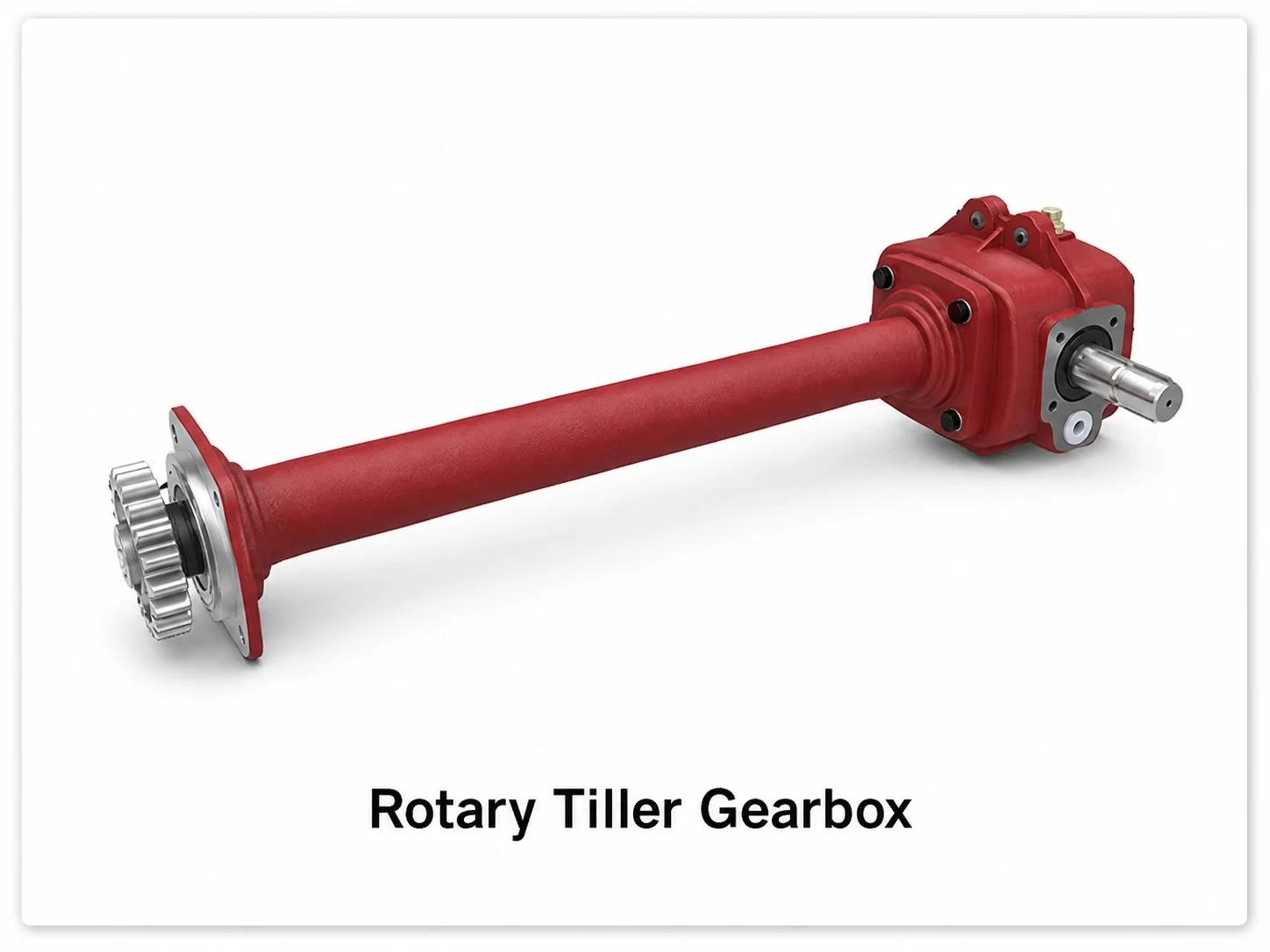
Seitenantrieb vs. Mittelantrieb
Die wichtigste Konstruktionsentscheidung bei Bodenfräsen betrifft die Positionierung des Hauptgetriebes relativ zum Rotor. Diese Wahl beeinflusst die Gleichmäßigkeit der Bodenbearbeitung, die strukturelle Belastung, die Gewichtsverteilung und die Wartungsfreundlichkeit. Die beiden gängigen Konfigurationen bieten jeweils spezifische Vorteile und bringen technische Kompromisse mit sich.
Seitenantriebskonfiguration
Bei einer Seitenantriebs-Motorhacke befindet sich das Hauptzapfwellengetriebe an einem Ende des Rotors – typischerweise rechts, wenn man vom Traktor aus auf ihn blickt. Der Zapfwellenantrieb tritt von hinten in das Getriebe ein, das Kegelradgetriebe lenkt die Kraft um 90 Grad um, und die Abtriebswelle erstreckt sich über die gesamte Breite der Motorhacke und treibt alle Messerflansche direkt an. Dies ist die gängigste Bauweise bei Kompaktmotorhacken (122 bis 183 cm Arbeitsbreite) und leichten bis mittelschweren Modellen, die für die Gartenvorbereitung, den Gemüseanbau im kleinen Maßstab und die Landschaftspflege eingesetzt werden.
Die seitliche Antriebsanordnung ist mechanisch einfacher: ein Getriebe, ein Zahnradsatz, ein zu haltendes Ölvolumen. Sie führt jedoch zu einer asymmetrischen Lastverteilung – das dem Getriebe zugewandte Ende überträgt ein höheres Drehmoment als das abgewandte, da das Drehmoment entlang des Rotors progressiv verbraucht wird, während jeder Messerflansch Energie von der Welle abnimmt. In schwerem Lehmboden erhalten die abgewandten Messer möglicherweise nicht genügend Drehmoment, um vollständig einzudringen, was zu einer ungleichmäßigen Bearbeitungstiefe über die Arbeitsbreite führt.
Die Rotorwelle des Seitenantriebs muss ausreichend stabil sein, um das volle Drehmoment am Getriebeende zu übertragen und gleichzeitig die Biegebelastungen durch ihr Eigengewicht und die Bodenreaktionskräfte über ihren freien Bereich aufzunehmen. Breitere Bodenfräsen (ab ca. 183 cm) mit Seitenantrieb bergen das Risiko einer übermäßigen Wellendurchbiegung – die Welle biegt sich unter Last durch, wodurch sich der Abstand der Messerspitze zur Fräshaube verändert und Schwingungsfrequenzen entstehen, die den Lagerverschleiß beschleunigen.
Mittelantriebskonfiguration
Bei einer Motorhacke mit Mittelantrieb ist das Hauptgetriebe mittig im Rahmen der Hacke, direkt über der Rotormitte, montiert. Der Zapfwellenantrieb tritt von hinten über ein rechtwinkliges Eingangsgetriebe (manchmal auch „Oberteil“ genannt) ein, welches eine horizontale Querwelle antreibt, die das zentrale Hauptgetriebe speist. Das Hauptgetriebe verteilt die Kraft dann über seine Abtriebswelle, die sich in beide Richtungen gleichmäßig erstreckt, auf beide Rotorhälften.
Diese Konfiguration halbiert die freie Wellenlänge auf jeder Seite, wodurch die Wellendurchbiegung deutlich reduziert und eine gleichmäßigere Drehmomentverteilung über die gesamte Arbeitsbreite gewährleistet wird. Mittelgetriebene Bodenfräsen sind Standard bei mittelschweren und schweren Modellen (Arbeitsbreite 183 bis über 305 cm), die in der Landwirtschaft, im Obstbau und bei der Primärbodenbearbeitung im Reihenanbau eingesetzt werden. Die symmetrische Lastverteilung reduziert zudem die Lagerbelastung des Getriebes – jedes Abtriebslager trägt die Hälfte des Rotorgewichts und die Hälfte der gesamten Bodenreaktionskraft im Vergleich zu einer seitlich angetriebenen Konstruktion.
Der Kompromiss liegt in Komplexität und Kosten. Eine Motorhacke mit Mittelantrieb benötigt entweder zwei Getriebe (Eingangs-Winkelgetriebe plus zentrales Verteilergetriebe) oder ein komplexeres Gehäuse mit beiden integrierten Funktionen. Die Ölabdichtung gestaltet sich schwieriger, da das Getriebe durch die zentrale Position von beiden Seiten Erdspritzern ausgesetzt ist. Auch der Wartungszugang ist erschwert – das Getriebe ist mittig in der Maschine verbaut und von der Fräshaube, dem Rotor und dem Rahmen umgeben.
◀️
Seitlicher Antrieb – am besten geeignet für
Kompakt- und Kleintraktoren (15–45 PS), Arbeitsbreiten unter 183 cm, Garten- und Landschaftspflege, leichte bis mittelschwere Böden. Vorteile: geringere Kosten, einfachere Wartung, geringeres Gewicht.
⬇️
Mittelantrieb – Am besten geeignet für
Nutz- und Reihenkulturtraktoren (45–150+ PS), Arbeitsbreiten ab 183 cm, kommerzielle Landwirtschaft, schwere Lehmböden und Primärbodenbearbeitung. Vorteile: gleichmäßige Arbeitstiefe, geringere Wellenbelastung, geeignet für höhere Motorleistungen.
Mechanismus des Klingeneingriffs: Kräfte, die das Getriebe bewältigen muss
Jedes Fräsmesser beschreibt eine Zykloidenbahn – eine Kurve, die die Rotorrotation mit der Vorwärtsbewegung des Traktors kombiniert. Zu jedem Zeitpunkt schneidet nur ein Bruchteil der Rotormesser aktiv den Boden; die übrigen schwingen im Inneren der Fräshaube. Dadurch entsteht ein pulsierendes Drehmoment, dessen Frequenz der Messerüberfahrt entspricht: die Anzahl der Messer pro Flansch multipliziert mit der Rotordrehzahl.
Eine typische Motorhacke mit vier Messern pro Flansch erzeugt bei einer Drehzahl von 200 U/min eine Drehmomentpulsation von 800 Schwingungen pro Minute (13,3 Hz). Diese Frequenz liegt im Bereich, der in schlecht konstruierten Gehäusen und Befestigungskonstruktionen Resonanzen hervorruft. Dies erklärt, warum bei manchen Motorhacken-Getrieben Risse an den Befestigungsschraubenlöchern auftreten, selbst wenn die durchschnittliche Drehmomentbelastung deutlich unter den Auslegungsgrenzen liegt. Das Getriebegehäuse muss daher über eine ausreichende Wandstärke und Rippenverstärkung verfügen, um der Ermüdung bei dieser Pulsationsfrequenz – und nicht nur bei statischer Belastung – standzuhalten.
Die Eingriffskräfte des Messers zerfallen in drei Komponenten, die von den Getriebelagern gleichzeitig aufgenommen werden müssen. Die Tangentialkraft – die Schnittkraft in Drehrichtung des Messers – erzeugt das Drehmoment, das die Zahnräder übertragen müssen. Die Radialkraft – der Gegendruck des Bodens auf das Messer in Richtung der Rotorachse – erzeugt eine Biegebelastung der Rotorwelle und einen Axialschub auf die Getriebelager. Die Zugkraft – der Bodenwiderstand, der der Vorwärtsbewegung des Traktors entgegenwirkt – trägt zur Gesamtzugkraft bei und erzeugt zudem ein zyklisches Drehmoment an der Getriebeaufhängung, das versucht, die gesamte Bodenfräse um die Dreipunktaufhängung nach vorne zu drehen.
⚙️ Wie die Drehzahl des Sägeblatts die Getriebebelastung beeinflusst
Die Schnitttiefe – der Bogen an Erde, den jedes Messer pro Arbeitsgang abträgt – hängt vom Verhältnis zwischen Fahrgeschwindigkeit und Rotordrehzahl ab. Eine höhere Fahrgeschwindigkeit bei gleicher Rotordrehzahl erhöht die Schnitttiefe, wodurch der Drehmomentbedarf pro Messer steigt, da jedes Messer eine dickere Bodenschicht durchtrennen muss. Deshalb wird das Getriebe überlastet, wenn der Traktor zu schnell für die Zapfwellendrehzahl läuft, selbst wenn der Motor nicht seine volle Leistung erbringt.
Faustregel: Für eine feine Saatbettbereitung ist eine Eindringtiefe von 25–50 mm optimal. Für eine grobe Einarbeitung von Ernterückständen sind 50–100 mm ausreichend. Reduzieren Sie die Fahrgeschwindigkeit oder erhöhen Sie die Rotordrehzahl (über die Motordrosselklappe), wenn die Fräse Klumpen hinterlässt – das Getriebe muss dann mehr Drehmoment pro Messer übertragen als optimal.
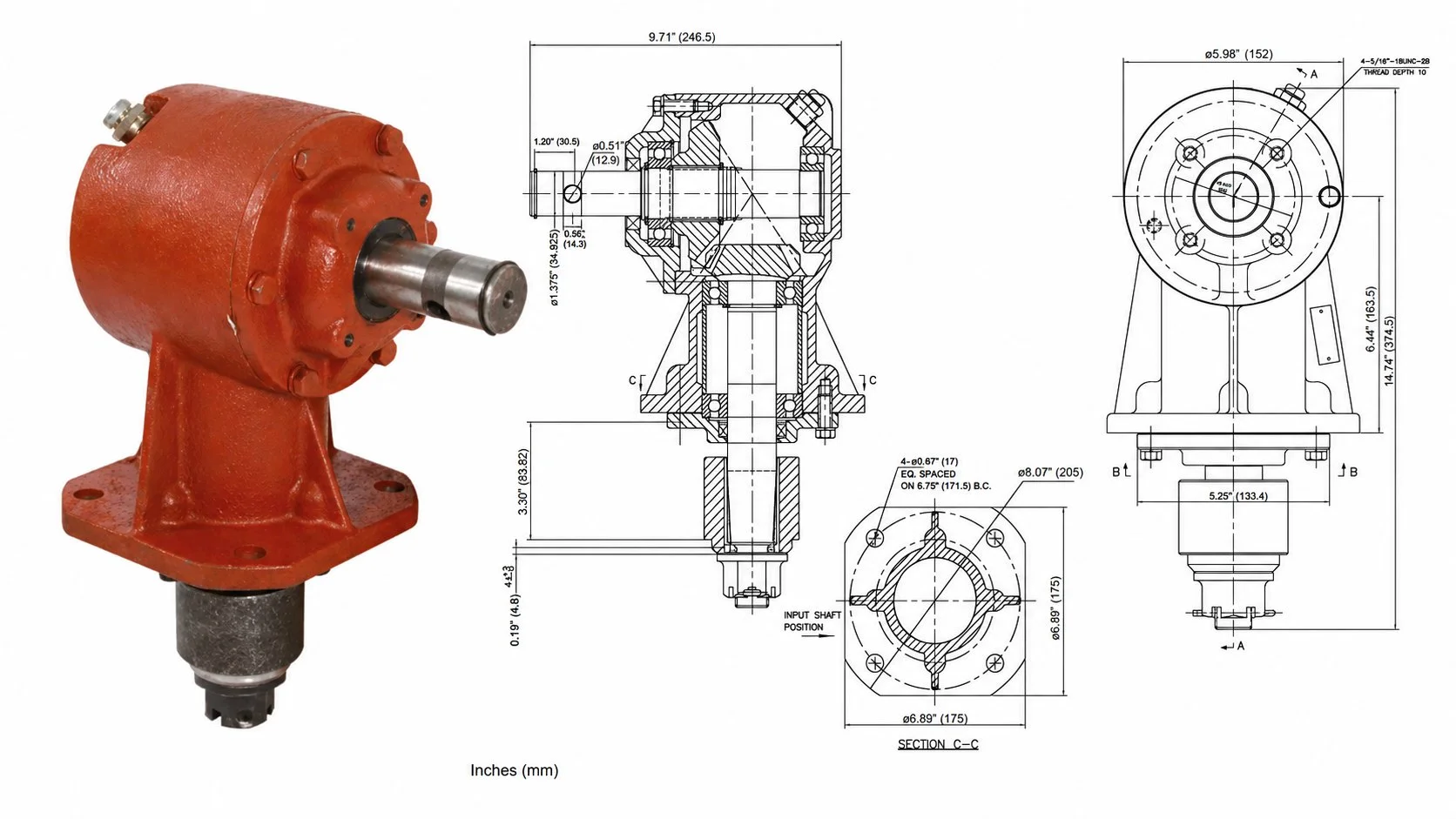
Maßreferenz für rechtwinklige Getriebe – Geometrie von Eingangswelle, Ausgangswelle und Befestigungsschraubenmuster für Fräsantriebe
Bodenart und ihre Auswirkungen auf die Getriebebelastung
Die Bodenklassifizierung ist der entscheidende Faktor für das vom Getriebe zu erbringende Drehmoment und die zu absorbierende Stoßbelastung. Unterschiedliche Bodentypen bieten den rotierenden Schaufeln einen grundlegend anderen mechanischen Widerstand, weshalb die Getriebeauslegung die ungünstigsten – und nicht die durchschnittlichen – Feldbedingungen berücksichtigen muss.
| Bodentyp | Schnittwiderstand | Auswirkungen Risiko | PS pro Fuß Breite | Getriebeproblem |
|---|---|---|---|---|
| sandiger Lehm | Niedrig | Minimal | 3–5 PS/ft | Schleifstaub dringt in Dichtungen ein |
| Schluff | Mäßig | Niedrig | 5–8 PS/ft | Anhaltendes mäßiges Drehmoment |
| Schwerer Lehm | Hoch | Mittel (Stücke) | 8–14 PS/ft | Anhaltend hohes Drehmoment, thermische Belastung |
| Steinig / Kies | Variable | Hoch | 10–16+ PS/ft | Stoßbelastung auf Zähne und Lager |
| Verdichteter Unterboden | Sehr hoch | Mäßig | 12–18 PS/ft | Dauerhaftes Spitzendrehmoment, Lagerermüdung |
Die Angabe „PS pro Meter Arbeitsbreite“ ist der wichtigste Parameter für die Dimensionierung von Getrieben für Bodenfräsen. Eine 1,5 Meter (60 Zoll) breite Bodenfräse, die in schwerem Lehmboden arbeitet, benötigt 40–70 Zapfwellen-PS – das Getriebe muss für mindestens 1251 PS dieses Bereichs ausgelegt sein, um eine ausreichende Sicherheitsreserve zu gewährleisten. Die Unterdimensionierung des Getriebes für die Bodenverhältnisse ist die Hauptursache für vorzeitigen Getriebeausfall bei Bodenfräsen, da die Bediener häufig auf Feldern mit gemischten Bodenverhältnissen arbeiten, wo Stellen mit schwerem Lehmboden oder eingebetteten Steinen lokale Lastspitzen verursachen, die die Getriebeleistung überschreiten, obwohl die durchschnittliche Last akzeptabel ist.
Der Feuchtigkeitsgehalt spielt eine weitere Rolle. Nasser Lehmboden ist deutlich schwerer zu bearbeiten als trockener – die Kohäsionsfestigkeit von gesättigtem Lehm kann den Schnittwiderstand im Vergleich zu demselben Boden bei optimaler Feuchtigkeit verdoppeln oder verdreifachen. Das Bearbeiten von nassem Lehmboden ist die mit Abstand schwierigste Aufgabe für jeden Bodenbelag. Landwirtschaftliches Getriebe — Es vereint einen anhaltend hohen Drehmomentbedarf mit der Tendenz, dass sich feuchter Boden um die Dichtungen herum festsetzt und so abrasiver Schlamm in das Getriebegehäuse eindringt.
Getriebe-Pinne-Kopplungsmethoden
Die Verbindung zwischen der Getriebeausgangswelle und dem Fräsrotor muss das volle Drehmoment übertragen und gleichzeitig Fluchtungsfehler, Vibrationen und Stoßbelastungen absorbieren. Drei Kupplungsmethoden dominieren den Markt, jede mit ihren spezifischen technischen Eigenschaften:
Direktflanschkupplung
Die Getriebeausgangswelle und die Rotorwelle sind mittels Flanschverbindungen verschraubt. Dies ist die steifste, kompakteste und effizienteste Kupplungsmethode – spielfrei, verlustfrei und mit exzellenter Drehmomentkapazität. Der Nachteil besteht darin, dass bei der Montage eine exakte Ausrichtung erforderlich ist. Jede Fehlausrichtung erzeugt zyklische Biegebelastungen auf beide Wellen, die den Lagerverschleiß beschleunigen. Diese Bauweise kommt bei Zentralantrieben zum Einsatz, bei denen das Getriebe fest in den Fräsrahmen integriert ist.
Kettenantrieb
Eine Rollenkette verbindet ein Kettenrad am Getriebeausgang mit einem Kettenrad an der Rotorwelle. Kettenantriebe gleichen geringfügige Fluchtungsfehler aus und bieten eine zusätzliche Untersetzungsstufe (bei unterschiedlich großen Kettenrädern). Allerdings erfordern Ketten Schmierung, regelmäßige Spannungsanpassung und müssen bei Verschleiß ausgetauscht werden – was den Wartungsaufwand erhöht. Kettenschlagen bei Lastwechsel verursacht zusätzliche Geräusche und Stoßbelastungen. Dies tritt häufig bei seitlich angetriebenen Kompaktfräsen auf, bei denen Getriebe- und Rotorachse versetzt angeordnet sind.
Innenverzahnung
Einige Hochleistungs-Motorhacken integrieren Drehzahlreduzierung und Kraftverteilung in ein geschlossenes Getriebegehäuse – im Prinzip ein Mehrwegegetriebe mit integriertem Rotorantrieb. Dadurch entfällt die externe Kupplung vollständig, und die gesamte Kraftübertragung findet innerhalb eines abgedichteten, geschmierten Gehäuses statt. Diese Bauweise ist zwar die langlebigste und wartungsärmste, aber auch die teuerste und im Falle eines Ausfalls interner Komponenten am aufwendigsten zu reparieren. Sie findet sich bei Premium-Motorhacken europäischer Hersteller und industriellen Steinverlegemaschinen.
Auswahl von Zahnradmaterial, Übersetzungsverhältnis und Zahnprofil
Getriebe für Motorhacken verwenden typischerweise spiralverzahnte Kegelradsätze für die 90-Grad-Kraftumlenkung. Die spiralförmige Verzahnung verteilt die Last gleichzeitig auf mehrere Zähne und reduziert so die maximale Kontaktspannung im Vergleich zu geradverzahnten Kegelrädern. Dies ist für Motorhacken entscheidend, da die pulsierende Drehmomentbelastung zu einem Wechsel des Zahnkontaktdrucks mit der Schnittfrequenz führt – ein geradverzahnter Kegelradsatz würde unter dieser zyklischen Belastung deutlich schneller ermüden.
Das Zahnradmaterial muss ein ausgewogenes Verhältnis zwischen Oberflächenhärte (für Verschleißfestigkeit an der Kontaktfläche) und Kernzähigkeit (für Schlagfestigkeit beim Auftreffen der Zahnräder auf Steine) aufweisen. Optimal ist hierfür einsatzgehärteter legierter Stahl – beispielsweise 20CrMnTi oder 8620, der an der Oberfläche auf HRC 58–62 gehärtet ist und gleichzeitig einen zähen, duktilen Kern mit HRC 30–35 aufweist. Durchgehärtete Zahnräder (gleichmäßig gehärtet) sind zwar günstiger, aber spröde – sie weisen zwar eine gute Verschleißfestigkeit auf, brechen jedoch unter Stoßbelastung, wodurch sie für steinige Böden ungeeignet sind.
Die Übersetzungsverhältnisse von Fräsengetrieben liegen im Vergleich zu anderen Zapfwellenanwendungen in einem engen Bereich. Die meisten Fräsen betreiben den Rotor mit 150 bis 300 U/min, angetrieben von einer Zapfwellendrehzahl von 540 U/min – was Übersetzungen zwischen 1,8:1 und 3,6:1 erfordert. Das jeweilige Übersetzungsverhältnis bestimmt das Verhältnis zwischen Bodenbearbeitungsqualität (höhere Rotordrehzahl = feineres Krümelkorn) und Drehmomentkapazität (niedrigere Rotordrehzahl = mehr Kraft für schwere Böden). Einige Fräsen bieten ein Zweiganggetriebe mit wählbaren Übersetzungen: eine niedrigere Übersetzung für die Primärbodenbearbeitung in schweren Böden und eine höhere Übersetzung für die Saatbettbereitung in leichten Böden.
| Anwendung | Übersetzungsverhältnis | Rotordrehzahl (ab 540) | Bodenqualität |
|---|---|---|---|
| Primäre Bodenbearbeitung (schwerer Lehmboden) | 3,0:1 bis 3,6:1 | 150–180 | Grob – Klumpenzerkleinerung, Einarbeitung von Rückständen |
| Universal (gemischte Böden) | 2,2:1 bis 3,0:1 | 180–245 | Mittelgroß – für die meisten Pflanzungen geeignet |
| Saatbettbereitung (leichter Boden) | 1.8:1 bis 2.2:1 | 245–300 | Fein – in einem Arbeitsgang bereit fürs Saatbeet. |
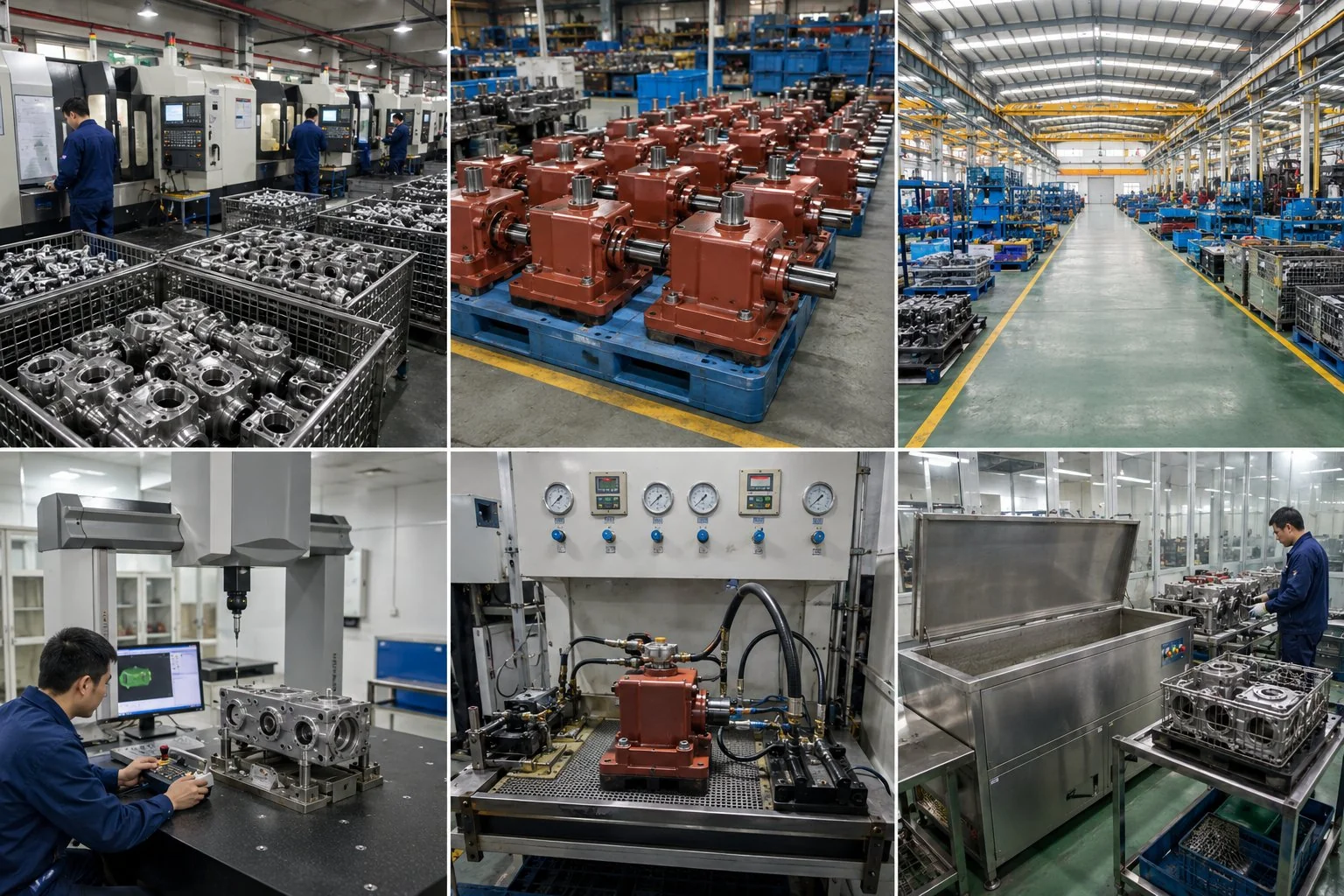
Schmierung in einer Umgebung mit hohen Vibrationen
Bodenfräsen erzeugen stärkere und anhaltende Vibrationen als nahezu alle anderen Zapfwellenanbaugeräte. Die kontinuierliche Interaktion zwischen Fräsmesser und Boden erzeugt breitbandige Vibrationen über ein breites Frequenzspektrum, die alle Bauteile durchdringen – und das Getriebeschmiersystem muss trotz dieser ständigen mechanischen Belastung zuverlässig funktionieren.
Das Hauptproblem ist die Schaumbildung im Öl. Vibrationen verwirbeln das Getriebeöl und führen zur Bildung von Luftblasen, die die Schmierfähigkeit zwischen Zahnrädern und Lagerrollen beeinträchtigen. Aufgeschäumtes Öl kann keine Lasten tragen – es kommt zu Metall-auf-Metall-Kontakt, obwohl der Ölstand im Schauglas ausreichend erscheint. EP-Getriebeöl (Hochdrucköl) mit Antischaumzusätzen ist für Motorhackengetriebe nicht optional, sondern unerlässlich. Standard-Getriebeöl ohne EP-Zusatz schäumt unter den Vibrationsbedingungen einer Motorhacke und verursacht bereits in der ersten Saison beschleunigten Verschleiß.
Die Ölstandskontrolle ist bei Vibrationen deutlich wichtiger als bei Anwendungen mit geringeren Vibrationen. Vibrationen führen dazu, dass das Öl im Gehäuse höher spritzt, als es die Schwerkraft allein bewirken würde. Dadurch können die unten liegenden Lager und der Zahneingriff unterversorgt werden, während die oberen Gehäusewände und die Entlüftungsöffnung mit überschüssigem Öl benetzt werden. Ein korrekter Ölstand – weder zu hoch noch zu niedrig – gewährleistet, dass das Spritzmuster alle internen Komponenten unter Vibrationsbedingungen optimal schmiert.
🛢️ Schmierempfehlungen für Pinne-Getriebe
Ölsorte: EP 80W-90 mit Antischaumzusätzen (mindestens API GL-5-konform).
Änderungsintervall: Alle 75–100 Betriebsstunden, oder früher, wenn das Öl dunkel aussieht, verbrannt riecht oder Metallpartikel am magnetischen Ablassstopfen sichtbar sind.
Füllstand: Bis zur Mitte des Schauglases oder bis zum Boden der Einfüllöffnung (gemäß Herstellerangaben). Überprüfen Sie den Füllstand mit der Motorhacke auf ebenem Untergrund und bei Umgebungstemperatur.
Einbruch: Die ersten zwei Stunden mit reduzierter Tiefe und Drehzahl laufen lassen, dann ablassen und neu befüllen. Das Einlauföl bindet Bearbeitungspartikel, die sonst zirkulieren und die Zahnradoberflächen beschädigen würden.
Dichtungsintegrität und Schutz vor Fremdkörpern
Die Getriebe von Motorhacken arbeiten nur wenige Zentimeter über der Bodenoberfläche in einer Umgebung, die mit Staub, Bodenpartikeln und Feuchtigkeit angereichert ist. Die Abtriebswellenabdichtung ist der empfindlichste Punkt – sie dreht sich mit Rotordrehzahl, während ständig Bodenpartikel die Dichtfläche berühren. Eine defekte Abtriebswellenabdichtung lässt erdverunreinigte Feuchtigkeit in das Gehäuse eindringen und verwandelt sauberes Getriebeöl in eine abrasive Paste, die Zahnräder und Lager innerhalb weniger Stunden im Dauerbetrieb zerstört.
Hochwertige Getriebe für Motorhacken verwenden ein mehrstufiges Dichtungssystem: einen äußeren Labyrinth- oder Schleuderring, der Schmutzpartikel durch Zentrifugalkraft abführt, gefolgt von einer Doppellippen-Wellendichtung (idealerweise aus FKM-Material für Chemikalien- und Hitzebeständigkeit), die auf einem polierten Wellenzapfen mit einer Oberflächenrauheit unter Ra 0,4 µm läuft. Die Entlüftungsöffnung muss oberhalb des höchsten Ölspritzniveaus positioniert und mit einem Filterelement ausgestattet sein, um zu verhindern, dass staubhaltige Luft während des Druckausgleichszyklus eindringt, der durch die Temperaturschwankungen im Gehäuse während des Betriebs entsteht.
Die tägliche Kontrolle des Dichtungsbereichs nach dem Pflügen ist die wirksamste vorbeugende Maßnahme. Ein dünner Ölfilm, der sich um die Abtriebswelle ausbreitet – sichtbar als nasser Ring direkt außerhalb der Dichtung – ist das erste Anzeichen für eine verschlissene Dichtung. Wird dies frühzeitig erkannt und die Dichtung ausgetauscht (eine relativ kostengünstige Reparatur), lassen sich die schwerwiegenden Lager- und Getriebeschäden verhindern, die entstehen, wenn verunreinigtes Öl wochenlang durch das Getriebe zirkuliert.
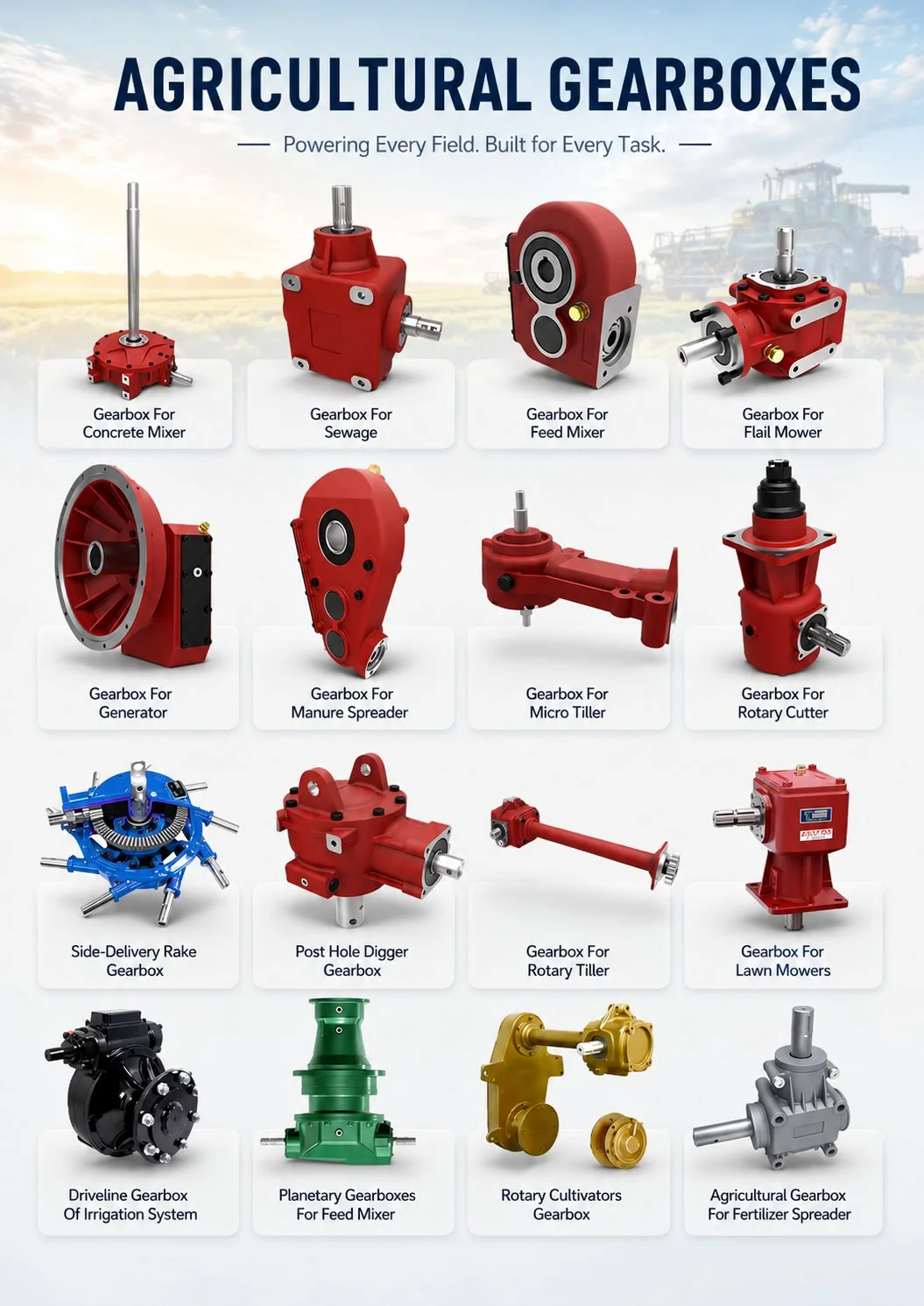
Häufige Probleme mit dem Steuergetriebe beheben
Getriebe von Motorhacken weisen Ausfallmuster auf, die sich von anderen Zapfwellenanwendungen unterscheiden. Die Kombination aus kontinuierlichem Eingriff, hohen Vibrationen und Bodenkontakt schafft ein einzigartiges Diagnosefeld:
Getriebeüberhitzung in schwerem Lehm Der anhaltend hohe Drehmomentbedarf in Lehmböden erzeugt mehr Wärme als in leichteren Böden. Ölstand und Ölsorte prüfen (muss EP-zertifiziert sein). Fahrgeschwindigkeit reduzieren, um die Eindringtiefe und den Drehmomentbedarf zu verringern. Besteht das Problem weiterhin, ist das Getriebe möglicherweise für die Bodenverhältnisse unterdimensioniert – ein Gerät mit höherer PS-Leistung in Betracht ziehen.
Die Vibrationen nehmen im Laufe der Saison zu Eine zunehmende Vibration deutet auf verschlissene Lager, lockere Befestigungsschrauben oder beginnende Zahnradschäden hin. Prüfen Sie zunächst die Lagervorspannung. Stellen Sie anschließend sicher, dass alle Befestigungsschrauben mit dem vorgeschriebenen Drehmoment angezogen sind. Sind beide Punkte korrekt, lassen Sie das Öl ab und prüfen Sie es auf Metallpartikel. Das Vorhandensein von Zahnradmaterialfragmenten bestätigt einen inneren Schaden, der eine Demontage erforderlich macht.
Ölleck an der Abtriebswelle nur beim Fräsen Wenn der Dichtungsbereich im Stillstand trocken ist, aber während des Betriebs leckt, könnte die Entlüftung verstopft sein. Beim Pflügen baut sich durch die Erwärmung des Öls ein Innendruck auf, der Öl an der Dichtung vorbeidrückt. Reinigen oder ersetzen Sie zuerst die Entlüftung – sie ist die häufigste Ursache für Dichtungslecks, die nur im Betrieb auftreten.
Klickende oder klopfende Geräusche aus dem Getriebeeingangsbereich — Wird typischerweise durch Abnutzung verursacht Zapfwelle Kreuzgelenke übertragen das Spiel im Antriebsstrang auf die Getriebeeingangswelle. Die starken Vibrationen im Betrieb der Motorhacke beschleunigen den Verschleiß der Kreuzgelenke im Vergleich zu vibrationsärmeren Anbaugeräten. Überprüfen Sie den Antriebsstrang und tauschen Sie alle Kreuzgelenke mit spürbarem Spiel aus.
Ungleichmäßige Frästiefe über die Arbeitsbreite Bei Seitenantriebs-Fräsen kann dies darauf hindeuten, dass sich die Rotorwelle unter Last durchbiegt – das Getriebeende gräbt sich aufgrund des höheren Drehmoments tiefer ein, während das gegenüberliegende Ende flacher läuft. Dies ist eine konstruktionsbedingte Einschränkung der Seitenantriebsbauweise in schweren Böden. Die Lösung besteht in einer Mittelantriebs-Fräse oder einer speziell für die jeweiligen Bodenverhältnisse ausgelegten Fräse, nicht allein in einem Getriebewechsel.
Beschaffung eines Ersatzgetriebes für Motorhacken
Wenn das Getriebe einer Motorhacke ausfällt, muss das Ersatzteil hinsichtlich Übersetzungsverhältnis, Befestigungsschraubenmuster, Abtriebswellenabmessungen und Drehrichtung mit dem Original übereinstimmen. Da Motorhacken weltweit von Dutzenden von Herstellern produziert werden – von italienischen Premiumherstellern bis hin zu chinesischen Anbietern von Kompakttraktoren – ist die Auswahl an passenden Ersatzteilen sehr groß. Ein qualifizierter Ersatzteilhersteller kann die meisten OEM-Konfigurationen anhand der Teilenummer oder der Abmessungen nachbilden.
Die wichtigsten Qualitätsmerkmale für Getriebe von Motorhacken sind die gleichen grundlegenden Merkmale, die für alle Getriebe gelten. Zapfwellengetriebe Anwendungsbereiche: Dokumentierte Werkstoff- und Wärmebehandlungsspezifikationen für Zahnräder, Markenlager mit geprüften Tragzahlen, FKM- oder Doppellippendichtungstechnologie und werkseitige Belastungsprüfung nach 100% vor dem Versand. Falls Sie eine spezifische Querverweis-Angabe benötigen, Kontaktieren Sie unser Ingenieurteam Mit der OEM-Teilenummer, der Marke und dem Modell der Motorhacke oder detaillierten Maßangaben prüfen wir die Kompatibilität, bevor wir ein Gerät versenden.
Häufig gestellte Fragen
Benötigen Sie ein Fräsengetriebe, das speziell für Ihren Boden entwickelt wurde?
Ever-Power Hersteller Landwirtschaftliches Getriebe Einheiten für Rotationsfräsen – mit einsatzgehärteten Spiralkegelrädern, Antivibrationslager-Vorspannung und FKM-Dichtungssystemen, die für die bodenintensiven Anforderungen der Rotationsbearbeitung entwickelt wurden.
Herausgeber: Cxm