What Is an Irrigation Reel Gearbox?
An irrigation reel gearbox is the high-ratio speed reduction unit that converts fast turbine or PTO rotation into the ultra-slow drum revolution needed to wind a polyethylene hose (200 to 800 metres long, 50 to 125 mm diameter) onto a large reel drum while a rain gun or boom sprinkler at the far end of the hose irrigates the field as it is pulled back toward the machine. The hose reel gearbox must reduce the input speed — typically 500 to 1,500 RPM from a water-driven turbine, or 540 RPM from a PTO — to an output drum speed of just 0.5 to 5 RPM, producing hose retrieval speeds of 5 to 120 metres per hour that directly determine the water application rate and uniformity.
Ten/Ta/To irrigation reel gearbox is the precision control centre of the travelling irrigator. The drum speed sets the travel speed of the rain gun across the field — faster retrieval means less water per unit area (lighter application), slower retrieval means more water per unit area (heavier application). A 5 percent variation in drum speed produces a 5 percent variation in application rate — creating visible wet and dry bands across the field that reduce crop yield in under-watered zones and waste water and energy in over-watered zones. This speed-precision requirement, combined with continuous outdoor exposure to water, mud, and weather, defines the unique engineering demands of the irrigation reel gearbox.
Two Drive Sources: Water Turbine vs. PTO
The majority of modern travelling irrigators use a water turbine to drive the reel — a small Pelton or Francis-type turbine powered by the same pressurised water supply that feeds the rain gun. The turbine converts water pressure energy into mechanical rotation at 500 to 1,500 RPM, and the irrigation reel gearbox reduces this to the 0.5 to 5 RPM drum speed through a multi-stage gear train (typically worm gear plus helical spur stages, achieving total ratios of 50:1 to 200:1). The advantage is self-contained operation: the reel rewinds automatically as long as water pressure is supplied, requiring no tractor connection during the irrigation run.
PTO-driven reel systems use the tractor Vývodový hřídel at 540 RPM through a right-angle gearbox plus chain-and-sprocket reduction to drive the reel drum. PTO-driven systems are simpler mechanically (no turbine) and provide higher torque capacity for winding heavy, water-filled hoses — but require the tractor to remain connected throughout the irrigation run, tying up a valuable machine for 4 to 12 hours per set. PTO drive is primarily used on smaller reels (200 to 400 m hose) or as a backup drive on turbine-equipped machines for retrieval when water pressure is unavailable.
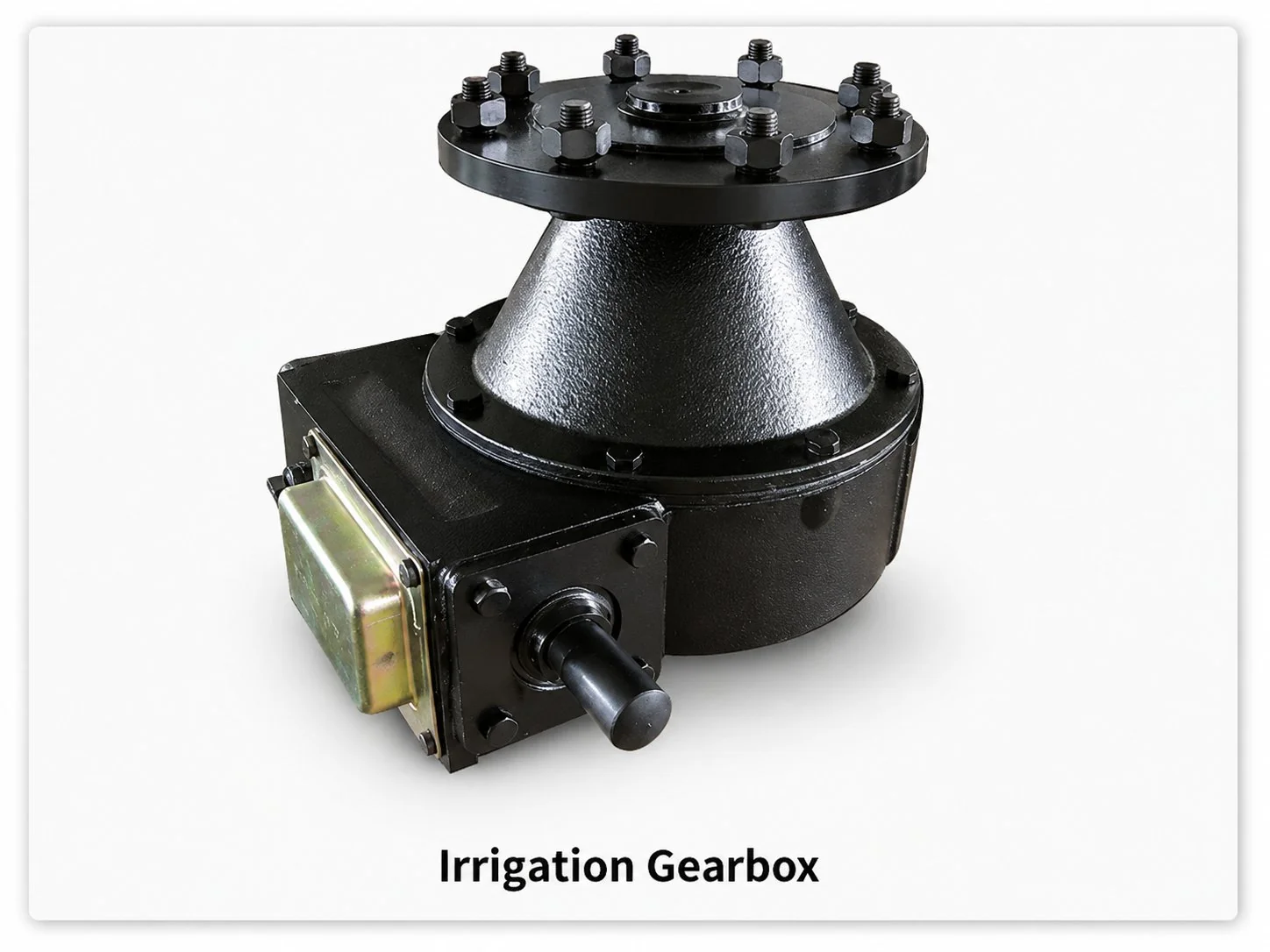
Irrigation reel gearbox — high-ratio reduction drive for controlled hose retrieval
Speed Precision: Why Every RPM Matters
The water application rate of a travelling irrigator is inversely proportional to the hose retrieval speed — halving the retrieval speed doubles the water applied per unit area. This direct relationship means that the irrigation reel gearbox must deliver consistent, repeatable output speed at every point in the retrieval cycle. However, the torque demand on the gearbox is not constant — it increases progressively as the hose winds onto the drum, because each successive layer adds weight and increases the effective drum diameter (and therefore the winding torque). A full 800 m reel with 110 mm hose may require 3 to 5 times the winding torque at the last layer compared to the first.
A traveller irrigation gearbox that produces inconsistent retrieval speed delivers uneven water distribution across the irrigated strip. For high-value crops (potatoes, vegetables, sugar beet), a 10 percent application non-uniformity can reduce yield by 3 to 8 percent in under-watered zones while wasting water and promoting disease in over-watered zones. On a 50-hectare irrigated block applying 25 mm per pass, a 10 percent non-uniformity wastes approximately 125,000 litres of water per pass — energy, pumping, and water costs that add up significantly across a full irrigation season of 10 to 20 passes.
Modern irrigation reel gearbox systems address the variable-torque challenge through two approaches. Turbine-driven systems use a governor valve that adjusts the water flow to the turbine, maintaining consistent turbine speed as the torque demand increases — the převodovka then delivers a proportionally consistent output speed. Electronic speed-control systems use a sensor on the hose guide to measure actual retrieval speed and adjust the turbine inlet valve automatically through a closed-loop control — compensating for both the increasing torque from hose accumulation and for water pressure fluctuations from the supply system. The gearbox ratio accuracy and mechanical consistency are the foundation on which these control systems operate — an erratic gearbox defeats even the most sophisticated electronic control.

Water and Weather Sealing for Field-Deployed Operation
Ten/Ta/To irrigation reel gearbox operates in continuous water exposure — spray from the rain gun, hose leakage, rainwater, and standing water in muddy field conditions. The turbine-driven gearbox is particularly vulnerable because the turbine shaft seal must contain the pressurised water supply (3 to 8 bar) while simultaneously sealing the gearbox oil on the opposite side. Any turbine seal deterioration allows pressurised water to enter the gearbox, emulsifying the oil and destroying bearing and gear surfaces within hours of continued operation.
Double mechanical seal with pressurised barrier fluid between water and oil sides. Ceramic-carbon seal faces for long life under continuous water contact. Seal life: 3,000 to 5,000 hours with clean water supply. Sediment in water accelerates seal wear — inline filtration recommended.
IP65/IP67 equivalent housing with O-ring sealed joints. Double-lip shaft seals at drum output with grease-purged chamber. Epoxy powder coating at 100+ micrometres. Stainless steel fasteners and drain plug. Sealed breather valve rated for temporary submersion during field transport through flooded headlands.
Stručný přehled technických specifikací
Irrigation Reel Gearbox Oil and Lubrication
Synthetic PAO EP ISO VG 320 is the recommended irrigation reel gearbox oil — the heavier grade providing the thick oil film that the worm gear sliding contact and the low-speed, high-torque output bearings require. The worm gear stage (present in turbine-driven gearboxes) generates higher contact pressures and temperatures than helical or bevel gear stages of equivalent power, demanding the superior film strength and oxidation resistance of VG 320 synthetic. For PTO-driven reels using right-angle bevel gearboxes without a worm stage, VG 220 is adequate — but using VG 320 across all reel gearboxes on a farm simplifies inventory management and provides additional protection margin.
The primary lubrication concern for the irrigation reel gearbox is water contamination — the single most common failure mode in reel gearbox service. Check oil condition at the start of every irrigation set: milky or cloudy oil indicates water ingress requiring immediate oil change and seal inspection. Oil change intervals are 500 to 1,000 hours or annually for clean, sealed zemědělská převodovka installations. If water contamination has occurred, shorten the change interval to 250 hours until the contamination source is permanently sealed. The magnetic drain plug should be inspected at every change — bronze particles (from turbine-driven worm wheel wear) or rust flakes (from water-contaminated bearings) provide early warning of developing problems.
Variable Winding Torque and Bearing Design
The winding torque on the irrigation reel gearbox output shaft increases progressively throughout each retrieval cycle. At the start of retrieval (hose fully deployed, drum nearly empty), the effective drum diameter is at its minimum and the hose weight on the drum is minimal — the torque demand is lowest. As hose winds onto the drum, each successive layer increases both the drum diameter (requiring more torque per revolution to maintain the same hose retrieval speed) and the total hose mass on the drum (adding gravitational loading). At the final layer of a full 800 m reel, the winding torque can reach 3 to 5 times the initial value — meaning the gearbox output bearings and gear teeth experience their highest loading at the end of every retrieval cycle.
Tapered roller bearings at the drum output shaft position are specified to handle this variable loading pattern — providing the combined radial (from gear mesh) and axial (from drum weight and hose tension) load capacity needed at the maximum-torque condition. The bearing L10 life must be calculated for the maximum-layer torque, not the average cycle torque — because bearing damage accumulates preferentially at the highest load events even though they represent only 10 to 20 percent of the total retrieval time. Deep-groove ball bearings, while adequate for the average torque, may brinell under the peak loading at the final hose layers on large-capacity reels (600 to 800 m hose length).
Water Quality and Turbine Seal Life
The water supply quality directly affects the turbine mechanical seal life in the irrigation reel gearbox. Clean borehole or mains water allows seal lives of 3,000 to 5,000 operating hours. River or canal water containing sand, silt, or organic debris can reduce seal life to 500 to 1,500 hours as abrasive particles score the ceramic-carbon seal faces, opening micro-channels that allow pressurised water to bypass into the gearbox oil chamber. An inline strainer or filter (100 to 200 micrometre mesh) upstream of the turbine inlet is the most effective and least expensive measure for extending both turbine seal life and the overall service life of the gearbox — a 50 to 100 dollar filter can prevent a 500 to 1,500 dollar gearbox replacement by protecting the 150 to 300 dollar mechanical seal from abrasive particle damage.
PTO Driveline for Tractor-Driven Reels
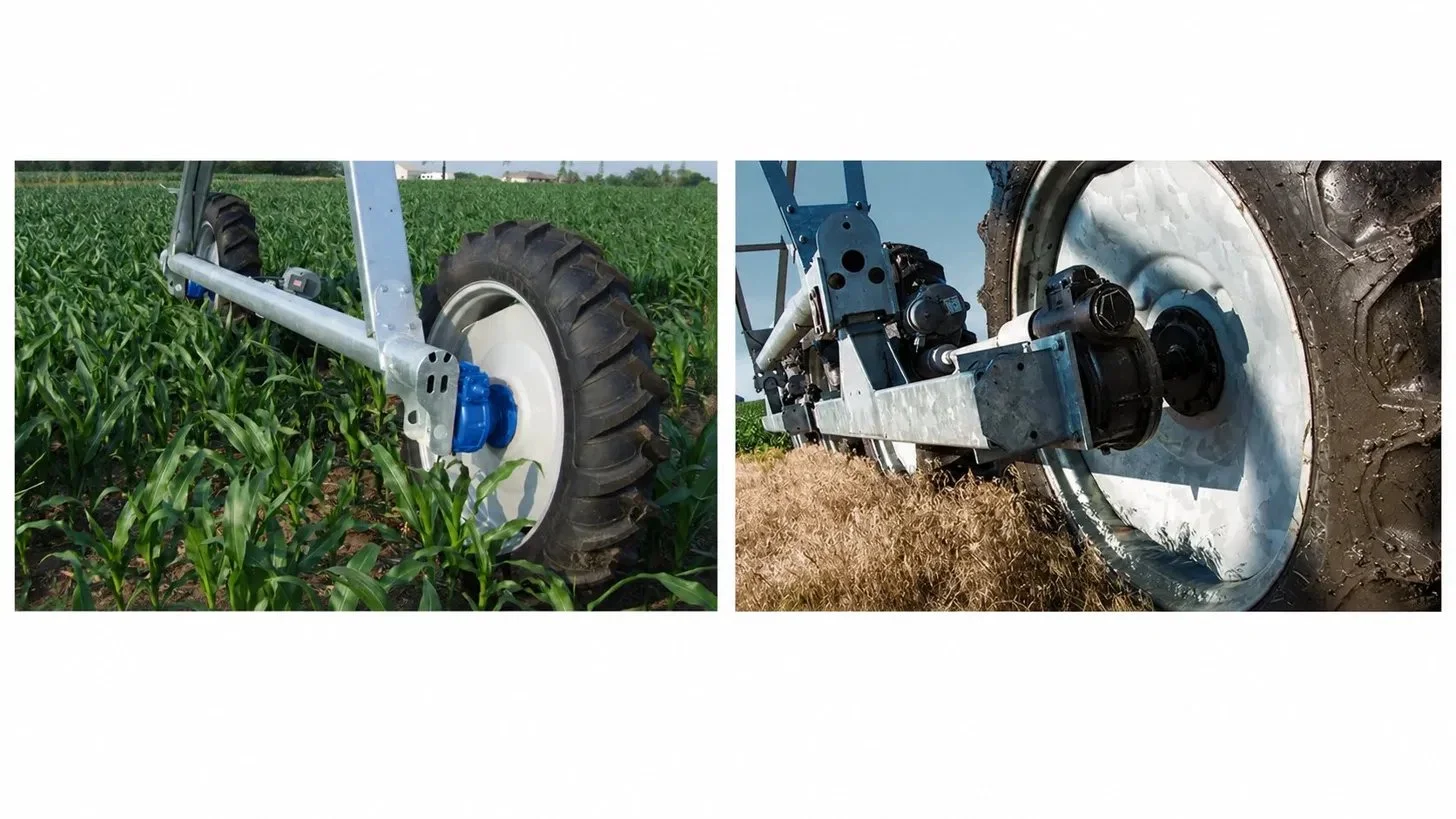
PTO-driven irrigation reels connect to the tractor through a standard Pohon vývodového hřídele with slip clutch protection. The continuous low-speed, high-torque operation (4 to 12 hours per irrigation set) produces a sustained, steady loading pattern that is gentler on the driveline than the impact-loaded duty of tillage or mowing gearboxes — but the extended continuous run time accumulates U-joint bearing fatigue faster on a calendar basis. Series 2 to Series 4 drivelines are adequate for the modest power levels (5 to 20 HP typical for PTO-driven reels), with U-joint greasing at every 8 to 10 operating hours essential for the long continuous run times during each irrigation set.
Harmonogram sezónní údržby
Full oil change with synthetic VG 320. Inspect turbine mechanical seal for leakage (run water through with gearbox empty of oil to check). Verify oil clarity after initial run — any cloudiness indicates seal failure. Check all housing seals and O-rings. Verify speed-control sensor and valve operation. Grease PTO driveline if applicable.
Oil level check (top up if needed). Oil clarity check through sight glass or drain plug sampling — milky oil means water ingress, change immediately and investigate seal. Monitor retrieval speed consistency during the run. Clean mud and debris from around gearbox seals after each set.
Drain all water from turbine and supply lines to prevent freeze damage. Top up gearbox oil. Apply grease to exposed shaft surfaces. Store reel under cover if possible — UV and weather exposure degrade housing coating and seal materials. Record total accumulated irrigation hours for next-season maintenance planning.
Aftermarket Irrigation Reel Gearbox Replacement
Irrigation reel gearbox replacement is driven primarily by turbine mechanical seal failure (allowing water contamination of the oil) and worm wheel wear from accumulated low-speed, high-torque operation. A well-maintained gearbox with clean water supply and functioning seals typically lasts 8 to 20 years (3,000 to 8,000 operating hours). Water contamination from a failed seal can destroy a gearbox in a single irrigation season if undetected. Cross-reference parameters include the turbine shaft configuration (turbine-driven) or input shaft spline (PTO-driven), the drum shaft output size and coupling, the total ratio, the mounting arrangement, and the hose-reel drum diameter compatibility.
Our engineering team maintains cross-reference data for major travelling irrigator brands and can supply aftermarket gearboxes with verified ratio and dimensional compatibility. Both complete gearbox assemblies (including turbine mechanical seal) and individual worm wheel, bearing, and seal kits are available for operators who prefer to rebuild rather than replace the complete agricultural gearbox unit. Contact our team with your reel model, hose length, and drive type for precise specification matching.
Často kladené otázky
Irrigate with Precision, Reel after Reel
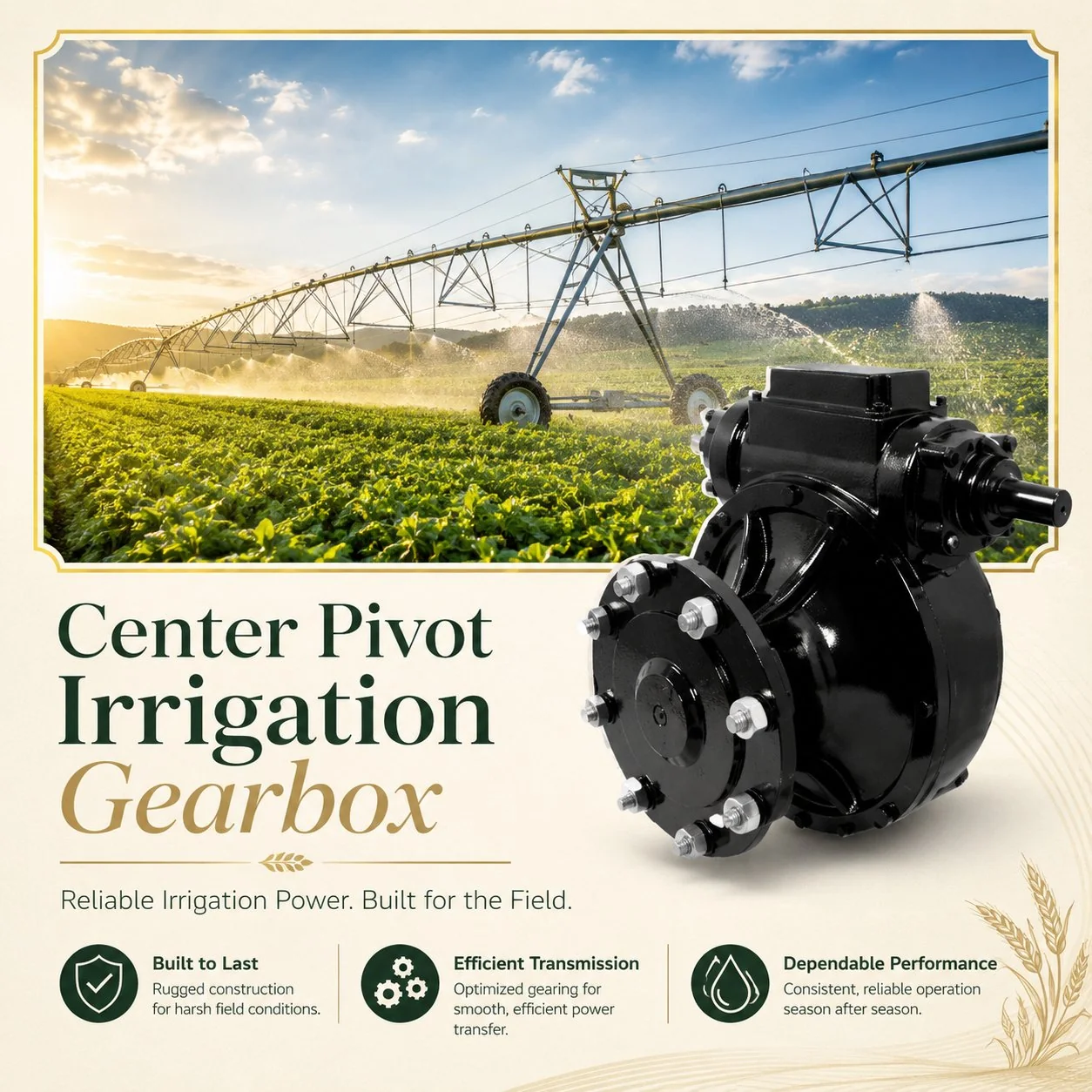
Water-sealed, precision-ratio irrigation reel gearboxes for uniform application — from compact PTO-driven units to high-capacity turbine-powered systems covering 200 to 800 metres per pass.
Střihač: Cxm