Boom Sprayer Pump Types: Centrifugal vs. Diaphragm vs. Piston
Boom sprayers use three primary pump types, each with distinct speed requirements that determine the Převodovka PTO ratio. Centrifugal pumps dominate the high-flow low-pressure market segment — boom sprayers for cereal crops, pasture spraying, and general herbicide application typically operate at 3 to 8 bar nozzle pressure with flow rates of 150 to 500 litres per minute spread across boom widths of 12 to 36 metres. A centrifugal pump for this duty runs at 3,000 to 4,000 RPM, requiring a 1:5.5 to 1:7.5 speed-increasing gearbox from a 540 RPM PTO or a 1:3 to 1:4 speed increase from a 1,000 RPM PTO. The advantages are high flow capacity, smooth pulsation-free output, and graceful behaviour when the discharge is restricted (pressure rises but the pump does not stall).
Diaphragm pumps are the most common choice for medium-pressure spraying — fungicide application, contact herbicides, and growth regulator spraying that demands 8 to 25 bar nozzle pressure to achieve the required spray quality. These positive-displacement pumps deliver consistent flow regardless of discharge pressure (limited by the relief valve setting) and can handle abrasive chemical formulations that would erode centrifugal pump impellers within a season. Diaphragm pumps operate at 400 to 900 RPM — requiring a 1:1 ratio (direct drive) or a 1:1.5 to 1:1.7 modest speed increase from a 540 RPM PTO. The trade-off is pulsating output: a 6-cylinder diaphragm pump produces 6 pressure pulses per revolution at 8 to 15 Hz, requiring an accumulator to damp the pulsation before it reaches the spray boom.
Piston pumps deliver the highest pressures (25 to 80 bar) used for specialty applications: weed wiper attachments, root drench applications, and high-pressure cleaning systems integrated into the sprayer. Piston pumps operate at 300 to 700 RPM and use either direct drive (1:1) or a modest speed reduction (1:0.6 to 1:0.9) from a 540 RPM PTO. The very high pressure output requires careful gearbox sizing — even small flow rates at 50+ bar consume substantial power (1 litre per minute at 50 bar requires approximately 0.1 HP at 100% pump efficiency, or 0.15 HP at typical 65% pump efficiency).
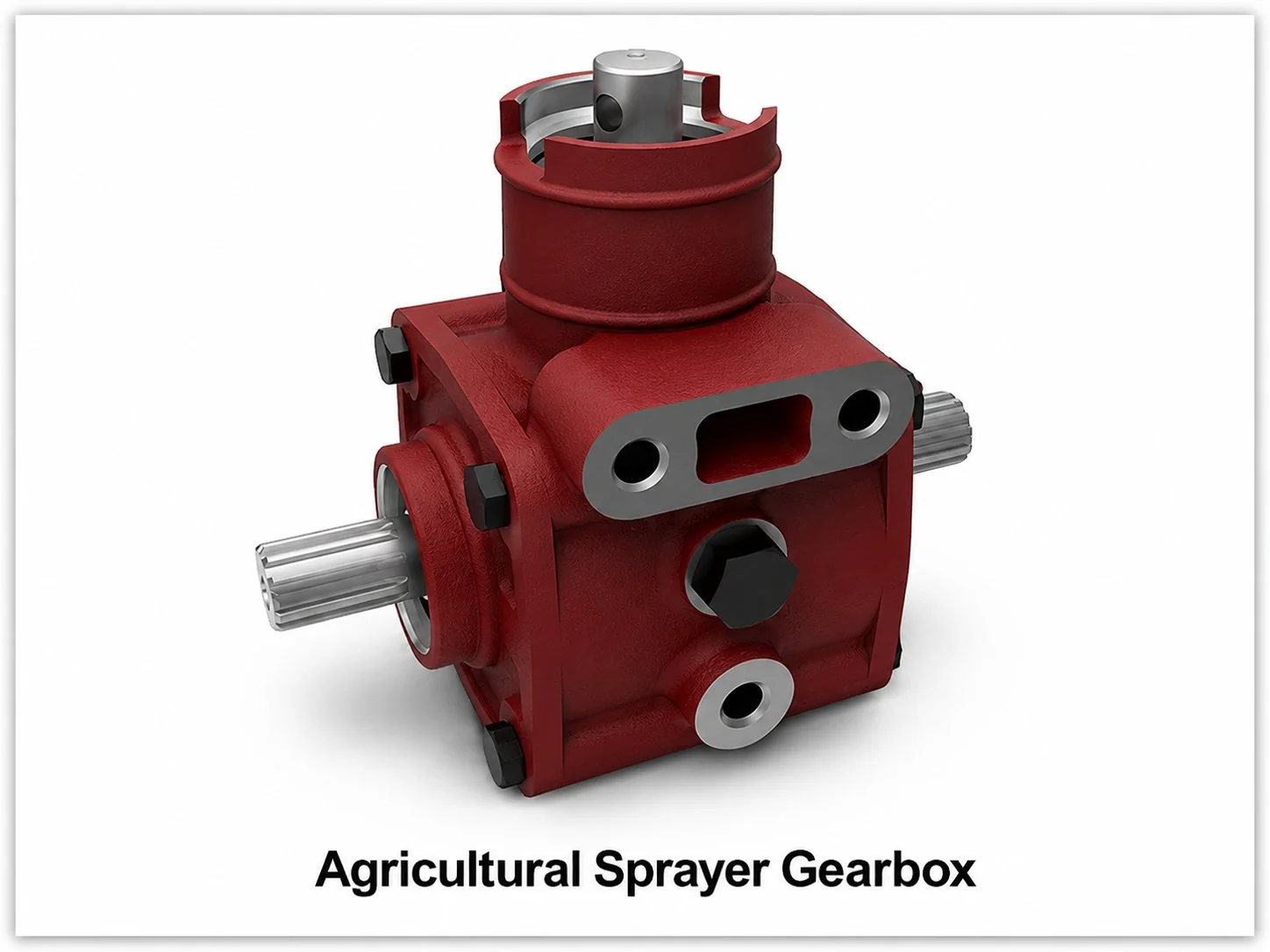
Speed-Increasing Ratio Selection for Centrifugal Pump Drive
Centrifugal spray pumps follow the same affinity laws as irrigation pumps: flow proportional to speed, pressure proportional to speed squared, and power proportional to speed cubed. A 5 percent gearbox speed error at the input becomes a 5 percent pump speed error at the output, which becomes a 10 percent pressure error at the nozzle and a 16 percent power error at the gearbox. The cube-law relationship means that operating a centrifugal spray pump 10 percent above its rated speed (an attempt to increase flow rate) demands 33 percent more power — potentially overloading both the gearbox and the tractor PTO.
From a 540 RPM PTO, achieving 3,000 RPM pump speed requires a 1:5.56 ratio — close to the practical upper limit for single-stage spiral bevel gear design. For pump speeds of 3,500 to 4,000 RPM (typical for higher-pressure centrifugal sprayers), the required 1:6.5 to 1:7.4 ratio exceeds single-stage capability and demands a two-stage převodovka postřikovače design. A two-stage configuration combines a bevel input stage (1:2.5 to 1:3) with a helical output stage (1:2.5 to 1:3), distributing the total ratio across two gear meshes and keeping each stage within its efficient ratio range. The cumulative two-stage efficiency is 91 to 95 percent — slightly lower than the 96 to 98 percent achievable in a single-stage unit, but a worthwhile trade-off for the structural margin it provides at the high output speed.
From a 1,000 RPM PTO, the required total ratio drops to 1:3 to 1:4 for the same pump speeds — comfortably within single-stage capability. This is a significant advantage of 1,000 RPM PTO operation for high-pressure spraying: simpler gearbox, higher efficiency, lower cost, and lower noise. Manufacturers of agricultural gearbox solutions like Převodovka Ever-Power PTO offer both single-stage and two-stage configurations, allowing the sprayer integrator to select the optimal mechanical balance for their specific PTO speed and pump speed combination.
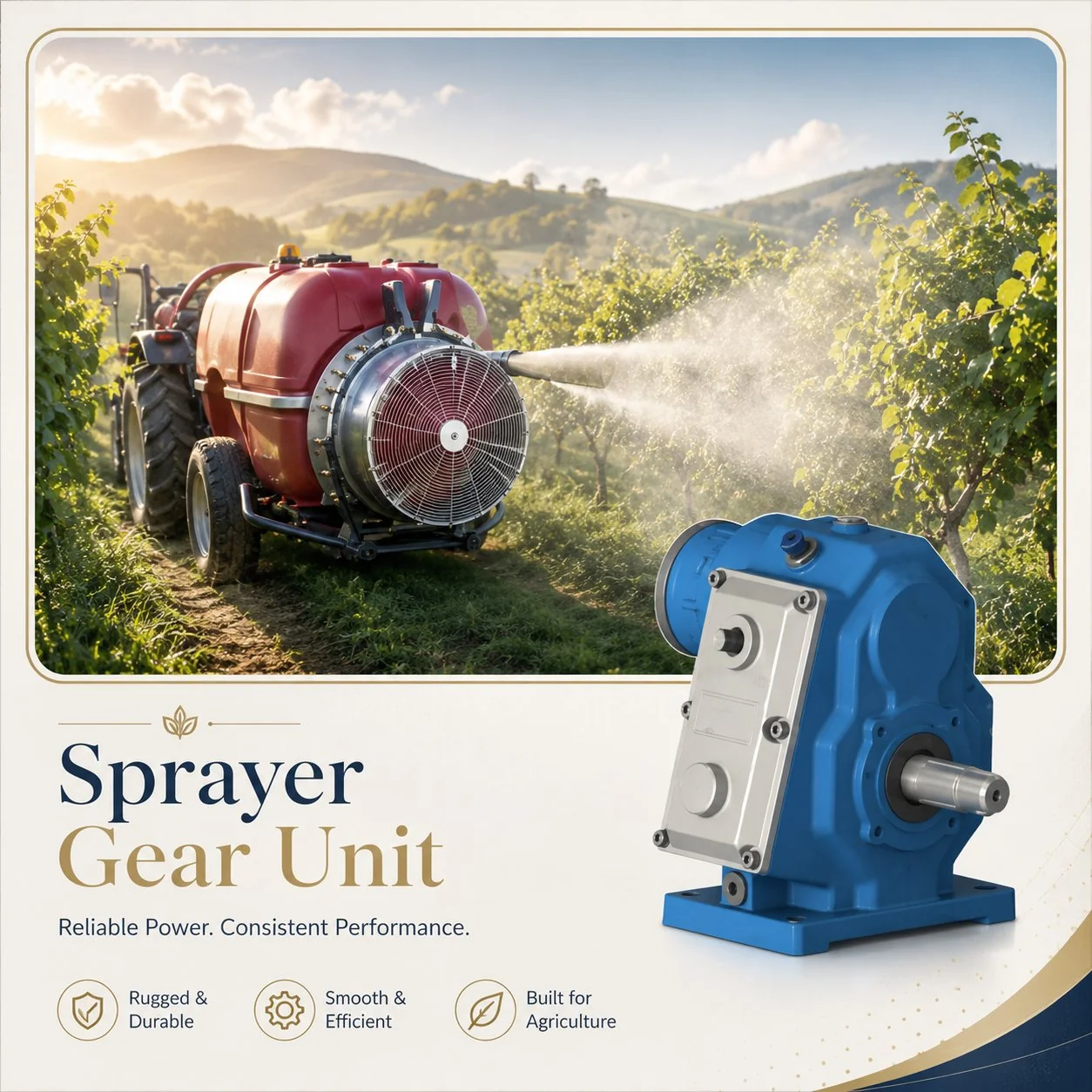
Pressure Pulsation: Gearbox Output Stability and Spray Uniformity
Pressure pulsation at the spray nozzle has two distinct origins: the inherent pulsation of positive-displacement pumps (each piston or diaphragm stroke produces a pressure pulse) and the speed pulsation introduced by gearbox and driveline dynamics. The first source is addressed through accumulator dampers in the pump discharge plumbing. The second source — gearbox-induced pulsation — is what the gearbox specification can directly control through design choices that affect output speed stability.
Gearbox-induced speed pulsation has three principal causes. The first is PTO driveline Hooke’s-joint speed variation: a standard U-joint driveline operating at an angle generates twice-per-revolution speed variation at the gearbox input. For a 540 RPM PTO at 10 degrees driveline angle, this variation is approximately ±3 percent — and the gearbox transmits this speed variation directly to the pump, producing ±3 percent pump speed fluctuation, ±6 percent pressure fluctuation, and visible variation in spray droplet size and pattern. A constant-velocity (CV) driveline eliminates this source by removing the inherent Hooke’s-joint geometry — but is rarely specified on boom sprayers because their drawbar geometry typically maintains driveline angles below 5 degrees where standard U-joints are acceptable. The second cause is gear mesh excitation — small periodic variations in gear tooth geometry that produce speed pulses at the tooth-meshing frequency (gear RPM × tooth count). For an AGMA Quality 10 gear set running at 540 RPM with 18 teeth, the tooth-meshing frequency is 162 Hz with a speed variation of less than 0.1 percent — negligible for spray application purposes. The third cause is bearing irregularity — pulsation from bearing race or ball defects that can reach 0.5 to 1 percent speed variation as bearings wear toward failure.
For a převodovka postřikovače driving a centrifugal pump, target speed stability is ±1 percent under all operating conditions — load variation, temperature variation, and PTO speed variation. This stability allows the spray pressure regulation system to maintain ±2 percent pressure accuracy at the nozzles, which translates into ±1 percent application rate accuracy — within the agronomic tolerance for chemical application. For deeper engineering of speed-increasing pump drive ratios across various agricultural pump applications, see our technical guide on převodovka zemědělského postřikovače selection and matching.
Chemical Resistance: Seals and Coatings for Spray Environment
Agricultural chemical formulations include organic solvents (xylene, hydrocarbon carriers in EC formulations), acidic activators (sulphate adjuvants), alkaline glyphosate concentrates, and high-load wetting agents that aggressively attack standard NBR (nitrile) shaft seals and standard zinc-plated fasteners. While the gearbox itself does not contain chemical (the gearbox transmits torque to the pump, which contains the chemical), spray drift and refill spillage routinely deposit chemical on the gearbox housing exterior — and any chemical that contacts a worn or improperly sealed shaft can migrate into the gearbox oil along the shaft surface.
The shaft seal specification for a chemical-resistant sprayer gearbox should be FKM (fluoroelastomer, brand name Viton) rather than the default NBR (nitrile rubber). FKM resists organic solvents, acids, alkalis, and wetting agents at concentrations that destroy NBR within months. Double-lip seals with a grease-purged intermediate chamber provide additional protection — the outer lip excludes the bulk of any chemical contact, the grease barrier traps any chemical that passes the outer lip, and the inner lip prevents the contaminated grease from migrating into the gearbox oil. Sealed breather valves prevent chemical mist from being drawn into the housing during the thermal breathing cycle that occurs as the gearbox cools after each spraying session.
Housing coating should be epoxy or polyester powder coating at 80 micrometre minimum thickness — standard acrylic paint deteriorates rapidly under repeated chemical exposure and the alternating wet-dry cycles of spray-and-rinse operation. External fasteners (housing bolts, drain plugs, inspection covers) should be stainless steel or zinc-nickel plated rather than standard zinc-plated mild steel, which corrodes under chemical attack and seizes in the housing threads. A quality zemědělská převodovka supplier offers chemical-resistant specification packages for sprayer applications that bundle these upgrades into a factory-configured product rather than requiring field retrofit. Tank-mix compatibility is another consideration that affects gearbox life indirectly: when multiple chemicals are tank-mixed in the spray solution, their combined chemical activity can be more aggressive than any individual product alone, accelerating the degradation of standard seals and coatings beyond what their individual chemical exposure ratings would predict.
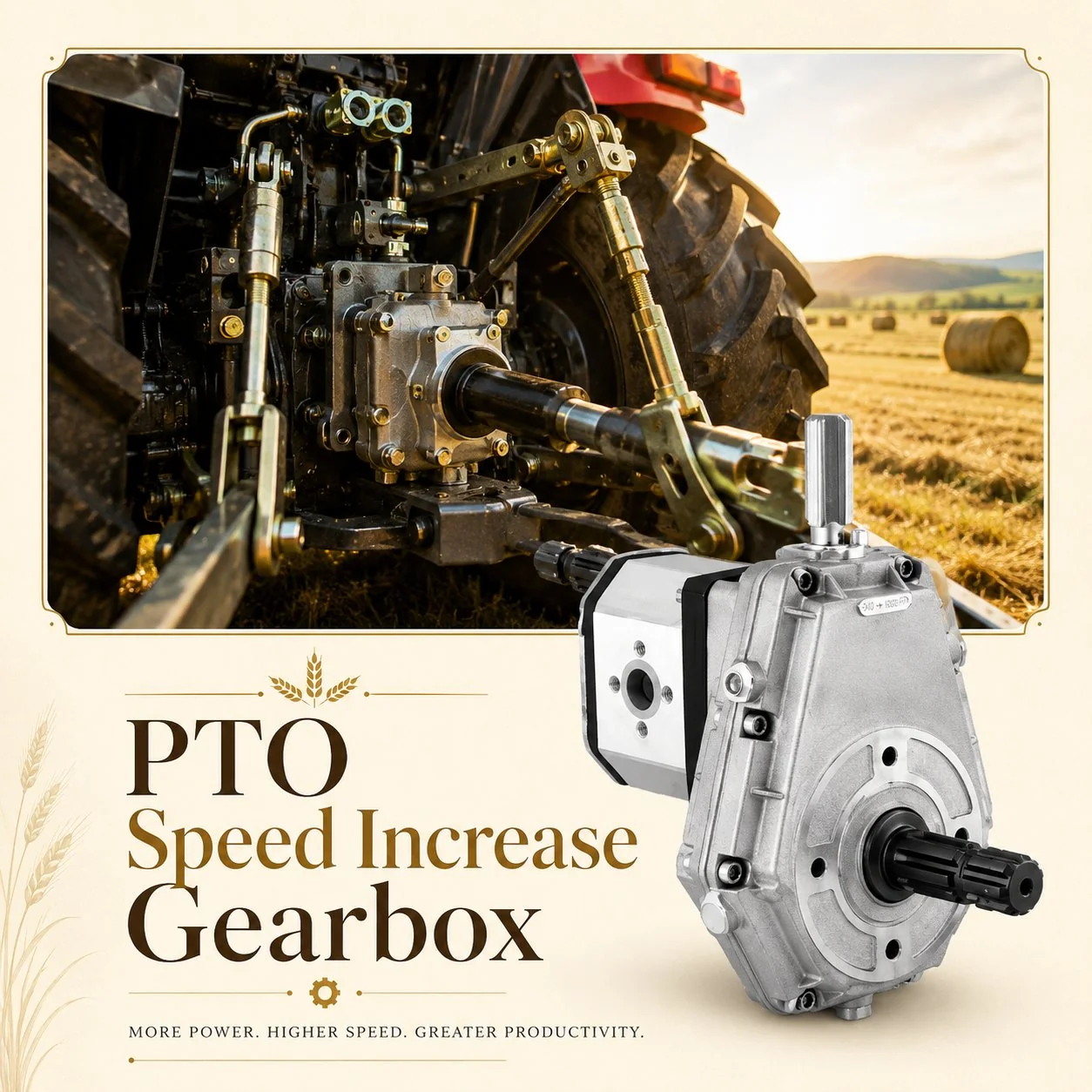
Boom Hydraulics Integration: Optional Auxiliary Gearbox Output
Modern wide booms (24 to 36+ metres) use hydraulic actuators for boom folding, height control, and self-levelling — functions powered by hydraulic flow at 100 to 200 bar pressure. Most sprayers source this hydraulic flow from the tractor’s own hydraulic system, eliminating the need for additional pump drive from the gearbox. However, sprayers operated with tractors that have limited hydraulic flow capacity (older tractors, compact tractors used for smaller specialist sprayers) may incorporate a dedicated hydraulic pump driven from a secondary output on the spray pump gearbox.
A multi-output sprayer gearbox provides the main centrifugal or diaphragm pump output at the required speed plus a secondary output (typically at PTO speed of 540 RPM, or slightly geared) for the hydraulic pump drive. The secondary output power demand is modest — typically 3 to 8 HP for boom folding and levelling functions — but the gearbox must accommodate this additional load without compromising the primary pump output stability. Multi-output configurations are more expensive than single-output units of equivalent main pump capacity, but eliminate the dependency on tractor hydraulics and allow the sprayer to operate consistently across the wide range of tractor models in a typical contractor fleet.
Maintenance and Pre-Season Calibration
Spray application is calendar-driven — once a crop disease or weed population reaches treatment threshold, the application window closes within days. Equipment failure during this window has direct yield consequences that no amount of post-event repair can recover. Pre-season preparation should include an oil change (fresh oil with full additive strength for the demanding speed-increasing operation), bearing inspection, slip clutch verification on the PTO driveline, and Vývodový hřídel U-joint greasing and wear check. Test the pump pressure and flow under operating conditions before the first field application to confirm that the gearbox is delivering the rated pump speed and the pump is meeting its rated output.
During the spraying season, daily checks include oil level verification, visual leak inspection at all shaft seal locations (chemical-induced seal degradation is the most common failure mode and is detected by oil weeping before catastrophic seal failure), and pump pressure verification using the sprayer’s pressure gauge. A drop in pump pressure at constant flow indicates either pump wear (impeller erosion in centrifugal pumps or valve seat wear in diaphragm pumps) or gearbox speed loss from progressive bearing or gear deterioration (driveline wear, gearbox slip from clutch or bearing distress). Either cause requires diagnosis and correction before the next application — running at reduced pressure produces oversized droplets, reduced coverage, and inadequate weed or pest control.
Post-season, thorough rinsing of the entire sprayer including the gearbox exterior is essential. Chemical residue on the housing accelerates corrosion during the off-season storage period, and any chemical residue that remains in the spray plumbing during winter storage can corrode pump components and seal materials and contaminate the first application of the next season. Synthetic gear oil (PAO-based ISO VG 220) is recommended for sprayer agricultural gearbox applications — its superior thermal stability and oxidation resistance accommodate the speed-increasing duty cycle better than mineral oil, and its better water-shedding characteristics resist the moisture intrusion that occurs during winter storage in unheated equipment sheds.
Často kladené otázky
Stříkejte chytřeji se správným pohonem
From low-pressure centrifugal boom drives to medium-pressure diaphragm pump gearboxes — our speed-increasing gearboxes deliver the precise, stable output that calibrated spray application demands. Chemical-resistance specification packages available with FKM seals and powder-coated housings as standard.
Střihač: Cxm