Three Gear Technologies for 90-Degree Power Transmission
Three fundamentally different gear architectures can redirect power through a 90-degree angle: bevel gears (straight, spiral, or hypoid), worm gears, and face gears. Each technology occupies a distinct performance envelope defined by efficiency, torque capacity, speed range, noise level, and cost. Selecting the wrong type for a given application results in either wasted energy, premature failure, or excessive purchase cost — often all three simultaneously. Every right angle gearbox in the agricultural and industrial market uses one of these three approaches, and understanding their trade-offs is the foundation of correct specification.
🔩
Bevel Gears (Straight / Spiral / Hypoid)
Intersecting or offset shaft axes. Rolling tooth contact (high efficiency, 95–98%). Best for high-speed, high-power applications. Straight bevel is cheapest to manufacture; spiral bevel is quieter and stronger; hypoid provides shaft offset for compact packaging. Dominant in agricultural PTO gearbox applications.
⚙️
Worm Gears
Non-intersecting, perpendicular shaft axes. Sliding tooth contact (lower efficiency, 35–90% depending on ratio). Self-locking at high ratios (prevents back-driving). Best for high-reduction (10:1 to 100:1) applications requiring position hold. Used in irrigation drives, conveyor positioning, and mixer gearboxes.
🛡️
Face Gears (Crown Gears)
A spur or helical pinion meshes with a face gear disc. Efficiency comparable to bevel gears (93–97%). Tolerant of axial misalignment. Simpler to manufacture in small batches. Used in some specialized agricultural and aircraft applications where axial tolerance is critical.
In the agricultural gearbox sector, spiral bevel gears account for over 80% of right-angle gearbox installations. Straight bevel gears serve the lowest-cost segment (light-duty rotary cutters, small post hole diggers), while worm gears dominate in irrigation wheel drives and mixer applications where self-locking and high reduction ratios are needed. Hypoid gears are relatively rare in agricultural use but increasingly common in compact tractor transmissions and automotive-derived power take-off systems where shaft offset packaging advantages justify the higher manufacturing cost. For a detailed explanation of how PTO systems convert engine power into usable implement torque, refer to our engineering guide on pto drive gearbox technology.

Spiral Bevel Gears: The Workhorse of Agricultural Right-Angle Drives
Spiral bevel gears provide the core performance characteristics that PTO gearbox applications demand: high efficiency (96–98%), high torque capacity relative to gear size, smooth and quiet operation, and the ability to handle shock loads from field impacts without catastrophic tooth failure. The spiral tooth form — curved teeth that engage gradually as the gear rotates — distributes the contact load across a larger tooth face area than a straight bevel gear’s instantaneous full-face contact. This progressive engagement is the fundamental reason spiral bevel gears are quieter, stronger, and longer-lived than straight bevel gears of the same size.
The spiral angle — the angle of the tooth curve relative to the pitch cone — is typically 30 to 35 degrees in agricultural gearbox applications. This angle represents an engineering compromise: a steeper spiral angle (40+ degrees) would provide even smoother engagement and higher contact ratio, but it also generates higher axial thrust forces that require more robust thrust bearings and a stiffer housing. The 35-degree spiral angle standard used by most PTO gearbox manufacturers provides approximately 1.5 to 2.0 tooth contact ratio (meaning 1.5 to 2.0 teeth share the load at any instant) while keeping axial thrust forces within the capacity of standard tapered roller bearings.
Spiral Bevel Gear Mesh Efficiency
96–98%
Per gear stage at rated load and speed · Only 2–4% of input power lost as heat
Compared to 35–90% for worm gears and 85–92% for straight bevel gears at equivalent loads
Gear tooth hardness is the other defining performance parameter. Agricultural spiral bevel gears are case-hardened to 58–62 HRC surface hardness with a tough core of 30–38 HRC. The hard surface resists pitting and wear from the high Hertzian contact stresses at the tooth face, while the tough core absorbs the bending fatigue loads at the tooth root without brittle fracture. This combination is achieved through carburizing heat treatment — a process where the gear is exposed to a carbon-rich atmosphere at 900–930 °C, forming a hard carbon-rich case of 0.8 to 1.5 mm depth over the softer core material. Gears that skip this heat treatment step (identifiable by their low surface hardness of 28–35 HRC) fail rapidly under agricultural impact loading — typically showing pitting within the first season and tooth fracture within two to three seasons.
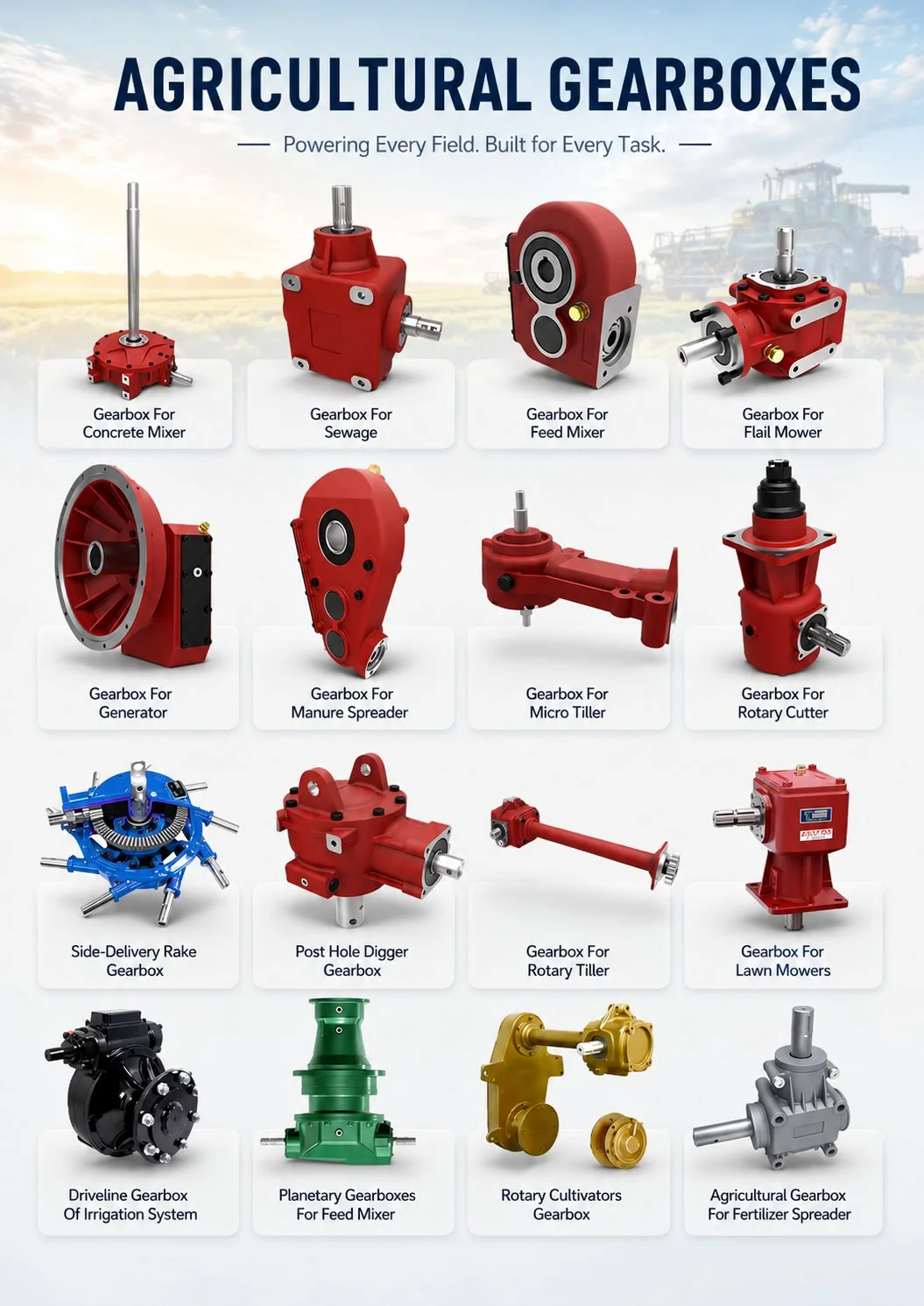
Overview of right-angle PTO gearbox configurations for agricultural implements — each application requires specific gear type, ratio, and bearing arrangement
Efficiency Curves: Where Power Gets Lost
Gear efficiency determines how much of the tractor’s PTO power actually reaches the implement — and how much is wasted as heat inside the gearbox. In a single-stage right angle gearbox with spiral bevel gears, 96–98% of input power reaches the output shaft. The 2–4% lost as heat is easily dissipated through the housing surface. In a worm gearbox at 40:1 ratio, only 40–55% of input power reaches the output — the remaining 45–60% is converted to heat that must be managed through housing design, lubricant selection, and duty cycle control.
| Gear Type | Efficiency | Ratio Range | Noise Level | Typical Agricultural Application |
|---|---|---|---|---|
| Straight bevel | 85–93% | 1:1 to 5:1 | High | Light-duty rotary cutters, small post hole diggers |
| Spiral bevel | 96–98% | 1:1 to 6:1 | Low | Rotary cutters, tillers, balers, harrows, flail mowers |
| Hypoid | 93–97% | 2:1 to 10:1 | Very low | Compact tractor final drives, automotive PTO |
| Worm gear | 35–90% | 5:1 to 100:1 | Low | Irrigation drives, mixer gearboxes, conveyor positioning |
| Face gear | 93–97% | 1:1 to 6:1 | Medium | Specialized, low-volume applications |
The efficiency gap between spiral bevel and worm gears has direct economic consequences. A 75 HP PTO gearbox with spiral bevel gears delivers approximately 73 HP to the implement. The same 75 HP input through a 50% efficient worm gearbox delivers only 37.5 HP — meaning you need a 150 HP tractor and worm gearbox to match the implement power of a 75 HP tractor with a bevel gear gearbox. The fuel cost, tractor purchase cost, and environmental impact of that extra power consumption accumulate over every operating hour across every season. This is why worm gears are only specified when their unique advantages (self-locking, extreme ratio range) are genuinely required, and why spiral bevel gears dominate in every application where efficiency matters.
Backlash Management in Right-Angle Gearboxes
Backlash — the small gap between meshing gear teeth when the driving direction reverses — is an unavoidable characteristic of all gear systems. A small amount of backlash is necessary to accommodate thermal expansion, lubricant film thickness, and manufacturing tolerances. Too much backlash creates impact loading during direction changes and torque reversals, generating noise, accelerating tooth surface wear, and reducing positional accuracy in applications where precise output positioning matters.
In agricultural PTO gearbox applications, backlash tolerances are relatively generous (0.10 to 0.30 mm) because the output typically drives a continuous-rotation implement like a mower blade or tiller rotor — there is no requirement for positional accuracy, and the load direction rarely reverses during normal operation. The primary concern is ensuring backlash does not exceed the design limit, which indicates gear tooth wear that may be approaching the replacement threshold.
Adjustable backlash in bevel gear sets is achieved through shim control of the pinion and gear mounting distances. Moving the pinion closer to the gear reduces backlash; moving it further away increases backlash. This adjustment is set during factory assembly and should not need readjustment during normal service life. If backlash increases noticeably (checked by holding the output shaft stationary and measuring the angular free play at the input shaft), it indicates gear tooth wear that warrants internal inspection. On a well-maintained agricultural gearbox with case-hardened spiral bevel gears and adequate lubrication, measurable backlash increase should not occur within the first 3,000 to 5,000 operating hours.
Thermal Limits and Continuous Duty Rating
Every right angle gearbox has two power ratings: a mechanical rating (the maximum torque and speed the gears and bearings can handle without fatigue failure) and a thermal rating (the maximum continuous power that can be transmitted without the oil temperature exceeding a safe limit, typically 90 °C for mineral oil or 110 °C for synthetic). In agricultural applications where gearboxes run for hours at rated load — rotary cutters clearing heavy brush, tillers working dense clay, balers processing at maximum throughput — the thermal rating often governs before the mechanical rating does.
Thermal rating depends on housing surface area (which determines heat dissipation rate), ambient temperature, air flow around the housing, oil volume, and gear mesh efficiency. A gearbox that is mechanically rated for 100 HP may have a thermal rating of only 60 HP in still air at 35 °C ambient — meaning it will overheat if run continuously at more than 60% of its mechanical capacity in hot, calm conditions. A quality PTO gearbox manufacturer provides both ratings and specifies the conditions (ambient temperature, air velocity) under which each applies.
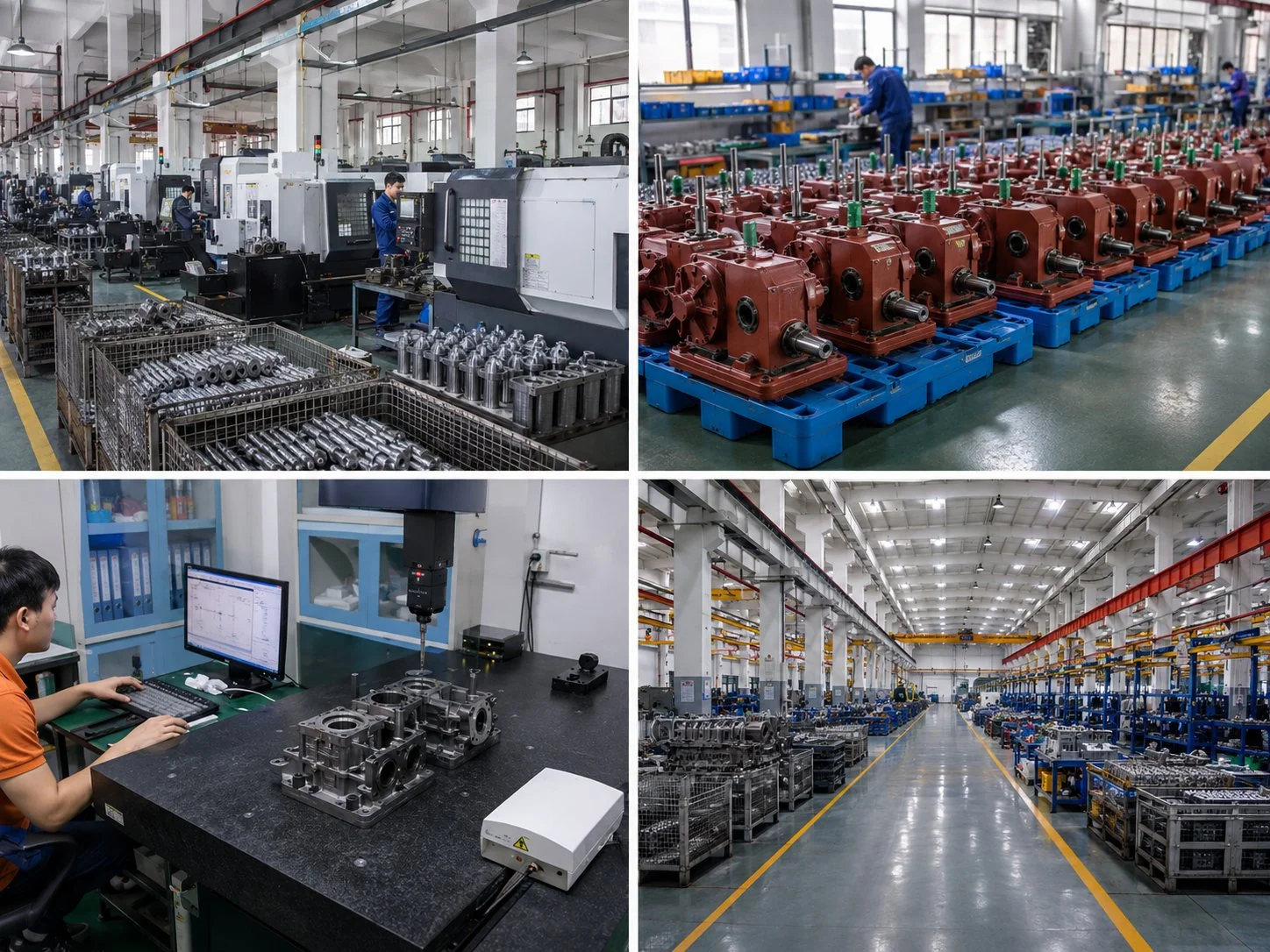
Improving thermal performance without changing the gearbox includes ensuring the housing surface is clean (dirt acts as insulation), verifying oil is at the correct level (too little reduces thermal mass, too much causes churning heat), upgrading to synthetic gear oil (which maintains film strength at higher temperatures), and mounting the gearbox where implement movement provides forced air cooling. For continuous-duty applications in hot climates, request a gearbox with finned housing or oil cooler provisions — features standard on premium units from manufacturers like Ever-Power PTO Gearbox.
Application Selection: Matching Gear Type to Your Requirements
Choosing between the available right-angle gear technologies reduces to four primary selection criteria: the required speed reduction ratio, the efficiency target, whether self-locking is needed, and the acceptable noise level. Most agricultural PTO applications have clear answers to these criteria that lead directly to the correct gear type.
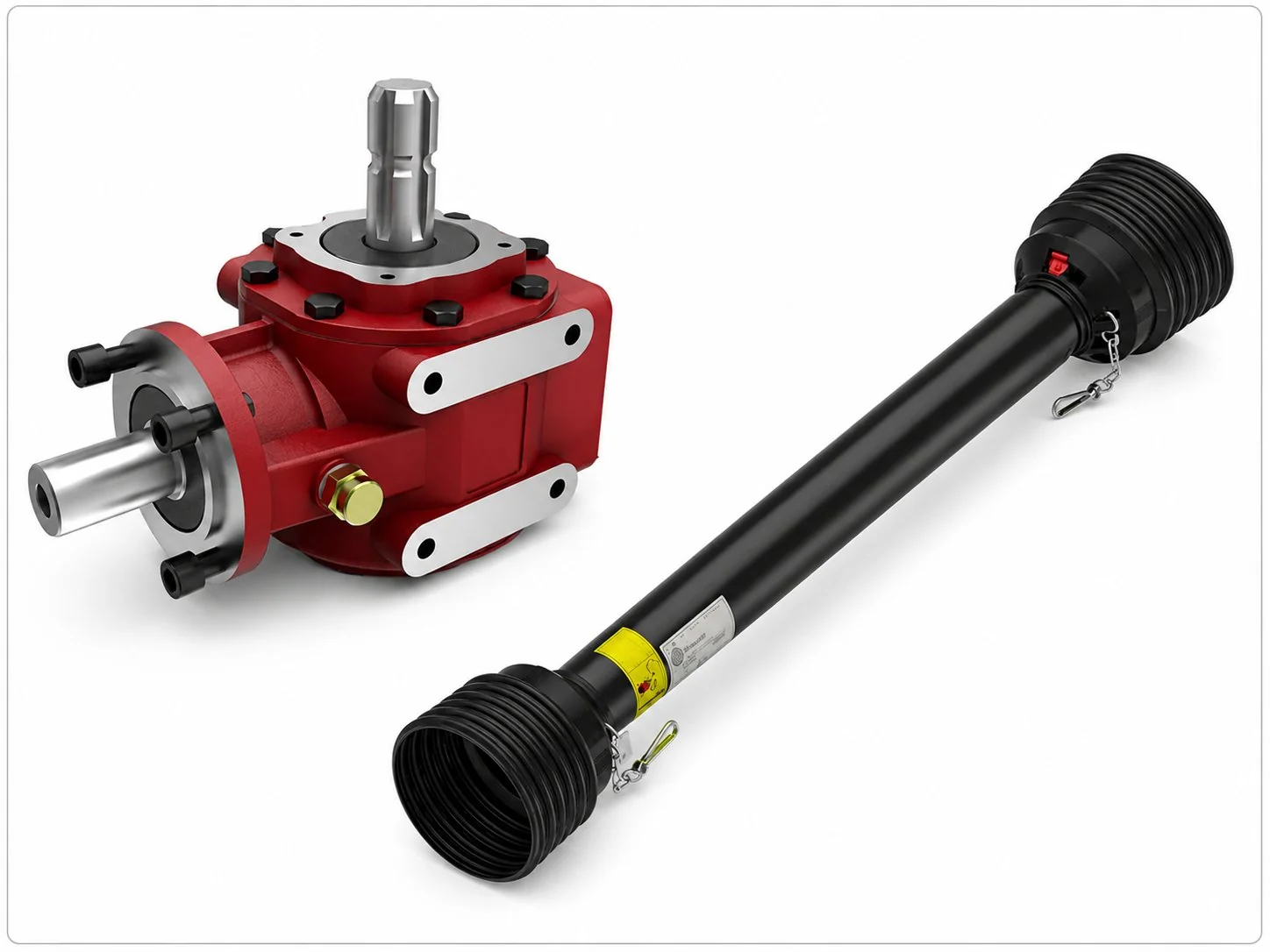
For ratios of 1:1 to approximately 4:1, spiral bevel gears are the default selection. They provide the highest efficiency, the best power density, and the lowest noise at these ratios. For ratios above 10:1 where self-locking is required (irrigation drives, mixer gearboxes), worm gears are the correct choice despite their lower efficiency. For ratios between 4:1 and 10:1, a two-stage gearbox combining a bevel first stage with a spur or helical second stage often provides better efficiency than a single high-ratio worm stage, at the cost of a larger housing. A PTO shaft with the correct length, spline fit, and overload protection completes the power path from tractor to any right-angle gearbox configuration.
For noise-sensitive applications (residential lawn mowing equipment, gearboxes mounted near operator cabs), spiral bevel or hypoid gears provide the quietest operation. Straight bevel gears are acceptable only where noise is not a concern and the lowest possible purchase cost is the priority — typically small-scale, low-hours-per-year implements where the noise exposure time is limited and the efficiency penalty of straight bevel gears at higher loads is tolerable.
Lubrication Requirements for Right-Angle Gearboxes
The gear contact mechanics inside a right angle gearbox dictate its lubrication requirements — and these requirements differ substantially between bevel and worm types. Spiral bevel gears operate with predominantly rolling contact at the tooth surface. The lubricant’s primary function is to maintain a hydrodynamic or elastohydrodynamic film between the tooth faces that prevents metal-to-metal contact during the brief, high-pressure engagement of each tooth pair. An EP (extreme pressure) gear oil rated GL-4 or GL-5 with the correct viscosity grade (typically ISO VG 220 for agricultural bevel gearboxes operating in temperate climates, or ISO VG 150 for cold-start conditions) provides the necessary film strength and additive protection.
Worm gears require a fundamentally different lubricant chemistry because their contact is predominantly sliding rather than rolling. The sliding action generates higher friction and more heat, and the bronze worm wheel is chemically reactive to certain EP additive packages designed for steel-on-steel contact. Worm gearboxes should use compounded gear oils formulated specifically for worm applications — typically containing fatty acid friction modifiers rather than the sulfur-phosphorus EP additives used in bevel gear oils. Using a standard GL-5 oil in a worm gearbox can chemically attack the bronze wheel surface, causing accelerated corrosive wear that appears as dark staining and surface roughening of the bronze teeth.
Hypoid gears present a third lubrication challenge: the offset shaft arrangement creates higher sliding velocities at the tooth contact than either standard bevel or spur gears. This higher sliding velocity demands a lubricant with aggressive EP additive loading and excellent boundary lubrication properties. Hypoid gear oils (GL-5 rated, typically 75W-90 or 80W-140) are formulated specifically for this high-sliding-velocity contact and should not be substituted with lower EP-rated oils even if the viscosity grade matches. Correct lubricant selection for each gear type is one of the most overlooked factors in right-angle gearbox longevity — using the wrong oil chemistry can halve the service life of an otherwise well-designed gearbox.
Frequently Asked Questions
Find the Right Gearbox for Your Implement
Spiral bevel, straight bevel, worm gear, or custom ratio — our engineering team helps you specify the correct right-angle PTO gearbox for your application. 500+ standard models plus custom design capability, all factory load-tested before shipment.
Editor: Cxm