Where Gearboxes Fit Inside a Combine Harvester
A modern combine harvester contains more individual gearboxes and drive units than almost any other mobile machine in agriculture. The engine provides a single power source — typically 200 to 600 HP — and that power must be split and delivered to multiple subsystems that all operate simultaneously but at different speeds, torque levels, and rotational directions. The combine harvester gearbox systems include the header drive, the feeder house chain drive, the threshing drum or rotor drive, the straw walker or separation rotor drive, the cleaning fan and sieve drive, the grain elevator drive, the tailings return auger, and the unloading auger drive. Each subsystem has its own gearbox or gear-driven transmission tailored to its specific speed and torque requirements.
Unlike a simple single-function implement where one PTO gearbox drives one tool, a combine’s gearbox architecture forms an interconnected power distribution network. The main engine drives a series of belt-and-sheave arrangements, mechanical clutches, and dedicated gearboxes that together form the combine’s internal power transmission. Failure in any one gearbox stops its corresponding function — and many functions are sequential, meaning the entire machine must stop if any link in the chain fails.
🌾
Header Drive Gearbox
Drives the cutting platform reel and sickle bar. Requires variable speed control (reel speed must match crop conditions) and a reversing function to clear blockages. Typically uses a bevel gear or planetary set with a hydraulic motor input for infinitely variable speed.
⚙️
Threshing Drum / Rotor Drive
The highest-power drive on the combine. A conventional drum runs at 400–1,200 RPM depending on crop type; a rotary axial-flow rotor runs at 250–700 RPM. Speed changes require a multi-ratio gearbox or variable-speed sheave to match crop conditions. Reversing function clears slug-fed blockages.
📦
Unloading Auger Gearbox
Drives the grain tank unloading auger system — a right-angle gearbox at the elbow where the vertical and horizontal auger tubes meet. Must handle high continuous torque during unloading (up to 100+ liters/second grain flow) with frequent start-stop cycling that impacts bearing life.

Reversing Gearbox Function in Threshing and Feeding Systems
The reversing gearbox is arguably the most critical specialized gearbox inside a combine harvester. When a heavy slug of crop material jams the feeder house or threshing drum — a common occurrence in damp or tangled crop conditions — the operator must reverse the drum or feeder chain direction to clear the blockage without leaving the cab. The reversing gearbox provides this instant directional change through a spur gear arrangement that keeps both forward and reverse gear meshes permanently engaged, with a sliding clutch collar that shifts between the two power paths.
The engineering demands on a reversing gearbox are severe. During normal forward operation, the gearbox transmits 50 to 200 HP continuously at drum speeds that vary from 400 to 1,200 RPM. When a blockage occurs, the operator engages reverse against a drum that may still have significant rotational inertia — creating a deceleration torque spike that can reach 3 to 5 times the normal operating torque. The clutch collar, gear teeth, and bearings must absorb this spike without damage, then immediately transmit reverse torque to clear the blockage. This cycle can repeat dozens of times per harvest day in difficult crop conditions.
Quality reversing gearboxes for combine service use case-hardened gears (typically 20CrMnTi steel, carburized to HRC 58–62 surface / HRC 30–35 core) to resist the repeated impact loading from direction changes. The clutch collar engagement surfaces are hardened and ground for precise fit, and the shift mechanism includes a synchronizer or positive-stop detent that prevents partial engagement — a partially engaged clutch collar under full load will strip within seconds. Bearing preload is set to accommodate the bidirectional axial thrust that alternates with every direction change, using matched tapered roller bearing pairs rather than single bearings that might unload during reversal.
🔄 Key Reversing Gearbox Design Rule
All gear teeth in a reversing gearbox carry load on both flanks — the drive side during forward operation and the coast side during reverse. Unlike unidirectional gearboxes where only the drive flank is highly loaded, reversing gearboxes require symmetric tooth profiles with equal case hardening depth on both flanks. Asymmetric or single-side-optimized gears will develop pitting on the weaker flank within one harvest season.
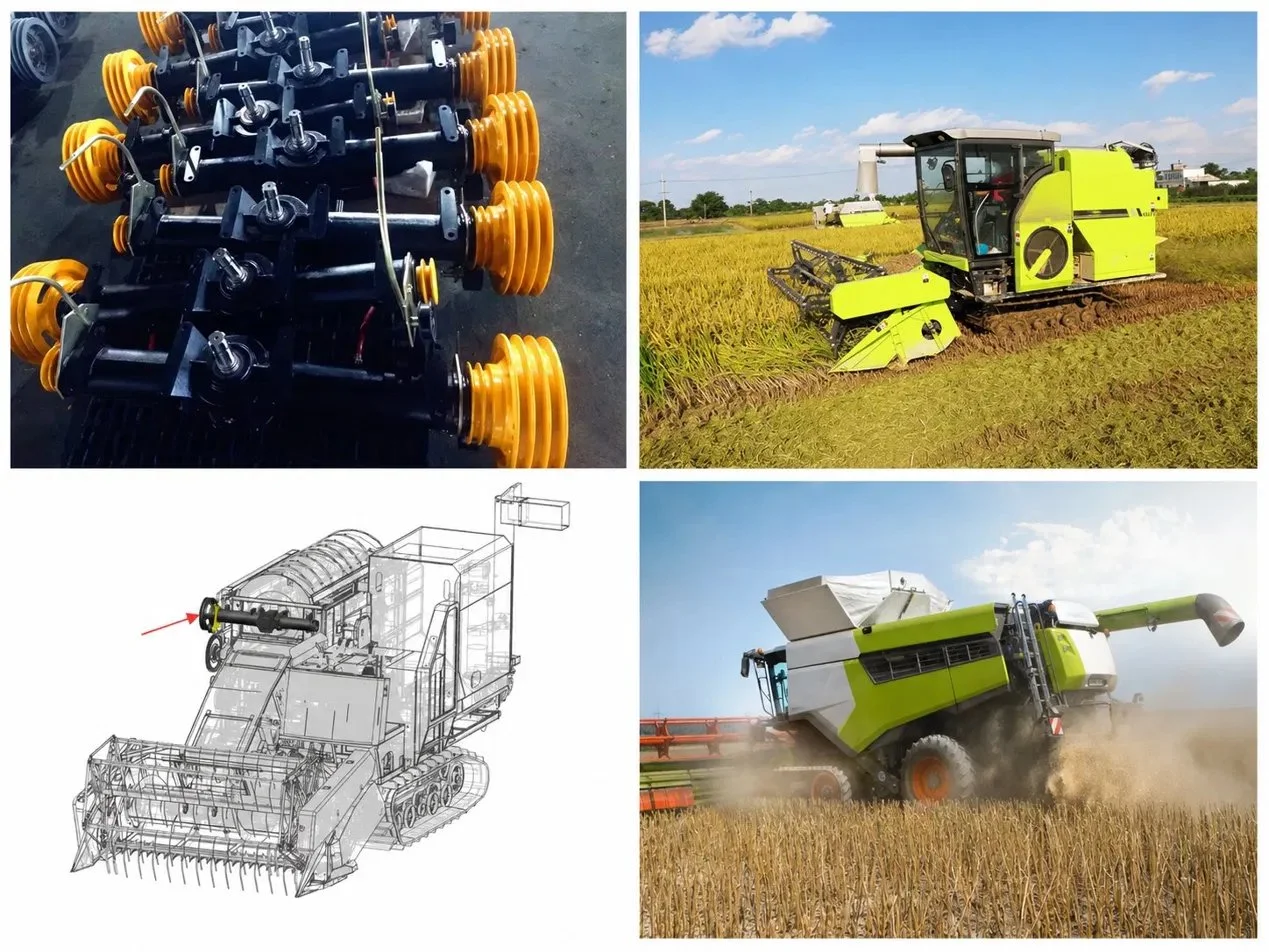
Reversing gearbox assembly showing forward/reverse gear pairs and clutch collar shift mechanism for combine harvester drum drive
Multi-Speed Gearbox Requirements Across Harvest Functions
Different crops require different threshing drum speeds, cleaning fan speeds, and sieve oscillation rates. Wheat threshes effectively at 900–1,100 RPM drum speed, while rice requires 500–700 RPM to avoid grain cracking, and corn demands 400–600 RPM with a wider concave clearance. A combine that harvests multiple crop types across the season needs a multi-speed gearbox on the threshing drum that allows the operator to change drum speed without modifying sheave positions manually.
Modern combines achieve this through two approaches: a mechanical multi-speed gearbox with 2 to 4 selectable ratios, or a continuously variable transmission (CVT) using a variable-width sheave or hydrostatic drive. The mechanical approach is simpler, more efficient, and cheaper, but limits the operator to discrete speed steps. The CVT approach provides infinite adjustment within its range but adds hydraulic complexity and 5–15% efficiency loss. From a gearbox engineering perspective, the mechanical multi-speed unit is a compact spur gear assembly with dog clutch selection — similar in principle to an automotive manual transmission but built for the sustained high-torque, high-vibration environment of crop processing.
The cleaning fan drive represents another multi-speed requirement. Fan speed directly controls the air blast intensity that separates grain from chaff on the cleaning sieves, and optimal speed varies with crop type, moisture content, and throughput rate. A dedicated two-speed or three-speed gearbox on the fan drive allows quick adjustment between crop types. The gearbox must tolerate the vibration transmitted from the sieve mechanism — typically an eccentric crankshaft driving reciprocating sieves at 200–300 cycles per minute — without loosening its own fasteners or developing bearing play from vibratory fretting.
Vibration Damping and Fatigue Life in Combine Gearboxes
A combine harvester generates more internal vibration than almost any other agricultural machine. The threshing drum creates a continuous rotating imbalance from uneven crop feed, the straw walkers or rotors oscillate at their natural frequency, the cleaning sieves reciprocate hundreds of times per minute, and the ground surface transmits random shock inputs through the axles. Every gearbox mounted on the combine frame absorbs these vibrations continuously throughout 12 to 18 hour operating days during harvest season.
Vibration affects gearbox reliability through three mechanisms. First, vibratory fretting at bearing outer races — the microscopic relative motion between the bearing outer ring and the housing bore caused by external vibration — gradually wears the housing bore oversize, allowing the bearing to shift position and introducing misalignment in the gear mesh. Second, bolt loosening from vibration can shift the gearbox housing position on its mounting, changing gear mesh alignment and increasing gear noise and wear. Third, fatigue cracking of the housing itself can initiate at stress concentration points (sharp internal corners, machining marks, or corrosion pits) under repeated vibratory loading, ultimately leading to catastrophic housing failure. For a deeper analysis of these failure mechanisms, see our article on pto gearbox failure analysis covering root causes across all agricultural gearbox applications.
Quality combine gearboxes mitigate vibration damage through rubber-isolated mounting (bonded rubber bushings between the gearbox housing and the combine frame that absorb high-frequency vibration while maintaining alignment), self-locking fasteners (nylon-insert or adhesive-locked bolts that resist vibratory loosening), and housing designs with generous fillet radii at all internal corners to reduce stress concentration. Bearing fits are specified at the tighter end of standard tolerance ranges to minimize fretting — an H7/p6 interference fit for outer races rather than the looser H7/k6 transition fit common in lower-vibration applications.
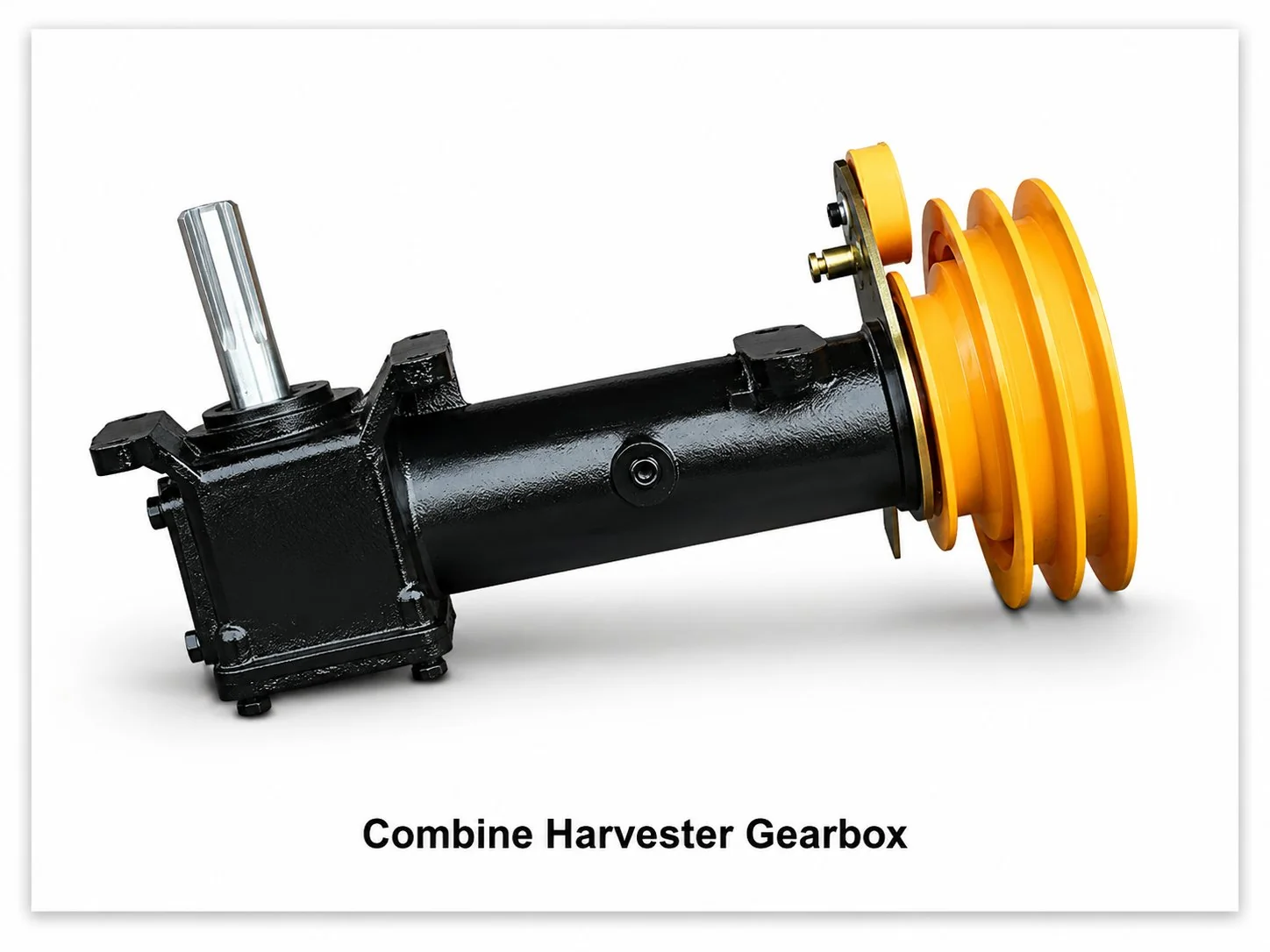
Combine Gearbox Maintenance Schedule
The concentrated harvest season means combine gearboxes accumulate 300 to 600 operating hours in just 3 to 6 weeks — a loading intensity unmatched by any other agricultural gearbox application. Maintenance must be compressed into short pre-season and in-season intervals to prevent mid-harvest failures.
| Interval | Action Items |
|---|---|
| Pre-Season (before first harvest day) | Full oil change on all gearboxes. Verify oil level at sight glasses. Check reversing gearbox clutch collar engagement (must click fully into detent). Inspect all drive belts for cracking and correct tension. Torque-check all gearbox mounting bolts. Grease all external fittings with EP grease. Test reversing function at idle before loading. |
| Daily (every 10–12 hours) | Check oil level on all accessible gearboxes. Listen for abnormal gear noise at startup. Inspect for oil leaks around shaft seals. Clear crop debris from gearbox housings and breather vents. Re-grease header drive and unloading auger elbow gearbox fittings. |
| Every 100 Hours (weekly during peak harvest) | Drain and inspect oil from reversing gearbox (highest-stress unit). Replace if metallic particles or water found. Inspect unloading auger gearbox bearings for play. Check header drive gearbox for seal weeping. Re-torque gearbox mounting bolts. |
| Post-Season | Full oil change on all gearboxes. Internal inspection of reversing gearbox (clutch collar wear, gear tooth surface condition). Measure bearing play on all accessible units. Replace any seals showing hardening or lip wear. Clean and coat all external housing surfaces with anti-corrosion spray. Document findings for next pre-season reference. |
The single highest-risk maintenance omission is neglecting the reversing gearbox oil during harvest season. This gearbox experiences bidirectional loading, high thermal cycling from reversal events, and contamination from crop dust infiltration. Its oil degrades faster than any other gearbox on the combine. A mid-season oil inspection and change at 100 hours prevents the majority of reversing gearbox failures that would otherwise occur during the final third of harvest — precisely when throughput is highest and spare parts availability is lowest.
Sourcing Replacement Combine Gearboxes
Combine harvesters from major manufacturers use proprietary gearbox assemblies that are dimensionally specific to each model and year. Cross-referencing a replacement gearbox requires the OEM part number, the combine model and serial number range, and physical verification of mounting dimensions, shaft sizes, gear ratio, and rotation direction. Aftermarket suppliers like Ever-Power PTO Gearbox maintain cross-reference databases for popular combine models and can manufacture compatible replacements with the same specifications as the original — often with upgraded bearings, seals, and surface treatments that extend service life beyond the OEM unit.
Lead time matters critically for combine gearboxes. A mid-harvest failure with an 8-week replacement wait means the crop stays in the field for two months — effectively a total loss in most climates. Pre-season spare gearbox procurement is the most cost-effective insurance against harvest-stopping downtime. Stock at minimum a spare reversing gearbox (highest failure rate) and a spare unloading auger elbow gearbox (second highest) before harvest begins. Contact our engineering team with your combine model for cross-reference verification and expedited availability.
Beyond the gearbox itself, verify the condition of companion components before installing a replacement unit. Input and output shaft splines should show no visible stepping or wear ridges — worn splines create backlash that accelerates the new gearbox’s gear tooth wear. Mounting surfaces on the combine frame should be flat and free of corrosion buildup that could prevent the housing from seating squarely, which causes shaft misalignment and uneven bearing loading. Replacing a gearbox without addressing worn mating components transfers the problem from the old unit to the new one within a single season. A thorough understanding of pto gearbox failure analysis helps identify these companion-component issues before they cause repeat failures.
For PTO shaft and driveline components that connect these gearboxes to their driven equipment, quality PTO shaft assemblies with properly rated universal joints and overload protection are essential companion components to any gearbox replacement program. When replacing a combine harvester gearbox, always inspect the mating PTO driveline for U-joint play, spline wear, and shear bolt condition — a worn driveline introduces vibration and misalignment that degrades even a brand-new gearbox. The agricultural gearbox and driveline should be treated as a system, not as independent components.
Frequently Asked Questions
Source Your Replacement Gearbox Today
Reversing gearboxes, header drives, unloading auger units — we cross-reference OEM part numbers and verify dimensional compatibility for major combine brands. Agricultural gearbox solutions backed by load testing on every unit and fast harvest-season shipping.
Editor: Cxm