What ISO 500 Covers and Why It Matters
The ISO 500 series — officially titled Agricultural tractors — Rear-mounted power take-off types — defines the physical interface between a tractor and every PTO-driven implement in the world. It standardizes the spline profile, shaft dimensions, rotational speed categories, and safety guard clearances that allow a पीटीओ गियरबॉक्स manufactured in Korea to bolt onto a tractor built in Germany and drive an implement assembled in Brazil.
Without this standard, every tractor manufacturer would use proprietary shaft dimensions, implement makers would need dozens of input shaft variants, and farmers would face a compatibility nightmare every time they added equipment. ISO 500 eliminates that chaos by defining exactly three PTO speed categories, two spline profile families, and precise dimensional tolerances for every component in the PTO power chain.
The standard is divided into three parts, each addressing a different aspect of the PTO interface. Understanding all three is essential for anyone who designs, manufactures, or specifies कृषि गियरबॉक्स equipment for global markets.
Before the ISO 500 series was formalized, the agricultural machinery industry relied on a fragmented patchwork of national standards. American manufacturers followed ASAE specifications, European firms referenced DIN or BSI documents, and Japanese companies used JIS protocols. A farmer who purchased a German tractor and an American implement could easily discover that the PTO shaft profiles did not match — not because either was poorly made, but because they were built to different dimensional references. The convergence toward ISO 500 began in the 1970s when international trade in agricultural equipment accelerated, and the standard has been revised multiple times since then to incorporate new PTO speed categories, updated safety requirements, and improved dimensional tolerances based on field experience across millions of tractor-implement combinations worldwide.
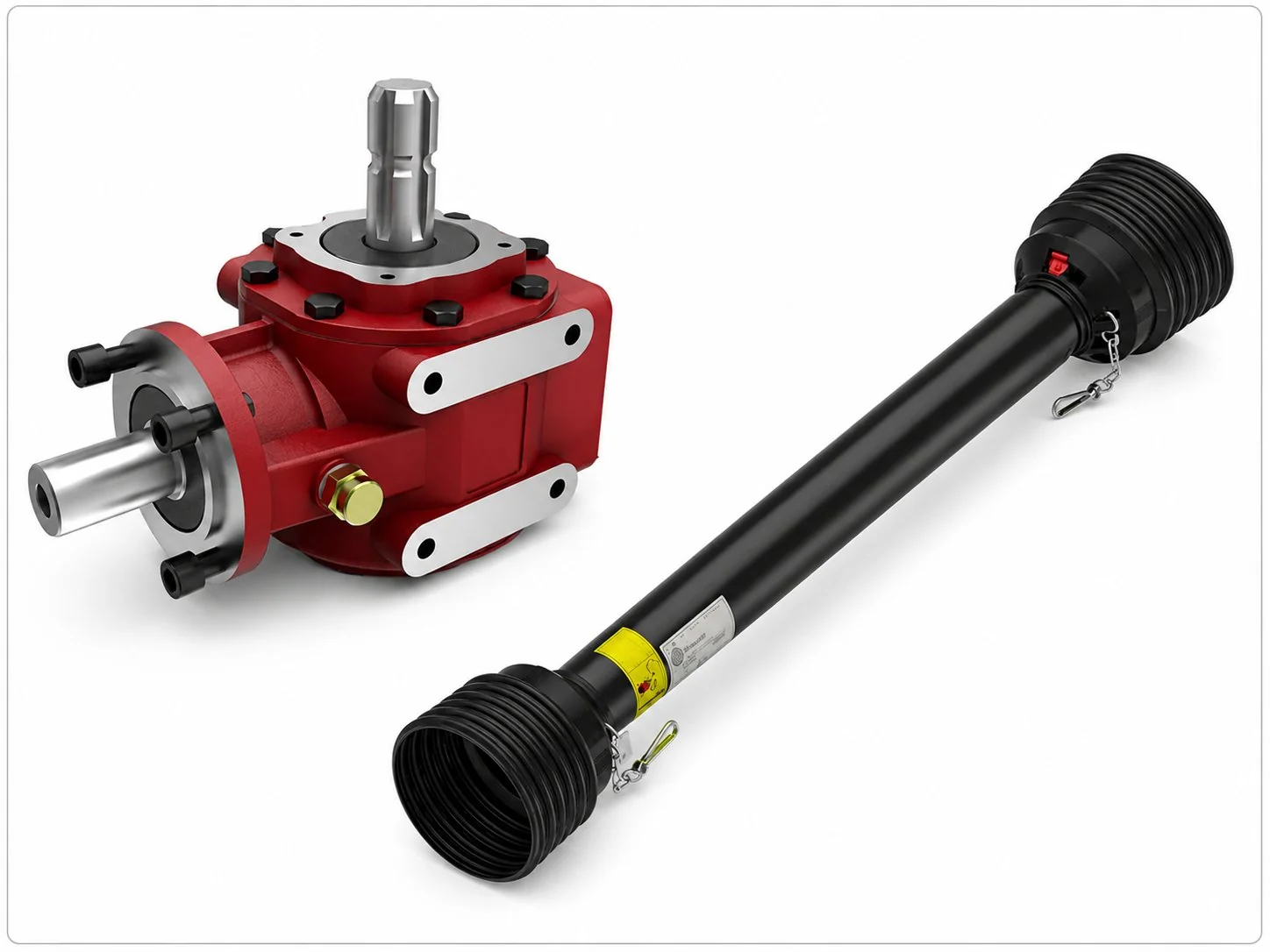
PTO gearbox with driveline shaft — every interface dimension in this assembly is governed by ISO 500
ISO 500-1: PTO Dimensions, Spline Profiles and Speed Categories
ISO 500-1 is the core document. It defines the tractor-side PTO stub shaft — the physical output point where tractor engine power becomes available to implements. Every पीटीओ गियरबॉक्स input shaft must mate with one of the profiles defined here, and the precision of that mating determines how efficiently torque transfers from tractor to implement and how long both the shaft and the gearbox input coupling will survive in service.
PTO Speed Categories
ISO 500-1 defines three standardized rotational speeds for rear PTO outputs. Each speed category corresponds to a specific spline profile and shaft diameter, which means the speed rating is physically encoded into the hardware — you cannot accidentally connect a 540 RPM implement to a 1000 RPM output because the spline profiles will not engage.
| पीटीओ प्रकार | Rated Speed | Spline Count | Shaft Diameter | Typical Tractor Class |
|---|---|---|---|---|
| Type 1 | 540 आरपीएम | 6 splines | 1-3/8 in. (34.9 mm) | Up to ~100 HP |
| Type 2 | 1000 RPM | 21 splines | 1-3/8 in. (34.9 mm) | 65–150 HP |
| Type 3 | 1000 RPM | 20 splines | 1-3/4 in. (44.5 mm) | 100–500+ HP |
The torque capacity of each PTO type follows directly from the shaft geometry. Torque transmitted through a splined connection depends on the number of splines, the effective contact area per spline, and the allowable shear stress of the shaft material. For a Type 1 shaft with 6 straight-sided splines on a 34.9 mm diameter, the effective torque-carrying area is significantly smaller than a Type 3 shaft with 20 involute splines on a 44.5 mm diameter. This is why high-horsepower tractors exclusively use Type 3 — the physics of the spline geometry determines the upper torque limit, and no amount of material improvement can overcome the fundamental geometric limitation of fewer, smaller splines.
🔑 Critical Detail: Type 2 vs. Type 3
Both Type 2 and Type 3 operate at 1000 RPM, but they are not interchangeable. Type 2 uses a smaller diameter shaft with 21 splines; Type 3 uses a larger shaft with 20 splines. The different spline counts and diameters make accidental cross-connection physically impossible — an intentional safety design baked into the standard from its inception. When specifying a PTO gearbox for a 1000 RPM tractor, you must know whether the tractor has a Type 2 or Type 3 output. Ordering the wrong input shaft configuration means the gearbox physically cannot connect to the tractor, and no field adaptation is possible without replacing the entire input shaft assembly.
Spline Profile Specifications
The standard specifies involute spline profiles with precise dimensional tolerances. Each profile is engineered to balance torque capacity, manufacturability, and wear resistance across the expected service life of both the tractor PTO stub shaft and the mating gearbox input coupling:
⚙️
6-Spline Profile (Type 1)
Major diameter 34.9 mm, minor diameter 28.9 mm, straight-sided splines with a pressure angle of 30 degrees. This is the most widely used PTO interface globally, found on compact and mid-range tractors. Torque capacity is adequate for most implements below 75 PTO HP. The straight-sided tooth form simplifies manufacturing and inspection but concentrates stress at the root fillet, which is why the standard specifies generous root radii to minimize fatigue cracking.
🔧
21-Spline Profile (Type 2)
Same 34.9 mm shaft diameter as Type 1 but with 21 involute splines instead of 6 straight-sided splines. The finer spline count distributes torque across more contact surfaces, increasing torque capacity at the same shaft size. The involute tooth form provides self-centering action during engagement and progressively distributes load across the full tooth flank rather than concentrating it at the pitch line, which improves both wear resistance and fatigue life compared to the straight-sided alternative.
🔩
20-Spline Profile (Type 3)
Larger 44.5 mm shaft diameter with 20 involute splines. Designed for high-horsepower tractors transmitting substantial torque loads continuously throughout long working days. The larger shaft cross-section and generous spline engagement area handle 150+ PTO HP without excessive contact stress. The combination of larger diameter and involute profile delivers roughly three times the torque capacity of a Type 1 connection, which is why every tractor above 200 HP uses this interface exclusively.
Dimensional Tolerances and Fit Classes
ISO 500-1 does not merely specify nominal dimensions — it defines tolerance bands for every critical measurement on the PTO shaft and mating coupling. The shaft-to-coupling fit is a clearance fit, meaning there is always a small gap between the external spline on the PTO stub and the internal spline in the gearbox input shaft. This clearance serves multiple purposes: it allows quick field connection and disconnection without special tools, it accommodates manufacturing variation across different producers, and it provides space for lubricant to reach the spline contact surfaces.
However, the tolerance band is carefully controlled. Too much clearance introduces backlash — rotational free play that causes impact loading every time the torque direction reverses or fluctuates. For reciprocating implements like round balers or mower-conditioners where the torque load pulses cyclically, backlash-induced hammering is the primary mechanism that destroys spline interfaces prematurely. Too little clearance makes field connection difficult, increases the risk of binding under thermal expansion, and can prevent adequate lubrication of the spline surfaces. The ISO 500 tolerance band represents decades of field data showing where spline wear and failure rates reach their minimum across a wide range of agricultural operating conditions.
ISO 500-2: Guard Zone and Safety Clearances
ISO 500-2 addresses the safety engineering around the PTO interface — specifically the master shield guard zone. A spinning PTO shaft is one of the most dangerous components on any farm. The shaft rotates at either 540 or 1000 revolutions per minute, and exposed rotating shafts have been responsible for a disproportionate share of fatal agricultural machinery accidents for over a century. ISO 500-2 defines the minimum dimensions of the protective shield that must cover the PTO stub shaft and the front portion of the driveline, establishing a physical barrier between the operator and the rotating components.
The guard zone geometry specified in ISO 500-2 is not arbitrary. It was derived from anthropometric data representing the reach envelope of an adult operator standing at the rear of the tractor. The shield must prevent fingers, hands, clothing, and hair from contacting the spinning shaft even if the operator reaches toward the PTO area during normal implement connection or adjustment activities. The standard accounts for the fact that PTO connection typically happens with the engine running at idle, where the shaft may still be turning slowly, and operators frequently underestimate the entanglement risk at low rotational speeds.
1
Master Shield Geometry
The shield must enclose the PTO stub shaft with a clearance envelope that prevents any part of the operator’s body from contacting the rotating shaft. Minimum shield width, height, and extension length are specified to match each PTO type. The shield must extend forward far enough to cover the connection point where the driveline yoke engages the PTO stub, because this junction — where two rotating components meet — creates the highest entanglement risk.
2
Clearance Between Guard and Rotating Parts
The standard mandates minimum radial and axial clearance between the inner surface of the guard and the outermost surface of the rotating PTO shaft or connected driveline. This prevents contact from thermal expansion, vibration, or slight misalignment during normal operation. If the guard contacts the rotating shaft, it becomes a friction heat source and an entanglement hazard itself — defeating its entire purpose.
3
Non-Rotating Guard Requirement
The master shield must not rotate with the PTO shaft. It is mounted to the tractor frame and remains stationary while the shaft spins inside. This is a critical safety distinction — a rotating guard becomes an entanglement hazard itself. The shield material must also be robust enough to resist damage from incidental contact with implements during connection and disconnection, as a cracked or deformed shield may no longer maintain the required clearance envelope.
When designing or selecting a पीटीओ गियरबॉक्स, the input shaft and driveline connection must fit within the guard zone envelope defined by ISO 500-2. An oversized gearbox input housing or a driveline yoke that extends beyond the guard zone creates a safety compliance failure that can block product certification in regulated markets. This constraint is especially relevant for aftermarket gearboxes — a replacement unit with different external housing dimensions than the original can violate the guard zone even though its internal gear ratios and torque ratings are otherwise correct.

ISO 500-3: Front-Mounted PTO Requirements
ISO 500-3 extends the standard to front-mounted PTO systems, which are becoming increasingly common on modern tractors for driving front-mounted implements like snow blowers, front mowers, and sweepers. While most agricultural gearbox ISO 500 standards explained articles focus exclusively on the rear PTO, front PTO systems follow the same fundamental interface principles with several important differences that gearbox engineers and procurement specialists must understand.
Front PTOs typically operate at 1000 RPM only — there is no 540 RPM option on most tractor models with front PTO capability — and they use Type 3 spline profiles on larger tractors or Type 2 on mid-range models. The standard specifies different guard zone dimensions for the front PTO because the operator’s spatial relationship to the front of the tractor differs fundamentally from the rear. The operator is further away during normal driving, but the risk of contact during implement mounting and dismounting is actually higher at the front because the operator must stand between the tractor and the implement during the connection process, with less room to maneuver than at the rear three-point hitch.
Front PTO gearbox designs must also account for the different loading characteristics of front-mounted implements. A front-mounted snow blower, for example, experiences high-impact shock loads when the auger contacts frozen debris or hidden obstacles, and these shock loads propagate directly through the PTO driveline into the gearbox input shaft. The front PTO connection must withstand these impact forces without disengagement, which means the spline engagement length and retention mechanism are even more critical on front PTO applications than on rear-mounted equipment where implement loads tend to be more predictable.
Gearbox manufacturers developing products for front-mount applications must verify compliance with ISO 500-3 specifically, not assume that rear PTO dimensional specs transfer directly. The guard zone geometry, retention clip requirements, and shaft extension length all differ between Parts 1 and 3 of the standard.
540E and 1000E Economy PTO: What the Standard Says
Many modern tractors offer a 540E or “economy PTO” mode — the PTO stub still turns at 540 RPM, but the engine runs at reduced RPM (typically around 1600–1800 RPM instead of the standard 2100–2200 RPM). This reduces fuel consumption significantly for light-load PTO work such as running a उर्वरक फैलाने वाले गियरबॉक्स at partial capacity or operating a light-duty rotary mower on level ground.
Similarly, some tractors offer a 1000E mode that delivers 1000 RPM at the PTO while the engine runs at reduced RPM — typically around 1500 RPM instead of the standard 1900–2100 RPM for 1000 RPM PTO operation. The fuel savings in economy PTO modes can reach 15–25% depending on the load, making these modes popular for extended-duration PTO operations where maximum power is not required. However, the economy modes carry important limitations that operators and gearbox specifiers must understand.
⚠️ Important Clarification
540E uses the same 6-spline, 1-3/8 in. shaft interface as standard 540 RPM (Type 1). The gearbox does not know the difference — it receives 540 RPM regardless. However, because the engine runs at reduced RPM in 540E mode, maximum available PTO horsepower is lower. A gearbox and implement rated for 60 PTO HP in standard 540 mode may only receive 40–45 HP in 540E mode. This is acceptable for light work but means the implement will stall under heavy loads that would have been manageable in standard mode. The same principle applies to 1000E operation: the shaft speed is correct, but available torque reserves are reduced because the engine is producing less total power. This is entirely a tractor-side limitation — the gearbox itself does not need any modification or special rating for economy PTO operation, and no ISO 500 dimensional differences exist between standard and economy PTO interfaces.

Common Non-Compliance Issues and Field Failures
Despite ISO 500 being a well-established standard, non-compliance problems still surface in the field — particularly with low-cost aftermarket gearboxes and imported units that claim ISO compatibility but cut corners on dimensional accuracy. Understanding the most common failure modes helps procurement teams and maintenance engineers identify substandard products before they cause expensive downtime or safety incidents.
The most frequent non-compliance issue is spline tolerance deviation. Some manufacturers produce input shaft splines that fall outside the ISO 500 tolerance band — typically on the loose side, where the internal spline bore is slightly oversized relative to the specification. The gearbox will physically connect to the tractor PTO shaft, which gives the impression of compatibility, but the excessive clearance introduces backlash that manifests as a distinct “clunk” when the PTO engages under load. Over hundreds of operating hours, this backlash-driven impact loading peens and erodes the spline contact surfaces, eventually creating so much free play that the connection becomes unreliable. The gearbox may intermittently disengage under high-torque transients — precisely the worst possible moment for a loss of power transmission.
The second common issue involves incorrect spline hardness. ISO 500 does not directly specify material hardness, but the dimensional tolerances it requires are only achievable with properly heat-treated alloy steels. Gearbox input shafts made from lower-grade materials or inadequately case-hardened shafts will wear rapidly even if the initial dimensions are within tolerance. After a few hundred hours of use, the spline flanks develop visible wear steps, and dimensional inspection reveals that the shaft has worn outside the ISO tolerance band during service.
A third problem area involves guard zone violations on replacement gearboxes. When a gearbox is replaced with an aftermarket unit that has different external housing dimensions, the original master shield may no longer provide adequate coverage. The ISO 500-2 guard zone was designed around the original equipment dimensions, and a replacement gearbox with a larger input housing, longer input shaft extension, or differently positioned driveline connection point can protrude beyond the shield envelope. This creates an unguarded gap that exposes rotating components — a serious safety hazard that also violates regulatory requirements in most jurisdictions.
How ISO 500 Impacts PTO Gearbox Design
For gearbox manufacturers, ISO 500 compliance is not optional — it is the gateway to global market access. The standard shapes every aspect of gearbox engineering from initial concept through production and final inspection:
✅
Input shaft spline must match exactly — The internal spline in the gearbox input shaft must mate with the tractor PTO stub defined by ISO 500-1. Dimensional tolerance, tooth profile, and engagement length are all specified. A spline that is 0.1 mm outside tolerance creates uneven load distribution and accelerated wear. Manufacturers must invest in precision broaching or hobbing equipment and maintain calibrated inspection gauges to hold these tolerances consistently across production runs.
✅
Torque rating must correspond to PTO type — A gearbox marketed for 540 RPM (Type 1) applications must be rated for the torque range that typical Type 1 tractors deliver. Over-rating adds unnecessary weight and cost; under-rating is dangerous and creates liability exposure. The relationship between PTO type and expected torque range is well-defined: Type 1 at 540 RPM typically delivers up to approximately 95 Nm per PTO HP, while Type 3 at 1000 RPM delivers approximately 57 Nm per PTO HP for the same power. The gearbox internal gear train, bearings, and housing must be designed to handle the full torque spectrum of their rated PTO type.
✅
Driveline connection must fall within the guard zone — Per ISO 500-2, the gearbox input and the पीटीओ शाफ्ट connection must not protrude beyond the master shield envelope. This constrains the physical dimensions of the gearbox input housing and limits how far the input shaft can extend beyond the gearbox body.
✅
Multi-speed capability requires separate input shaft options — A gearbox intended for both 540 and 1000 RPM tractors needs either an interchangeable input shaft assembly or separate product variants — the spline profiles are physically incompatible. Some manufacturers offer a modular input shaft design where the splined coupling can be swapped without disassembling the entire gearbox, which simplifies inventory management for dealers and distributors serving mixed tractor fleets.
Regional Variations and ASAE/ASABE Alignment
While ISO 500 is the global reference, regional standards exist that largely align with it but contain local additions reflecting regional safety regulations, testing requirements, and historical equipment populations:
| मानक | Region | Relationship to ISO 500 |
|---|---|---|
| ASABE S207.2 | North America | Dimensionally identical to ISO 500-1 for Type 1 and Type 3 interfaces; includes additional PTO performance test methods and defines overrun protection testing protocols not found in the ISO document |
| EN 12965 | Europe | Harmonized with ISO 500; adds CE machinery directive safety requirements for PTO guards, including guard material strength testing and UV degradation resistance for plastic shield components |
| JIS B 9210 | जापान | Aligned with ISO 500-1 for standard tractors; Japan also uses compact tractor PTO profiles not covered by ISO 500, including a smaller-diameter 9-spline configuration for sub-20 HP mini tractors common in rice paddies |
| KS B 6317 | Korea | Directly adopts ISO 500 series; Korean gearbox manufacturers reference ISO 500 for all PTO interface dimensions, with additional requirements for documentation and traceability of heat treatment records for spline components |
For manufacturers like एवर-पावर पीटीओ गियरबॉक्स supplying into multiple markets simultaneously, ISO 500 compliance ensures automatic compatibility with the corresponding regional standards in North America, Europe, Japan, Korea, and Oceania. A gearbox that passes ISO 500 dimensional inspection will also satisfy the dimensional requirements of ASABE S207.2, EN 12965, JIS B 9210, and KS B 6317 — though the safety documentation requirements may differ by region and must be addressed separately.
One regional consideration that catches some manufacturers off guard involves Australia and New Zealand. Both countries reference ISO 500 for PTO interfaces but impose their own farm machinery safety regulations — particularly strict requirements for PTO guard labeling, operator manual content, and hazard pictographs that go beyond what ISO 500-2 specifies. कृषि गियरबॉक्स exporters targeting Oceanian markets should verify these additional documentation requirements early in the product development process to avoid delays at customs or during dealer onboarding.
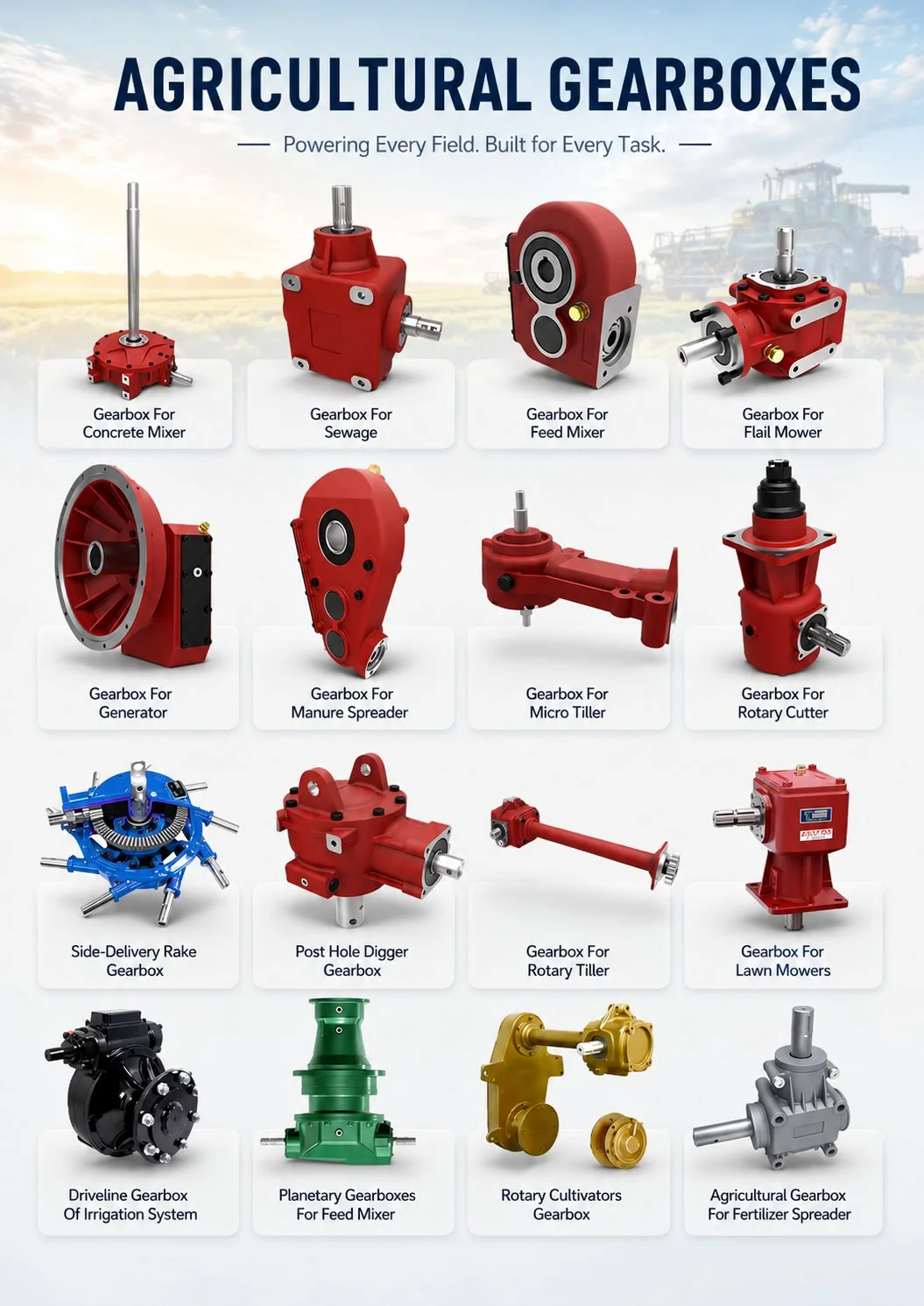
Quick-Reference: Matching PTO Type to Implement
Use this cross-reference when verifying which PTO type your implement gearbox requires. The implement categories listed below represent the most common equipment configurations, but individual implement models may vary — always verify the specific PTO type in the implement operator manual before ordering a replacement gearbox.
🌿
Type 1 (540 RPM / 6-spline) — Most Common
Rotary cutters, flail mowers, rotary tillers, post hole diggers, small balers, broadcast spreaders, hay tedders, and most mid-size farm implements. This covers approximately 70% of all PTO-driven agricultural equipment worldwide. The vast majority of compact and utility tractors under 100 HP are equipped exclusively with Type 1 PTO outputs, making this the default interface for the broadest range of farm implements.
🌾
Type 2 (1000 RPM / 21-spline) — Mid-Power
Medium-to-large balers, high-capacity mowers, some manure spreaders, and hydraulic pump drives in the 65–150 HP range. Type 2 is less common than Type 1 or Type 3 and occupies a transitional position in the PTO standard hierarchy. Many tractors in this power range offer both 540 and 1000 RPM PTO options, and the implement determines which speed is needed for correct operation.
💪
Type 3 (1000 RPM / 20-spline) — High Power
Large round and square balers, high-capacity forage harvesters, large grain carts with hydraulic drives, high-output manure injectors, and any implement requiring 100+ PTO HP. The larger shaft diameter handles the sustained torque that high-horsepower tractors deliver throughout full working days in demanding conditions. Type 3 is the dominant interface for row-crop and articulated tractors in professional farming operations.
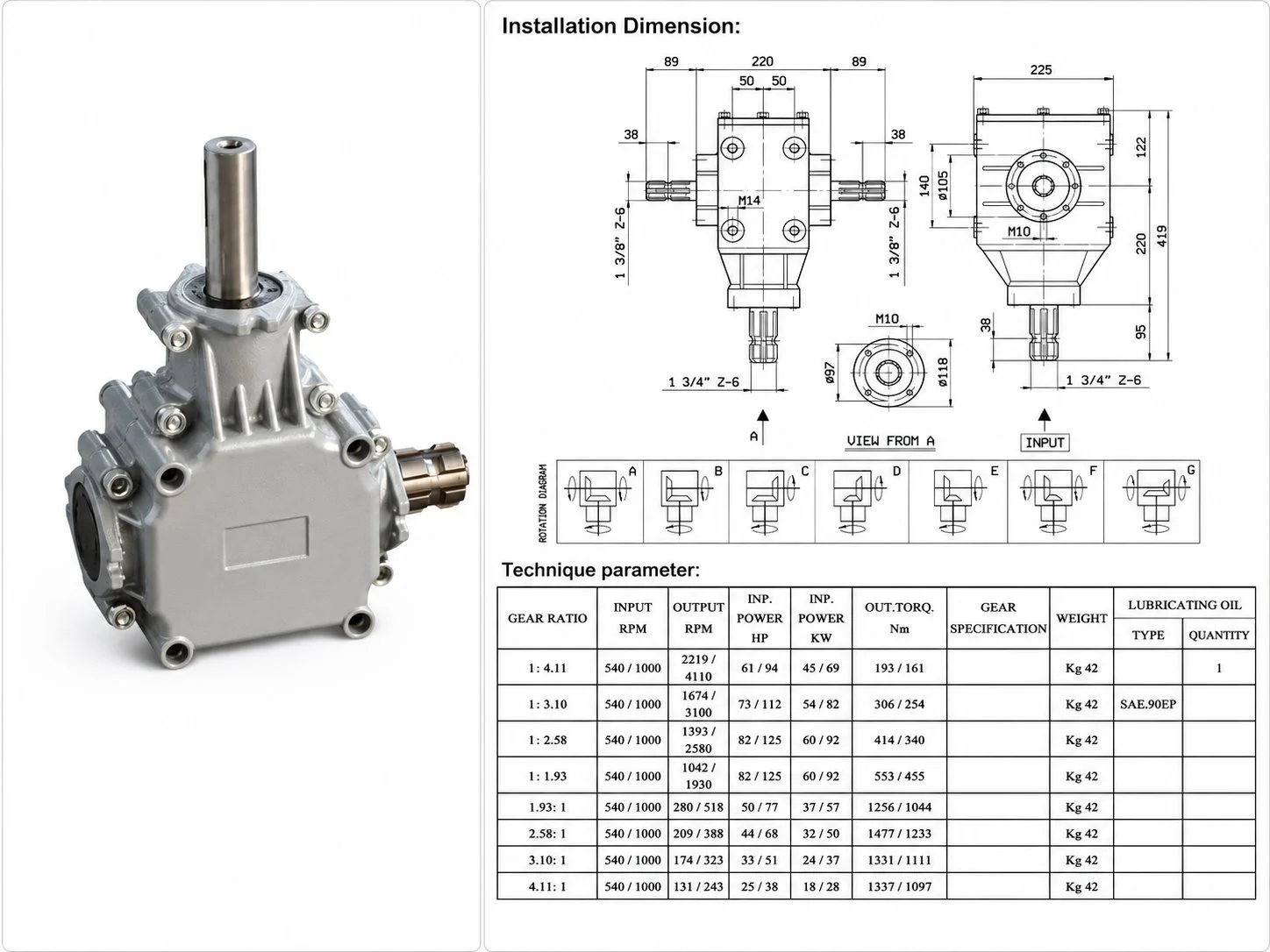
XL-Series gearbox dimensional reference — ISO 500 compliance verified for Type 1 and Type 3 interfaces
How to Verify ISO 500 Compliance When Purchasing
When sourcing कृषि गियरबॉक्स equipment — whether for original equipment integration, dealer resale, or direct farm use — verifying ISO 500 compliance protects you from dimensional mismatches, safety issues, and warranty disputes. The following verification steps should be part of any procurement process for PTO-driven gearbox assemblies:
📋
Request spline dimensional inspection report — A quality manufacturer measures every input shaft spline and can provide actual measurement data against ISO 500 nominal dimensions and tolerances. This report should include pitch diameter, major and minor diameters, tooth thickness, space width, and root fillet radius. Reject any supplier who cannot provide measured data — a generic “ISO 500 compliant” statement without measurements is meaningless.
📋
Confirm PTO type in the product specification — The datasheet should explicitly state “ISO 500 Type 1 (540 RPM, 6-spline)” or equivalent, not just “540 RPM.” The spline profile is the critical dimension, not just the speed. A gearbox marketed only by speed rating without specifying the spline configuration may not conform to the ISO standard dimensional requirements.
📋
Verify guard zone compatibility — For new implement designs, ensure the gearbox input housing dimensions fit within the ISO 500-2 guard envelope. Oversized housings or non-standard input yoke positions can prevent proper guard installation. Request a housing outline drawing with the critical external dimensions and compare it against the guard zone clearance envelope for your specific tractor model.
📋
Test-fit with a calibrated go/no-go spline gauge — For bulk procurement, use spline gauges manufactured to ISO 500 tolerances to verify that every incoming gearbox accepts the correct PTO stub profile without excessive play or interference. The go gauge should slide fully into the spline bore under its own weight; the no-go gauge should not enter more than two spline teeth deep. Any unit that fails either check is out of tolerance and should be rejected.
Consistent ISO 500 compliance across a product line requires investment in manufacturing quality systems, calibrated inspection equipment, and traceable material certifications. When evaluating potential पीटीओ गियरबॉक्स suppliers, the ability to produce and defend a complete dimensional inspection report to ISO 500 standards is one of the strongest indicators of manufacturing competence and product reliability. If you need ISO 500 documentation or dimensional verification for a specific gearbox model, हमारी इंजीनियरिंग टीम से संपर्क करें for a complimentary technical review.
अक्सर पूछे जाने वाले प्रश्नों
Need ISO 500-Compliant PTO Gearbox Solutions?
From Type 1 through Type 3 interfaces, our engineering team designs and manufactures PTO gearboxes verified against ISO 500 dimensional standards — with full documentation for OEM integration, dealer procurement, and regulatory compliance across every major agricultural market.
संपादक: सीएक्सएम