What Is a Feed Mixer Gearbox?
A feed mixer gearbox is the heavy-duty speed-reduction unit that converts high-speed, lower-torque PTO input into the very low speed (15 to 40 RPM) and extreme torque (up to 20,000 Nm) required to rotate the mixing augers inside a Total Mixed Ration (TMR) feed mixer. It is, by weight and torque capacity, the heaviest single gearbox found in any livestock operation — typically 150 to 350 kg depending on the mixer capacity, number of augers, and drive architecture.
TMR mixers blend silage, concentrates, minerals, vitamins, and other ingredients into a uniform ration that ensures every mouthful delivers the same nutritional balance. The mixing quality depends directly on auger speed consistency: too fast tears silage fibres and degrades rumen-effective fibre length; too slow fails to achieve uniform distribution within the designed mixing time. The feed mixer gearbox must therefore maintain stable, precise output speed under the highly variable torque loads created by different feed ingredients, fill levels, and mixing stages — from the initial loading of heavy, wet silage to the final blending of light mineral premixes.
Why Feed Mixers Demand Extreme Speed Reduction
From a 540 RPM PTO gearbox input, producing 15 to 40 RPM output requires a feed mixer gearbox ratio of 1:13.5 to 1:36 — far beyond what a conventional two-stage bevel-and-helical arrangement can achieve. This extreme ratio demands specialised multi-stage architectures: multi-stage planetary gear trains (two or three epicyclic stages in series), worm gear reducers, or hybrid bevel-input-plus-planetary-output combinations.
The corresponding output torque is immense. A 60 HP PTO at 540 RPM produces 795 Nm of input torque. At a 1:27 ratio with 92 percent efficiency, the output torque reaches approximately 19,700 Nm — nearly twenty times the input. This torque level demands output shaft diameters of 100 to 150 mm, planetary gear modules of 6 to 10 mm, and housing structures capable of reacting the full torque without deflecting bearing alignment. No other standard PTO-driven agricultural implement generates comparable output torque from a single gearbox unit.
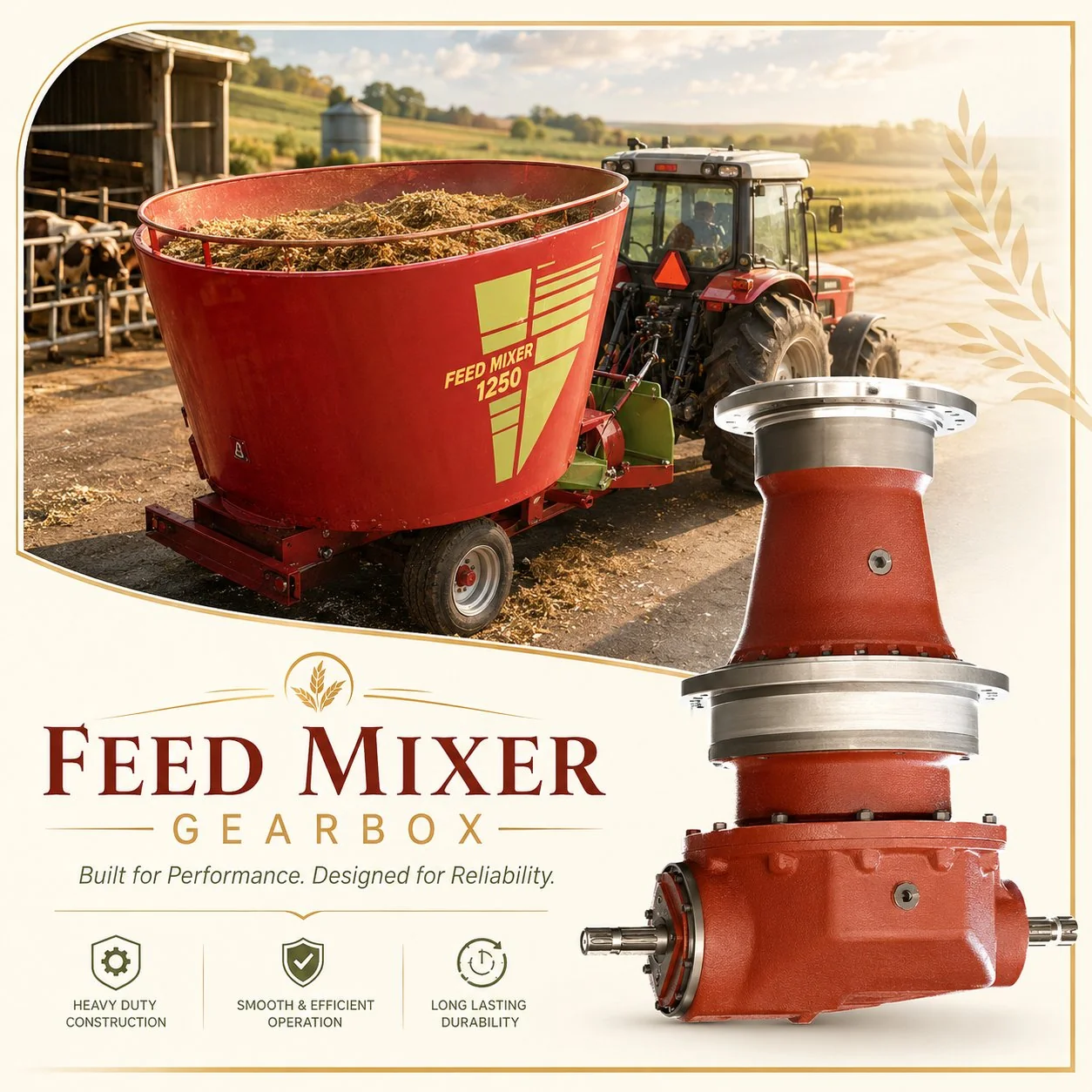
Feed mixer planetary gearbox — extreme-ratio reduction for vertical auger TMR applications
Vertical vs. Horizontal Mixer Gearbox Architecture
The two dominant TMR mixer types place fundamentally different mechanical demands on the feed mixer gearbox. A vertical auger mixer gearbox is mounted at the top of each helical screw (1.0 to 2.5 metres diameter) and drives the auger downward through a right-angle bevel input followed by multi-stage planetary reduction. It must support the full auger weight (200 to 500 kg) plus the sustained downward thrust from helical screw action — a force that can reach 30,000 to 50,000 N during heavy mixing. The thrust bearing at the output position must be specifically rated for this combined weight-plus-thrust loading.
A horizontal mixer gearbox sits at the end of a horizontal auger or paddle shaft and drives through a similar bevel-plus-planetary arrangement, but the loading is predominantly radial rather than axial — the auger weight is supported by bearings at both ends of the trough. Horizontal TMR mixer gearbox units are typically 20 to 30 percent lighter than vertical equivalents of the same capacity because they do not carry the full auger weight through the output bearing.
Planetary Gear Train: Engineering for 20,000 Nm Output
A multi-stage feed mixer planetary gearbox distributes the enormous output torque across 3 to 5 planet gears per stage, each sharing the total load equally. This load-sharing principle allows planetary architectures to transmit far higher torque in a more compact envelope than parallel-shaft arrangements — a critical advantage when the PTO gearbox must fit within the mixer tub geometry without protruding excessively above the auger mounting flange.
The planet bearings are the life-limiting component. Each planet gear rotates on its own bearing (typically needle roller or cylindrical roller) while simultaneously orbiting the central sun gear — a complex epicyclic motion that generates combined rolling and sliding contact. At 20,000 Nm output torque, the planet bearing contact stress approaches the fatigue limit of standard bearing steel (approximately 4,000 MPa for through-hardened 100Cr6). Premium agricultural gearbox manufacturers specify case-carburised bearing inner races with 60 to 62 HRC surface hardness and a minimum L10 fatigue life of 15,000 hours — equivalent to 15 to 20 years of daily operation at 2 to 3 hours per day.

Multi-stage planetary feed mixer gearbox — compact envelope, extreme torque output
Never dump a full loader bucket of feed onto a stationary auger. The instantaneous torque spike from accelerating a heavy feed mass from rest can exceed 3 to 5 times rated continuous torque — stressing planet bearings beyond their fatigue capacity and initiating damage that reduces feed mixer gearbox bearing service life by 30 to 50 percent. Always start the auger rotating before loading, and add feed in portions rather than single large dumps.
Worm Gear Alternative for Smaller Mixers
For smaller feed mixers (5 to 12 cubic metres, 25 to 60 HP PTO), a worm gear feed mixer reducer offers a cost-effective single-stage alternative. A worm gear achieves ratios of 1:10 to 1:60 in one compact stage — covering the entire mixer ratio range without multiple planetary stages. The worm also provides inherent self-locking: the output cannot back-drive the input when the PTO is disengaged, holding the auger stationary during loading without a separate brake mechanism.
Efficiency: 90 to 95%. Power delivery: 54 to 57 HP at auger from 60 HP input. Heat generation: 3.1 kW at 93% efficiency. Best for: large mixers 15 to 30 m³ where every HP matters for mixing time and fuel economy.
Efficiency: 75 to 85%. Power delivery: 45 to 51 HP at auger from 60 HP input. Heat generation: 8.9 kW at 80% efficiency. Best for: smaller mixers 5 to 12 m³ where self-locking and lower initial cost are priorities.
The 8.9 kW waste heat from an 80-percent-efficient worm gearbox raises the oil temperature by 15 to 25 degrees Celsius above what a planetary unit would reach under the same conditions — accelerating oil degradation and reducing bearing life. Worm gear feed mixer gearbox units therefore need more frequent oil changes (300 to 400 hours vs. 500 hours for planetary) and may require external cooling provisions (finned housing or oil cooler) for sustained warm-climate operation.
Technical Specifications at a Glance
PTO Driveline Matching and Start-Up Protocol
The PTO driveline connecting the tractor to the feed mixer gearbox must be rated for the full continuous power demand plus the transient overloads generated during initial feed engagement. Series 6 (540 RPM) or Series 8 (1,000 RPM) PTO shafts are the minimum specification for mixers above 15 cubic metres — the sustained torque at the gearbox input (600 to 1,200 Nm continuous at 540 RPM for 40 to 100 HP) exceeds the fatigue capacity of lighter Series 4 drivelines within two to three seasons of daily operation. The driveline length must provide adequate overlap on the telescoping spline tube at all operating positions — accounting for the vertical movement of a trailed mixer as it passes over uneven yard surfaces during filling and feeding runs.
The correct start-up procedure for a loaded feed mixer protects both the gearbox and the tractor driveline. Engage the PTO at low engine RPM (idle or just above, typically 800 to 1,000 RPM) and allow the auger to begin rotating slowly before gradually increasing engine speed to the operating PTO speed. This gradual acceleration distributes the inertial load of the feed mass over several seconds rather than imposing it as an instantaneous torque spike. On large four-auger vertical mixers filled to capacity (25 to 30 cubic metres of dense silage-based TMR at 600 to 800 kg per cubic metre), the total rotating feed mass can exceed 15,000 to 20,000 kg — and accelerating this mass from rest to full mixing speed in under one second would generate peak torques far exceeding the gearbox and driveline ratings. The idle-start protocol reduces this peak to a manageable level that the slip clutch and gearbox bearings can safely accommodate.
Slip clutch calibration on the PTO driveline should be verified at the start of each mixing season. The clutch must release at 1.5 to 2.0 times the rated continuous PTO torque — protecting the feed mixer gearbox from jam events (foreign objects caught between auger and tub wall, frozen silage blocks in winter, or overloaded mixer conditions) without false triggering during normal loaded mixing operations.
Cold-Weather Operation and Feed Mixer Gearbox Oil Selection
Feed mixers operate daily throughout winter — livestock must be fed regardless of outside temperature. At minus 10 to minus 25 degrees Celsius (typical winter mornings in northern Europe, Canada, and the northern United States), mineral ISO VG 320 gear oil becomes semi-solid, producing starting torques that can exceed the PTO slip clutch threshold and preventing the mixer from starting. Synthetic PAO-based VG 320 maintains acceptable fluidity down to minus 30 degrees Celsius — making synthetic oil a fundamental operating requirement rather than a performance luxury in any region where winter feeding is part of the management calendar.
Moisture contamination from condensation is another cold-weather challenge. The temperature differential between the warm gearbox interior (heated by mixing operation) and cold ambient air during overnight parking drives moisture into the housing through the breather vent. This accumulated moisture initiates corrosion on bearing surfaces and gear teeth. Sealed check-valve breathers (allowing warm air to escape but preventing cold, moisture-laden air from entering) and desiccant breather filters provide effective protection against condensation-driven contamination during the daily thermal cycles of winter operation.
Housing and Environmental Protection
Feed mixer gearboxes are exposed to corrosive effects of fermented silage juice and acidic leachate from mineral premixes. While the gearbox housing does not directly contact these materials, splash and spillage during loading coat exterior surfaces — requiring acid-resistant epoxy powder coating (80 to 100 micrometres minimum) and stainless steel external fasteners (drain plugs, inspection covers, mounting bolts) to prevent progressive external corrosion over the 15 to 20 year expected service life. Double-lip shaft seals with grease-purged intermediate chambers exclude both feed particles and corrosive liquid from the bearing compartment, and should be re-greased every 100 operating hours to maintain positive-pressure barrier integrity. For multi-auger vertical mixers where each auger has its own feed mixer gearbox, all seal positions across all gearboxes must be inspected and maintained simultaneously to prevent uneven contamination exposure.
Year-Round Maintenance Schedule
Oil level through sight glass or dipstick. Listen for abnormal bearing noise during the first 30 seconds. Inspect for oil leaks at shaft seal positions. Grease PTO shaft U-joints every 8 to 10 hours of mixer operation.
Full oil change with synthetic PAO ISO VG 320. Inspect magnetic drain plug for metallic particles — fine grey paste is normal; coarse chips indicate gear or bearing distress. Verify output shaft seal condition. Check auger mounting bolts for torque. Test slip clutch calibration.
Professional bearing inspection using vibration analysis. Planet bearing preload verification. Gear backlash measurement at the output stage. Replace bearings if vibration signature exceeds baseline by more than 6 dB in the bearing defect frequency band.
Aftermarket TMR Mixer Gearbox Replacement
TMR mixer gearbox replacement is driven by the extreme torque environment — planet bearing fatigue and ring gear wear eventually necessitate replacement after 10 to 20 years of daily service. Cross-reference parameters include the input spline profile (6-spline or 21-spline for 540 RPM), the output shaft flange dimensions and bolt pattern, the planetary ratio, and the thrust bearing capacity (vertical mixers). The housing external dimensions may differ between OEM and aftermarket units provided the mounting interface is dimensionally identical, but the internal gear geometry — module, tooth count, and hardness — must replicate the original output speed and torque characteristics.
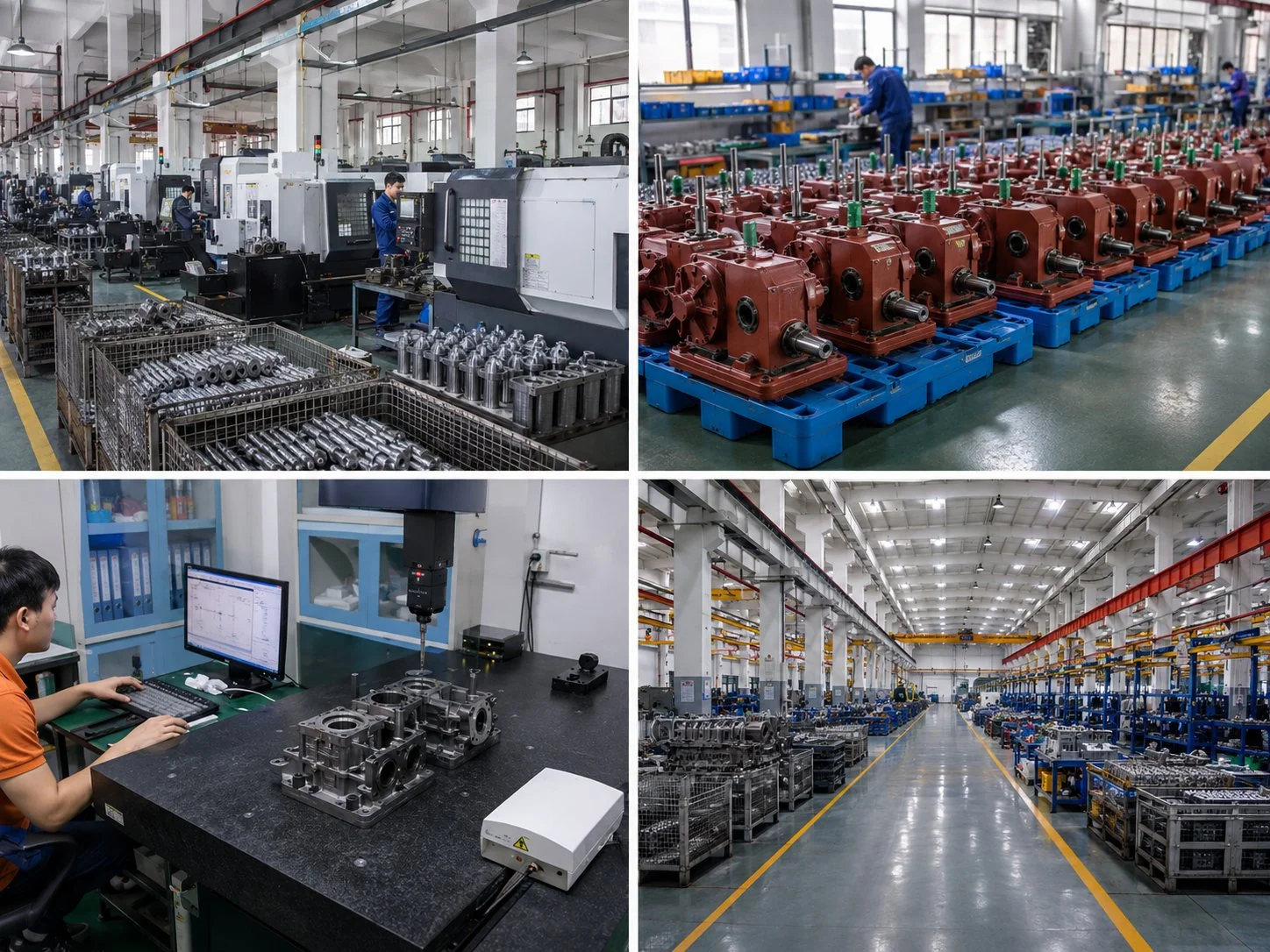
For multi-auger vertical mixers (two, three, or four augers), all gearboxes on a single machine should ideally be replaced simultaneously or from the same production batch. Mixing gearboxes with different wear levels (and therefore slightly different output speeds due to accumulated gear backlash) produce uneven auger rotation rates that degrade mixing uniformity and create unequal loading on the PTO distribution gearbox. Our engineering team at Ever-Power Agricultural Gearbox maintains cross-reference compatibility data for major brands and verifies dimensional and performance matching before shipment — eliminating field-fitment risk during the time-critical daily feeding schedule.
Frequently Asked Questions
Feed with Precision, Mix with Power
Our planetary feed mixer gearboxes deliver the extreme torque and decades-long bearing life that year-round daily livestock feeding demands — from single-auger compact mixers to four-auger high-capacity TMR systems.
Editor: Cxm