Why the Gearbox Is the Most Critical Component in a Post Hole Digger
A post hole digger is mechanically straightforward — an auger bit mounted on a shaft, connected to a gearbox, driven by the tractor’s PTO through a driveline. There is no hydraulic cushioning, no slip clutch on most economy models, and no energy-storage flywheel to smooth torque spikes. Every obstacle the auger encounters — a buried root, a seam of fractured rock, a pocket of compacted clay — transmits an instantaneous torque reaction directly through the auger shaft and into the Getriebe für Erdbohrer.
This makes the gearbox the single most vulnerable component in the system. The auger bit is replaceable for under a hundred dollars. The driveline is a standard PTO shaft assembly. The mounting frame is welded plate steel. But the gearbox — containing precision-machined spiral bevel gears, hardened shafts, tapered roller bearings, and close-tolerance seals — represents the bulk of the implement’s manufacturing cost and the bulk of its repair expense if it fails. A cracked housing or stripped gear set typically costs more to repair than the auger, driveline, and frame combined.
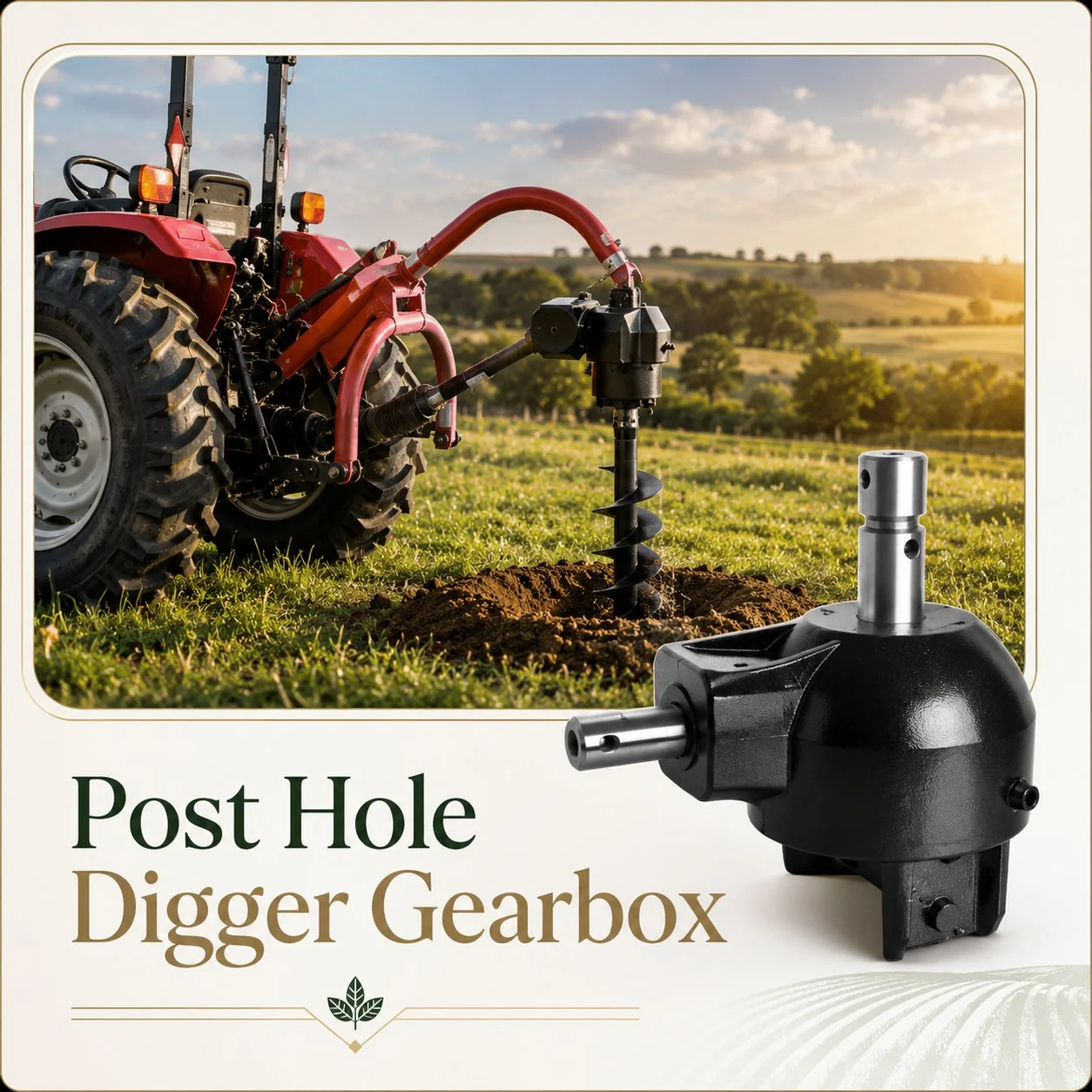
Understanding how to size this gearbox correctly — matching gear ratio, torque capacity, and spline configuration to the specific combination of auger diameter, soil conditions, and tractor power — is the difference between a post hole digger that drills thousands of holes across multiple seasons and one that fails catastrophically before the first fence line is complete.
Soil-Type-to-Torque Mapping: Quantifying the Demand
The torque required to bore a hole depends on three variables that interact in nonlinear ways: auger diameter, soil shear strength, and boring depth. Doubling the auger diameter does not simply double the torque requirement — it roughly quadruples it, because the cutting area increases with the square of the diameter while the average radius at which the cutting force acts also increases linearly. A 150 mm (6 in.) auger in clay might demand 250 Nm of sustained torque; a 300 mm (12 in.) auger in the same clay demands upwards of 1,000 Nm.
Soil shear strength varies enormously across soil classifications. Loose sandy soil offers minimal resistance — an auger advances under the weight of the digger with the gearbox barely loaded above its no-load friction level. Stiff clay with moisture content below 15% can generate specific energy requirements of 15 to 25 MJ/m³, translating into sustained torques that challenge even heavy-duty gearboxes. Rocky soils add a randomness factor that is nearly impossible to engineer around completely: a cobble caught between the auger flights and the bore wall can generate a torque spike four to six times higher than the steady-state drilling torque, lasting only milliseconds but long enough to damage gear teeth or shear a safety pin if the system does not include adequate overload protection.
Depth amplifies all these effects. As the auger descends, the accumulated spoil riding up the flights creates additional frictional torque against the bore wall. At depths beyond 900 mm (36 in.), this friction component can equal or exceed the cutting torque itself, effectively doubling the gearbox load compared to the first 300 mm of boring. Operators who bore deep holes in cohesive soils should cycle the auger — drilling 300 mm, raising to clear spoil, then drilling the next 300 mm — rather than attempting a single continuous pass that maximizes depth-related friction loading on the gearbox.
| Bodentyp | 150 mm Auger Torque | 225 mm Auger Torque | 300 mm Auger Torque | Recommended Gearbox Rating |
|---|---|---|---|---|
| Loose sand / loam | 80–150 Nm | 180–340 Nm | 350–600 Nm | Light-duty (≥800 Nm) |
| Firm clay | 200–350 Nm | 450–800 Nm | 900–1,400 Nm | Medium-duty (≥2,000 Nm) |
| Hard clay / shale | 350–600 Nm | 800–1,300 Nm | 1,400–2,400 Nm | Heavy-duty (≥3,500 Nm) |
| Rocky / fractured stone | 400–800 Nm + spikes | 900–1,800 Nm + spikes | 1,800–3,500 Nm + spikes | Heavy-duty with shear bolt (≥5,000 Nm) |
The torque values in this table represent sustained drilling torques at approximately 600 mm depth. Peak torques during rock encounters can exceed these values by a factor of 3× to 6× for milliseconds. The gearbox rating must accommodate these transient peaks without permanent deformation of the gear teeth — which means the gearbox housing and gear set must be rated for significantly more than the sustained torque alone.
Gear Ratio Selection: Balancing Speed and Torque
Post hole digger gearboxes use right-angle spiral bevel gear sets to redirect the horizontal PTO drive axis 90 degrees to the vertical auger axis. The gear ratio built into this right-angle drive determines the trade-off between auger rotational speed and available torque at the auger shaft.
A 1:1 ratio transmits the PTO speed directly to the auger — 540 RPM on a standard Category I/II PTO. At this speed, the auger advances rapidly in soft soils, making 1:1 gearboxes popular for fencing contractors working in sandy or loamy ground where productivity (holes per hour) matters more than torque capacity. However, the fast rotation speed generates higher centrifugal forces on the spoil, which can throw material out of the bore irregularly, leaving a rough-walled hole that requires more concrete to fill around the post.
Reduced ratios — 2.5:1, 3:1, and 4:1 are common — slow the auger while proportionally multiplying the torque. A 3:1 ratio on a 540 RPM PTO turns the auger at 180 RPM while tripling the available torque compared to the PTO output shaft. This slower, more powerful rotation is essential for boring in clay, shale, and partially rocky ground. The slower rotation also gives the operator more time to react to obstructions — at 540 RPM, the auger completes nine revolutions per second, leaving virtually no time to disengage the PTO before a sudden stop shears a gear tooth or twists the Zapfwelle driveline. At 180 RPM (three revolutions per second), the inertial energy stored in the rotating system is lower, and the operator has a perceptibly longer window to react.
⚙️ Ratio Selection Quick Reference
1:1 ratio (540 RPM output): Sand, light loam, coastal soils. Auger diameters up to 200 mm. Prioritizes speed over torque. Not recommended for clay or rocky conditions.
2.5:1 ratio (216 RPM output): Firm loam, moderate clay, mixed soils. Auger diameters 200 to 300 mm. Good all-purpose choice for mixed-terrain operations.
3:1 ratio (180 RPM output): Heavy clay, weathered rock, caliche. Auger diameters 250 to 350 mm. The standard recommendation for professional fence contractors.
4:1 ratio (135 RPM output): Dense shale, partially cemented ground, large-diameter boring (350 to 600 mm). Maximum torque output; often paired with rock-tooth auger bits and hydraulic down-pressure.
Spline Selection: 6-Spline, 20-Spline, and 21-Spline Interfaces
The spline connection between the tractor PTO stub and the gearbox input shaft is the torque-transmitting interface that must withstand every load the system generates — including the most violent sudden-stop events. Spline specifications on post hole digger gearboxes follow the ISO 500 series (specifically ISO 500-1 for PTO dimensions), which defines three primary configurations used worldwide.
The 6-spline 1-3/8 in. (34.9 mm) interface is associated with 540 RPM PTO systems and is found on most compact and utility tractors under 65 HP. Each spline tooth is relatively wide, providing a large contact area per tooth. However, with only six teeth distributing the torque, each tooth carries a significant share of the total load. Under extreme torque spikes — as encountered when an auger jams in rock — the shear stress per tooth can exceed the material’s yield strength, causing permanent deformation of the spline profile. This plastic deformation manifests as a “rounding” of the spline teeth that progressively worsens with each subsequent overload event until the connection slips freely.
The 21-spline 1-3/8 in. interface is the standard for 1,000 RPM PTO systems. With 21 narrower teeth distributing the torque, the load per tooth drops to roughly one-third of the 6-spline equivalent at the same total torque. This makes 21-spline connections inherently more resistant to overload damage — an important advantage for post hole diggers working in rocky soils where torque spikes are unpredictable and severe. Many heavy-duty post hole digger gearboxes specify 21-spline input connections even on tractors that also offer a 6-spline 540 RPM option, precisely because of this improved overload resilience.
The 20-spline 1-3/4 in. (44.5 mm) interface appears on high-horsepower tractors (typically above 100 HP) with 1,000 RPM PTO systems. The larger shaft diameter and 20-tooth spline provide the highest torque capacity of the three standards — suited for large-diameter auger applications (400 to 600 mm) driven by tractors in the 100 to 200 HP range. Post hole digger gearboxes with 20-spline input shafts are specialized heavy-duty units designed for commercial foundation boring, utility pole installation, and structural pier drilling, rather than general fence-post work.
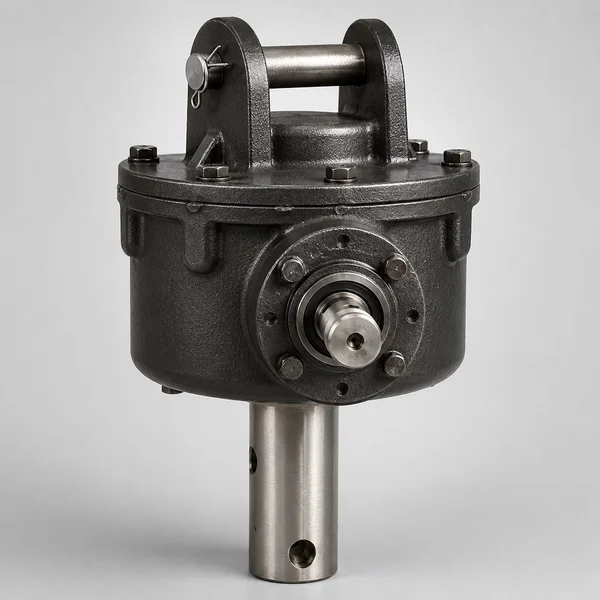
Post hole digger gearbox — right-angle spiral bevel drive with vertical auger output shaft
Intermittent Duty Cycle Analysis
Unlike a rotary cutter or tiller gearbox that runs continuously for hours, a post hole digger gearbox operates in short, high-intensity cycles: 15 to 90 seconds of boring under full load, followed by a pause while the operator repositions the tractor, sets the auger on the next mark, and re-engages the PTO. A typical fencing operation might bore 50 to 80 holes in a working day, with each boring cycle lasting under two minutes. The total accumulated PTO-engaged time might only be 60 to 100 minutes per day — far less than a mower or baler — but the intensity during each cycle approaches or exceeds the gearbox’s rated capacity.
This intermittent duty pattern has specific implications for gearbox engineering. Thermal management is less critical than in continuous-duty applications because the gearbox cools between cycles. Oil temperature rarely exceeds 50°C to 60°C in normal post hole operations, even on hot days, because the short duty cycles never allow the oil mass to absorb enough heat to reach problematic temperatures. This means the gearbox lubricant selection can prioritize viscosity stability and extreme-pressure performance over thermal conductivity — ISO VG 220 EP gear oil is the standard recommendation, and the higher viscosity provides better protection during the high-torque, low-speed conditions of auger boring than a lighter oil would.
Fatigue loading, however, is the critical concern. Each boring cycle subjects the spiral bevel gears to hundreds of high-stress tooth contacts at or near peak load. The cumulative fatigue damage from 50 to 80 such cycles per day, across hundreds of working days, is what ultimately determines gear life. The American Gear Manufacturers Association (AGMA) standard 2001-D04 classifies this pattern as “intermittent heavy-duty” and recommends gear contact stress ratings 15% to 20% above the calculated peak sustained stress to ensure adequate fatigue life. When specifying an Landwirtschaftliches Getriebe for post hole duty, verify that the manufacturer’s torque rating reflects this intermittent heavy-duty classification rather than a continuous-duty rating, which would overstate the gearbox’s capability for this specific application pattern.
Overload Protection: Shear Bolts, Slip Clutches, and Safety Valves
Post hole diggers encounter unpredictable underground obstructions that can generate instantaneous torque loads three to six times the steady-state boring torque. Without some form of overload protection, these spikes transmit directly through the gear train, the PTO driveline, and into the tractor’s PTO clutch and transmission. The resulting damage can extend far beyond the gearbox itself — broken driveline U-joints, damaged PTO clutch plates, and even cracked tractor transmission housings have been traced to a single violent auger jam in a post hole digger with no overload protection.
The simplest and cheapest protection is a shear bolt. A hardened bolt of calibrated diameter connects the auger shaft to the gearbox output. When torque exceeds the bolt’s shear strength, the bolt fractures, decoupling the auger from the gearbox within a single revolution. The gearbox, driveline, and tractor are protected. The downside is operational: replacing a sheared bolt in the field takes 5 to 15 minutes, and if shearing is frequent (common in rocky ground), it becomes a significant productivity loss. Carrying 20 to 30 spare shear bolts per day’s work is standard practice for rocky-terrain operations.
Slip clutches provide reusable overload protection. A spring-loaded clutch pack on the gearbox output shaft allows the drive to slip when torque exceeds the clutch setting, absorbing the shock without breaking any component. Once the obstruction passes, the clutch re-engages and boring continues. The trade-off is cost (a slip clutch mechanism adds 30% to 50% to the gearbox price) and the need for periodic clutch adjustment — the friction plates wear with each slip event, gradually reducing the clutch’s engagement torque until it begins slipping during normal boring rather than only during overloads. Annual inspection and adjustment of the clutch pack spring compression is necessary to maintain correct slip threshold.
Hydraulic diggers with pressure-relief valves represent the highest level of protection. Instead of a mechanical gearbox driving the auger directly, a PTO gearbox drives a hydraulic pump (a pto speed increaser gearbox configuration), and the hydraulic motor at the auger spindle is protected by a system relief valve that limits maximum pressure — and therefore maximum torque — regardless of the obstruction severity. The relief valve opens instantly, diverting flow back to the reservoir and stopping the auger within a fraction of a second. The response time is milliseconds, faster than any mechanical protection device. This is why professional utility-pole installers and structural-pier contractors almost universally use hydraulic post hole diggers for large-diameter boring in unpredictable ground.
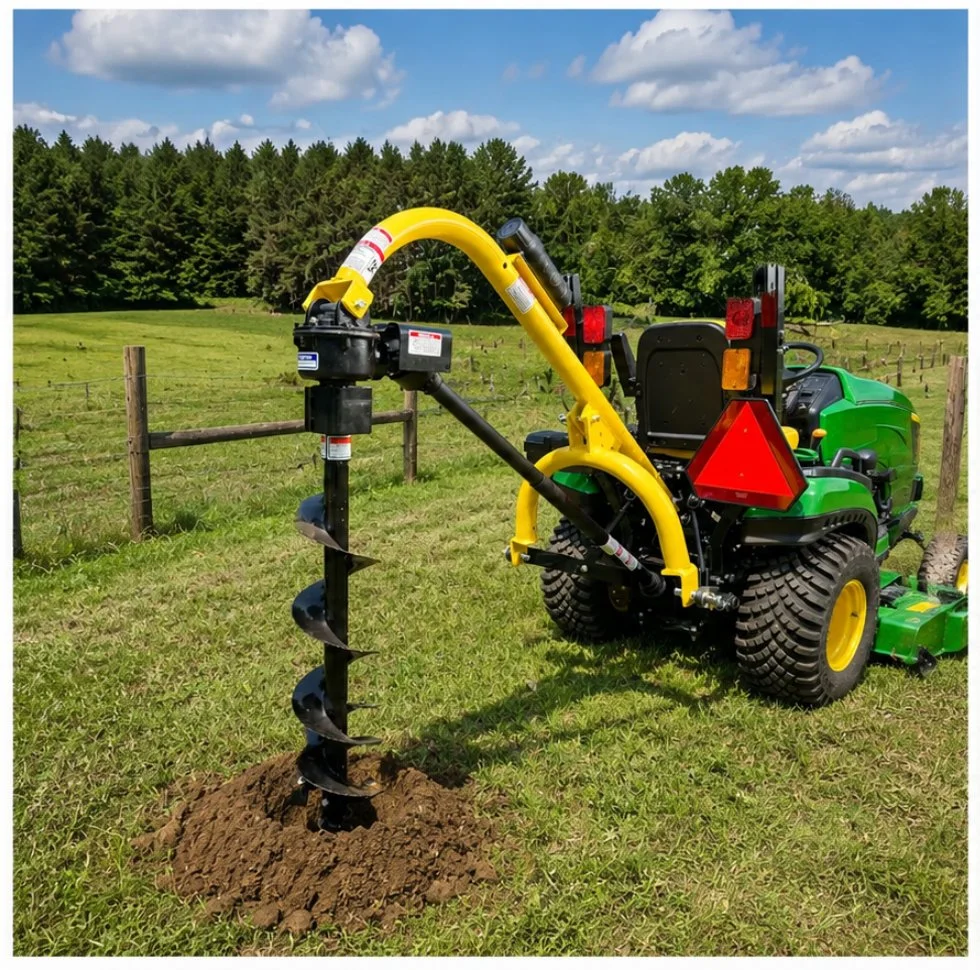
Auger Diameter vs. Gearbox Capacity: A Sizing Guide
The most common sizing mistake in post hole digger selection is matching the gearbox to the tractor horsepower while ignoring the auger diameter. A 50 HP tractor can spin a 150 mm auger all day in clay without approaching the gearbox’s limits, but fit a 350 mm rock auger to the same machine and the gearbox becomes the failure point — even though the tractor has plenty of power to turn the auger, the gearbox’s torque rating is insufficient for the forces that a large-diameter auger generates in resistant material.
The relationship is roughly cubic: torque demand scales with the square of the auger diameter (increased cutting area and cutting radius) and linearly with penetration rate (deeper bite per revolution = more soil displaced per rotation). A 300 mm auger in the same soil condition as a 150 mm auger requires approximately four times the sustained torque. If you also push the larger auger at a faster penetration rate to maintain productivity, the torque demand increases further.
🔩
Light-Duty Gearbox (≤1,200 Nm)
Augers up to 200 mm. Tractors 15–35 HP. Sandy and loamy soils only. Cast aluminum housing, 6-spline input, 1:1 to 2:1 ratio. Typical applications: garden fencing, vineyard posts in soft soil, tree planting holes.
⚙️
Medium-Duty Gearbox (1,200–3,000 Nm)
Augers 200–300 mm. Tractors 35–65 HP. Clay and mixed soils. Cast iron housing, 6 or 21-spline input, 2.5:1 to 3:1 ratio. Typical applications: agricultural fencing, vineyard trellis installation, sign posts.
🏗️
Heavy-Duty Gearbox (3,000–7,000+ Nm)
Augers 300–600 mm. Tractors 65–200 HP. Rocky ground, shale, partially cemented soils. Ductile iron housing, 21 or 20-spline input, 3:1 to 4:1 ratio. Typical applications: utility pole boring, structural pier drilling, commercial fencing in rock.
Gearbox Construction: What Separates Quality from Compromise
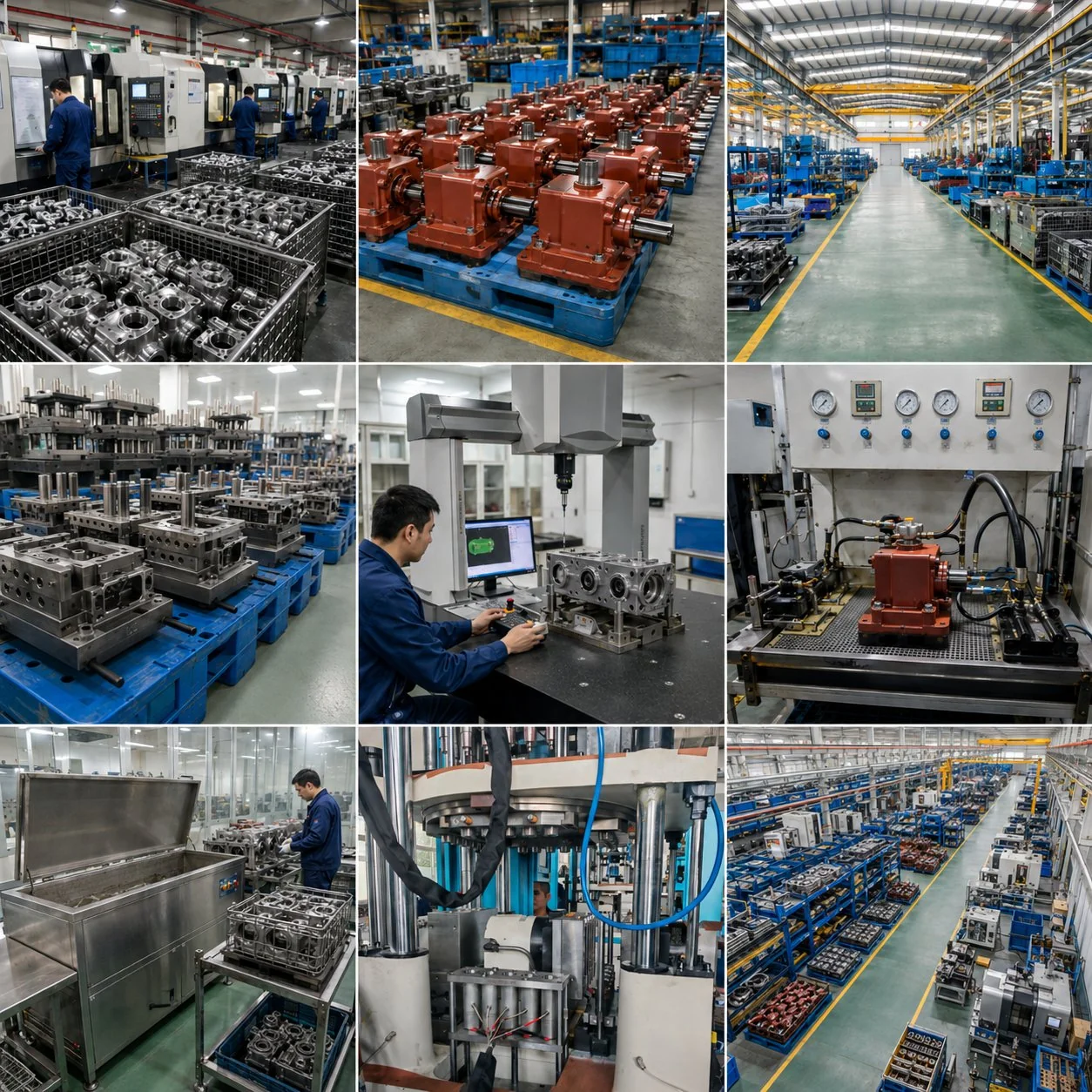
Inside a post hole digger gearbox, the core components are a matched set of spiral bevel gears, a horizontal input shaft supported by two tapered roller bearings, a vertical output shaft supported by two tapered roller bearings, and a split or single-piece housing that contains the gear mesh, bearings, seals, and lubricant. The quality of each component directly determines the gearbox’s service life under the punishing intermittent-overload duty cycle of post hole drilling.
Spiral bevel gears are used instead of straight bevel gears because the curved tooth geometry provides gradual tooth engagement — each tooth enters the mesh progressively across its face width, rather than impacting all at once. This gradual engagement distributes the shock load across a wider contact band, reducing peak contact stress by 15% to 25% compared to straight bevel teeth at the same torque. The manufacturing cost of spiral bevel gears is higher because the tooth profile requires specialized machine tools (typically Gleason or Klingelnberg generators), but the improvement in shock resistance is essential for post hole applications.
Bearing selection separates premium gearboxes from budget alternatives. Tapered roller bearings are the standard for PTO gearbox applications because they simultaneously support radial loads (from gear mesh forces) and axial thrust loads (from the spiral bevel gear’s inherent thrust component). The bearing’s dynamic load rating — published in the bearing manufacturer’s catalog — must exceed the calculated equivalent bearing load at the maximum expected torque, multiplied by the required life factor. For post hole digger gearboxes with their intermittent-overload pattern, bearing life calculations should use an application factor of 2.0 to 2.5, meaning the bearing’s dynamic capacity should be at least double the calculated steady-state load to provide adequate fatigue life under the cyclic peak loads.
Housing material affects both strength and repairability. Cast iron (grade FCD 450 or equivalent) is the standard for medium and heavy-duty post hole digger gearboxes. Ductile iron adds 40% to 80% more impact resistance compared to grey iron, which matters because housing cracks from impact overloads are a common failure mode — the entire housing flexes under extreme torque spikes, and grey iron’s low elongation (under 1%) means it cracks rather than deforming plastically. Ductile iron, with 5% to 18% elongation depending on grade, absorbs the same energy by deforming slightly without cracking, then returns to shape when the load releases. Some manufacturers use aluminum housings for light-duty gearboxes to save weight — acceptable for soft-soil applications with small augers, but unsuitable for any conditions involving rock contact.
Matching Gearbox to Tractor PTO Category
The ISO 500 standard defines PTO categories based on tractor power class, PTO shaft diameter, spline configuration, and rotational speed. Correctly matching the post hole digger gearbox to the tractor’s PTO category ensures mechanical compatibility and prevents overloading the driveline.
Category I tractors (15 to 35 HP) use a 540 RPM PTO with a 6-spline 1-3/8 in. stub. This is the lightest PTO class and pairs with light-duty post hole digger gearboxes running augers up to 200 mm in soft ground. The PTO’s torque capacity at this power and speed class is approximately 390 to 460 Nm — well matched to a gearbox with a 1:1 or 2:1 ratio driving a small auger in non-challenging soil.
Category II tractors (35 to 75 HP) also use 540 RPM with 6-spline 1-3/8 in. but deliver substantially more torque — up to approximately 1,000 Nm at the PTO stub. This is the most common category for agricultural post hole operations. A medium-duty gearbox with a 2.5:1 to 3:1 ratio multiplies this torque to 2,500 to 3,000 Nm at the auger, sufficient for 225 to 300 mm augers in firm clay.
Category III and IV tractors (75 to 200+ HP) offer 1,000 RPM PTO with 21-spline 1-3/8 in. or 20-spline 1-3/4 in. interfaces. The higher PTO speed at the same horsepower means lower torque at the PTO stub (torque is inversely proportional to speed at constant power), but the gearbox ratio compensates by multiplying torque more aggressively. A 4:1 ratio on a 1,000 RPM PTO yields 250 RPM at the auger with four times the input torque — ideal for heavy-duty commercial boring operations. Contact unser Ingenieurteam for specific gearbox recommendations matched to your tractor’s PTO category and the soil conditions at your project site.
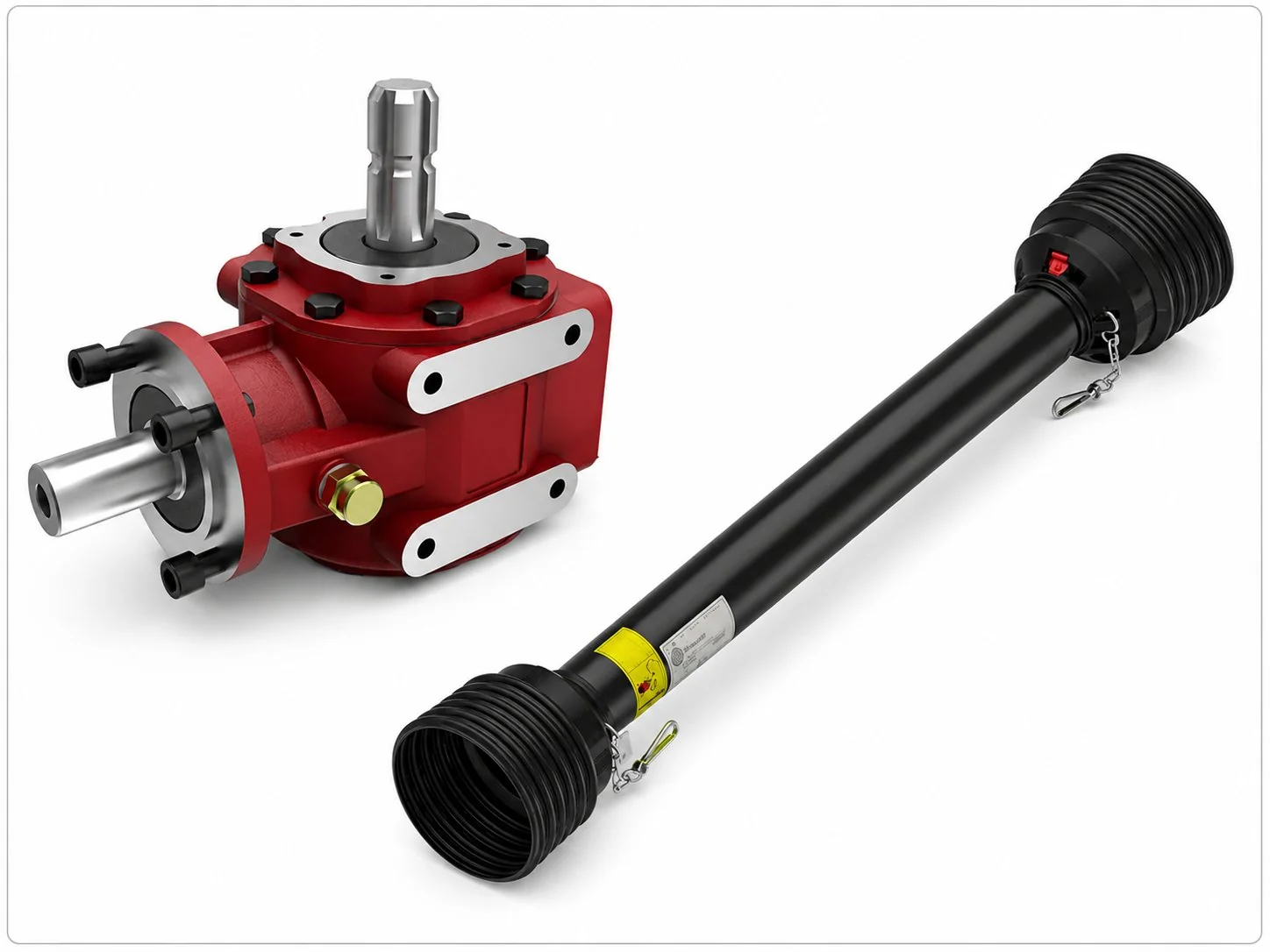
PTO gearbox and PTO shaft assembly — demonstrating the driveline connection from tractor to implement
Maintenance Essentials for Long Gearbox Life
Post hole digger gearboxes accumulate actual operating hours slowly — a machine that drills 60 holes per day for 100 working days per year may log only 150 to 200 PTO-engaged hours annually. This low hour count tempts operators into neglecting maintenance on the assumption that the gearbox “hasn’t been used much.” The reality is that those 150 hours were spent at or near maximum torque, in a dusty, muddy, debris-filled environment, and the gearbox has experienced thousands of torque spikes from underground obstructions. Time-based maintenance intervals are therefore more appropriate than hour-based intervals for most post hole digger gearboxes.
Change the gearbox oil at the start of every drilling season, regardless of hours accumulated. Drain the oil when warm (immediately after the last use of the previous season or after warming the machine with a brief run), flush the housing with clean oil, and refill with fresh ISO VG 220 EP gear oil to the correct level. Over-filling is almost as harmful as under-filling: excessive oil volume increases churning losses, raises operating temperature, and can pressurize the housing enough to blow out the input or output shaft seals.
Inspect the output shaft seal at every oil change. The output seal on a post hole digger operates in the worst possible environment — the vertical orientation means any seal leak drips oil directly onto the auger shaft and into the bore hole, contaminating the ground and signaling imminent bearing exposure to dirt and moisture. A $5 seal replacement at the annual service prevents a $500+ bearing-and-gear failure mid-season.
Check gear tooth backlash annually by locking the input shaft and rocking the output shaft. Excessive backlash (more than the manufacturer’s specified maximum, typically 0.15 to 0.30 mm for spiral bevel gears) indicates tooth wear or bearing wear that has allowed the gear mesh to open beyond design tolerance. Continued operation with excessive backlash accelerates tooth surface pitting and can lead to tooth fracture under the next significant torque spike.
Häufig gestellte Fragen
Need Help Sizing a Post Hole Digger Gearbox?
From light-duty garden post installations to heavy commercial pier boring, our engineering team provides expert gearbox selection, custom ratio configurations, and OEM replacement units backed by 20+ years of agricultural gearbox manufacturing.
Herausgeber: Cxm