What Is a Center Pivot Irrigation Gearbox?
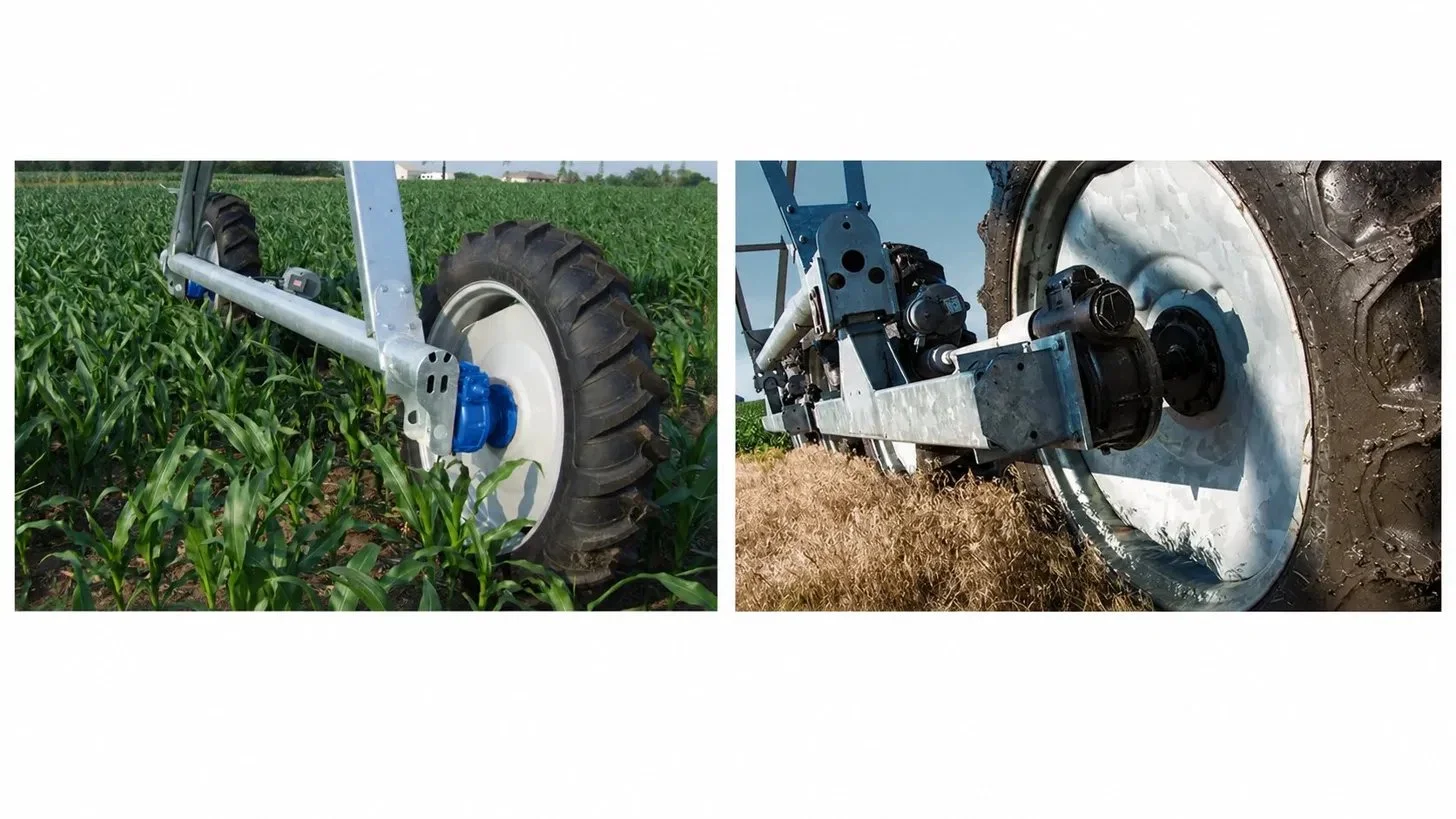
A center pivot irrigation gearbox is the sealed worm-gear drive unit mounted at each tower leg of a center pivot or linear-move irrigation system. Each tower has two drive wheels, and each wheel is powered by a small electric motor (0.37 to 1.5 kW) through an irrigation wheel drive gearbox that provides extreme speed reduction — typically 40:1 to 60:1 — converting motor speed (1,450 to 1,750 RPM) into the very slow wheel rotation (0.5 to 2 RPM) needed to move the tower along its circular or linear path at speeds of just 1 to 5 metres per minute.
A single center pivot system may span 400 to 800 metres from the central point to the last tower, irrigating 50 to 200 hectares in a single full-circle pass. The system consists of 5 to 12 tower spans, each requiring two center pivot irrigation gearbox units — meaning a single pivot installation contains 10 to 24 gearboxes, all of which must function reliably for 10 to 25 years in continuous outdoor exposure to sun, rain, frost, mud, and dust. This extreme environmental endurance requirement — combined with the self-locking, low-maintenance, and high-reliability demands — makes the irrigation gearbox one of the most specialised gearbox applications in agriculture.
How the Tower Drive System Works
The outermost tower of a center pivot must travel the longest arc distance to complete each revolution — and it defines the system rotation speed. Each inner tower must travel a proportionally shorter distance, moving in intermittent bursts timed by an alignment system that keeps all spans in a straight line. The last tower moves almost continuously while inner towers move and pause in alternating cycles. The pivot drive gearbox at each wheel receives start-stop commands from the alignment control — energising the electric motor to advance the tower and de-energising it when alignment is restored.
The alignment system uses microswitches or resolver sensors mounted on each tower to detect the angular position relative to the adjacent span. When the outer tower (which moves continuously or near-continuously) pulls ahead of an inner tower by more than the alignment tolerance (typically 1 to 3 degrees of arc), the inner tower motor is energised to advance that span until alignment is restored. On a 10-tower system, this cascading alignment process means the innermost towers may cycle on and off hundreds of times per revolution — each cycle imposing a start-stop torque event on the center pivot irrigation gearbox at that tower position.
This intermittent start-stop duty produces the most demanding loading pattern for the irrigation gearbox: every start event requires the motor to accelerate the tower mass (1,000 to 3,000 kg per tower span plus the water load in the pipe) from rest — a start-up torque spike of 2 to 4 times running torque that repeats hundreds of times per irrigation cycle. Over a 10 to 25 year service life, a single center pivot irrigation gearbox accumulates millions of start-stop cycles — a fatigue loading pattern that the worm and wheel gear set must endure without tooth surface failure or excessive wear.
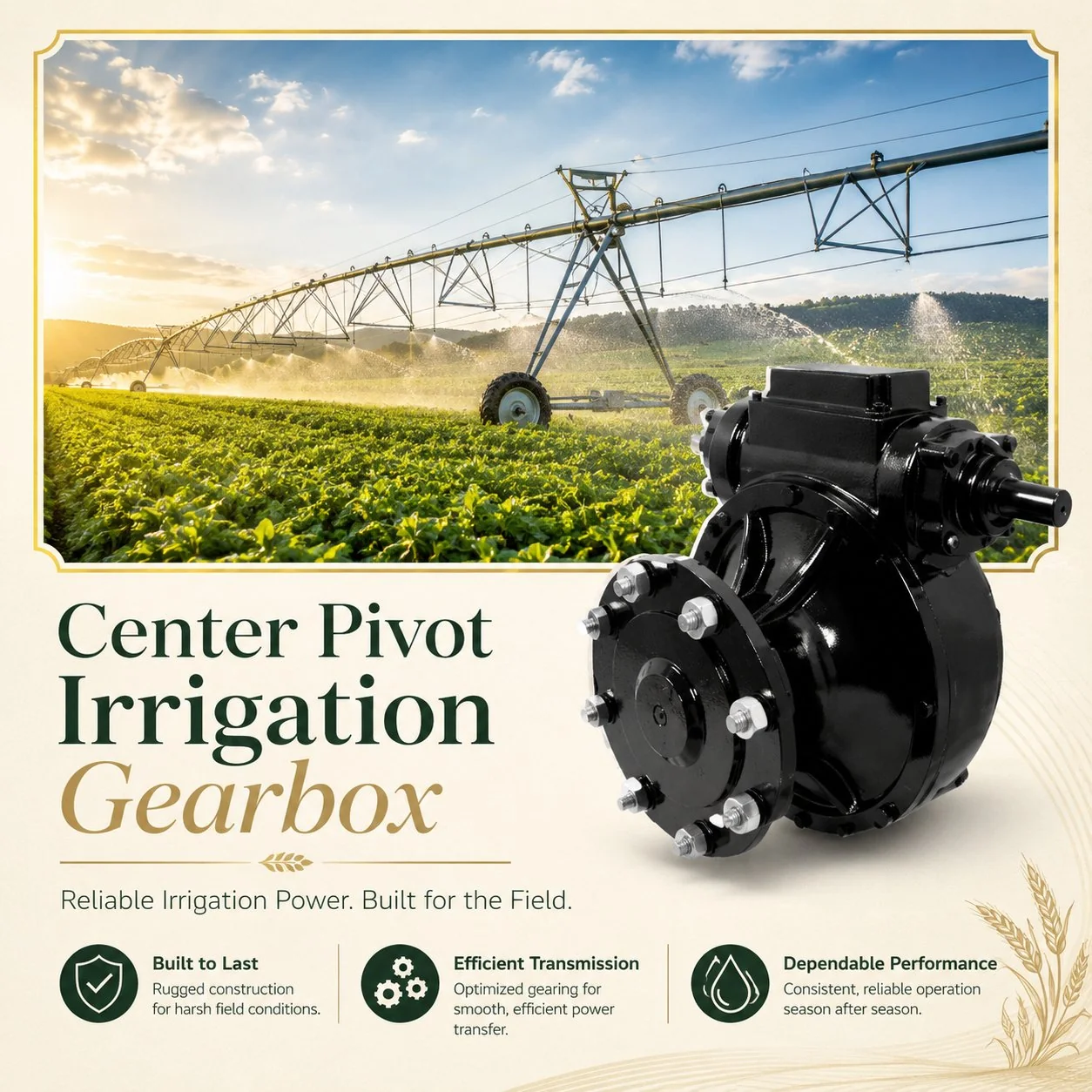
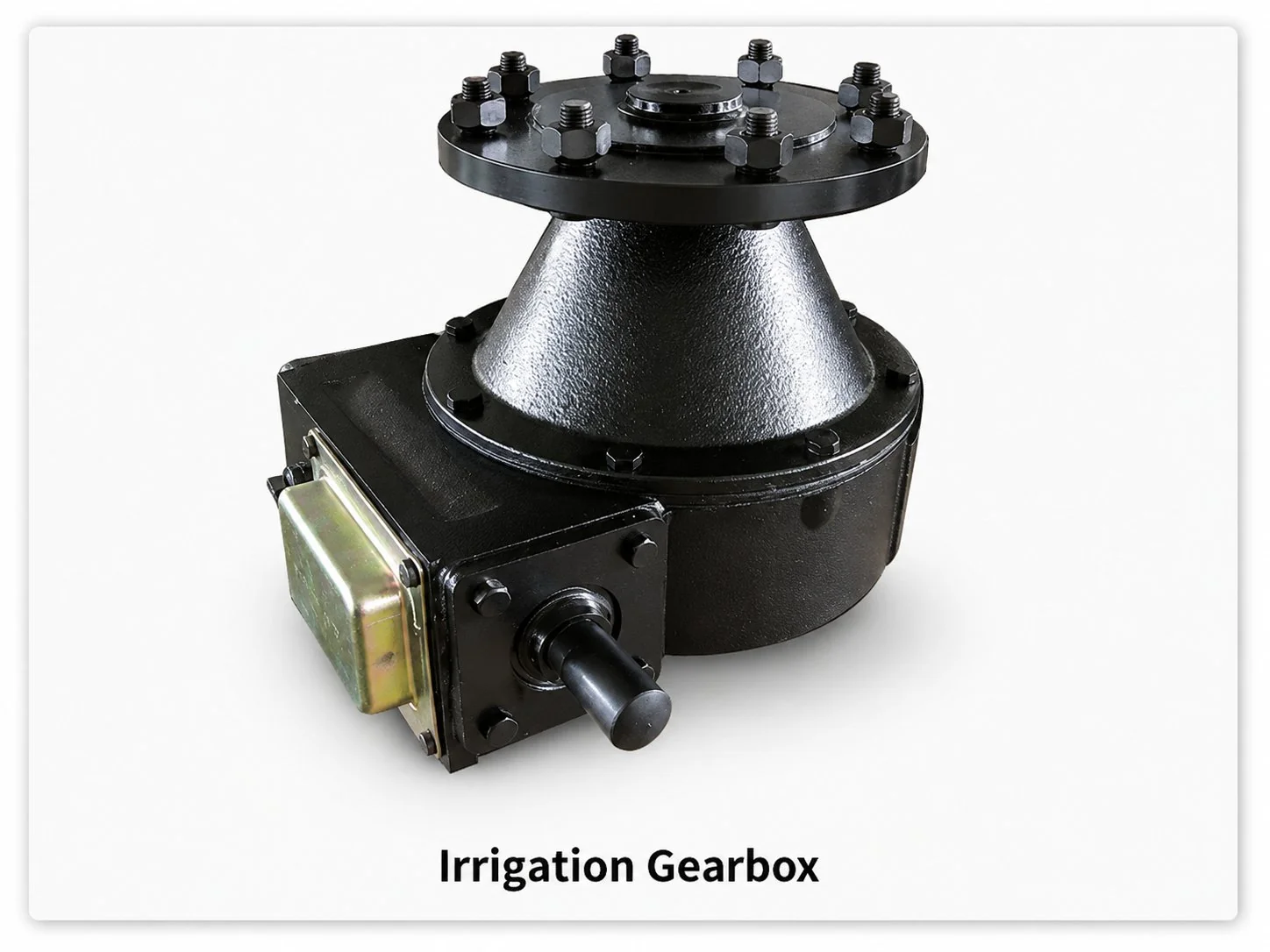
Center pivot irrigation gearbox — worm gear tower wheel drive with weather-sealed housing
Why Worm Gear: Self-Locking and Extreme Ratio in One Stage
The worm gear is the standard architecture for center pivot irrigation gearbox applications for two essential reasons. First, a single worm-and-wheel stage achieves ratios of 40:1 to 60:1 — the extreme reduction needed to convert 1,450+ RPM motor speed to sub-2-RPM wheel speed. Achieving this ratio with bevel or helical gears would require three or four gear stages (increasing cost, complexity, and failure points). Second, the worm gear provides inherent self-locking: at ratios above approximately 30:1 with standard friction coefficients, the output (wheel) cannot back-drive the input (motor) — meaning the tower holds its position when the motor is de-energised without requiring a separate brake mechanism.
Without self-locking, a center pivot irrigation gearbox would require an external brake at each tower to prevent wind, gravity (on sloping ground), or water pressure from pushing the tower out of alignment when the motor is off. A brake failure on even one tower would allow that span to drift — potentially collapsing the entire pivot structure. The inherent self-locking of the worm gear eliminates this single-point-failure risk entirely, providing passive, maintenance-free position holding at every tower regardless of external forces.
The trade-off for worm gear self-locking is lower mechanical efficiency. A self-locking irrigation gearbox at 50:1 ratio typically operates at 35 to 50 percent efficiency — meaning 50 to 65 percent of the motor input power is converted to heat rather than output torque. While this would be unacceptable in a high-power application, it is tolerable for irrigation drives because the absolute power level is low (0.37 to 1.5 kW) and the intermittent duty cycle allows cooling between operating bursts. The heat generated during each tower movement (typically 30 to 120 seconds of motor-on time followed by a pause) dissipates through the housing before the next cycle begins.
Center Pivot vs. Linear Move: Gearbox Requirements
Worm and Wheel Materials for Decade-Long Life
The worm shaft in a center pivot irrigation gearbox is machined from case-hardened alloy steel (typically 20CrMnTi or equivalent) with surface hardness of 58 to 62 HRC. The worm wheel (the large gear driven by the worm) is cast from centrifugally-cast phosphor bronze (CuSn10P or CuSn12) — a material chosen specifically for its compatibility with the hardened steel worm. The bronze wheel provides lower friction against the hardened worm than a steel-on-steel pair, better conformability during the running-in period (the soft bronze deforms microscopically to conform to the worm thread profile), and superior resistance to seizure under boundary-lubrication conditions.
The pivot drive gearbox bearing arrangement must handle the combined radial and thrust loads from the worm mesh forces and the external wheel loads (tower weight, ground reaction, wind forces). The worm shaft is supported by tapered roller bearings (handling both radial load and the axial thrust from the worm helix angle), while the wheel shaft uses deep-groove ball or tapered roller bearings rated for the low-speed, high-torque output conditions. Sealed bearing arrangements with synthetic grease fill (rated for minus 30 to plus 120 degrees Celsius) are specified to match the extreme temperature range of year-round outdoor exposure.

Irrigation wheel drive gearbox — worm and bronze wheel for extreme reduction and self-locking
Weather Sealing: Year-Round Outdoor Exposure
Unlike most agricultural gearboxes that are stored under cover during the off-season, the center pivot irrigation gearbox remains permanently mounted on the tower legs — exposed to sun, rain, snow, frost, wind-blown soil, and standing water (the wheel and lower gearbox housing are frequently submerged during irrigation in low-lying areas or heavy soils). This permanent outdoor exposure demands IP65 or IP67-equivalent sealing at every housing joint, shaft exit, and breather position.
Double-lip shaft seals at all exits. Housing split-line O-rings with chemical-resistant elastomer. Sealed breather valve (no desiccant — must withstand submersion). Epoxy powder coating at 100+ micrometres. Stainless steel external fasteners. Drain plug positioned for easy seasonal water purging.
Operating range: minus 30 to plus 50 degrees Celsius ambient. Synthetic oil maintains fluidity at minus 30 (mineral oil solidifies). UV-resistant housing coating (standard paint degrades in 2 to 3 years of direct sun exposure). Thermal cycling tolerance: daily swings of 30 to 40 degrees without seal hardening or housing cracking.
Technical Specifications at a Glance
Center Pivot Gearbox Oil and Lubrication
The correct center pivot gearbox oil is synthetic PAO EP ISO VG 320 — the heavier grade providing the thick oil film that the sliding worm-wheel contact requires at the low speeds and high contact pressures of irrigation duty. The synthetic base stock is mandatory (not optional as in some other agricultural gearbox applications) because the gearbox operates across an extreme temperature range: it must start and function at minus 30 degrees Celsius in winter-storage regions and survive sustained ambient temperatures above 40 degrees Celsius during summer irrigation in arid climates. Mineral VG 320 becomes semi-solid below minus 5 degrees Celsius — making it unsuitable for any installation in a climate with sub-zero temperatures.
Oil change intervals for center pivot irrigation gearbox units are typically 2,000 to 4,000 operating hours or every 2 to 5 years — significantly longer than most agricultural gearboxes because the intermittent duty cycle and low power level produce minimal oil degradation per operating hour. However, the primary concern is water contamination rather than thermal degradation. If the housing seals allow rainwater or irrigation water ingress, the oil emulsifies and loses its load-carrying capacity — producing rapid bronze wheel wear and worm scoring. Check oil condition annually (milky appearance indicates water contamination requiring immediate change), and verify housing seal integrity at the start of each irrigation season.
Terrain Challenges and Gearbox Loading on Slopes
Center pivots often operate on undulating terrain where some towers travel uphill while others travel downhill during the same rotation. On sloping ground (2 to 8 percent grade), the downhill tower gearboxes must resist the gravitational force that tries to push the tower ahead of the alignment — relying on the worm gear self-locking to hold position during each pause in the start-stop cycle. The uphill tower gearboxes must overcome both the tower mass friction and the gravitational component — increasing the motor torque demand by 20 to 40 percent compared to flat-ground operation. Gearboxes for hilly installations should be specified with a minimum 20 percent power margin above the flat-ground requirement to accommodate slope-related torque increases without exceeding the motor thermal capacity.
Soft, muddy soil conditions produce another loading challenge. When drive wheels sink into saturated soil (common in the irrigated zone directly beneath the pivot spans), the rolling resistance increases dramatically and the wheel may need to climb out of a rut at each start event — producing start-up torques that approach the stall capacity of the motor. Wide-flotation tyres (reducing ground pressure), concrete wheel tracks (eliminating rutting), and appropriately sized motors and gearboxes all contribute to reliable tower advancement under soft-soil conditions. The irrigation final drive gearbox must be rated for the worst-case start-up torque from muddy conditions, not the steady-state running torque on firm ground.
Maintenance Schedule
Check oil level and condition at every gearbox (milky oil means water ingress — change immediately). Inspect housing for cracks or corrosion. Verify shaft seal integrity. Check mounting bolts. Rotate each wheel by hand to verify smooth gearbox action — roughness indicates bronze wear or bearing damage.
Full oil change with synthetic VG 320 at every gearbox on the system. Inspect magnetic drain plug for bronze particles (indicating worm wheel wear). Check output shaft play for excessive radial or axial movement. Verify motor alignment and coupling condition.
Professional inspection of worm wheel wear pattern. Bronze wheel thickness measurement (replace if worn beyond minimum specification). Bearing replacement if vibration or play exceeds limits. Consider proactive replacement of all gearboxes as a set to maintain uniform performance across the system.
Aftermarket Center Pivot Gearbox Replacement
Center pivot gearbox replacement is typically triggered by bronze worm wheel wear (the wheel is the sacrificial wear component — designed to wear preferentially against the hardened steel worm so that the more expensive worm survives multiple wheel replacements). After 10 to 25 years and millions of start-stop cycles, the bronze wheel teeth thin to the point where the tooth contact pattern shifts, increasing noise, backlash, and the risk of tooth breakout under start-up torque. Cross-reference parameters include the worm ratio, output shaft size and keyway, housing mounting bolt pattern, motor flange configuration, and the wheel shaft height (centre distance from motor axis to wheel axis).
Our engineering team maintains cross-reference data for major pivot brands (Valley, Reinke, Zimmatic, T-L, and equivalent OEM specifications). Both complete gearbox assemblies and individual bronze wheel replacement kits are available. For large irrigation operations with 5 to 20+ pivots, proactive system-wide gearbox replacement programmes — replacing all gearboxes on all pivots on a scheduled cycle — prevent the unpredictable mid-season failures that risk crop water stress during the most critical growth stages.
Frequently Asked Questions
Irrigate with Confidence, Decade after Decade
Self-locking, weather-sealed pivot gearboxes with 10 to 25 year service life — from single-pivot farms to multi-system commercial irrigation operations.
Editor: Cxm