Why Gearbox Noise Is Not Just Noise
Matag PTO gearbox produces some operating sound — gear mesh has an inherent frequency signature, bearings generate a low background hum, and oil splash creates faint churning noise. That baseline is normal. The diagnostic value lies in changes from normal: new sounds, increasing amplitude, different frequency, or vibration you can feel through the implement frame that was not there before.
Noise and vibration analysis is the most accessible predictive maintenance tool available to equipment operators. Unlike oil analysis or thermal imaging, it requires no special equipment — just trained attention. This guide provides a structured framework for interpreting what your gearbox is communicating through sound and vibration.
Severity Classification: When to Act
Before diagnosing root causes, classify the severity of the noise or vibration to determine how urgently you need to respond:
| Severity | Symptoms | Timeline | Aksyon |
|---|---|---|---|
| Ubos | Slight new hum at steady speed; no vibration increase | Weeks to months | Monitor; check oil level and condition; note pattern |
| Medium | Audible whine or rumble; mild vibration felt on housing | Days to weeks | Diagnose root cause; plan repair; order parts |
| Taas | Grinding, clanking, or knocking; strong vibration; intermittent | Hours | Stop immediately; inspect before continuing |
| Critical | Metal-on-metal screeching; visible debris in oil; seizure risk | Immediate | Shut down PTO; do not restart until inspected |

Root Cause 1: Gear Whine
What it sounds like: A steady, high-pitched tonal whine that rises and falls with PTO speed. The frequency is directly proportional to gear mesh speed — if you increase engine RPM, the whine pitch increases proportionally.
What is happening: Gear whine originates from the periodic engagement and disengagement of gear teeth as they mesh. All gears produce a mesh frequency, but excessive whine indicates one or more of these issues:
🦷
Tooth Surface Wear
Pitting, scoring, or uneven wear on the gear tooth contact surface changes the engagement pattern. The worn teeth create irregular mesh contact, generating sound energy at the mesh frequency and its harmonics.
📏
Incorrect Backlash
Too little backlash causes gear teeth to bind and release, generating whine. Too much backlash allows tooth impact during load reversals. Both conditions produce distinctive tonal patterns at the mesh frequency.
🛢️
Lubricant Degradation
Contaminated, oxidized, or low-level oil reduces the hydrodynamic film between teeth, increasing metal-to-metal contact. Whine that appears suddenly after extended service often traces back to an overdue oil change.
Diagnostic step: Drain a sample of gear oil and inspect it. Dark, opaque oil with a burnt smell indicates thermal degradation. Metallic particles suggest active gear surface damage. Fresh oil alone may resolve a whine caused by contamination; if the whine persists with clean oil, the gear surfaces are worn.
Root Cause 2: Bearing Rumble
What it sounds like: A low-frequency rumble or growl — deeper and less tonal than gear whine. Unlike whine, it often varies more with load than with speed. It may come and go as the bearing defect rotates in and out of the loaded zone.
What is happening: Bearing damage creates irregular contact between the rolling elements (rollers or balls) and the races. The damage types have distinct characteristics:
Spalling (Race Damage)
Subsurface fatigue causes material to flake off the race surface. Rollers hitting the damaged area produce a rhythmic rumble that repeats once per shaft revolution. This is the most common bearing failure mode in gearbox sa agrikultura applications — caused by overloading or inadequate pre-load.
Brinelling (Dent Damage)
Static overload or impact creates permanent dents where rollers contact the race. The roller bumps over these dents with each revolution, producing a rhythmic thumping pattern. Common after a PTO gearbox has been dropped during installation or subjected to extreme shock loads.
Contamination Wear
Abrasive particles in the oil (from seal failure, contaminated refill, or internal wear debris) score both races and rollers. The resulting noise is a broadband grinding or hissing rather than a rhythmic pattern — because the damage is distributed across the entire race surface.
Diagnostic step: Place your hand flat on the gearbox housing while it is running (use caution — avoid rotating parts). If vibration increases under load and the frequency is low, it is likely bearing-related. Compare intensity between the input and output sides of the housing to localize which bearing is affected.
Root Cause 3: Shaft Misalignment and Driveline Issues
What it sounds like: A pulsing vibration that cycles once per revolution of the PTO shaft, often accompanied by a low-frequency knocking or clunking from the driveline area. The vibration may be visible — you can see the implement frame shaking at low RPM.
What is happening: Misalignment between the tractor PTO output and the gearbox input creates cyclic forces that the gearbox was not designed to handle. Sources include:
Excessive U-joint angle — PTO shaft universal joints operating above 25° create Cardan error: cyclic speed variation within each revolution. This sends pulsing torque spikes into the gearbox input bearing.
Worn U-joints — Journal cross bearings with perceptible play allow the driveline to whip and vibrate. The gearbox input shaft absorbs these cyclic side loads, overloading the input bearing.
Unequal U-joint phasing — If the yokes at each end of the driveline are not phased correctly (in line), the Cardan errors from each joint do not cancel — they add, doubling the vibration amplitude.
Diagnostic step: Disconnect the PTO shaft and run it briefly at low RPM unloaded. If the vibration is present in the driveline alone, the issue is in the shaft — not the gearbox. Check U-joint play by hand; any perceptible free play means replacement is needed.
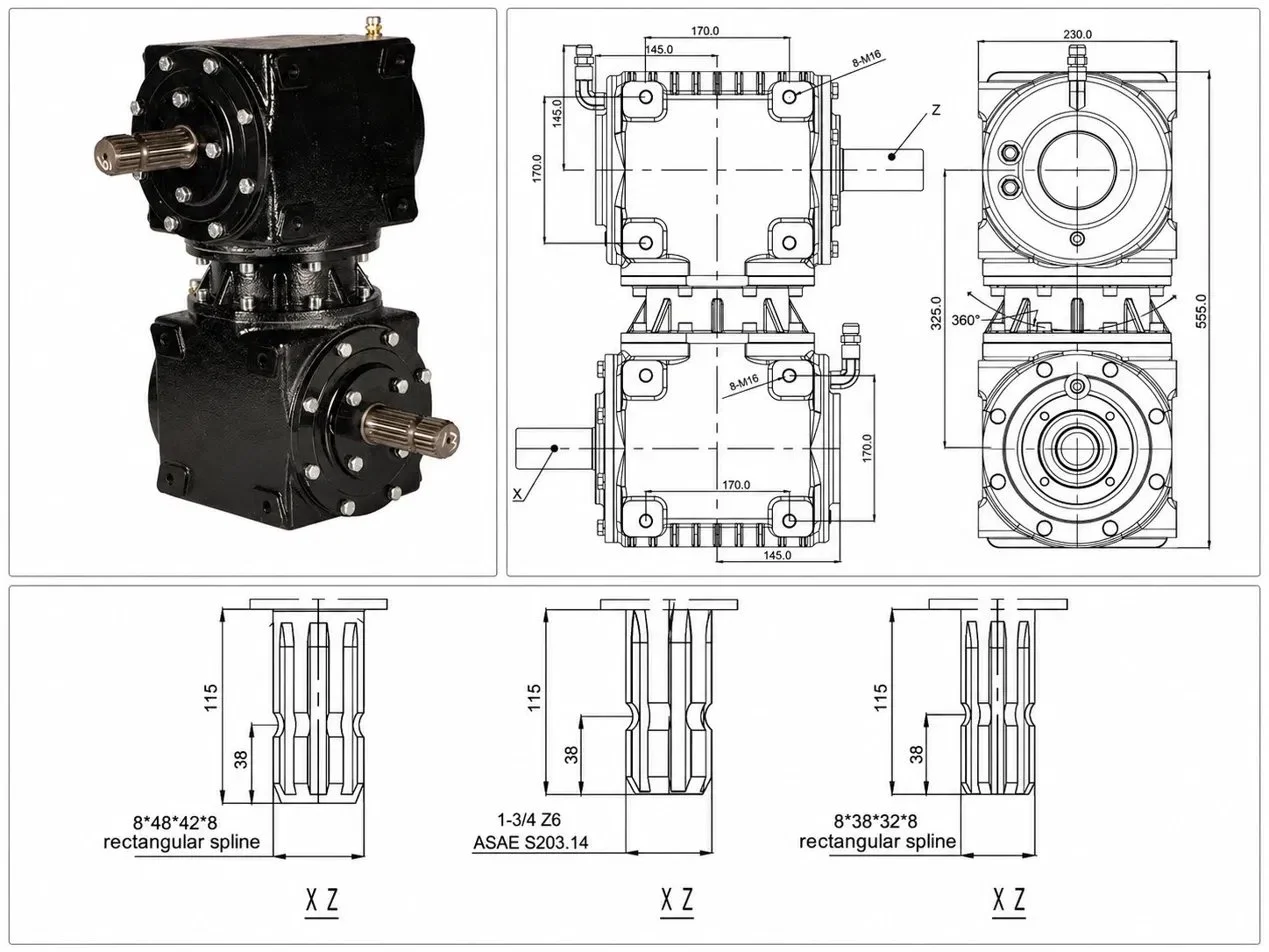
Dimensional reference showing input shaft alignment and mounting configuration — misalignment here creates vibration throughout the drivetrain
Root Cause 4: Housing Resonance and Structural Vibration
What it sounds like: A booming or droning noise that seems louder than the gearbox should produce for its size. The housing itself vibrates noticeably, and the noise may change pitch if you press on the housing or tighten a mounting bolt.
What is happening: The gear mesh frequency or one of its harmonics coincides with a natural resonant frequency of the gearbox housing. The housing amplifies the vibration energy like a bell, making an otherwise normal gear mesh sound dramatically louder. This is more common in:
Thin-walled cast housings — Budget gearboxes often use thinner housing sections to save material cost. Thinner walls have lower natural frequencies that are more likely to be excited by gear mesh.
Loose mounting bolts — A gearbox that is not rigidly mounted to the implement frame can vibrate at frequencies it would not if properly restrained. Always check mounting bolt torque before assuming internal gearbox problems.
Cracked housings — A crack changes the housing stiffness, shifting its resonant frequency. A gearbox that suddenly becomes louder without any other change may have a developing crack. Inspect mounting lugs and bolt-hole areas carefully.
Diagnostic step: Verify all mounting bolts are torqued to specification. If the noise persists, change engine RPM slowly — if the noise peaks at a specific RPM and diminishes above and below it, you have identified a resonance condition.
Quick Diagnostic Reference Table
Use this reference to quickly narrow down the root cause based on the characteristics of the noise or vibration:
| Sintomas | Frequency | Varies With | Most Likely Cause |
|---|---|---|---|
| High-pitched whine | Gear mesh frequency | RPM (speed) | Gear tooth wear, backlash, or oil issue |
| Low rumble or growl | Shaft frequency | Load (torque) | Bearing spalling or brinelling |
| Rhythmic clunking | Once per revolution | RPM | Chipped gear tooth or driveline imbalance |
| Pulsing vibration | 1× or 2× shaft speed | RPM | Shaft misalignment or U-joint wear |
| Booming / droning | Peaks at specific RPM | RPM band | Housing resonance; check mounting bolts |
| Broadband grinding | No clear frequency | Constant | Contaminated oil or advanced internal wear |
Preventing Noise and Vibration Before They Start
Most pag-troubleshoot sa kasaba ug vibration sa gearbox situations are preventable. These practices keep your PTO gearbox operating within its design envelope:
Change oil at the specified interval — EP 80W-90 gear oil, changed every 75–100 hours depending on application severity. Oil is the primary defense against gear surface wear and bearing damage.
Maintain PTO driveline condition — Replace U-joints and slip joint components before they develop play. Driveline vibration is the number-one external cause of premature gearbox bearing failure.
Check mounting bolts periodically — Vibration loosens mounting hardware over time. Loose mounting changes gearbox dynamic behavior and accelerates housing fatigue.
Establish a noise baseline — The first time you run a new gearbox, listen carefully and note the normal operating sound at various speeds. Any future deviation from that baseline is your early warning signal.

When Noise Means Replacement Is the Right Decision
Not every noise problem can be solved with oil, alignment, or component replacement. If your PTO gearbox exhibits any of these signs, replacement is more cost-effective than repair: grinding metal-on-metal sounds that persist regardless of operating conditions, visible gear tooth fragments in the drained oil, housing cracks at mounting lugs or split-line seams, or bearing seizure marks on the input or output shaft. These conditions indicate cascading internal damage where repairing one component does not address the secondary damage already done to adjacent parts.
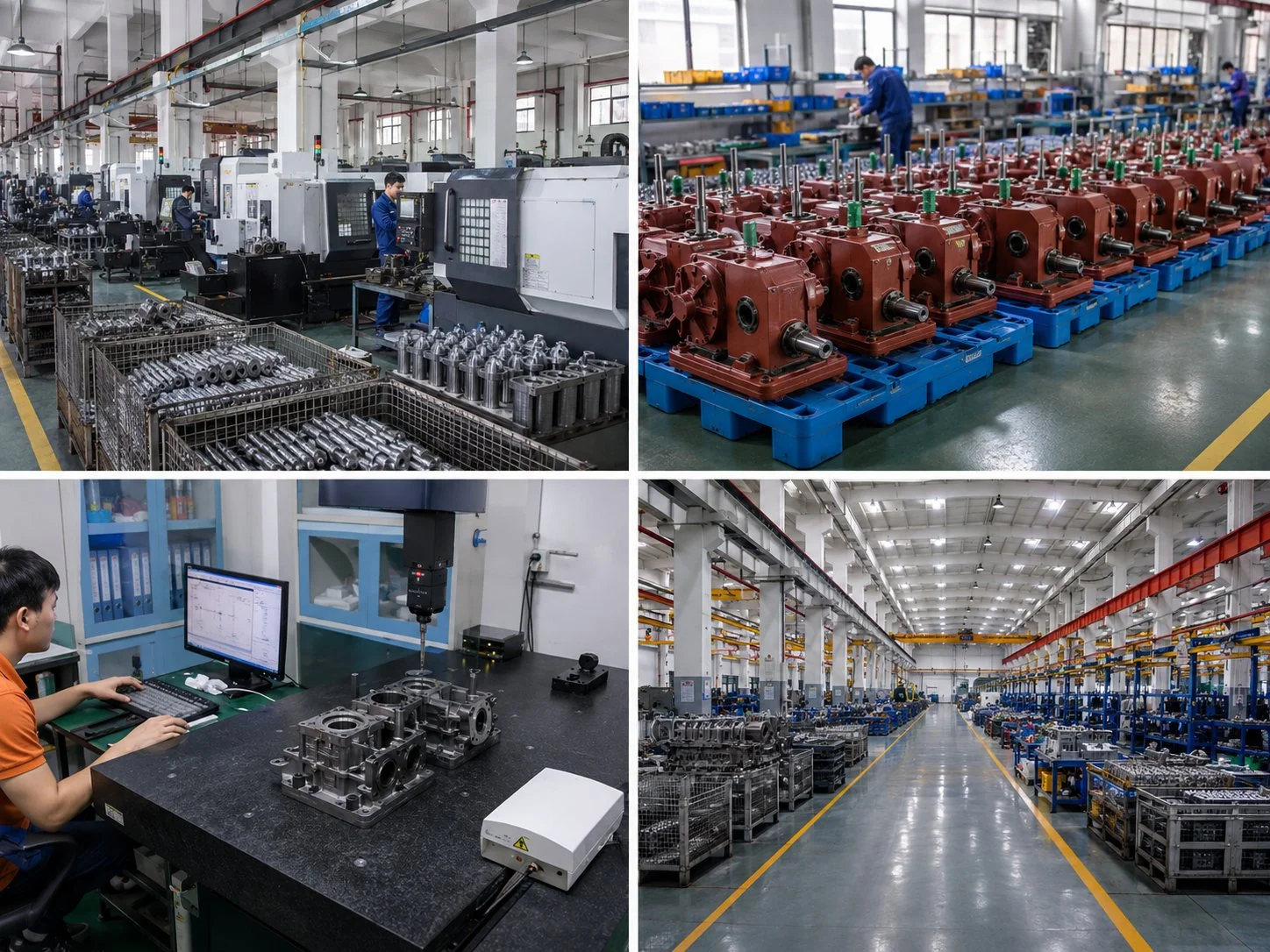
When a replacement is needed, a quality manufacturer like Kanunay nga Gahum nga PTO Gearbox tests every unit under load before shipment — confirming noise level, vibration, temperature rise, and seal integrity are within specification. This means your replacement arrives ready to install with a verified noise baseline from the factory.
Mga Kanunayng Gipangutana nga Pangutana
Need Help Diagnosing Your Gearbox?
Our engineers diagnose noise and vibration issues daily. Whether you need a replacement gearbox or want to identify the root cause before ordering, we provide expert technical support backed by 20+ years of gearbox sa agrikultura manufacturing.
Editor: Cxm