Why Pump Speed Accuracy Determines Performance
A centrifugal pump’s performance — flow rate, discharge pressure, and power consumption — is governed by the affinity laws, which describe a mathematical relationship between pump speed and output that is as precise as it is unforgiving. Flow rate changes proportionally with speed: a 10 percent speed reduction produces a 10 percent flow reduction. Discharge pressure (head) changes with the square of speed: that same 10 percent speed reduction drops pressure by 19 percent. And power consumption changes with the cube of speed: the 10 percent speed reduction cuts power demand by 27 percent. These relationships mean that even a modest error in PTOギアボックス ratio — producing 2,600 RPM instead of the pump’s design speed of 2,900 RPM — reduces flow by 10 percent, pressure by 20 percent, and shifts the pump’s operating point off its efficiency curve into a region of higher vibration, increased cavitation risk, and accelerated seal wear.
The cube-law power relationship also works in reverse and with potentially dangerous consequences. Running a centrifugal pump 10 percent above its design speed increases power consumption by 33 percent — potentially overloading the tractor PTO and the gearbox beyond their rated capacity. A farmer who swaps a gearbox for one with a slightly higher ratio (intending to increase irrigation flow by 10 percent) actually increases the gearbox power demand by a third, with the very real possibility of overheating the gearbox, stalling the tractor engine, or triggering the PTO overload protection. This non-linear relationship between speed and power is the fundamental reason why PTO pump gearbox ratios must be precisely matched to the pump’s design speed rather than approximated.
Centrifugal Pump Drive: The Most Common PTO Pump Application
Centrifugal pumps account for over 80 percent of PTO-driven agricultural water pump installations. They are used for flood and border-check irrigation, centre-pivot pressurisation, dam-to-field transfer, stock water supply, and emergency dewatering. The pump’s impeller must spin at its rated speed — typically 1,450 RPM (4-pole, 50 Hz equivalent), 2,900 RPM (2-pole, 50 Hz equivalent), or 3,500 RPM (2-pole, 60 Hz equivalent) — to produce the design flow and head marked on the pump’s nameplate curve.
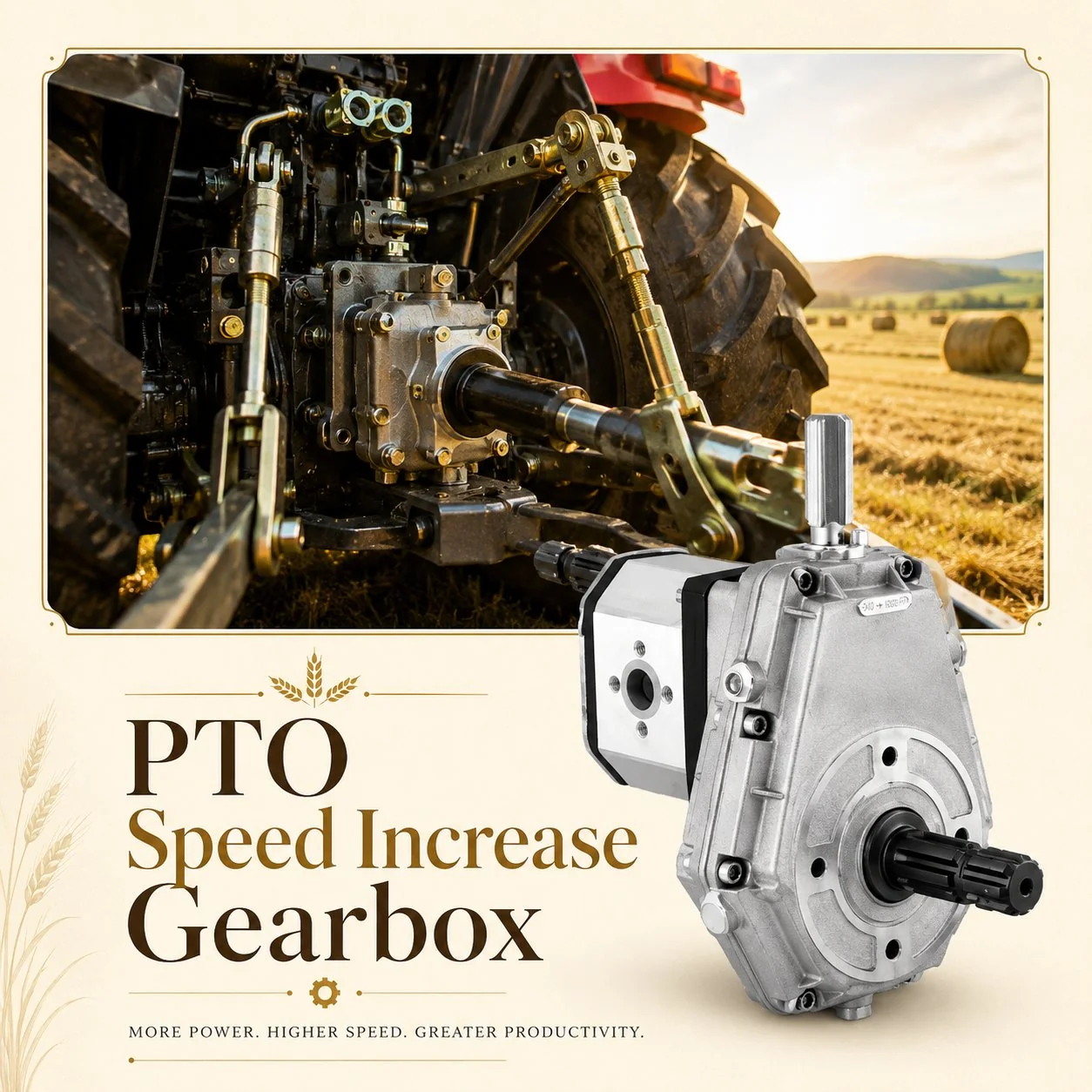
From a 540 RPM PTO, the required PTO water pump gearbox ratios are approximately 1:2.7 for 1,450 RPM pumps, 1:5.4 for 2,900 RPM pumps, and 1:6.5 for 3,500 RPM pumps. From a 1,000 RPM PTO, the ratios drop to 1:1.45, 1:2.9, and 1:3.5 respectively. The higher ratios (1:5.4 and above) push the limits of single-stage bevel gear design — a 1:5.4 ratio requires a pinion-to-gear tooth count combination that produces a very small pinion with limited tooth strength. Two-stage gearbox configurations (bevel stage plus helical stage, or two helical stages) distribute the total ratio across two gear meshes, allowing each stage to operate within its efficient and structurally reliable ratio range while achieving the total speed multiplication needed for high-speed pump drive.
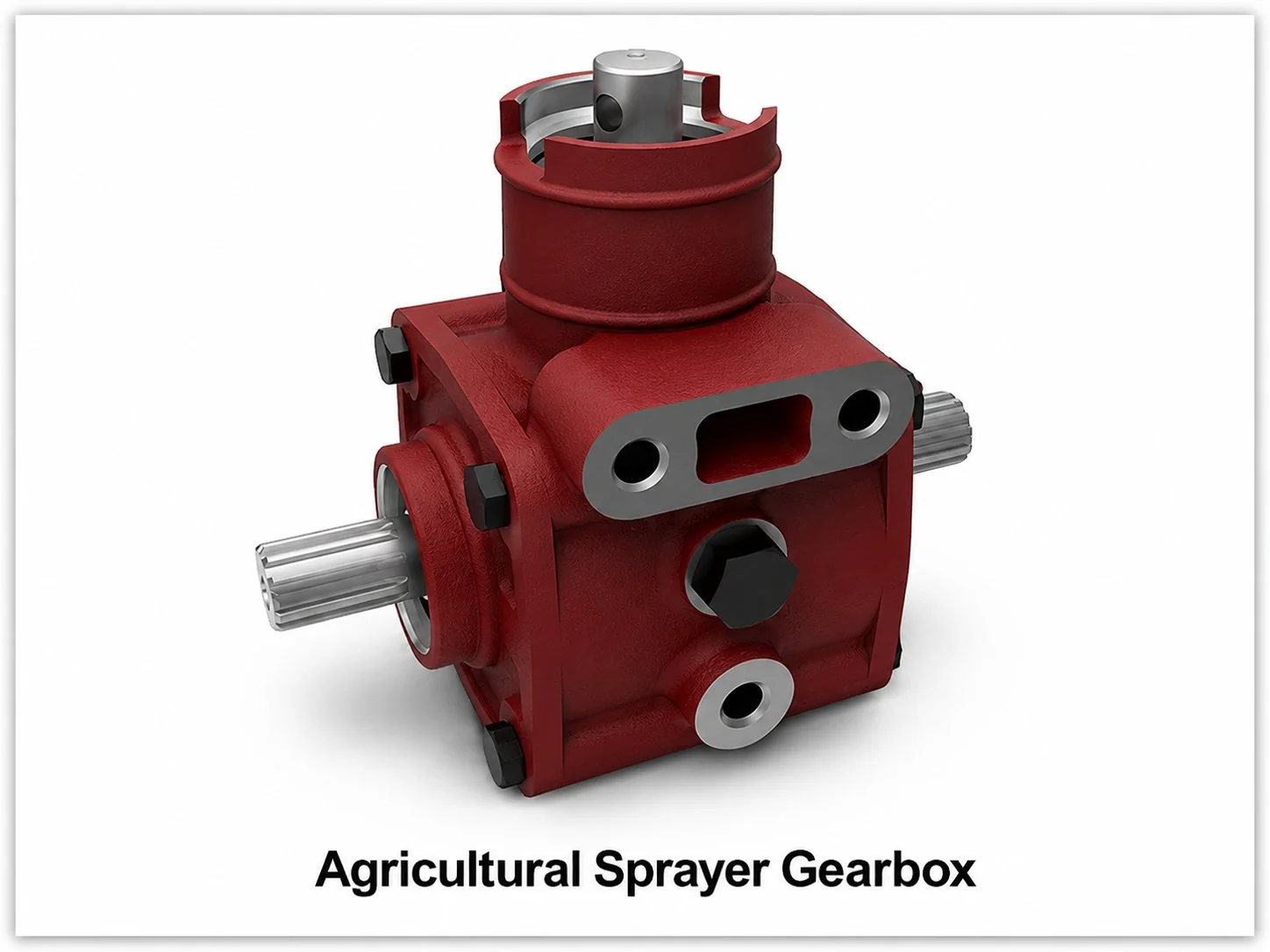
The gearbox efficiency directly affects the pump’s available power. A single-stage gearbox at 96 percent efficiency wastes 4 percent of the PTO input as heat. A two-stage gearbox at 93 percent efficiency wastes 7 percent. For a 50 HP PTO driving a pump through a two-stage gearbox, 3.5 HP is consumed by the gearbox — power that heats the gearbox oil rather than moving water. This efficiency loss is unavoidable but must be accounted for when sizing the tractor: the pump’s shaft power requirement plus the gearbox losses equals the PTO power demand. Under-sizing the tractor by ignoring gearbox losses leads to the engine running at full throttle continuously, accelerating engine wear and preventing the governor from maintaining stable PTO speed under varying pump load. For the related engineering of speed increasers in sprayer pump applications, see our detailed guide on agricultural sprayer gearbox pump drive matching.
Positive Displacement Pump Drive: Slurry, Effluent, and High-Pressure Applications
Positive displacement pumps — including gear pumps, lobe pumps, progressive cavity pumps, and piston pumps — operate on a fundamentally different principle from centrifugal pumps. They trap a fixed volume of fluid per revolution and push it from the inlet to the outlet, regardless of discharge pressure. Their flow rate is proportional to speed (like centrifugal pumps), but their pressure capability is independent of speed — limited only by the pump’s structural strength and the relief valve setting. This pressure independence means that a positive displacement pump connected to a blocked discharge line will build pressure until something fails: the pump seal, the pipe, the gearbox, or the tractor PTO clutch.
The gearbox requirement for positive displacement pumps is typically a speed reducer rather than an increaser — the opposite of centrifugal pump applications. Progressive cavity pumps for slurry and effluent operate at 200 to 600 RPM; piston pumps for high-pressure spraying and cleaning operate at 300 to 800 RPM; gear pumps for hydraulic power and fuel transfer operate at 500 to 1,500 RPM. From a 540 RPM PTO, most positive displacement pumps require either a 1:1 direct drive (rare, but possible for some gear pumps) or a 1.5:1 to 2.5:1 speed reduction. The 農業用ギアボックス for a positive displacement pump application must include a pressure relief mechanism — either a relief valve in the pump’s discharge piping or a torque-limiting device in the drive train — to prevent the pump from generating destructive pressure when the discharge is restricted or blocked.
Gearbox-to-Pump Coupling: Alignment, Vibration, and Disconnect
The mechanical coupling between the gearbox output shaft and the pump input shaft must transmit the full operating torque while accommodating minor shaft misalignment, absorbing torsional vibration, and providing a convenient disconnect point for pump service. Three coupling types dominate PTO pump drive installations, each with distinct engineering trade-offs that affect gearbox loading and pump performance.
Jaw couplings with elastomeric spider inserts are the most widely used coupling type for centrifugal pump drives. The spider element (available in hardness grades from Shore 80A to 64D) absorbs torsional vibration and accommodates angular misalignment up to 1 degree and parallel offset up to 0.3 mm. For most agricultural pump installations where mounting frames are fabricated rather than precision-machined, the jaw coupling’s misalignment tolerance prevents the tight-tolerance alignment problems that cause premature bearing failure in both the gearbox and the pump. Medium-hardness spiders (Shore 92A) suit the majority of applications — providing adequate vibration damping without excessive torsional deflection that would cause pump speed variation under load change.
Belt drives between the gearbox output and the pump input provide inherent overload protection through belt slip, continuous speed adjustment capability through variable-diameter pulleys, and physical separation between the gearbox and pump that simplifies mounting geometry. The disadvantages are belt maintenance (tension adjustment, belt replacement), efficiency loss (3 to 5 percent, primarily from belt flexure and slip), and gradual speed reduction as belts wear and stretch — a particularly problematic characteristic for centrifugal pump applications where even a 5 percent speed decrease reduces pressure by 10 percent. Belt drives are declining in favour of direct jaw coupling as manufacturers like Ever-Power PTOギアボックス offer gearboxes with precise ratios that eliminate the need for belt-ratio speed adjustment between the gearbox and pump.
Direct flange coupling (gearbox output flange bolted directly to pump input flange) is the most compact and efficient connection but demands precise alignment between the gearbox and pump shafts. Any angular or parallel misalignment is absorbed entirely by the gearbox output bearing and the pump input bearing — there is no flexible element to compensate. Direct flanging is used on factory-integrated pump-gearbox units where both components are precision-machined to a common mounting face, but is generally not recommended for field-assembled installations where mounting frame tolerances and thermal distortion make precise alignment difficult to achieve and maintain.
Continuous-Duty Thermal Design for Irrigation Pump Gearboxes
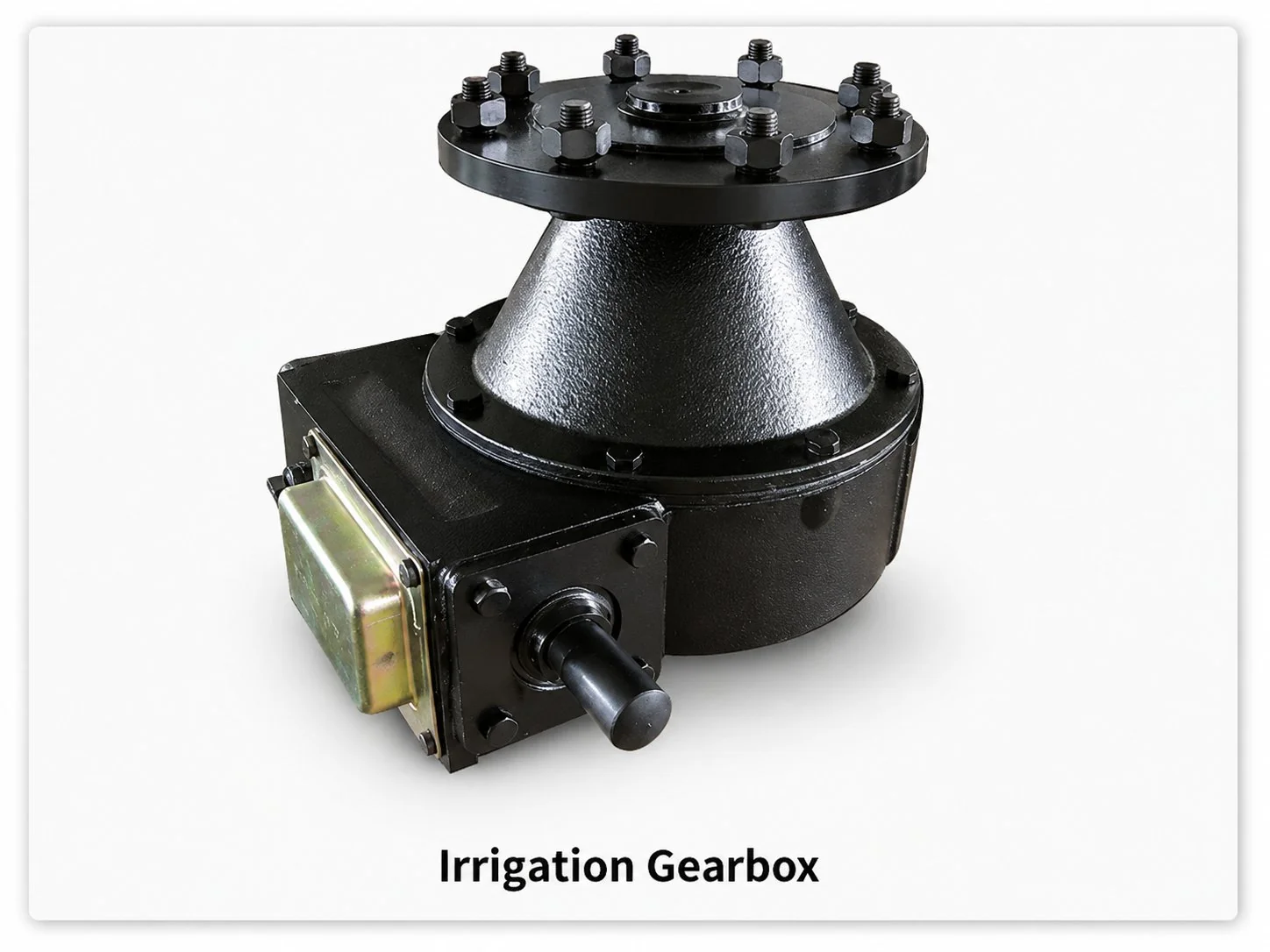
Irrigation pumping is the most thermally demanding application for a PTOギアボックス in agriculture. An irrigation pump may run 12 to 24 hours continuously during peak water demand — far exceeding the intermittent duty cycles of mowing, tilling, or harvesting equipment that runs for hours but includes frequent pauses for turning, repositioning, and refilling. The gearbox must reach thermal equilibrium (heat generation equals heat dissipation) at an oil temperature that remains within the safe operating range of the lubricant — typically below 90 degrees Celsius for synthetic EP gear oil and below 80 degrees for mineral oil.
A gearbox dissipating 3 to 5 kW of heat (typical for a 50 to 80 HP irrigation pump drive at 94 to 96 percent efficiency) in an ambient temperature of 35 degrees Celsius requires sufficient housing surface area and oil volume to stabilize at or below the 90-degree limit. Standard agricultural gearbox housings designed for intermittent-duty applications may not achieve thermal equilibrium within this limit during 24-hour continuous operation — the housing surface area is simply too small to reject the continuous heat load at the elevated ambient temperatures common during irrigation season. The solution is either a larger gearbox frame (oversized by one step relative to the torque requirement, providing additional oil volume and housing surface), or an external oil cooler (air-cooled heat exchanger) that supplements the housing’s natural heat rejection with forced convection cooling.
Synthetic PAO-based EP gear oil (ISO VG 220 or manufacturer-specified equivalent) is mandatory for continuous-duty irrigation pump gearboxes. The sustained thermal loading degrades mineral oil rapidly — oxidation products form varnish deposits on internal surfaces that insulate the housing and reduce heat transfer, creating a thermal feedback loop where degraded oil causes higher temperatures that further accelerate degradation. Synthetic oil resists this oxidation cycle for 2,000 to 4,000 hours under continuous duty, compared to 500 to 1,000 hours for mineral oil at the same temperature — a cost difference of 2 to 3 times at purchase that delivers 3 to 5 times the service life, making synthetic the economically superior choice for any gearbox running more than 500 hours per season.
Application-Specific Gearbox Sizing: Irrigation, Firefighting, and Transfer
| 応用 | ポンプの種類 | Pump Speed | Ratio (from 540) | Typical HP |
|---|---|---|---|---|
| Flood/border irrigation | Centrifugal (high-flow) | 1,450 RPM | 1:2.7 increase | 30–100 |
| Sprinkler/pivot pressure | Centrifugal (high-head) | 2,900 RPM | 1:5.4 increase | 20–80 |
| Rural firefighting | Centrifugal (high-pressure) | 2,900–3,500 RPM | 1:5.4–6.5 increase | 15–40 |
| Slurry/effluent | Progressive cavity | 200–500 RPM | 1:1–1.5:1 reduction | 20–60 |
| Stock water/transfer | Centrifugal (medium) | 2,900 RPM | 1:5.4 increase | 5–20 |
| Field dewatering | Mixed-flow or axial | 1,000–1,450 RPM | 1:1.9–2.7 increase | 15–50 |
The sizing table illustrates a critical point: PTO pump applications span both speed increase and speed decrease requirements, with ratios ranging from 1.5:1 reduction (slurry pumps) to 1:6.5 increase (high-pressure firefighting). No single 農業用ギアボックス serves all pump applications — the ratio must be selected to match the specific pump’s design speed, and changing the pump (even to a different model of the same brand and size) may require a different gearbox ratio if the new pump’s rated speed differs from the original.
Maintenance for Continuous-Duty Pump Gearboxes
The oil change interval for a continuous-duty irrigation pump gearbox should reflect the actual operating hours, not the calendar-based schedule adequate for intermittent-duty equipment. A pump gearbox running 2,000 hours per irrigation season accumulates more operating hours in 6 months than a mower gearbox accumulates in 4 to 5 years. The recommended schedule is 500 hours for synthetic oil or 250 hours for mineral oil — whichever occurs first. At 12 to 16 hours per day during peak irrigation, this means a synthetic oil change every 5 to 6 weeks of continuous operation.
の PTOシャフト driveline on pump installations accumulates wear faster than on most other agricultural applications because of the continuous rotation — U-joint needle bearings that last 2,000+ hours on a seasonal implement may reach their greasing and replacement threshold within a single irrigation season. Grease the U-joints every 8 to 10 hours of continuous pump operation (daily in a 24-hour pumping schedule) and check for play at every oil change interval. A worn U-joint on a continuous-duty pump drive creates cyclic speed variation that the pump experiences as pressure pulsation — causing fatigue damage to pipe joints and fittings that manifests as leaks at threaded connections throughout the irrigation system.
Monitor the gearbox housing temperature daily during the first week of each irrigation season to establish a thermal baseline. The temperature should stabilize at a consistent level (typically 40 to 60 degrees above ambient) within 2 to 3 hours of starting and remain stable for the duration of operation. A gradual temperature increase over days or weeks indicates declining oil condition (reduced viscosity from thermal degradation), increasing bearing friction (from progressive wear or contamination), or reduced heat rejection capacity (from dust accumulation on the housing surface). A PTO water pump gearbox rated for continuous duty at the actual ambient temperature — not just the mechanical torque capacity — is the essential specification distinction between a gearbox that survives irrigation season and one that overheats and fails.
よくある質問
Match Your Pump to the Right Gearbox
Send us your pump nameplate data (model, rated speed, shaft power) and your PTO speed — our engineering team will calculate the exact gearbox ratio, verify thermal capacity for your duty cycle, and recommend the correct coupling type. Precision-ratio gearboxes for irrigation, firefighting, and industrial pump drive applications, available from stock or manufactured to order.
編集者: Cxm