What Is a Rotary Lawn Mower Gearbox?
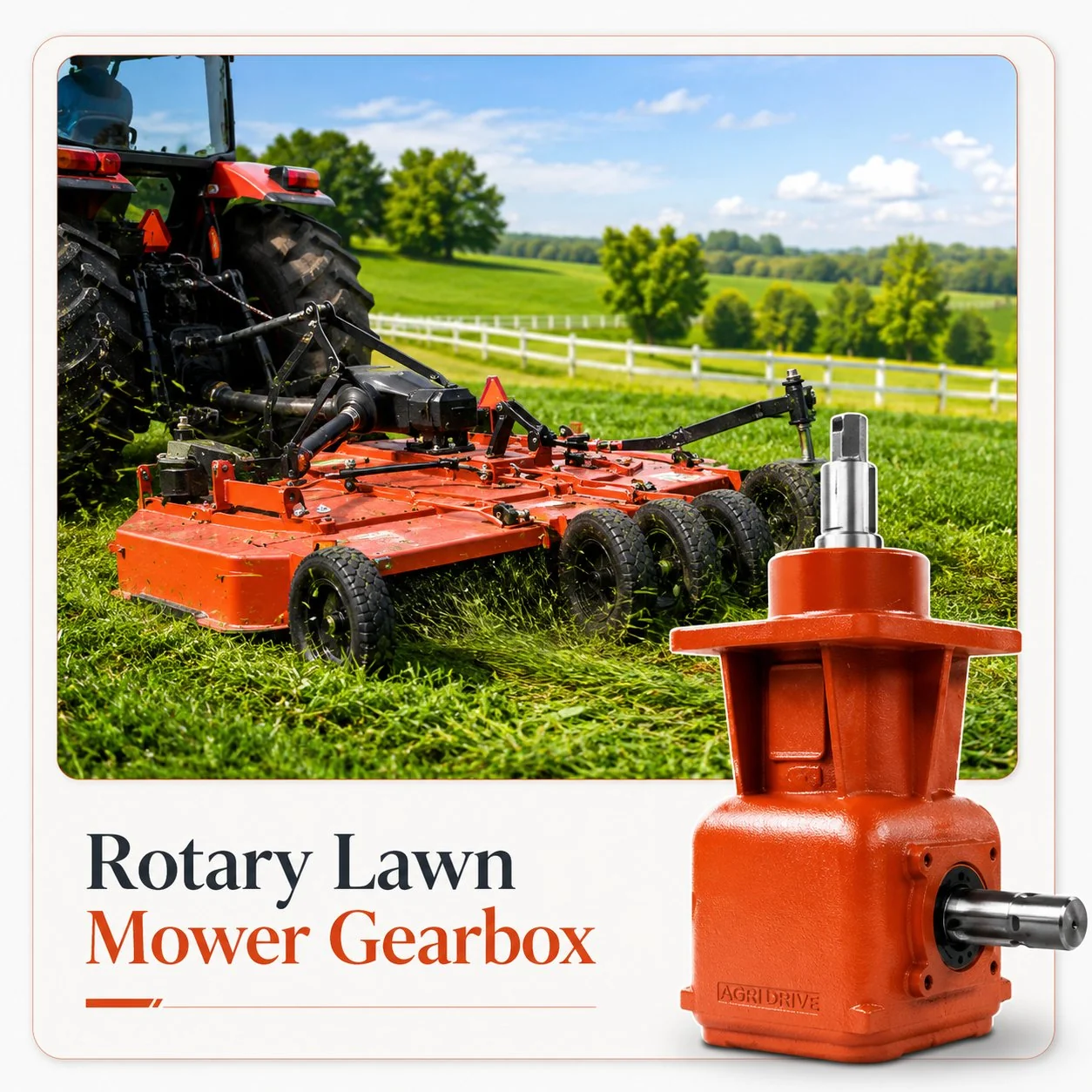
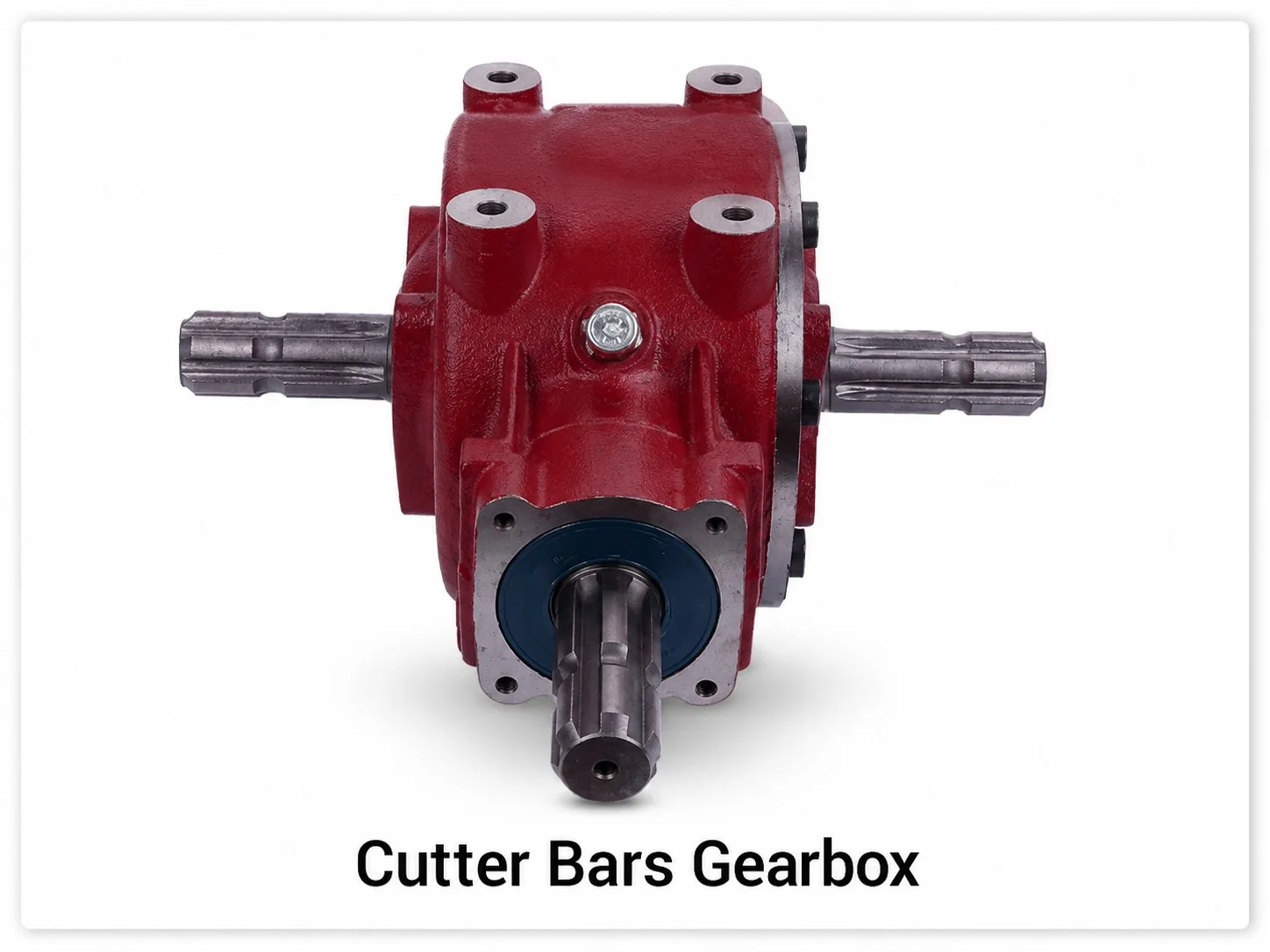
A rotary lawn mower gearbox is the right-angle PTO-driven gear unit mounted beneath the mower deck that converts horizontal tractor PTO rotation into the vertical blade spindle rotation needed to drive one or more cutting blades. The gearbox receives power through a horizontal input shaft connected to the tractor PTO (typically via a driveshaft and slip clutch), redirects that power through a 90-degree bevel gear pair, and delivers it to a vertical output shaft that directly drives the blade carrier. This single component is responsible for every aspect of cutting performance — blade tip speed determines cut quality, output torque determines the ability to cut through thick growth without bogging, and bearing integrity determines vibration level and service life.
The term “rotary lawn mower gearbox” encompasses a family of gearboxes serving different applications: finish mowers that produce a manicured lawn-quality cut on sports fields and commercial properties, ロータリーカッター用ギアボックス units (also called bush hog gearboxes) that clear heavy brush and rough pasture, and medium-duty pasture mowers that maintain grassland. While all share the same right-angle bevel architecture, they differ significantly in power rating, gear ratio, blade speed, and impact resistance — reflecting the vastly different cutting demands of each application.
Blade Tip Speed: The Key to Cut Quality
The quality of cut produced by any rotary mower is determined primarily by the blade tip speed — the linear velocity of the outermost edge of the blade as it sweeps through the grass. For a clean, shearing cut on maintained turf, the blade tip speed must be between 4,500 and 5,500 metres per minute (75 to 92 m/s). Below this range the blade tears rather than cuts the grass, producing ragged leaf tips that turn brown and compromise turf appearance. Above this range the blade creates excessive air turbulence that scatters clippings unevenly.
の rotary lawn mower gearbox ratio directly controls the blade tip speed. For a finish mower with 500 mm blade radius operating from a 540 RPM PTO, a 1:1 ratio produces 540 RPM blade speed and a tip speed of approximately 28 m/s — far too slow for a clean cut. A 1:1.92 speed-increasing ratio (a common finish mower specification) produces 1,037 RPM and a tip speed of approximately 54 m/s — within the optimal cutting range. The rotary mower gearbox ratio is therefore not an arbitrary design choice but a precisely calculated value derived from the blade radius and the target tip speed for the intended cutting application.
Right-angle bevel gearbox for rotary mower blade spindle drive
Regulatory standards (ANSI/OPEI B71.4 for commercial mowers) limit maximum blade tip speed to 6,000 metres per minute (100 m/s) for safety — higher speeds increase the energy and range of thrown debris. The rotary lawn mower gearbox ratio must be selected to keep the blade tip speed below this safety limit at maximum PTO speed, while still exceeding the minimum 4,500 m/min needed for clean cutting. Never substitute a higher-ratio gearbox without recalculating the resulting blade tip speed against safety standards.
Finish Mower vs. Rotary Cutter vs. Flail Mower: Gearbox Comparison
Gear and Bearing Design for Blade Impact Loading
The most severe engineering challenge for any rotary lawn mower gearbox is surviving blade impact events — moments when the blade strikes a rock, root, fence post, or other hard object hidden in the mowing path. A blade rotating at 800 to 1,000 RPM with 10 to 25 kg of blade mass generates enormous kinetic energy, and when this energy is absorbed in a millisecond-duration impact, the instantaneous torque spike at the ギアボックス output can reach 5 to 10 times the continuous rated torque. The gears and bearings must absorb this spike without tooth fracture, bearing brinelling, or housing cracking — and then continue operating normally for the remainder of the mowing session.
Case-carburised spiral bevel gears with surface hardness of 58 to 62 HRC and core hardness of 30 to 35 HRC provide the combination of surface wear resistance and core toughness needed for impact survival. The hard surface resists wear and pitting from sustained mesh contact; the tough core absorbs impact energy through controlled plastic deformation at the tooth root rather than brittle fracture. For heavy-duty ロータリーカッター用ギアボックス applications (pasture and brush cutting where impacts are frequent and severe), the gear module is 5 to 7 mm; for finish mowers on maintained turf (where impacts are infrequent), module 3 to 5 mm is adequate.
The output spindle bearing arrangement is critical for both cutting quality and service life. Tapered roller bearings in back-to-back (O-configuration) provide the radial stiffness needed to maintain blade concentricity (minimising vibration and uneven cut height) and the axial load capacity to resist the downward thrust from blade rotation and the upward lift force generated by the blade airfoil. For ロータリーカッター用ギアボックス applications, triple-lip spring-loaded seals (rather than standard double-lip seals) protect the bearings from the soil, grass pulp, and moisture that the cutting action drives upward around the output shaft — the most contamination-exposed seal position in any agricultural gearbox application.
の rotary mower gearbox bearing at the output position must be specifically rated for the combined sustained rotational load plus the intermittent impact loading. Standard L10 bearing life calculations based on continuous load alone significantly overestimate actual service life if impact events are frequent — a separate impact endurance analysis using the peak impact torque and estimated impact frequency is needed to accurately predict bearing replacement intervals under the specific mowing conditions.

Technical Specifications at a Glance
Slip Clutch Protection and PTO Driveline Matching
A slip clutch on the PTO駆動系 is the primary defence against catastrophic ロータリーモア用ギアボックス damage from severe blade impact events. The slip clutch is calibrated to release at 1.5 to 2.0 times the rated continuous PTO torque — allowing the driveline to slip and absorb the impact energy rather than transmitting the full shock load through the gears and bearings. For rotary cutter applications (where blade impacts with rocks and stumps are expected rather than exceptional), the slip clutch must be checked before each mowing session and re-calibrated if the release torque has drifted from the specified setting. A clutch that has glazed from repeated heat cycling and no longer releases at the correct torque provides no protection against the next impact event.
PTO driveline selection for mower applications depends on the power rating and impact severity. Series 4 drivelines are adequate for finish mowers up to 30 HP on maintained turf (low impact risk). Series 6 drivelines are the minimum for rotary cutters above 40 HP on rough ground (frequent impact loading). The driveline must be properly phased — both U-joint yokes aligned in the same rotational plane — to prevent twice-per-revolution speed variation that produces visible mowing patterns (streaking) on finish-cut turf. Telescoping spline tube overlap must accommodate the full range of three-point hitch travel without bottoming out or separating.
Multi-Spindle Configurations for Wide-Area Mowing
Commercial and municipal mowing operations that require wide cutting widths (1.5 to 4.5 metres or more) use multi-spindle mower decks with two, three, or four blade spindles — each driven by its own rotary lawn mower gearbox. The PTO power is distributed to the multiple gearboxes through a combination of belt drives, intermediate gearboxes, and cross-shaft assemblies. On a three-spindle finish mower, the central gearbox receives the PTO input directly, and two belt-driven side gearboxes receive power from pulleys on the central gearbox output or from an intermediate cross-shaft. Each gearbox independently drives its own blade at the same speed — producing overlapping cutting arcs that cover the full deck width without leaving uncut strips between adjacent blades.
The engineering challenge for multi-spindle configurations is maintaining consistent blade speed across all spindles under varying load conditions. When one blade enters a thick patch of grass while the adjacent blades are in lighter growth, the loaded blade slows slightly — and if the belt drive to that gearbox slips, the speed differential produces visible mowing patterns (streaking) on the finished turf. V-belt or synchronous-belt drive systems with proper tension maintenance (checked every 50 to 100 operating hours) prevent this speed differential. For the highest cut-quality requirements on sports fields and golf course fairways, some premium mower manufacturers use gear-driven cross-shafts rather than belts to eliminate belt-slip variation entirely — accepting the higher cost and weight for the guaranteed speed synchronisation that professional turf presentation demands.
Each gearbox in a multi-spindle system should be serviced on the same schedule — oil changes, bearing inspections, and seal replacements performed simultaneously across all units. Mixing gearboxes with different wear levels produces uneven blade speeds and vibration patterns that compromise both cut quality and total mower frame life. When replacing a failed gearbox on a multi-spindle mower, consider replacing all gearboxes simultaneously if the remaining units are approaching the end of their expected service life — the downtime cost of a second gearbox failure weeks later often exceeds the incremental cost of proactive replacement.
Rotary Mower Gearbox Oil and Lubrication
The standard rotary mower gearbox oil specification is EP gear oil SAE 80W-90 (equivalent to ISO VG 220) — the same multi-purpose gear oil used across most right-angle 農業用ギアボックス applications. Oil capacity in a mower gearbox is modest (0.8 to 1.5 litres), and the operating temperature during normal mowing is moderate (50 to 75 degrees Celsius) — well within the thermal stability range of standard mineral gear oil. Synthetic PAO oil is not required for most mower applications but provides benefit for operations that mow frequently in cold conditions (below minus 5 degrees Celsius) or that operate continuously in hot climates where ambient temperature exceeds 35 degrees Celsius.
Oil change intervals follow the manufacturer standard of 500 hours for routine operation — but with an important first-fill exception: the initial oil fill should be changed after the first 50 operating hours. This early change removes the metallic wear particles generated during the gear break-in period (when the gear tooth surfaces are still conforming to their final contact pattern) before these particles can accumulate and accelerate wear of the precision bearing surfaces. After the first-fill change, the 500-hour interval applies for subsequent changes. Inspect the magnetic drain plug at every oil change — metallic particles are normal during break-in but indicate developing gear or bearing damage if found after the first 200 hours of service.
Seasonal Maintenance Schedule
Oil level and condition check — change if milky, dark, or over 500 hours old. Inspect output seal for grass pulp contamination or oil weeping. Blade balance verification (unbalanced blades accelerate output bearing wear). PTO driveline U-joint greasing. Slip clutch calibration test.
Oil level verification. Output seal area cleaning — remove accumulated grass buildup that traps moisture against the seal. Bearing noise monitoring — increasing rumble indicates developing bearing fatigue. Blade sharpening and re-balancing (dull, unbalanced blades increase gearbox vibration loading).
Clean gearbox and mower deck thoroughly. Remove blade for sharpening and balance inspection. Top up oil. Apply grease to output shaft surfaces. Store under cover on flat surface to prevent deck distortion that could misalign the gearbox mounting.
Aftermarket Rotary Mower Gearbox Replacement
Rotary mower gearbox replacement is the most common gearbox change in the commercial mowing aftermarket — driven by the combination of high output speed, frequent blade impact loading, and the grass-pulp-and-moisture contamination environment that is unique to mowing applications. A well-maintained mower gearbox typically lasts 1,500 to 4,000 operating hours (3 to 10 mowing seasons depending on annual usage and impact severity). Cross-reference parameters include the input shaft spline profile (6-spline 1-3/8 inch for 540 RPM is the dominant standard), the output shaft size and keyway, the mounting bolt pattern (typically 4-bolt square at 5.5 inch spacing), the pilot bore diameter (the mower deck mounting hole that receives the gearbox output flange), and the gear ratio.
Our engineering team maintains cross-reference compatibility data for major mower and rotary cutter brands (Comer, Omni, and equivalent OEM specifications) and can supply dimensionally compatible aftermarket replacements with verified ratio, torque, and mounting accuracy. Because mower gearboxes are relatively compact (15 to 37 kg), shipping is fast — often critical when a mid-season gearbox failure threatens to delay a time-sensitive commercial mowing schedule.
よくある質問
Cut Clean, Cut Confident
From finish mowers producing lawn-grade turf to heavy-duty rotary cutters clearing rough pasture — our rotary mower gearboxes deliver the blade speed precision, impact durability, and multi-season reliability that professional mowing demands.
編集者: Cxm