Material Cost Breakdown: Where Your Money Actually Goes
1 農業用ギアボックス is an assembly of four major material components: gears, bearings, housing, and seals. The proportional cost of each component varies by gearbox size and quality tier, but in a typical medium-duty PTO gearbox (40–75 HP), the approximate cost distribution is 30–40% for the gear set (pinion and ring gear), 15–25% for the bearings, 25–35% for the housing and covers, and 5–10% for seals, fasteners, and assembly labor. Understanding this breakdown reveals why the specification of each component has a direct and measurable impact on the final 農業用ギアボックスの価格.
Gear steel represents the single largest material cost differentiator. A gear set machined from 1045 carbon steel (a common economy choice) costs approximately 40–50% less than an equivalent set machined from 8620 or 20MnCr5 alloy steel — the grades required for effective carburizing. The alloy content (nickel, chromium, molybdenum) that enables deep, uniform case hardening adds $500–1,500 per tonne to the raw steel cost. This material premium propagates through every manufacturing step: alloy steel requires more machining power to cut, more careful heat treatment control, and longer cycle times in every operation from forging through final grinding. The compounding effect of better material through every process stage is the fundamental reason why a premium gearbox costs more — and why that cost difference translates directly into measurably superior performance and longer service life under agricultural operating conditions.
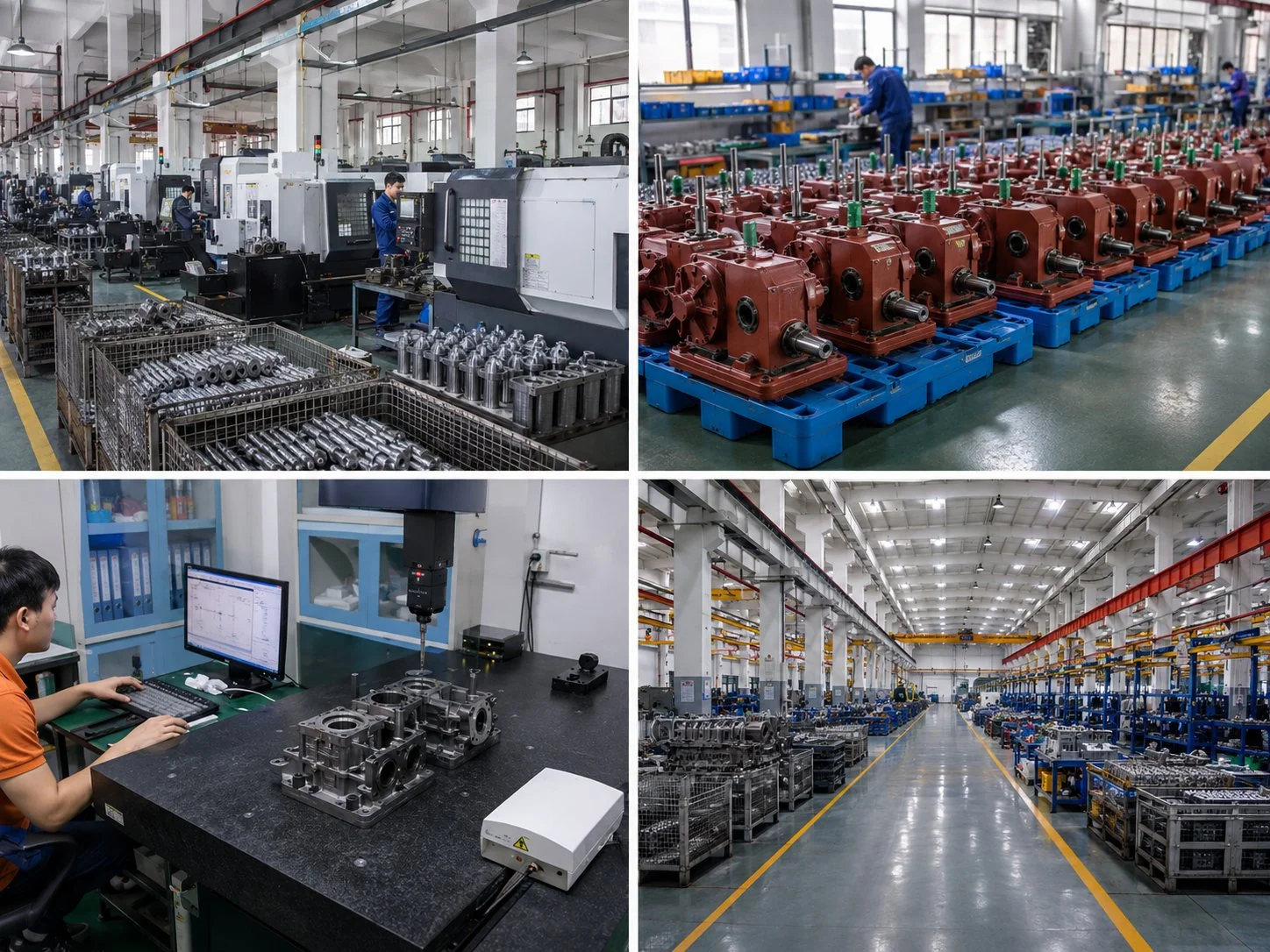
Manufacturing Process Impact: Hobbed vs. Ground Gears
The gear manufacturing process is the second largest cost driver after material grade. Economy gearboxes use hobbed-only gears — teeth are cut on a hobbing machine and used as-machined without further finishing. The hobbing process is fast (2–5 minutes per gear for typical PTO gearbox sizes) and produces teeth that are dimensionally adequate for basic power transmission. However, hobbed teeth have a relatively rough surface finish (Ra 1.6–3.2 micrometers) and profile accuracy limited to AGMA Quality 8 or below.
Premium gearboxes add a finish grinding operation after hobbing and heat treatment. Gear grinding (on a dedicated form grinder or profile grinder) takes 10–30 minutes per gear and produces tooth surfaces with Ra 0.4–0.8 micrometer finish and AGMA Quality 10–12 accuracy. The grinding step removes heat treatment distortion, corrects any profile errors from hobbing, and produces the smooth, precise tooth surfaces that minimize noise, maximize contact pattern uniformity, and deliver the full fatigue life that the case-hardened material is capable of providing. Grinding adds $15–50 per gear to the manufacturing cost — a fraction of the gearbox price that delivers disproportionate improvements in noise, efficiency, and service life.
The practical consequence is clear: an $800 gearbox with hobbed-only through-hardened gears may last 500 hours under agricultural loading. A $1,400 gearbox with carburized and ground gears — the same physical size, same bolt pattern, same ratio — can deliver 3,000 to 5,000 hours under identical conditions. The per-hour cost of the premium gearbox is dramatically lower than the economy unit, even before accounting for the downtime cost of mid-season replacement. For a broader perspective on how PTO gearbox engineering connects to tractor power transmission, see our detailed guide on トラクターPTOギアボックス specifications and selection.
Bearings, Housing, and Seals: The Supporting Cast That Determines Life
Bearings are the second most important cost and quality variable in an 農業用ギアボックス. A tapered roller bearing from a tier-one manufacturer (SKF, NSK, Timken, NTN) costs 2 to 5 times more than a visually identical unbranded bearing from a commodity supplier. The difference is in steel cleanliness (fewer non-metallic inclusions that initiate fatigue spalling), dimensional precision (tighter tolerances for more uniform load distribution), and heat treatment consistency (more predictable and longer L10 bearing life). A single bearing failure in a PTO gearbox typically causes catastrophic secondary damage to gears, seals, and the housing bore — so the bearing quality directly affects the probability of a total gearbox loss, not just bearing replacement cost.
Housing metallurgy creates a similar cost-quality trade-off. Gray cast iron housings are the economy standard — inexpensive to cast, easy to machine, and adequate for vibration damping. Ductile (nodular) cast iron housings cost 20–30% more but absorb approximately three times the impact energy before cracking. In agricultural PTO applications where the gearbox is exposed to rock strikes, frozen material impacts, and general field abuse, the higher impact resistance of ductile iron housing significantly reduces the probability of a cracked housing that scraps the entire gearbox. Aluminum housings, used on some lightweight and high-speed industrial gearboxes, are generally unsuitable for heavy-duty agricultural applications due to lower stiffness and impact resistance.
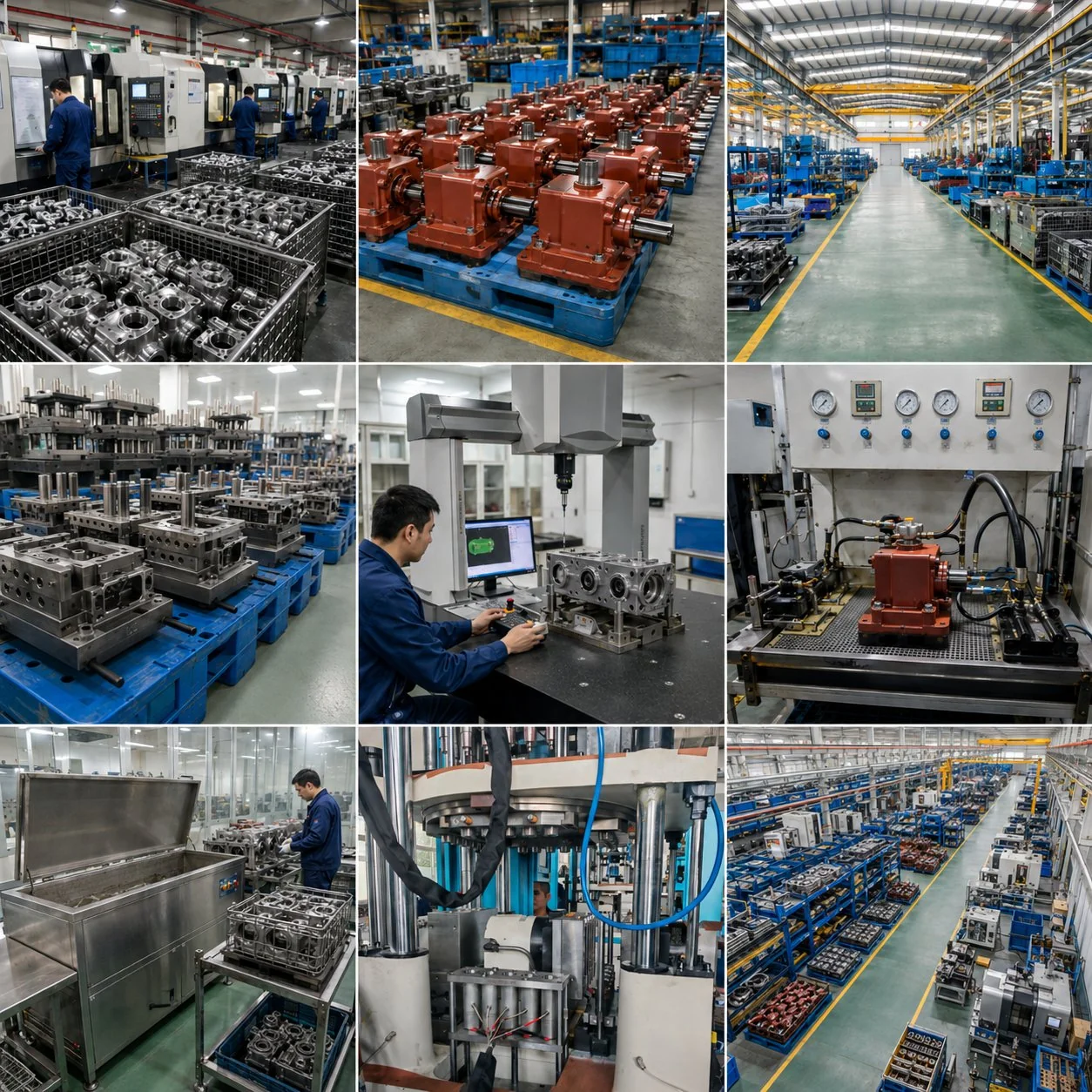
Precision gear manufacturing — the quality of every machining and heat treatment step directly determines both the price and the service life of the finished gearbox
Total Cost of Ownership vs. Unit Price: The Calculation That Changes Decisions
The purchase price of a PTOギアボックス is only the initial cost. Total cost of ownership (TCO) includes the purchase price, installation labor, oil and maintenance consumables over the gearbox’s life, and — most significantly — the cost of downtime if the gearbox fails during a critical operating window. For a commercial rotary cutter used 400 hours per year, the TCO calculation over a 5-year planning horizon illustrates why the cheapest gearbox is rarely the cheapest option.
💡 5-Year TCO Example: 400 Hours/Year Rotary Cutter
Economy gearbox ($500): Expected life 500 hours. Requires 4 replacements over 5 years (2,000 total hours). Total gearbox cost: $2,000. Plus 4 installation events at $200 labor each: $800. Plus estimated downtime cost (2 mid-season failures at $1,500/day × 2 days): $6,000. 5-year TCO: approximately $8,800.
Premium gearbox ($1,400): Expected life 4,000+ hours. No replacement needed in 5 years (2,000 total hours). Total gearbox cost: $1,400. One installation: $200. Estimated downtime cost (near-zero failure probability): $0. 5-year TCO: approximately $1,600.
The TCO difference is not marginal — it is an order of magnitude. The premium gearbox costs less than 20% of the economy option’s total 5-year expense. This calculation explains why professional agricultural operators and fleet managers consistently specify premium gearboxes even when budget pressure exists: the upfront price premium is recovered within the first avoided failure event, and every subsequent season of reliable operation is pure cost savings.

Volume Pricing and OEM Procurement Strategies
For implement manufacturers and large fleet operators purchasing multiple gearboxes, volume pricing tiers significantly reduce the per-unit cost. A factory-direct manufacturer like Ever-Power PTOギアボックス typically structures pricing in tiers: 1 to 4 units at list price, 5 to 24 units at 10 to 15 percent discount, 25 to 99 units at 15 to 25 percent discount, and 100+ units at project-specific pricing that can reach 25 to 40 percent below list. These volume discounts reflect real manufacturing cost reductions — longer production runs amortize setup cost over more units, material purchasing in larger batches reduces per-kilogram steel cost, and reduced per-unit handling and shipping overhead.
For OEM implement builders, the most cost-effective procurement strategy is standardizing on one or two gearbox families across multiple implement models, allowing larger combined volumes that access deeper discount tiers. A standardized approach also reduces inventory complexity, simplifies warranty parts stocking, and allows negotiation of blanket purchase agreements with scheduled deliveries that match production forecasts. Contact our team for OEM volume pricing structures and annual supply agreements. For PTOシャフト そして 農業用ギアボックス packages bundled for implement production lines, our integrated supply programs offer additional cost advantages beyond individual component pricing.
Warranty, After-Sales Support, and Hidden Cost Factors
The listed price of an agricultural gearbox does not capture all the cost factors that affect the total purchasing decision. Warranty terms vary dramatically between suppliers — from 90-day defect-only coverage at the economy end to 12 to 24-month full-replacement warranties from premium manufacturers. A longer warranty period represents a tangible value that should be factored into the price comparison: a $1,200 gearbox with a 12-month warranty may be a better value than a $900 gearbox with a 90-day warranty if the probability of an early failure is significant.
Shipping and logistics costs are another frequently overlooked factor. A factory-direct gearbox from an overseas manufacturer may list a lower unit price but incur $100 to $300 per unit in international freight, customs duties, and local handling charges. A domestically stocked aftermarket supplier may list a higher unit price but deliver to the farm within 2 to 3 business days at $50 or less in ground freight. For emergency mid-season replacements, the availability premium of a local-stock supplier is almost always justified by the avoided downtime cost — a single day of lost mowing, harvesting, or tilling revenue typically exceeds the price difference between the cheapest available gearbox and the one that can ship tomorrow.
Technical support accessibility also affects the effective value of a gearbox purchase. A supplier who provides cross-referencing assistance, installation guidance, oil specification recommendations, and troubleshooting support saves the operator time and prevents installation errors that cause premature failure. Budget suppliers that provide product only — no technical support, no cross-reference verification, no installation documentation — transfer the engineering risk to the operator. For operators without in-house mechanical expertise, this transferred risk can manifest as an incorrectly installed gearbox that fails within weeks, negating the initial price saving.
Budget vs. Premium: Matching Price Tier to Application Demand
The optimal price tier depends on the application’s duty cycle and the economic consequence of gearbox failure. Not every implement justifies a premium gearbox, and not every application can tolerate a budget one. The rational approach matches the gearbox investment to the application risk rather than applying a blanket buy-the-best or buy-the-cheapest strategy.
Budget gearboxes (through-hardened gears, commodity bearings, gray iron housing) are appropriate for implements that operate fewer than 100 hours per year, carry less than 25 HP continuous load, and are used in applications where a mid-season failure creates inconvenience rather than economic catastrophe. Examples include homeowner finish mowers, small-acreage rotary cutters, garden tillers, and seasonal post-hole diggers. The expected life of 500 to 1,000 hours provides 5 to 10 years of service at these low duty levels — acceptable performance at the lowest possible entry cost.
Premium gearboxes (carburized and ground gears, tier-one bearings, ductile iron housing) are essential for implements that operate more than 200 hours per year, carry 30+ HP continuous load, or are used in applications where a failure causes significant economic loss. Commercial rotary cutters, hay tedders, feed mixers, sprayer pump drives, combine header drives, and any implement used in a professional agricultural operation fall into this category. The 3,000 to 5,000+ hour expected life provides 5 to 15+ years of commercial service, and the near-zero mid-season failure probability protects the operator from the disproportionate cost of harvest-window or application-window downtime.
Mid-tier gearboxes (induction-hardened gears, quality-brand bearings, gray or ductile iron housing) serve the wide middle ground of semi-professional applications: hobby farms with 200+ hours of annual use, municipal maintenance departments operating multiple implements at moderate duty, and agricultural operations running smaller implements that are important but not harvest-critical. The 1,500 to 3,000 hour expected life and moderate price point provide a practical balance between the budget and premium tiers.
The decision becomes particularly clear when expressed as cost per operating hour. A $500 economy gearbox lasting 500 hours costs $1.00 per hour. A $1,400 premium gearbox lasting 4,000 hours costs $0.35 per hour — less than one-third the per-hour cost despite nearly three times the purchase price. When this calculation is presented alongside the avoided downtime cost (typically $500 to $3,000+ per day for a commercial operation), the premium gearbox is not a luxury — it is the financially rational choice for any application that accumulates significant operating hours.
Buyers should also consider the resale and trade-in value of implements equipped with premium gearboxes. A used rotary cutter with a documented premium gearbox (verifiable by gear hardness, bearing brand, and manufacturer documentation) commands a significantly higher resale price than an identical implement with an unknown or economy gearbox. The premium gearbox effectively preserves the implement’s residual value, making the net ownership cost even lower than the simple per-hour calculation suggests. This is particularly relevant for lease operations and rental fleets where residual value directly affects the financial return on the equipment investment.
よくある質問
Need a Cross-Compatible Replacement?
Transparent pricing backed by full specification disclosure — every gearbox quote includes gear steel grade, heat treatment method, bearing brand, housing material, and factory test documentation. No hidden quality compromises, no specification ambiguity. Request a quote with your OEM part number or dimensions and receive a detailed proposal within 24 hours.