Drive Architecture: PTO to Rotor Speed Conversion
A straw chopper’s drive path is mechanically straightforward — PTO shaft to gearbox input, gearbox output to rotor — but the engineering challenge is significant because the gearbox must increase speed rather than reduce it. Most agricultural riduttore della presa di forza applications use speed reducers (output slower than input), but a straw chopper rotor must spin 3 to 5 times faster than the tractor PTO to generate the tip speed needed for effective residue chopping. This speed increase reverses the torque multiplication relationship: while the output speed is higher, the output torque is proportionally lower (minus efficiency losses), and the gearbox gear teeth on the high-speed output stage experience higher cyclic loading from the elevated number of stress cycles per unit of operating time.
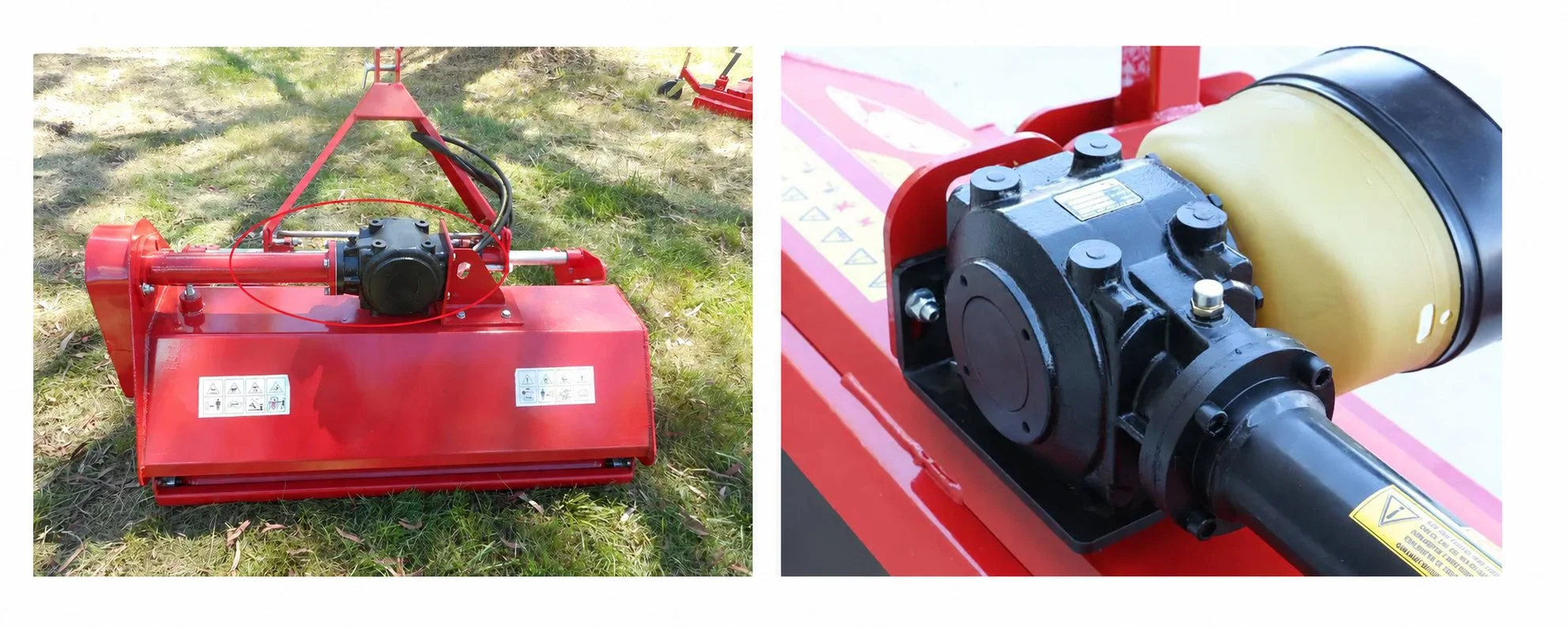
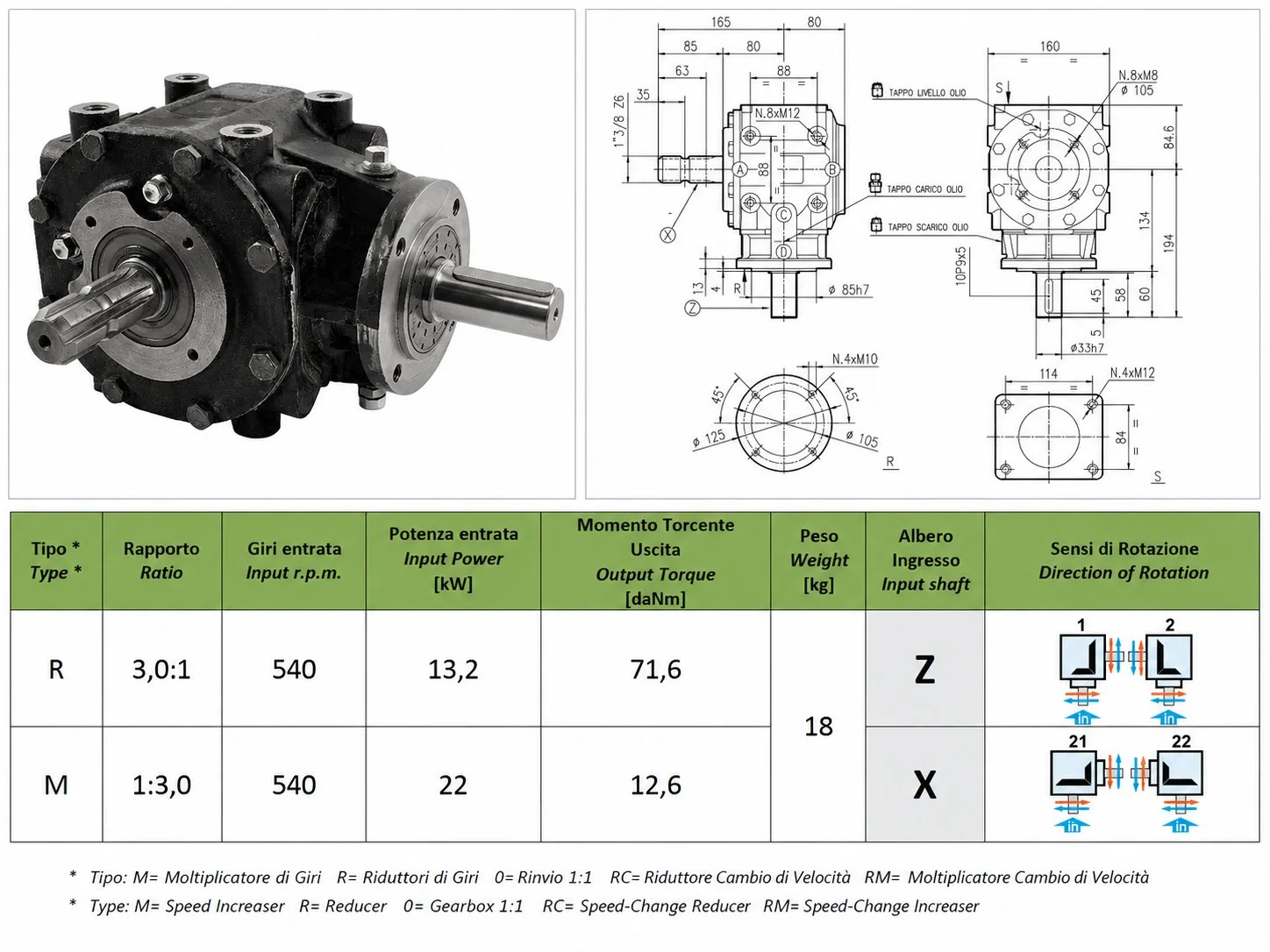
From a 540 RPM PTO, achieving 2,000 RPM rotor speed requires a 1:3.7 speed increase ratio. From a 1,000 RPM PTO, the same rotor speed requires a 1:2 ratio — substantially less demanding on the gearbox and the reason why larger straw choppers increasingly specify 1,000 RPM PTO operation for their heaviest-duty models. The gearbox configuration is a right-angle bevel unit (converting horizontal PTO rotation to the horizontal rotor axis, which is perpendicular to the direction of travel) with the input gear larger than the output gear to create the speed multiplication.
The rotor itself carries the cutting elements — either free-swinging flail knives on a flail-type chopper or rigid bolted blades on a fixed-knife chopper — and acts as a substantial flywheel that stores rotational kinetic energy. A 3-metre rotor assembly with flails attached typically weighs 120 to 250 kg and stores 10 to 30 kJ of kinetic energy at operating speed. This stored energy smooths the pulsating torque generated by individual knife impacts against crop stalks, reducing the cyclic stress transmitted back through the gearbox — the same flywheel principle that protects forage harvester cutterhead gearboxes, but at lower total energy levels because the straw chopper rotor is smaller and lighter than a forage harvester drum.

Flail vs. Fixed-Knife Rotors: How the Cutting Method Affects the Gearbox
The choice between flail and fixed-knife rotor design directly determines the gearbox loading pattern, the power requirement per metre of working width, and the overload behaviour when the rotor encounters foreign objects.
Flail-type rotors use individually hinged knives — typically Y-shaped, hammer-shaped, or straight-blade flails mounted on pivot pins along the rotor shaft. Each flail swings freely under centrifugal force during rotation and can deflect rearward upon striking an immovable object (a large stone, a tree root), absorbing the impact energy through deceleration of the individual flail mass rather than transmitting the full shock through the rotor to the gearbox. This inherent impact absorption makes flail rotors more forgiving of rocky field conditions and reduces the peak torque spikes that the gearbox must withstand. The trade-off is that flail choppers produce less uniform particle size than fixed-knife designs — the free-swinging action shreds rather than shears, resulting in a wider distribution of particle lengths. Flail-type choppers require 1.5 to 3 HP per metre of working width for typical cereal straw residue, with the lower end applying to light, dry wheat straw and the upper end to heavier barley or oat straw with significant stalk volume.
Fixed-knife rotors use rigid blades bolted directly to the rotor drum or mounted on flanges with no hinge or pivot. Each blade cuts through the residue with a shearing action against a counter-knife or against the ground surface, producing a more uniform and generally shorter particle size than flail rotors. However, fixed-knife rotors transmit the full impact force of every strike directly through the blade mounting, the rotor shaft, and the gearbox bearings — with no energy-absorbing deflection mechanism. A stone strike on a fixed-knife rotor generates a torque spike 3 to 8 times the running torque, compared to 1.5 to 3 times for a flail rotor encountering the same obstacle. This higher peak loading demands a stronger straw chopper gearbox specification — heavier gear module, larger bearings, and more robust overload protection. Fixed-knife choppers require 3 to 6 HP per metre of working width and are the standard choice for heavy residue: corn stalks (which are thick-walled and resist shredding), sunflower stems (which are woody and fibrous), and sorghum stubble (which stands 200 to 400 mm above the soil surface and is heavily lignified).
Power-per-Metre Sizing: Matching Gearbox to Working Width
The power requirement of a straw chopper scales linearly with working width — twice the width requires approximately twice the PTO power because twice the residue volume must be processed per unit of forward travel. This linear scaling makes power-per-metre the fundamental sizing parameter for both the implement and its gearbox. The manufacturer’s stated HP requirement assumes a specific crop type, residue density, and forward speed; operating in heavier residue or at higher ground speed increases the actual power demand proportionally.
| Crop Residue Type | Rotor Type | HP per Metre | Typical Width | Total PTO HP |
|---|---|---|---|---|
| Wheat/barley straw | Flail | 1.5–2.5 | 2–4 m | 30–80 |
| Rice straw (dry) | Flail | 2.0–3.0 | 1.5–3 m | 30–75 |
| Corn stalks | Fixed-knife | 3.5–5.0 | 3–6 m | 80–200 |
| Sunflower/sorghum | Fixed-knife | 4.0–6.0 | 3–5 m | 100–250 |
The gearbox must be rated for the total PTO HP of the widest model in the range, with the understanding that the manufacturer may offer the same gearbox across several working widths by adjusting the rotor length while keeping the central drive assembly unchanged. Manufacturers like Riduttore di potenza Ever-Power rate their speed increaser gearboxes by continuous input power at the specified ratio — ensuring that the stated capacity reflects sustained field operation, not a short-duration laboratory test that does not account for thermal equilibrium under real-world duty cycles.
Wide-Body Choppers: Centre-Mount and Dual-Output Gearbox Configurations
Narrow straw choppers (1.5 to 3 metres working width) use a single gearbox mounted at one end of the rotor, with the PTO driveline connecting from the tractor to the gearbox input and the gearbox output driving the rotor directly through a flange coupling. This end-drive arrangement is simple and effective for narrow machines but creates an asymmetric loading pattern on the rotor bearings — the drive-side bearing carries the combined radial load from the rotor weight plus the reaction torque from the gearbox, while the non-drive-side bearing carries only the radial weight load. For narrow machines where the total rotor mass is moderate, this asymmetry is acceptable.
Wide-body choppers (4 to 6+ metres) face a different engineering problem. A long, heavy rotor driven from one end deflects under its own weight and cutting loads, and the torsional wind-up (angular twist) along the rotor length can cause the far end of the rotor to lag the drive end by several degrees — producing uneven chopping intensity across the working width. The solution is a centre-mount gearbox with dual outputs: the gearbox is positioned at the midpoint of the rotor, and the two output shafts drive the left and right rotor halves simultaneously. This arrangement halves the unsupported rotor span, eliminates the torsional wind-up problem, and distributes the drive reaction load symmetrically across both rotor bearing positions.
A centre-mount dual-output straw chopper gearbox is a more complex assembly than a single-output unit. The bevel gear set converts the PTO input from horizontal to the transverse rotor axis, and a secondary spur or helical gear stage splits the output into two counter-rotating shafts (or two co-rotating shafts, depending on the rotor design). The dual-output configuration must ensure equal torque distribution between the two halves — an imbalance causes one rotor half to absorb more than its share of the cutting load, overloading its bearings and gear mesh while the other half runs underloaded. Matched gear sets with verified backlash and contact pattern are essential for equal power split in dual-output gearbox designs.
Impact Loading, Foreign Objects, and Overload Protection
Straw choppers operate at ground level in fields that have just been harvested — terrain littered with stones exposed by the harvest process, broken implement components, fence wire fragments, and occasionally larger metallic objects. The rotor, spinning at 1,500 to 2,500 RPM with knife tips reaching peripheral speeds of 40 to 65 m/s, impacts these objects with enormous instantaneous force. The resulting torque spike propagates through the rotor shaft, through the gearbox gear mesh, and into the PTO driveline in milliseconds — far faster than any electronic control system can react.
The primary overload protection for the gearbox is a slip clutch or shear bolt on the PTO driveline between the tractor and the gearbox input. The slip clutch must be calibrated to release at a torque level that protects the gearbox from damage while remaining engaged during the normal operating torque range — including the moderate torque peaks from routine crop chopping. The calibration window is typically 1.5 to 2.0 times the rated continuous torque: set below 1.5× and the clutch slips during normal heavy-crop operation, wasting power as heat; set above 2.0× and the clutch allows damaging torque levels to reach the gearbox before activating. For detailed guidance on the shared engineering principles between straw choppers and flail vegetation management, see our technical guide on riduttore per trinciatrice a flagelli design and specification.
Flail-type choppers provide inherent secondary protection through the free-swinging flail mechanism: each flail deflects individually upon impact, absorbing kinetic energy by decelerating the flail mass against the pivot resistance. Fixed-knife choppers lack this mechanism — every impact transmits directly to the rotor and gearbox without attenuation. This is why fixed-knife choppers for stony fields should specify a gearbox rated at least 30 percent above the calculated continuous power demand, with a slip clutch set at 1.5× rather than 2.0× — the lower clutch threshold sacrifices a small amount of peak throughput capacity but provides substantially better protection for the gearbox internals against the higher peak loads inherent in rigid-knife cutting.
Operating Environment: Dust, Debris, and Gearbox Protection
Straw chopping generates one of the highest dust concentrations of any field operation. The rotor pulverises dry crop residue at high speed, creating a dense cloud of fine organic dust, silica particles from soil disturbance, and airborne chaff that envelops the entire machine during operation. This dust environment attacks every exposed component — and the riduttore della presa di forza, typically mounted on top of or adjacent to the rotor housing, sits in the centre of the dust plume.
Standard agricultural gearbox sealing is marginal for straw chopper applications. The combination of fine dust particles (10 to 50 micrometres), the high-frequency vibration from the rotor, and the elevated housing temperature from the speed-increasing gear mesh creates conditions that accelerate seal lip wear 2 to 3 times faster than in a clean-air application. Double-lip shaft seals with a grease-purged intermediate chamber are the minimum specification — the outer lip excludes the bulk of the dust while the grease barrier captures particles that penetrate the outer seal before they can reach the inner lip and contaminate the oil. Sealed breather valves (desiccant type or pressure-relief check valves) replace standard open breathers to prevent dust ingestion during the thermal breathing cycle as the gearbox heats and cools.
Post-operation cleaning is equally important. Dust and residue that accumulates on the gearbox housing traps moisture against the casting surface, promoting corrosion and clogging the cooling fins that the housing relies on for heat dissipation. Blowing off the gearbox exterior with compressed air after each day’s operation — a 2-minute task — removes the insulating dust layer and restores the housing’s thermal performance for the next day. For distributore agricolo models used in straw chopper applications, specifying powder-coated housings provides an additional corrosion barrier that resists the combined effects of organic acid in crop dust, moisture, and the abrasive cleaning action of compressed air and pressure washing over the implement’s service life.
Maintenance: Oil, Bearings, and Albero cardanico Ispezione
The oil change interval for a straw chopper speed increaser gearbox should be shorter than for a conventional agricultural gearbox operating in cleaner conditions. The high-speed gear mesh generates more heat per litre of oil (accelerating thermal degradation), and the dusty environment increases the probability of contaminant ingress past the shaft seals. A practical schedule is 200 hours for synthetic gear oil or 100 hours for mineral oil — approximately one oil change per season for moderate-use operators and two per season for commercial contractors operating 400+ hours annually. Check the oil colour on a clean white cloth at each service: clear amber indicates clean oil, dark brown indicates thermal degradation, black with gritty texture indicates particulate contamination, and milky appearance indicates water entry — each condition requiring a different corrective action.
Bearing inspection should coincide with each oil change. With the PTO disconnected and the rotor free to turn, rotate the gearbox output shaft by hand and feel for roughness, grinding, or clicking that indicates bearing surface damage. Grasp the output shaft and check for radial and axial play — any detectable movement indicates bearing wear or preload loss that must be corrected before the next operating season. A bearing that shows perceptible play in a stationary test will deteriorate rapidly under the high-speed, high-vibration conditions of straw chopper operation.
PTO driveline maintenance — greasing the universal joints, lubricating the telescoping tube splines, checking for U-joint bearing play, and verifying the slip clutch calibration — is essential pre-season maintenance that directly affects gearbox life. A worn U-joint generates cyclic speed variation at twice the PTO rotation frequency (Hooke’s joint effect), creating a pulsating torque input to the gearbox that accelerates gear tooth fatigue. A dry telescoping tube resists smooth extension and compression, transmitting driveline geometric loads to the gearbox input bearings that the driveline is designed to absorb internally. Ten minutes of driveline maintenance before the season prevents gearbox damage that takes hours to repair.
Domande frequenti
Order Your Straw Chopper Gearbox
From light-duty flail choppers for cereal straw to heavy-duty fixed-knife shredders for corn and sorghum — our speed increaser gearboxes are rated for the continuous high-speed duty that residue management demands. Single-output and dual-output centre-mount configurations available, with cross-reference verification for all major chopper brands.
Redattore: Cxm