Why Heat Treatment Defines Gear Performance
A gear tooth in a loaded PTO gearbox experiences two distinct stress regimes simultaneously. The tooth surface endures compressive Hertzian contact stress where the mating teeth press together — pressures that can exceed 1,500 MPa in agricultural bevel gears under impact loading. The tooth root endures cyclic bending stress as each tooth is loaded and unloaded once per revolution — a fatigue loading pattern that accumulates millions of stress cycles per season. Resisting these two stress types requires two different material properties: surface hardness (to resist pitting and wear from contact stress) and core toughness (to resist bending fatigue and absorb shock without brittle fracture).
No single uniform hardness satisfies both requirements. A fully hard gear (60+ HRC throughout) resists surface wear beautifully but shatters under impact because it lacks the ductility to absorb shock energy. A soft gear (25–30 HRC throughout) absorbs shock without fracture but wears rapidly at the tooth surface because it cannot resist the contact pressures. The solution — and the fundamental purpose of gear heat treatment — is to create a composite structure: a hard, wear-resistant surface case surrounding a tough, shock-absorbing core. Three primary heat treatment processes achieve this composite structure, each through a different metallurgical mechanism.
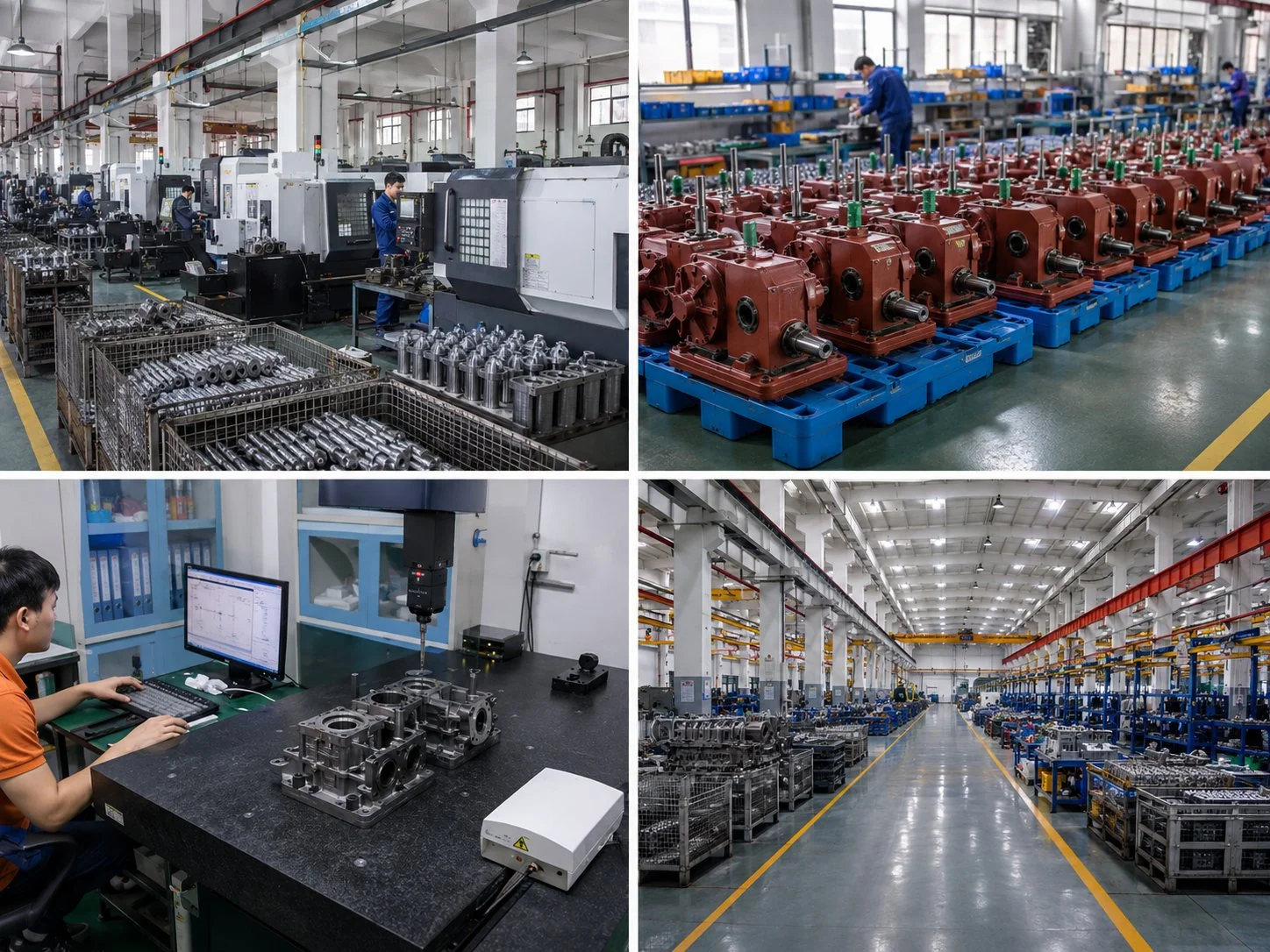
Carburizing: The Gold Standard for Agricultural Gearbox Gears
Carburizing is a thermochemical process that diffuses carbon atoms into the surface of a low-carbon steel gear (typically 8620, 4320, or 20MnCr5) at temperatures between 900 and 950 °C. The carbon enriches the surface layer to approximately 0.7–0.9% carbon content — high enough to form very hard martensite when the gear is subsequently quenched (rapidly cooled). The core, which retains its original low carbon content of 0.15–0.25%, transforms into a tough martensitic-bainitic structure that resists impact and bending fatigue. The result is a gear with 58–63 HRC surface hardness and 30–42 HRC core hardness — the ideal composite structure for high-load agricultural gearbox applications.
Pre-Machining
The gear is machined to near-final dimensions from annealed low-carbon alloy steel, leaving 0.1–0.15 mm stock per surface for post-hardening finish grinding. Keyways and splines are cut at this stage while the steel is still soft and machinable.
Carburizing (Carbon Diffusion)
The gear is heated to 900–950 °C in a carbon-rich atmosphere (endothermic gas or vacuum with hydrocarbon injection) for 4 to 24 hours depending on the required case depth. Carbon diffuses into the surface, creating a gradient from 0.8% carbon at the surface to the original 0.2% at the case-core boundary.
Quenching (Rapid Cooling)
The gear is quenched in oil or high-pressure gas to transform the carbon-enriched surface into hard martensite. The quenching rate must be fast enough to form martensite (58–63 HRC) at the surface but controlled enough to minimize distortion and residual stress.
Tempering
The quenched gear is reheated to 150–200 °C for 1–2 hours to relieve internal stresses from quenching without significantly reducing surface hardness. Tempering converts brittle untempered martensite into tempered martensite — still very hard (57–62 HRC) but with improved toughness.
Finish Grinding
Final gear tooth profile and surface finish are achieved by grinding through the hardened case. This removes the 0.1–0.15 mm distortion layer from quenching and produces the precise tooth geometry and surface finish (Ra 0.4–0.8 µm) required for quiet, efficient mesh operation in a PTO gearbox.
Case depth — the thickness of the hardened surface layer — is the critical carburizing parameter for gear designers. Insufficient case depth means the hard layer is too thin to support the contact load; the subsurface stress field extends below the case into the softer core, causing subsurface fatigue cracking that appears as tooth surface pitting. Excessive case depth wastes processing time and can actually reduce fatigue life by making the case so thick and brittle that it cracks under impact loading. For agricultural PTO gearbox bevel gears with a module of 4 to 8 mm, the target effective case depth (depth to 50 HRC) is typically 0.8 to 1.5 mm — roughly 10–15% of the tooth thickness at the pitch line.
Nitriding: Minimal Distortion for Precision Gears
Nitriding diffuses nitrogen (rather than carbon) into the surface of an alloy steel gear at 500–580 °C — significantly below the steel’s transformation temperature. Because no phase transformation occurs during nitriding, there is virtually no dimensional distortion. A nitrided gear retains its pre-treatment dimensions so accurately that finish grinding after treatment is often unnecessary, saving both manufacturing time and cost.
The nitrided surface layer achieves 65–72 HRC — harder than carburized cases — through the formation of iron and alloy nitride compounds. However, the case depth is typically only 0.2 to 0.5 mm, substantially shallower than carburizing. This thin hard layer provides excellent wear resistance and scuffing resistance but offers limited support for high Hertzian contact loads. Nitrided gears perform best in applications with moderate contact stress but high sliding velocity — conditions found in worm gears, some high-speed helical gears, and precision instrument gearboxes.
Nitriding Surface Hardness
65–72 HRC
Harder than carburized cases (58–63 HRC) but limited to 0.2–0.5 mm case depth
Virtually zero distortion — no finish grinding required in most applications
For agricultural gearbox applications where impact loading is common — rotary cutters striking rocks, combine header gearboxes absorbing crop blockage shocks, snow plow gearboxes encountering frozen obstacles — nitriding alone is generally insufficient. The thin hard case cannot absorb the concentrated subsurface stress from impact events, and the shallow case depth provides minimal fatigue life reserve under heavy Hertzian loading. Carburizing remains the dominant choice for heavy-duty agricultural bevel and spur gears. Nitriding finds its niche in precision worm gears, instrument drives, and applications where dimensional accuracy after treatment is paramount. For a deeper look at how gear noise originates from surface quality and tooth engagement patterns, see our technical guide on PTO gearbox noise troubleshooting.
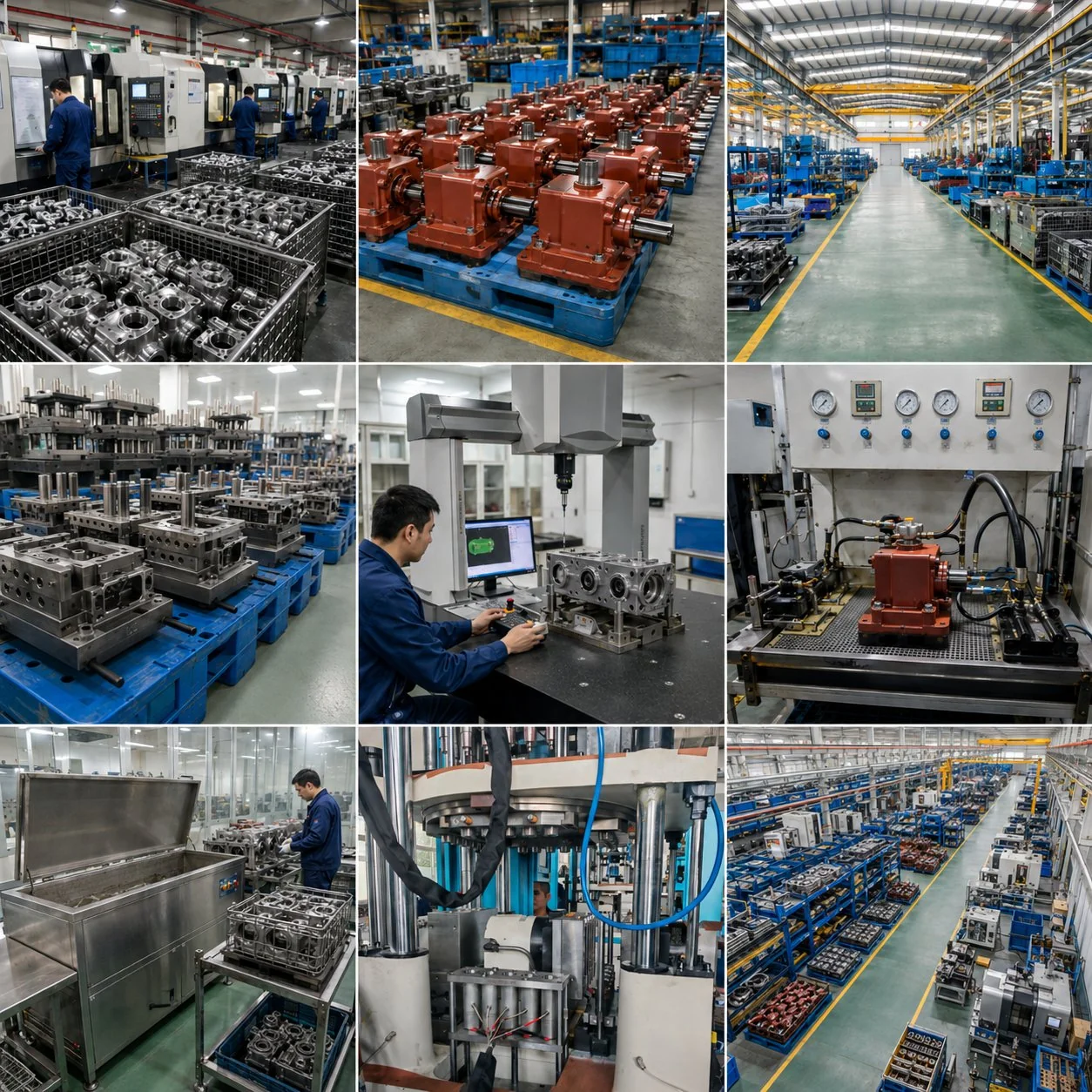
Induction Hardening: Selective Surface Treatment at Speed
Induction hardening uses electromagnetic induction to rapidly heat the gear tooth surface to above the austenitizing temperature (850–1,000 °C), followed by immediate quenching with water or polymer spray. Only the surface layer heated by the induction coil transforms to martensite — the core, which never reached transformation temperature, remains in its original softer state. The result is a hardened case of 50–60 HRC over a tough core of 25–35 HRC — a composite structure similar to carburizing but achieved in seconds to minutes rather than hours.
The key advantage of induction hardening is speed and selectivity. A single gear tooth root can be hardened in 10–30 seconds per tooth, and the process can selectively treat specific areas (tooth flank, root fillet, bearing journal) while leaving other areas soft. This selectivity is valuable when a gear must have a hard tooth surface but a soft bore (for press-fitting onto a shaft) or a soft hub area (for keyway retention strength). Induction hardening requires medium-carbon steel (0.40–0.55% carbon, such as 4140, 4340, or 1045) that contains sufficient carbon to form hard martensite without carburizing enrichment.
Case depth in induction hardening depends on frequency and power density: high frequency (100–500 kHz) produces shallow cases of 0.5–2 mm suitable for small gear teeth; low frequency (1–10 kHz) produces deeper cases of 3–8 mm for large gears. For medium-module PTO gearbox gears (module 4–8), medium frequency (10–100 kHz) typically achieves the optimal 1–3 mm case depth. The disadvantage compared to carburizing is that induction-hardened gears generally achieve 2–4 HRC points lower surface hardness and less uniform case depth across complex tooth geometries — particularly in the critical tooth root fillet area where fatigue cracks initiate.
Process Comparison: Choosing the Right Heat Treatment
| Parameter | Carburizing | Nitriding | Induction Hardening |
|---|---|---|---|
| Surface hardness | 58–63 HRC | 65–72 HRC | 50–60 HRC |
| Core hardness | 30–42 HRC | 25–35 HRC | 25–35 HRC |
| Case depth (effective) | 0.8–2.5 mm | 0.2–0.5 mm | 1–5 mm |
| Process temperature | 900–950 °C | 500–580 °C | 850–1,000 °C (surface only) |
| Distortion | Moderate (requires finish grinding) | Minimal (grinding often unnecessary) | Moderate to high (local heating) |
| Process time | 4–24 hours + quench + temper | 10–80 hours | Seconds to minutes per tooth |
| Best agricultural use | Bevel gears, spur gears, high-load PTO gears | Worm gears, precision drives | Large gears, replacement parts, shafts |
For heavy-duty agricultural gearbox applications — rotary cutters, balers, tillers, combine drives — carburizing is the recommended process. It delivers the deepest case with the best balance of surface hardness and core toughness, and the mandatory finish grinding after carburizing produces the precise tooth geometry needed for quiet, efficient operation. Induction hardening is a practical alternative for large gears where the furnace size for full carburizing is a limitation, and for replacement gears manufactured in small quantities where the per-piece cost of a dedicated carburizing cycle is prohibitive. Nitriding is reserved for precision and worm gear applications where dimensional stability after treatment is the priority.
Through-Hardened vs. Case-Hardened: Why the Distinction Matters
Through-hardening (also called bulk hardening) heats the entire gear to the austenitizing temperature and quenches it, producing a uniform hardness throughout the cross-section — typically 28 to 38 HRC. Through-hardened gears are inexpensive to produce because the process is simple and requires no specialized atmosphere furnace or post-treatment grinding. They are adequate for low-load, low-hour applications where the gear is essentially a wear item to be replaced periodically.
Case-hardened gears — produced by carburizing, nitriding, or induction hardening — have a hard surface over a tough core, as described in the preceding sections. The performance gap between through-hardened and case-hardened gears is dramatic under agricultural loading conditions. A through-hardened spur gear at 32 HRC develops visible surface pitting after 500 to 1,000 hours of moderate-load operation. A carburized gear at 60 HRC surface in the same application can operate for 5,000 to 10,000 hours before equivalent pitting develops — a 5 to 10 times difference in surface durability that is entirely attributable to the heat treatment process. This order-of-magnitude life difference explains why specifying a case-hardened gear set is the single most impactful engineering decision for any PTO gearbox intended for professional agricultural use.
The bending fatigue advantage of case-hardened gears is equally significant. The compressive residual stress induced in the hardened case by the quenching process acts as a pre-load that opposes the tensile bending stress at the tooth root during loading. This residual compressive stress effectively increases the gear tooth bending fatigue strength by 30 to 50 percent compared to a through-hardened gear with the same geometry and root hardness. For any PTO gearbox operating more than 200 hours per season under moderate to heavy load, case-hardened gears are the only engineering-justified specification.
Distortion Management: The Hidden Cost of Heat Treatment
Heat treatment distortion — dimensional and shape changes caused by the thermal gradients and phase transformations during heating and quenching — is the primary manufacturing challenge in producing heat-treated gears. A carburized spiral bevel pinion can distort by 0.05–0.15 mm in tooth profile and 0.02–0.08 mm in lead (tooth alignment along the face width) during quenching. These distortions, if uncorrected, cause concentrated loading on one area of the tooth face, leading to premature pitting, excessive noise, and reduced gear life. The distortion magnitude varies with gear geometry, steel composition, furnace uniformity, and quench severity — making distortion prediction and control a complex engineering discipline that separates quality gear manufacturers from commodity producers.
Quality PTO gearbox manufacturers manage distortion through a combination of process control and post-treatment correction. Symmetrical gear blank design minimizes thermal gradients during heating and quenching. Controlled quenching — using press quenching (quenching in a fixture that restrains distortion), gas quenching (slower, more uniform cooling in vacuum carburizing), or marquenching (holding the quench at an intermediate temperature before final cooling) — reduces distortion by 40–60% compared to unrestrained oil quenching. Post-treatment finish grinding removes the remaining distortion and produces the final tooth geometry to AGMA Quality 10–12 accuracy.
The economic impact of distortion control is significant. A manufacturer that skips finish grinding after carburizing saves $10–20 per gear in machining cost but delivers a gear with 0.05–0.15 mm of profile distortion that causes concentrated loading, noise, and premature failure. The grinding cost is a small fraction of the total gearbox value and an even smaller fraction of the implement downtime cost when a poorly finished gear fails mid-season. This is why quality-conscious manufacturers like Ever-Power PTO Gearbox include finish grinding as a standard step in the production of all carburized gears, not an optional upgrade. For reliable PTO shaft and agricultural gearbox solutions with verified heat treatment quality, our engineering team can provide full metallurgical documentation upon request.
Frequently Asked Questions
Get Engineering Support in 24 Hours
Every PTO gearbox gear we manufacture receives documented heat treatment with verified case depth, surface hardness, and core toughness — metallurgical test reports available upon request. From carburized spiral bevel sets to nitrided worm wheels, our heat treatment processes match the application demands of your specific implement.