Why Trucks Need Specialized Gearbox Designs
A truck gearbox operates in a fundamentally different engineering regime than a passenger car transmission. Commercial diesel engines produce peak torque at low RPM — typically 1,000 to 1,400 RPM — within a narrow usable band of perhaps 500 RPM. A passenger car gasoline engine might deliver usable power across a 4,000 RPM range. This narrow diesel power band means a truck needs far more gear ratios to keep the engine in its productive zone across the vehicle’s full operating speed range, from a 0 km/h standing start under full gross vehicle weight to 100+ km/h highway cruise.
Additionally, the torque magnitudes are vastly higher. A heavy-duty diesel engine produces 1,800 to 2,500+ N·m of torque — 10 to 15 times more than a typical passenger car engine. Every gear, shaft, bearing, and synchronizer in a truck gearbox must be engineered for these loads while maintaining acceptable weight, packaging dimensions, and shift quality.
The five truck gearbox types currently in commercial use each balance these demands differently. Understanding their mechanical principles, advantages, and limitations helps fleet operators, owner-drivers, and maintenance technicians make informed decisions about procurement, operation, and service.
Type 1 — Manual Synchronized Gearbox
The manual synchronized gearbox is the oldest and mechanically simplest design still in widespread commercial truck use. Its architecture consists of an input shaft driven by the engine through a friction clutch, a counter shaft (lay shaft) carrying the gear train, and an output shaft delivering power to the driveline. Synchronizer rings — friction cones that equalize the speed of the gear and the shaft before engagement — allow the driver to shift without double-declutching.
Light and medium trucks typically use 5 or 6 synchronized forward gears. Heavy-duty trucks may use 9, 10, 13, or even 18 forward ratios achieved through compound designs: a main box with 4 or 5 ratios multiplied by a range section (high/low) and sometimes a splitter section (direct/overdrive within each main ratio). The Eaton Fuller 18-speed “Super 18” is the iconic example — a 4-speed main box × 2 splitter × 2 range + reverse, providing 18 forward and 4 reverse ratios from a surprisingly compact package.
The mechanical advantage of manual synchronized gearboxes is efficiency: at any given gear ratio, power flows directly through meshing gears with no hydraulic coupling losses. Peak efficiency exceeds 97% in direct (1:1) gear. The disadvantage is driver dependency — fuel economy, clutch life, and driveline longevity all depend on the operator’s shifting skill. A poorly trained driver can consume 15–20% more fuel and halve clutch life compared to an experienced operator in the same truck.
✅
Vorteile
Highest mechanical efficiency. Lowest purchase cost. Lightest weight. Simplest maintenance. No electronic control dependency. Long service life with proper operation.
⚠️
Limitations
Requires skilled operator. Fuel economy varies with driver. Higher driver fatigue on congested routes. Longer shift times interrupt power delivery. Clutch is a wear item.
Type 2 — Automated Manual Transmission (AMT)
An AMT is mechanically identical to a manual synchronized gearbox — same gear train, same synchronizers, same fundamental power path. The critical difference is that the clutch actuation and gear selection are performed by electronically controlled pneumatic or hydraulic actuators rather than the driver’s hands and feet. The driver selects drive mode; the ECU handles every shift based on engine speed, road speed, load, and gradient data.
AMTs have become the dominant transmission type in new heavy-duty trucks across North America, Europe, and increasingly in Asia-Pacific markets. The Eaton Fuller Advantage, Volvo I-Shift, Mercedes-Benz PowerShift, and ZF TraXon are all AMTs built on proven manual gearbox architectures with added electronic shift control. The shift logic in these units is sophisticated — modern AMTs learn the driver’s route patterns, pre-select gears for upcoming grades, and skip gears during acceleration when the engine has sufficient torque to pull the next available ratio.
Because the underlying gear train is a constant-mesh manual design, the AMT retains the mechanical efficiency advantage — no torque converter, no planetary gear losses. The 1–2% efficiency improvement over a torque-converter automatic, compounded across hundreds of thousands of kilometers per year, translates to significant fuel savings in long-haul operations. The trade-off is a momentary torque interruption during each shift (the clutch must disengage and re-engage), which is perceptible but engineered to be brief — typically 200–400 milliseconds in current-generation units.
Type 3 — Dual-Clutch Transmission (DCT)
A dual-clutch transmission uses two separate input shafts — one carrying odd-numbered gears (1st, 3rd, 5th, etc.) and one carrying even-numbered gears (2nd, 4th, 6th, etc.) — each with its own clutch. While one clutch is engaged and transmitting power, the other pre-selects the next anticipated gear on its shaft. When the shift occurs, the engaged clutch releases while the pre-selected clutch engages simultaneously — delivering a seamless shift with no torque interruption.
In the passenger vehicle world, DCTs are common (Volkswagen DSG, Porsche PDK). In the truck world, they are less widespread but gaining traction in medium-duty and urban delivery applications where smooth, uninterrupted power delivery improves both drivability and cargo safety. The Volvo I-Shift Dual Clutch, introduced for heavy-duty applications, represents the current state-of-the-art: it combines the gear-train efficiency of a manual with shift speeds that rival a planetary automatic.
The mechanical complexity is higher than a standard AMT — two input shafts, two clutches, and the associated hydraulic control system add weight, cost, and maintenance complexity. Heat management for the clutch packs during slow-speed maneuvering (where both clutches slip simultaneously) is the primary engineering challenge. The clutch pack thermal capacity determines how long the truck can creep at walking pace — exceeding this thermal limit causes clutch material degradation, shift quality deterioration, and eventually clutch failure requiring costly replacement.
Despite these challenges, for operations that value smooth power delivery and fast shifts — refuse collection, urban distribution, and tanker transport of liquid cargo — the DCT’s seamless shifting provides a tangible operational advantage. The absence of torque interruption during gear changes is particularly valuable when carrying liquid loads, where sudden torque breaks cause dangerous surge forces inside the tank that affect vehicle stability and driver control.
Type 4 — Continuously Variable Transmission (CVT)
A CVT provides an infinite number of gear ratios between its minimum and maximum limits — there are no discrete gear steps. In passenger cars, this is typically achieved with a metal belt or chain running between two variable-diameter pulleys. In truck and heavy equipment applications, the mechanism is hydrostatic or hydro-mechanical: a variable-displacement hydraulic pump drives a hydraulic motor, with the ratio controlled by changing the pump’s swash plate angle.
The advantage is that the engine can be held at its most fuel-efficient RPM regardless of vehicle speed — the CVT continuously adjusts the ratio to match. The disadvantage is efficiency: hydrostatic CVTs lose 10–20% of input power to hydraulic fluid heating, compared to less than 3% losses in a gear-mesh transmission. This efficiency penalty limits CVTs to applications where the ratio flexibility outweighs the energy cost — primarily in agricultural tractors (where CVTs are widespread), construction equipment, and some specialty vehicles.
In the conventional truck market, CVTs remain niche. The fuel economy penalty from hydraulic losses is unacceptable for long-haul operations where every fraction of a percent matters across millions of kilometers. However, hydro-mechanical CVTs that blend gear-mesh transmission with a smaller hydraulic variator (providing continuously variable ratio adjustment within discrete mechanical gear ranges) are appearing in agricultural and municipal vehicles where operating profile diversity justifies the complexity.
Type 5 — Torque-Converter Automatic
The torque-converter automatic uses a fluid coupling (the torque converter) between the engine and a planetary gear set that provides multiple forward ratios through a combination of clutch packs and band brakes. The torque converter absorbs the speed difference between engine and transmission input during acceleration — functioning as both a fluid coupling and a torque multiplier at low speeds.
The Allison 3000, 4000, and 4700 series are the most recognized torque-converter automatics in the commercial truck market. They are dominant in vocational applications: refuse trucks, concrete mixers, fire apparatus, urban buses, and military vehicles. The reason is their exceptional low-speed maneuverability — the torque converter provides smooth, infinitely variable torque multiplication from zero speed, enabling precise creep control and seamless direction changes that gear-based transmissions cannot match.
The engineering trade-off is efficiency. At highway cruise, the torque converter lock-up clutch engages to eliminate slip, but during urban stop-and-go cycles, the converter absorbs energy as heat. Modern units mitigate this with aggressive lock-up strategies and six or more gear ratios, but a torque-converter automatic will always consume slightly more fuel than an AMT or manual in identical conditions. For vocational applications where the operational benefits outweigh the fuel cost, this trade-off is overwhelmingly justified.
Gear Material and Lubrication Engineering Across Types
The mechanical differences between truck gearbox types extend deep into their metallurgy and lubrication systems. Manual and AMT gearboxes use carburized alloy steel gears — case-hardened to HRC 58–62 on the contact surfaces for wear resistance while retaining a tough, ductile core for shock absorption. The synchronizer cones are typically sintered bronze or molybdenum-coated steel, designed to friction-match shaft speeds within a fraction of a second. These gearboxes run on gear oil (typically SAE 50 or SAE 50/60 heavy-duty transmission fluid) that must provide both EP protection for the gear teeth and friction compatibility for the synchronizer materials — a demanding dual requirement that limits acceptable oil formulations.
Torque-converter automatics operate in an entirely different lubrication environment. The planetary gear sets, clutch packs, and torque converter all share a single automatic transmission fluid (ATF) that must simultaneously lubricate gears, provide hydraulic pressure for shift control, cool the torque converter, and deliver precise friction coefficients for the clutch packs. ATF formulations for commercial automatics (such as Allison TES 295 or TES 668) are application-specific — using the wrong fluid can cause clutch shudder, shift quality degradation, and accelerated wear.
Dual-clutch transmissions present the most demanding lubrication challenge in the truck gearbox landscape. Wet DCTs (where the clutch packs run in oil) require a fluid that provides gear protection, clutch friction management, and thermal conductivity for the dual-clutch packs — all simultaneously. Dry DCTs (where the clutches operate in air) separate the gear lubrication from clutch friction, simplifying fluid requirements but requiring clutch replacement as a wear item. The distinction between wet and dry DCT variants has significant implications for maintenance scheduling and total cost of ownership.
For fleet maintenance managers, the critical takeaway is that gear material selection and lubricant specification are not interchangeable between gearbox types. Each type demands its own fluid chemistry, change interval, and inspection protocol. Cross-contamination — for example, adding gear oil to a torque-converter automatic or ATF to a manual gearbox — causes component damage that may not be immediately apparent but accelerates wear dramatically over subsequent operating hours.
Side-by-Side Comparison
| Besonderheit | Manual | AMT | DCT | CVT | Auto (TC) |
|---|---|---|---|---|---|
| Effizienz | 97%+ | 96–97% | 95–97% | 80–90% | 88–94% |
| Shift speed | 0.5–2 s | 0.2–0.4 s | < 0.1 s | Seamless | 0.3–0.6 s |
| Torque interrupt | Ja | Brief | Keiner | Keiner | Keiner |
| Driver skill needed | Hoch | Niedrig | Niedrig | Minimal | Minimal |
| Beste Anwendung | Long-haul, experienced drivers | Long-haul, mixed fleet | Urban delivery, tankers | Agriculture, specialty | Vocational, stop-and-go |
| PTO compatibility | Exzellent | Good (with PTO mode) | Limited | Via transfer case | Excellent (Allison PTO) |
PTO-Equipped Truck Gearboxes: Where Truck Transmissions Meet PTO Power
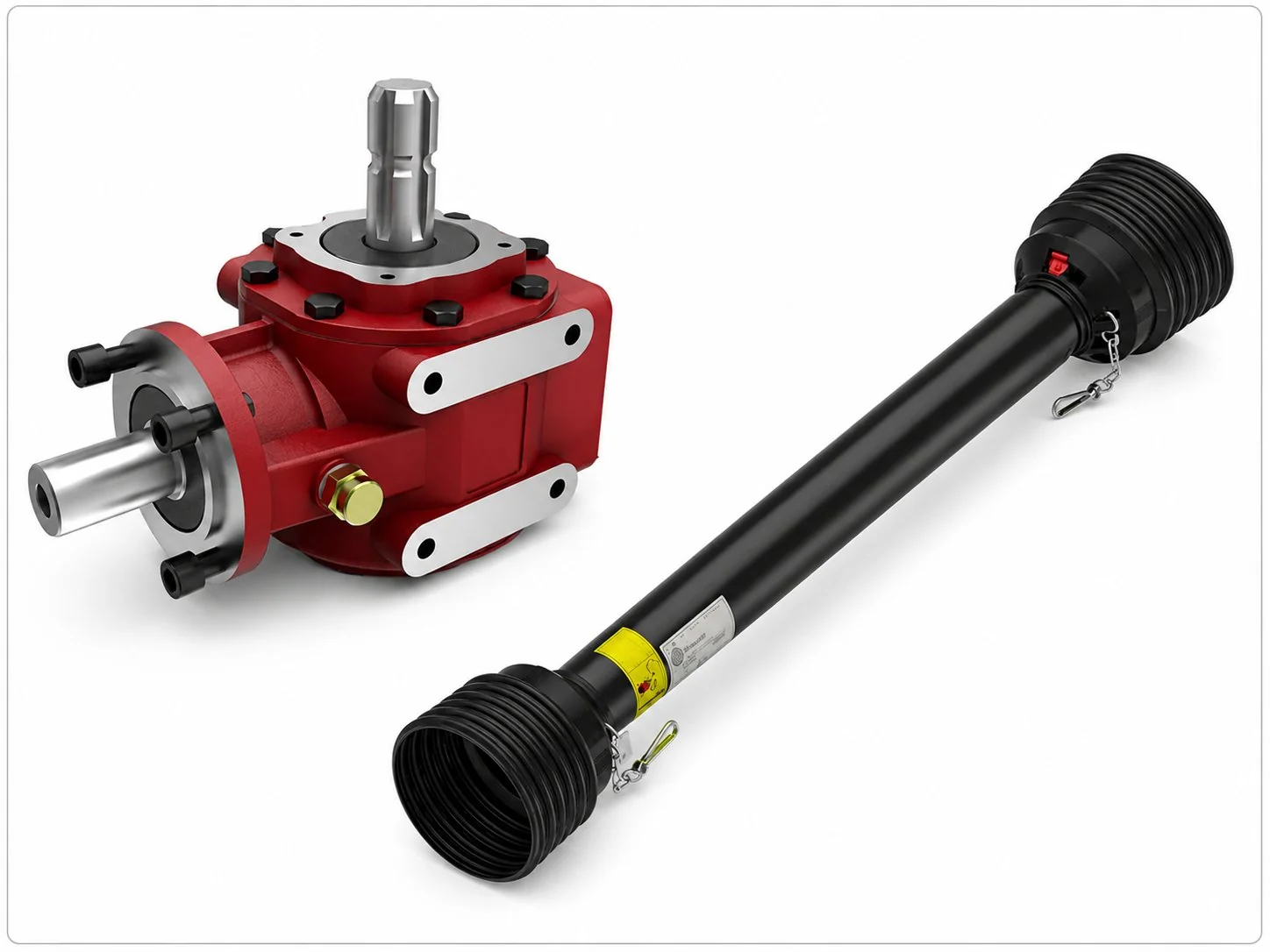
Many commercial trucks require PTO (power take-off) outputs to drive hydraulic pumps, air compressors, winches, or mechanical attachments. The Zapfwellengetriebe in a truck context is a mechanical device that bolts to an aperture on the truck transmission housing, engaging a gear on the transmission countershaft or an auxiliary gear set to extract rotational power while the engine is running.
Manual and AMT transmissions offer the most straightforward PTO integration — both have accessible countershaft gears and standardized PTO apertures. Torque-converter automatics (particularly Allison units) are designed from the factory with integrated PTO gear provisions and electronic PTO engagement logic. DCTs and CVTs present more challenges for PTO integration due to their dual-shaft and hydrostatic architectures, respectively — PTO on these platforms typically requires a dedicated Zapfwelle arrangement from the transfer case or a separate engine-driven PTO.
When specifying a truck for PTO-driven equipment, the transmission type directly affects PTO capability: available PTO torque (limited by the countershaft gear that the PTO engages), available PTO speed (determined by the gear ratio at the PTO aperture and the engine RPM), and engagement method (mechanical shift fork on manuals, pneumatic or electronic actuator on AMTs and automatics). The Landwirtschaftliches Getriebe engineering principles of gear ratio, torque capacity, and thermal management apply equally to truck PTO applications — the physics of power transmission does not change with the vehicle platform.
Häufig gestellte Fragen
Need a PTO Gearbox for Your Truck?
Ever-Power manufactures PTO gearboxes, speed increasers, and agricultural gearbox solutions compatible with all major truck transmission platforms — manual, AMT, and automatic. Kontaktieren Sie unser Ingenieurteam. for PTO specification matching.
Herausgeber: Cxm