Powered Deep Tillage: Where the PTO Gearbox Matters
Conventional subsoilers and rippers are passive draft implements — rigid tines pulled through the soil by the tractor’s drawbar, requiring no PTO drive and no gearbox. These tools work well in dry, friable soils where the static shank can fracture the compacted layer through pure mechanical force. However, in clay-rich soils, plastic soils, or heavily compacted profiles where the static fracture force exceeds the tractor’s available drawbar pull, passive subsoiling becomes impractical — the tractor’s wheels lose traction before the shank breaks the hardpan, leaving the compaction untouched. This is where powered deep cultivators come in.
A powered deep cultivator uses a PTO-driven oscillating, rotating, or vibrating mechanism to break the hardpan dynamically rather than statically. The dynamic loading mechanism — whether a rotating tine assembly, a vibrating shank, or a deep-set rotor — applies cyclic force to the soil at frequencies of 5 to 20 Hz, reducing the average draft force required by 40 to 70 percent compared to passive subsoiling. The PTO gearbox driving this mechanism must convert the high-speed PTO input (540 or 1,000 RPM) into the low-speed, high-torque output that the soil-fracturing mechanism requires — typically a 1:3 to 1:8 speed reduction depending on the cultivator design.
The most common powered deep cultivator configurations are deep-set rotary tillers (similar to a standard rotary tiller but with longer tines reaching 250 to 400 mm working depth), oscillating subsoilers (where the shank moves fore-and-aft at low frequency under PTO drive), and combined deep-shallow units that pair a passive subsoiler shank with a powered rotary leveller mounted behind it. Each configuration creates a distinct gearbox loading profile, but all share the fundamental requirement of high sustained output torque combined with the ability to absorb violent impact spikes from rocks and root masses encountered at the working depth.
Low-Speed High-Torque Gearbox Design Principles
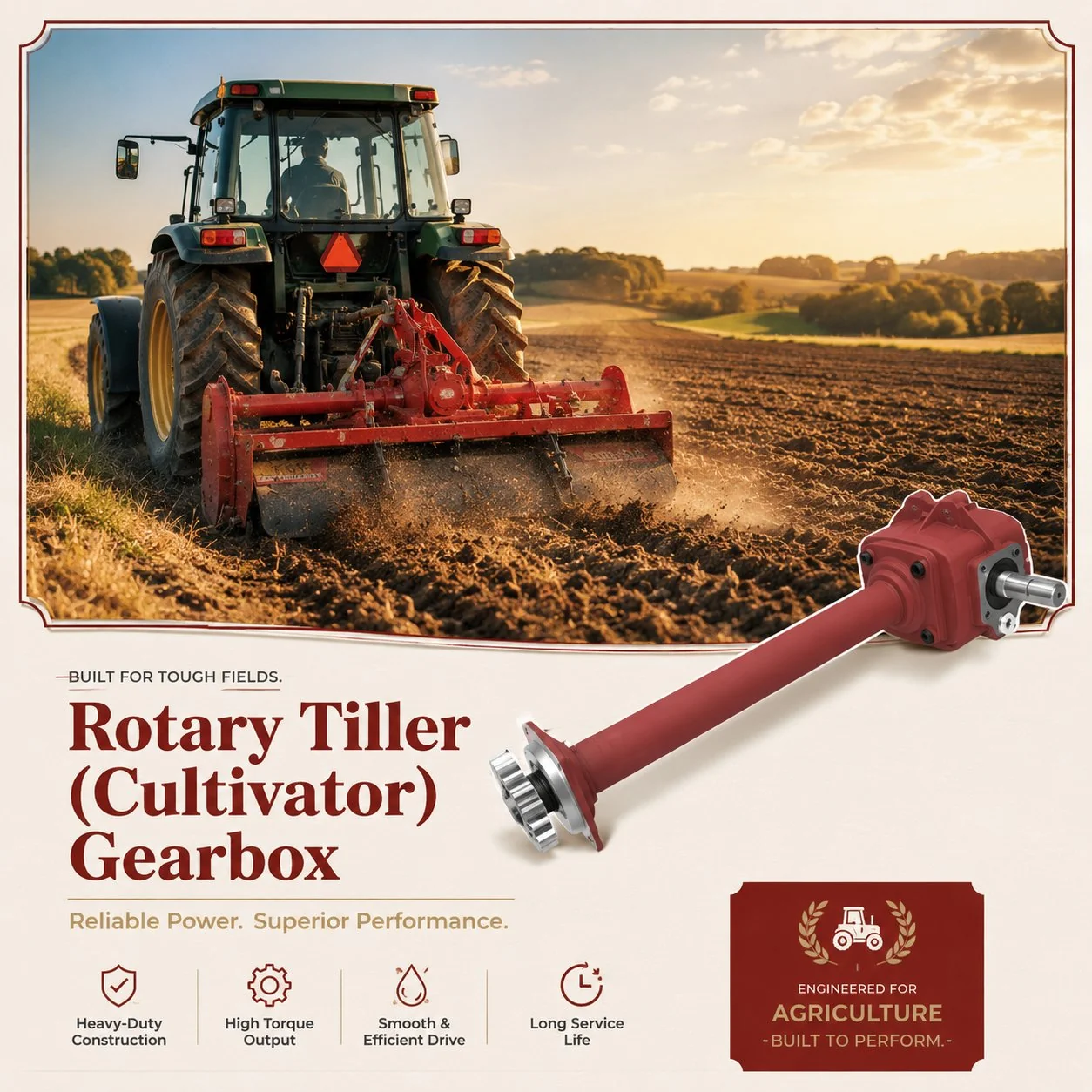
Usa ka deep cultivator gearbox represents the high-torque extreme of the agricultural gearbox design spectrum. Where a seed drill fan gearbox transmits modest torque at very high output speed, a deep cultivator gearbox transmits very high torque at modest output speed — and the engineering trade-offs are fundamentally different. The output torque at 100 RPM transmitting 60 HP is over 4.5 times higher than the input torque at 540 RPM transmitting the same power (output torque scales inversely with speed reduction ratio). This torque amplification demands gear teeth with substantial root strength, larger module sizes, and shaft diameters sized for fatigue resistance rather than just stiffness.
The gear module (the tooth size parameter that determines both load capacity and rotational speed at a given pitch line velocity) for a typical deep cultivator output gear is 5 to 8 mm — substantially larger than the 3 to 4 mm module used in a comparable-power rotary mower gearbox where the output speed is higher. Larger modules produce larger gear teeth with deeper roots, distributing the cutting load across more material and providing the bending strength needed to resist tooth root cracking under sustained high-torque operation. The output shaft diameter at the bearing positions is typically 60 to 100 mm — also substantially larger than the 35 to 50 mm common in high-speed agricultural gearboxes — providing the cross-sectional area needed to handle the high torsional shear stress without exceeding the fatigue endurance limit of the shaft material.
Bearing selection for the high-torque output position requires tapered roller bearings rather than the deep-groove ball bearings preferred for high-speed applications. Tapered rollers handle the combined radial and axial loads generated by helical or spiral bevel gear meshes at high torque, and their substantially higher load capacity per envelope size makes them the only practical choice for the bearing positions adjacent to the high-torque output gear. Manufacturers like Kanunay nga Gahum nga PTO Gearbox specify matched tapered roller bearing sets with controlled preload for deep cultivator gearbox output positions — the preload setting (typically 0.05 to 0.15 mm axial compression) ensures uniform load distribution across the bearing rollers under the high cyclic loading characteristic of soil-engaging implements.
Deep Rotary Tillers and Powered Subsoilers: Drive Architecture
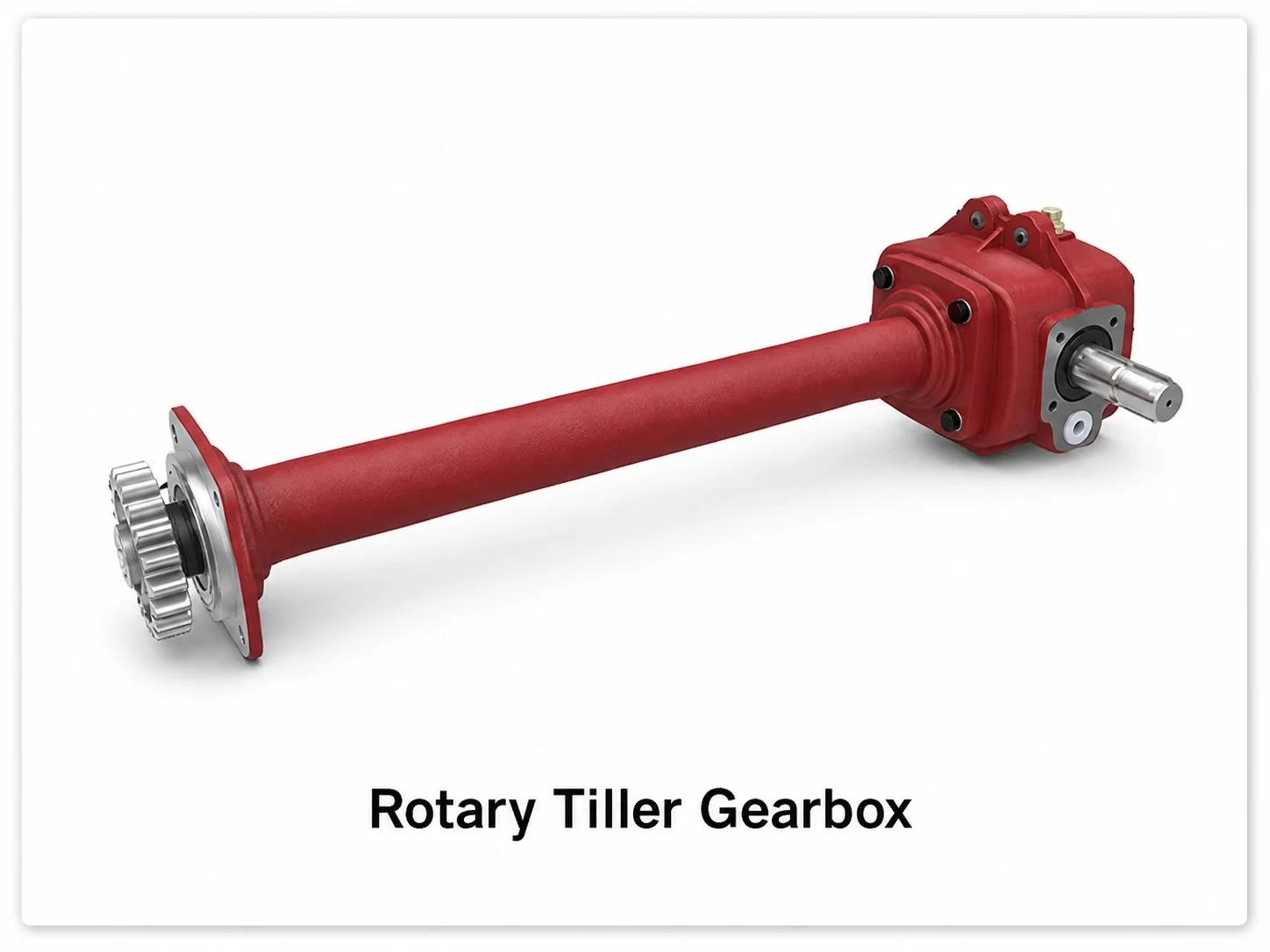
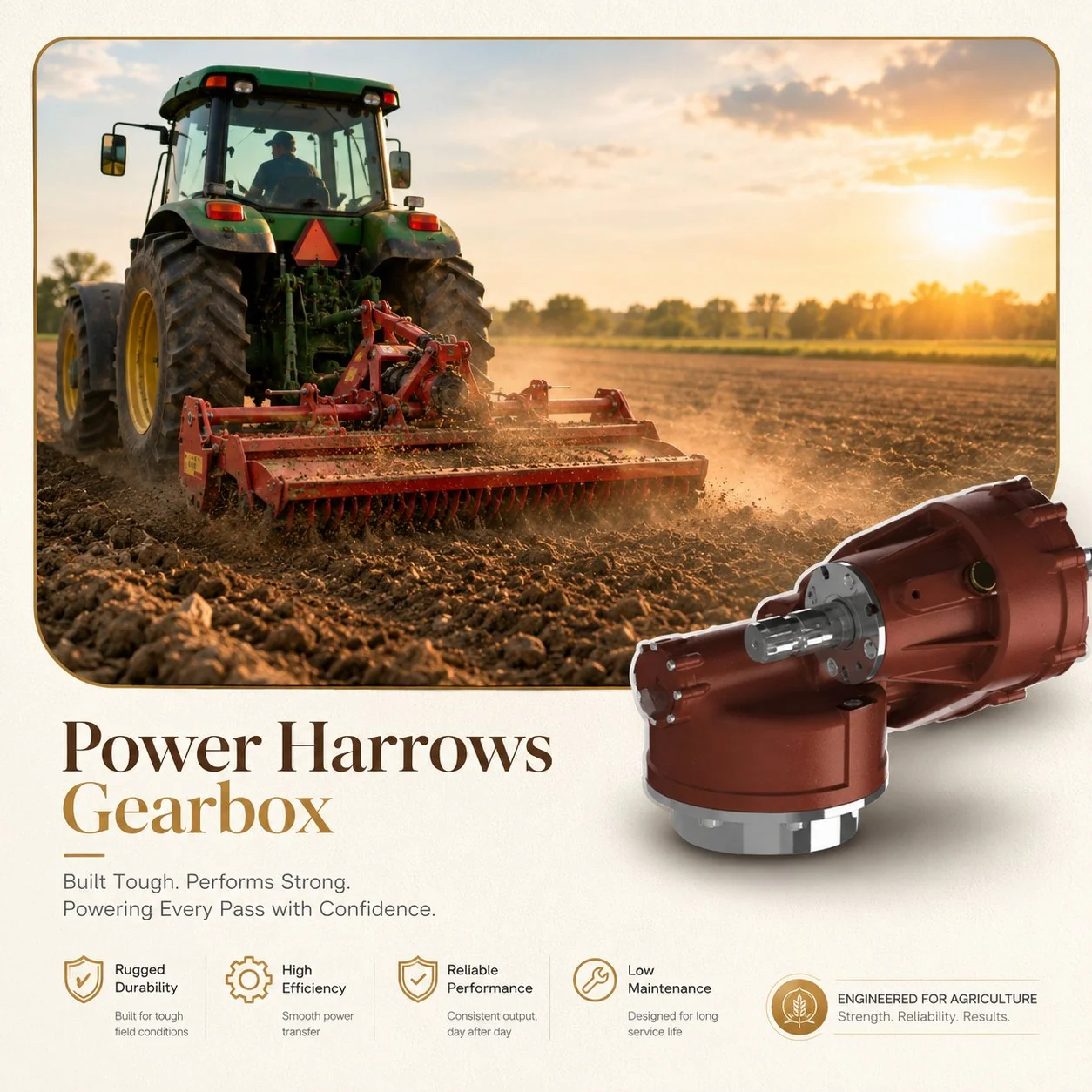
A deep rotary tiller extends the working depth of a standard rotary tiller from the typical 150 to 200 mm of conventional tillage to 250 to 400 mm of subsoil rehabilitation. The tine assembly carries longer blades on a heavier rotor shaft, and the gearbox driving the rotor must transmit 30 to 50 percent more power than a shallow-tillage gearbox sa agrikultura of the same working width because the deeper tine engagement consumes proportionally more energy per unit of forward travel. From a 540 RPM PTO, the gearbox reduces speed to 200 to 280 RPM at the rotor shaft — a 1:1.9 to 1:2.7 reduction ratio that produces the rotor tine tip speed (5 to 7 m/s) needed for effective soil shattering and lateral fragmentation at the increased working depth where soil density and cohesive strength are substantially higher than in the surface tillage layer. For comparison with shallower tillage equipment that uses similar drive architecture but lower torque ratings, see our engineering guide on gearbox sa power harrow design and application.
Powered subsoilers use a different mechanism: rather than a rotating tine assembly, they employ vertical shanks (typically 4 to 8 shanks across a 3 to 5 metre working width) with PTO-driven oscillation that vibrates each shank fore-and-aft at 5 to 15 Hz frequency and 30 to 80 mm stroke amplitude. The oscillation mechanism uses an eccentric crank driven from the PTO gearbox output — converting rotary motion to reciprocating motion through a crank-and-pitman linkage similar to the mechanism used in reciprocating-knife mowers but at much higher torque levels. The crank shaft must rotate at the desired oscillation frequency — 300 to 900 RPM if the oscillation is 5 to 15 Hz (since one oscillation cycle = one crank revolution) — which requires a 1:1.8 to 1:0.6 ratio range from a 540 RPM PTO depending on the target frequency.
Rock Impact Protection: Surviving the Subsoil Environment
At 300 to 600 mm working depth, deep cultivators encounter the geological features that surface tillage equipment never sees: large field stones (200+ mm boulders that have settled below the cultivation layer), bedrock outcrops, buried roots and stumps from previous land clearing, and metal artifacts (broken plough points, irrigation pipe fragments, fence posts) that have been ploughed under by decades of conventional tillage. Each of these obstacles generates impact loads on the tine or shank that can exceed 5 to 15 times the normal running force within milliseconds.
Overload protection on deep cultivators uses a layered approach. The primary defence is a PTO driveline slip clutch or shear bolt calibrated to release at 1.5 to 2.0 times the rated continuous torque — protecting the PTO gearbox from torque spikes that would otherwise damage gear teeth or fracture shafts. Individual shank protection is the secondary defence: each tine or shank is mounted on a hydraulic or spring-reset breakaway assembly that allows the shank to deflect rearward when it encounters an immovable obstacle, then returns to its working position once the obstacle is cleared. Hydraulic reset systems (using a hydraulic accumulator to provide breakaway force) offer the highest reset accuracy and resistance to false triggering on small obstacles, while spring-reset systems are mechanically simpler and less expensive but require periodic spring tension adjustment to maintain consistent breakaway force.
The gearbox housing material specification matters more on deep cultivators than on most agricultural implements because of the impact loading severity. Ductile iron (SG iron, EN-GJS-400-15 or higher grade) is the minimum acceptable housing material — standard grey cast iron fractures under the shock loads typical of subsoil rock impacts, while ductile iron deforms locally without through-wall cracking or catastrophic housing fracture. For the most demanding applications (volcanic soils with substantial boulder content, reclaimed land with buried construction debris), welded steel housings provide impact toughness 3 to 5 times higher than ductile iron at the cost of moderately reduced thermal conductivity — a worthwhile trade-off for protecting the gearbox against catastrophic impact failure.
Power-per-Metre Sizing: Matching Tractor and Gearbox to Working Width
Deep cultivation is the most power-intensive PTO operation in mainstream agriculture, consuming 30 to 60 HP per metre of working width depending on soil type, working depth, and forward speed. For comparison: a shallow rotary tiller consumes 15 to 30 HP per metre, a power harrow 12 to 25 HP per metre, and a seedbed cultivator 8 to 15 HP per metre. The substantially higher power demand of deep cultivation reflects the geometric reality that doubling the working depth more than doubles the soil mass being engaged (because the shank or tine engages soil along its full length), and the deeper soil is typically denser and more cohesive than the surface layer above it.
A 3-metre powered deep tiller therefore requires 90 to 180 PTO HP — a power range that limits this equipment to medium-large agricultural tractors (130 to 250 HP engine power, with at least 100 HP available at the PTO after driveline losses). The gearbox sa agrikultura must be rated for the full continuous power demand plus a 30 to 40 percent margin for the torque peaks from rock and root impacts that occur multiple times per hour during typical operation. Under-sizing the gearbox by ignoring this peak margin produces predictable consequences: gear tooth root cracking within one to two seasons, output bearing wear that develops into housing damage, and eventually a complete gearbox replacement that costs 3 to 5 times the price difference between the correctly sized and the under-sized gearbox at original purchase.
Maintenance for High-Torque Soil-Engaging Gearboxes
Deep cultivator gearboxes operate seasonally — typically 50 to 150 hours per year of intense use during the pre-planting or post-harvest soil preparation window. The compressed annual operating hours might suggest extended oil change intervals, but the severity of the operating conditions argues for the opposite approach. Oil change at the end of each working season (regardless of hours accumulated) is the recommended schedule — the high-torque gear mesh generates thermal degradation that is not fully reversed during the long off-season storage period, and water condensation accumulates in the oil during storage that contaminates the gear and bearing surfaces if not removed before the next season begins.
Inspect the gear backlash at every seasonal oil change. Rotate the input shaft with the output locked and feel for the dead-zone of free rotation before the output gear engages — typical new-gearbox backlash is 0.10 to 0.25 mm at the gear pitch radius (measured at the output shaft tooth flank). Backlash increasing to 0.50 mm or more indicates significant gear wear that warrants bearing inspection and possibly gear replacement before the next operating season. Use synthetic PAO-based EP gear oil ISO VG 320 (one grade heavier than the VG 220 used in medium-load agricultural gearboxes) — the elevated viscosity maintains adequate oil film thickness at the high tooth contact stress characteristic of low-speed high-torque operation.
PTO shaft selection for deep cultivators must match the high torque transmission requirement — undersized drivelines that perform adequately on shallow tillage equipment may fail catastrophically when transferred to a deep cultivator application. Verify that the PTO shaft Series rating (Series 6 for higher torque, Series 8 for the highest torque applications) is appropriate for the deep cultivator’s power input. A constant-velocity (CV) PTO driveline is recommended for deep cultivators operated at angles greater than 25 degrees relative to the tractor — common when tilling around field boundaries or on undulating terrain. The CV driveline eliminates the cyclic torque pulsation that standard Hooke’s-joint drivelines generate at high operating angles, protecting the gearbox input bearings from the accelerated fatigue that this pulsation would otherwise cause.
Mga Kanunayng Gipangutana nga Pangutana
Go Deeper — Specify the Right Gearbox
From powered deep rotary tillers to oscillating subsoiler crank drives — our high-torque gearboxes are engineered for the sustained loading and impact resistance that subsoil rehabilitation demands. Ductile iron housings, oversized gear modules, and matched tapered roller bearing arrangements included as standard.
Editor: Cxm