Post-Storage Inspection: What to Check Before the First Start
The spring startup inspection is the annual opportunity to identify and correct problems that developed during storage before they cause in-season failures. A systematic 30-minute inspection of each Mjenjač kardana before the first field operation of the season is the single highest-value maintenance activity in the annual calendar — catching 80 percent of the issues that would otherwise cause mid-season breakdowns.
Visual Inspection of Housing and Seals
Examine the gearbox housing for cracks, dents, corrosion damage, or paint deterioration that occurred during storage. Check all shaft seal areas for dried oil residue (indicating a slow leak that developed during storage) or visible seal lip damage (cracks, hardening, or deformation from UV exposure or temperature cycling). A seal that leaked during storage will leak more aggressively under operating pressure and temperature.
Drain and Inspect the Oil
Drain the gear oil completely into a clean container. Examine the oil for water contamination (milky or cloudy appearance), metallic particles (visible glitter or sediment from internal wear), and unusual color or odor (indicating thermal degradation or chemical contamination). Even if the oil was changed before storage, condensation during temperature cycling can introduce significant water content over a 4 to 6 month storage period in unheated buildings.
Check Bearing Play
With the oil drained and the gearbox still mounted on the implement, grasp the output shaft firmly and attempt to push, pull, and rock it in all directions. Any detectable axial play (in-out movement) or radial play (side-to-side wobble) indicates bearing wear or preload loss that must be corrected before operation. On the input shaft, spin it by hand and feel for roughness, grinding, or clicking that indicates bearing damage from corrosion pitting during storage.
Inspect Input Shaft Splines
Examine the input shaft splines for wear (rounded or thinning spline teeth), corrosion (surface rust that developed during storage), and dimensional integrity (check fit with the PTO driveline yoke — excessive play between splines indicates wear that will worsen rapidly under load). Light surface rust can be cleaned with emery cloth; significant spline wear requires shaft replacement.
Refill with Fresh Oil and Test Run
Fill the gearbox with the correct type and volume of fresh gear oil as specified by the manufacturer. Run the gearbox under no-load conditions for 10 minutes — listening for unusual noise, checking for oil leaks at all seal locations, and monitoring housing temperature. This no-load run circulates fresh oil through all internal passages and allows the seals to re-seat after months of inactivity before the gearbox is subjected to working loads.
Oil Flush Procedure for Contaminated Gearboxes
If the drained storage oil shows water contamination (milky appearance) or significant metallic particles, a flush cycle is necessary before refilling with service oil. The flush removes contaminants that cling to internal surfaces and settle in passages where a simple drain cannot reach.
Fill the gearbox with inexpensive mineral gear oil (not the premium service oil — the flush oil will be discarded). Run the gearbox at idle speed (no load) for 5 to 10 minutes to circulate the flush oil through all internal passages, bearing cavities, and gear mesh zones. Drain completely and allow a full 10 to 15 minutes for residual flush oil to drip out of all internal passages. For severe water contamination (heavy milky appearance or visible free water in the drain sample), repeat the flush cycle a second time before filling with the premium service oil. The cost of two flush oil fills is negligible compared to the bearing and gear life protected by removing corrosive water contamination before the first working hour. For a comprehensive guide to ongoing lubrication management, see our detailed resource on održavanje poljoprivrednih mjenjača throughout the operating season.
PTO Driveline Re-Greasing and Guard Inspection
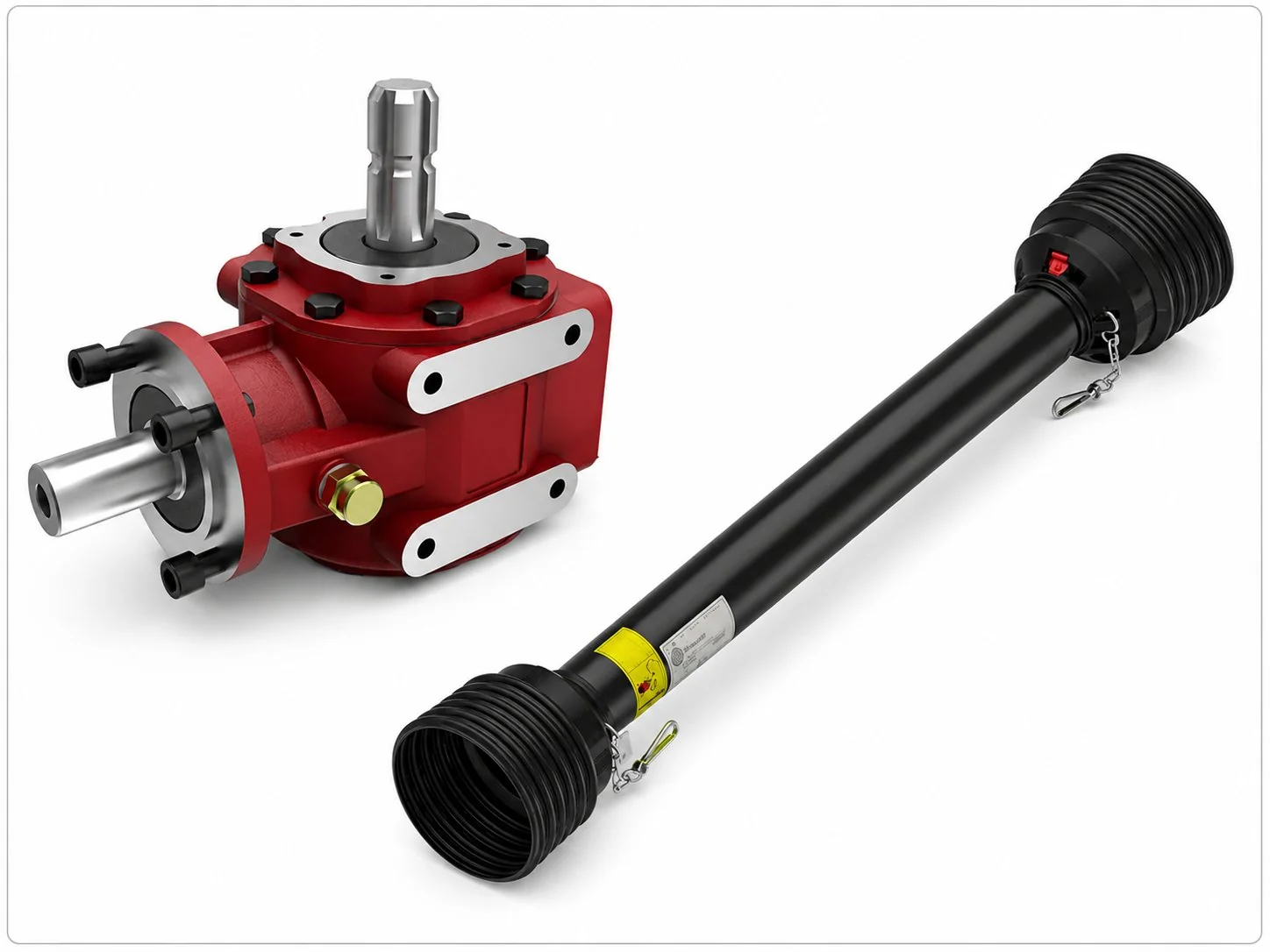
The Kardansko vratilo driveline connecting the tractor to the gearbox requires its own spring maintenance — the universal joints, telescoping tube, and guard bearings all need attention after months of inactivity. Grease each universal joint (typically 4 to 8 grease nipples per driveline) until fresh grease appears at all four bearing seals of each cross journal. Old grease hardens during storage and loses its protective film on the needle bearings — fresh grease displaces the hardened residue and restores the lubricant film that prevents the first-revolution dry-start damage that initiates needle bearing failure.
Lubricate the telescoping tube splines with multi-purpose grease applied to the male and female spline surfaces. Extend and compress the tube several times to distribute the grease across the full spline engagement length. Dry or corroded telescoping tube splines generate a binding resistance that transmits shock loads to the gearbox input shaft bearings — a problem that is entirely preventable with proper lubrication.
Inspect guard tubes for cracks or jamming — spin each guard tube by hand around the shaft. If it binds, drags, or does not rotate freely, the internal bearing surface is seized and the guard must be replaced before operation. A jammed guard rotates with the shaft and becomes an entanglement hazard.
Check restraint chains — verify that both guard restraint chains are intact, securely attached at both ends, and correctly adjusted to prevent the guard from rotating with the shaft. Replace any chain that shows corrosion weakening, missing links, or damaged attachment points.
Verify telescoping overlap — with the implement at maximum distance from the tractor, confirm that the driveline telescoping halves still overlap by at least one-third of their travel. Storage on uneven ground can shift the implement position relative to the tractor, altering the driveline geometry from the previous season’s operating configuration.
Mid-Season Monitoring: Catching Problems Before They Become Failures
The spring inspection and end-of-season storage preparation bookend the operating season, but the months between require ongoing monitoring to detect developing problems while they are still repairable rather than catastrophic. Mid-season monitoring does not require scheduled downtime — it consists of brief checks that can be performed during normal operational pauses (refueling stops, lunch breaks, end-of-day shutdown).
Oil level is the most critical daily check and the one most frequently neglected. A slow seal leak that loses 50 ml of oil per day is invisible to the casual observer — no puddle, no obvious drip — but over 20 operating days, one liter of oil has been lost from a gearbox that may only hold 1.5 to 2 liters. At that point, the oil level has dropped below the lowest gear mesh zone, and the bearings on the upper shaft positions are running on splash lubrication that is marginal at best and non-existent at worst. A daily 30-second oil level check (sight glass or dipstick) catches this slow decline before it reaches the danger zone. The best practice is to check oil level every morning before the first PTO engagement of the day.
Sound monitoring requires no tools — only attentive listening during the first minutes of operation each day. Every gearbox has a normal operating sound — a specific combination of gear mesh tone, bearing hum, and housing resonance that the operator learns to recognize subconsciously after the first few days of the season. A change in this sound signature — new grinding, clicking, knocking, or a shift in pitch — indicates that something inside the gearbox has changed. The most common mid-season sound changes are bearing deterioration (a low-frequency rumble that develops gradually over days or weeks), gear tooth damage (a once-per-revolution clicking or knocking from a chipped or cracked tooth), and oil starvation (a high-pitched whine indicating insufficient lubrication film between gear teeth).
Temperature monitoring is equally straightforward. Touch the gearbox housing briefly at the same location each day — a consistent reference point near a bearing position provides the most useful trend data. The absolute temperature matters less than the trend: a gearbox that was warm yesterday but is noticeably hotter today at the same load and ambient temperature is generating more internal friction, indicating a developing problem. The most common causes of progressive temperature increase are oil level decline (less oil means less heat absorption capacity), bearing deterioration (increasing friction from damaged rolling elements), and oil degradation (reduced viscosity from thermal breakdown, creating thinner films and more friction). Any progressive temperature increase warrants investigation within 24 to 48 hours — not at the end of the season when the accumulated damage may already be irreversible.
End-of-Season Storage Preparation: Protecting Your Investment
Proper end-of-season storage preparation is the other half of the seasonal maintenance cycle — and it is where most gearbox neglect occurs because the pressure of the completed season creates a tendency to park the equipment and walk away until spring. Investing 20 minutes per gearbox at the end of the season prevents the corrosion, contamination, and seal deterioration that cause the majority of spring startup problems.
Drain the old operating oil while the gearbox is still warm from its last use — warm oil flows freely and carries suspended contaminants out of the housing more effectively than cold oil. Inspect the drained oil for metal particles, water, and abnormal color. Refill with fresh gear oil to the normal operating level. This fresh oil contains active corrosion inhibitor additives that protect all internal steel surfaces (gear teeth, bearing raceways, shaft journals) from moisture-induced corrosion throughout the storage period. For gearboxes stored in unheated, high-humidity environments, filling the housing completely to the top (above the normal level) ensures that surfaces normally above the oil line are also protected.
Clean the exterior of the gearbox housing thoroughly — removing accumulated dirt, crop residue, and moisture that hold water against the housing surface and accelerate paint deterioration and external corrosion. Touch up any paint damage with a corrosion-resistant primer and topcoat. Apply a light film of grease or oil to all exposed machined surfaces (shaft ends, mounting flange faces, bolt heads) to prevent surface rust during storage. Cover or shelter the implement to protect the gearbox from direct rain, snow, and UV exposure — UV radiation degrades rubber shaft seals over a single winter of unprotected outdoor storage.
✅ End-of-Season Storage Checklist
☐ Drain warm operating oil and inspect for contamination indicators
☐ Refill with fresh gear oil (to top for high-humidity storage environments)
☐ Clean housing exterior and touch up paint damage
☐ Grease all PTO driveline U-joints and telescoping tube splines
☐ Apply protective oil film to exposed machined surfaces
☐ Store implement under cover, away from direct weather and UV exposure
A quality Mjenjač kardana maintained through proper seasonal preparation — spring inspection, in-season monitoring, and end-of-season storage preparation — can deliver 10 to 20 years of reliable agricultural service. Neglecting any phase of this cycle shortens the gearbox life disproportionately because the damage from each neglected period compounds with the next. Contact our team for model-specific maintenance schedules. For poljoprivredni mjenjač replacement parts, spare seals, and recommended oil specifications, our technical support team provides ongoing maintenance support for every gearbox we manufacture.

Često postavljana pitanja
Reliable Gearboxes, Delivered Worldwide
From pre-season replacement gearboxes to spare seal kits and oil specifications — our technical support team keeps your PTO gearboxes operating at peak performance season after season. Factory-direct quality, worldwide logistics, and engineering support that continues long after the purchase.