Drive Architecture: How a Potato Harvester Uses PTO Power
A trailed or self-propelled potato harvester is one of the most mechanically complex PTO-driven implements in agriculture. Unlike a rotary cutter (one gearbox, one blade) or a baler (one main gearbox, a few chain-driven functions), a potato harvester distributes the tractor’s PTO power to five or more distinct drive functions — each requiring a different output speed and torque characteristic. The main Mjenjač kardana at the harvester’s input serves as the central power distribution hub, converting the 540 RPM PTO input into a main shaft drive at typically 200 to 350 RPM, from which secondary drives branch to each harvesting function through chain drives, belt drives, or auxiliary gearboxes.
The digging share is the first function in the harvesting sequence. The share blade cuts beneath the potato ridge at a depth of 200 to 300 mm, lifting the entire soil-and-tuber mass onto the primary web conveyor. The share itself is either fixed (driven only by forward tractor motion) or oscillating (driven by a dedicated eccentric mechanism from the gearbox that vibrates the share at 8 to 15 Hz to reduce soil penetration resistance by 20 to 40 percent). This oscillation mechanism requires a secondary output from the main gearbox — typically a belt-driven eccentric shaft that converts rotary motion into reciprocating share vibration.
The primary web conveyor receives the entire lifted soil mass and transports it rearward while allowing soil to fall through the open web links. The web speed — typically 1.5 to 3.0 m/s depending on soil conditions and forward travel speed — must be matched to the tractor ground speed to avoid either bunching (web too slow) or stretching (web too fast) the crop flow. The primary web is driven through a chain reduction from the main gearbox output, and on premium harvesters, the web speed is adjustable through a variable-ratio gearbox or hydraulic drive that allows the operator to fine-tune the web-to-ground speed ratio from the cab.
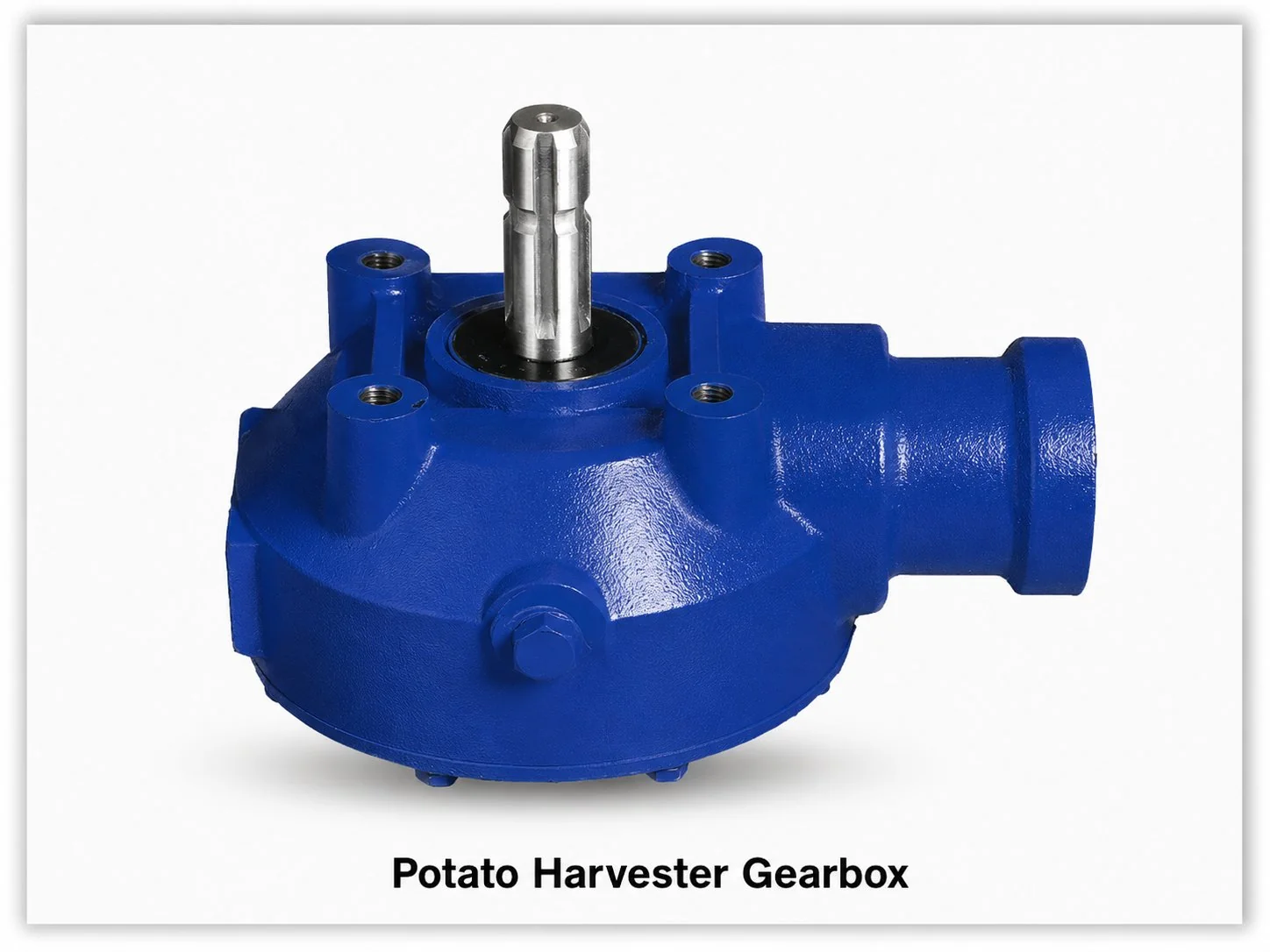
PTO gearbox for potato harvester applications — precision speed reduction and multi-output power distribution for digging, conveying, and separation functions
Separation Stages and Haulm Removal: Secondary Gearbox Functions
After the primary web, the crop flow passes through one or more separation stages designed to remove clods, stones, and soil aggregates that are similar in size to potato tubers. These stages use a combination of agitation (controlled vibration of the web or roller surface), star wheels (rotating rubber-fingered wheels that gently roll tubers while allowing soil to pass), and cross conveyors (belt or roller systems that move the crop laterally to inspection tables or further separation stages). Each stage has its own speed requirement — typically 0.5 to 2.0 m/s, slower than the primary web to increase the dwell time on each separation surface.
The haulm removal system strips potato vines (haulm) and foliage from the crop flow before the tubers reach the storage hopper or elevator. Haulm rollers are counter-rotating rubber or polyurethane rollers that grip the vine material and pull it away from the tubers. The rollers run at 3 to 5 m/s peripheral speed — significantly faster than the crop flow speed — to ensure positive grip and clean separation. The haulm roller drive requires moderate torque at relatively high speed, typically delivered through a dedicated poljoprivredni mjenjač with a 1:2 to 1:3 speed increase from the main shaft, or through a direct chain drive from a high-speed secondary output on the main gearbox.
The elevator (cross conveyor or boom elevator that transfers tubers from the harvester to a trailer or storage bin) is the final mechanically driven stage. It runs at a controlled speed of 1.0 to 2.5 m/s — fast enough to maintain crop flow but slow enough to minimize drop damage as tubers leave the elevator onto the trailer. The elevator drive is often the most lightly loaded of all the harvester functions, but it must be the most reliable because a stalled elevator backs up the entire upstream crop flow within seconds, potentially overloading the separation stages and causing a cascading blockage that requires 20 to 30 minutes of manual clearing.
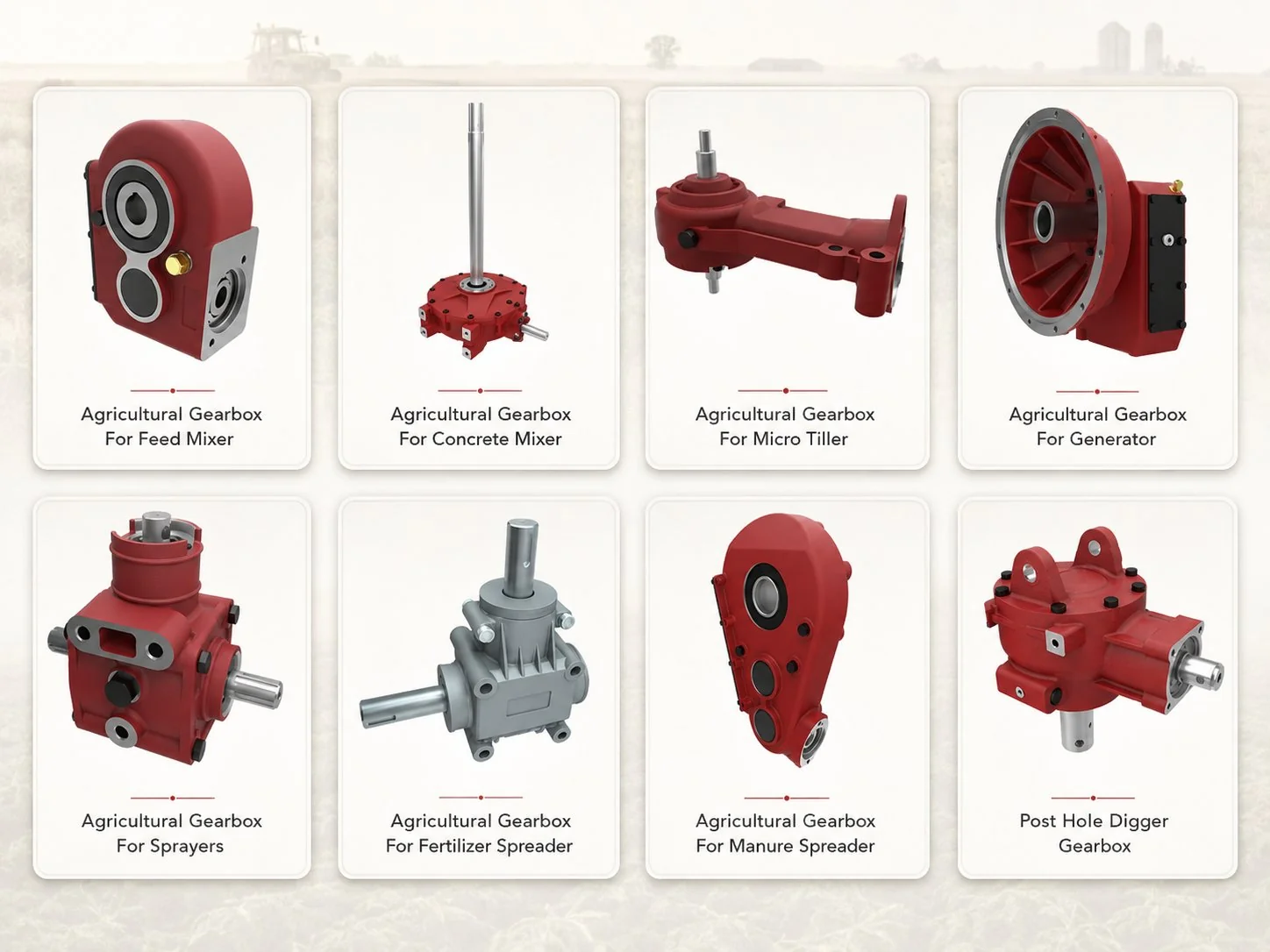
Gearbox Types Used in Potato Harvester Drive Systems
The main input gearbox is a right-angle bevel reduction unit that converts horizontal PTO rotation to the harvester’s main shaft axis (typically horizontal but perpendicular to the tractor PTO line). A standard ratio of 1.5:1 to 2.5:1 speed reduction brings the 540 RPM input down to the 220 to 350 RPM range needed for the main drive shaft. This gearbox carries the highest continuous load of any component in the harvester drive system — all downstream functions draw their power through this single unit, and the cumulative torque demand during heavy soil conditions can reach 80 to 120 percent of the tractor’s rated PTO torque for sustained periods.
Auxiliary gearboxes are used for functions that require speed or direction changes that cannot be achieved through simple chain or belt drives from the main shaft. The agitator mechanism (which vibrates the primary web to improve soil separation) typically uses a dedicated eccentric gearbox — a compact unit with an offset output shaft that converts rotary input to reciprocating motion at 6 to 12 Hz frequency and 15 to 30 mm stroke. This agitator gearbox must withstand the continuous cyclic loading of the reciprocating mechanism without developing the bearing play that would reduce agitation amplitude and compromise separation effectiveness.
On multi-row harvesters (2-row, 4-row, and 6-row machines), the power distribution becomes significantly more complex. A 4-row harvester may require 120 to 200+ HP at the PTO to drive four sets of digging shares, primary webs, and separation stages simultaneously. The main gearbox must distribute this power across multiple output shafts — or a single high-capacity output that feeds a secondary distribution gearbox located at the harvester’s centreline. Manufacturers like Ever-Power PTO mjenjač offer multi-output gearbox configurations specifically designed for high-power harvester applications where a single output cannot carry the full combined drive load.
Soil and Moisture Sealing: The Operating Environment Challenge
Potato harvester gearboxes operate in one of the most contamination-intensive environments in agriculture. The harvester moves through soil continuously — with the digging share lifting 200 to 600 tonnes of soil per hectare (depending on ridge size and digging depth) and depositing most of that soil onto and around the harvester’s mechanical components. The gearboxes, particularly the main input gearbox and the agitator drive, are exposed to a constant rain of soil particles, potato juice from damaged tubers (which is acidic and corrosive), and moisture from the soil mass passing over and around the housing.
Standard agricultural gearbox sealing is inadequate for this environment. The fine soil particles (particularly in silt and clay soils) penetrate standard single-lip shaft seals within days of harvest operation, creating an abrasive slurry inside the gearbox that rapidly destroys bearing surfaces and gear tooth flanks. Effective sealing for potato harvester gearbox applications requires double-lip shaft seals with a grease-purged intermediate chamber (the outer lip excludes soil while the grease barrier captures any particles that pass the outer seal), sealed or desiccant breather valves (standard open breathers ingest soil dust with every thermal breathing cycle), and machined housing joints with anaerobic sealant (preventing soil-laden water entry at the housing parting line).
The corrosive environment also demands attention to housing coating. Potato juice (pH 5.5 to 6.5) combined with soil moisture creates a mildly acidic solution that attacks bare cast iron surfaces. Epoxy or polyester powder coating on the gearbox exterior provides superior protection compared to standard paint, which chips and cracks readily under the abrasive contact of soil flowing past the housing during harvest. For operators running 200+ harvest hours per season, the coating upgrade pays for itself within two seasons through reduced external corrosion and the maintenance access it preserves (corroded bolt heads and inspection covers are a significant source of repair delay during time-critical harvest operations).

Overload Protection: Stones, Clods, and Blockage Events
Potato harvesting in stony soils generates frequent torque spikes as stones lodge between web links, jam star wheels, or wedge between rollers. A 150 mm stone passing through the primary web can generate instantaneous torque loads 3 to 5 times the normal running torque — sufficient to strip gear teeth or fracture shaft keys in an unprotected drive system. The main PTO driveline typically includes a slip clutch calibrated to protect the main gearbox, but the downstream auxiliary drives (agitator, haulm rollers, elevator) also need individual overload protection to prevent localised damage from blockage events that affect only one harvesting stage.
Shear bolts are the simplest form of overload protection for individual drive stages. A shear bolt installed in the chain sprocket hub or coupling between a gearbox output and its driven component breaks cleanly at a predetermined torque, disconnecting the overloaded stage while allowing the remaining functions to continue operating. The disadvantage is downtime for bolt replacement — typically 5 to 15 minutes per event, which accumulates significantly in stony fields where 5 to 10 shear bolt failures per day are common. Slip clutch protection on individual stages eliminates this downtime by allowing the overloaded drive to slip momentarily during the blockage event and re-engage automatically when the blockage clears, but at higher initial cost and with the need for periodic clutch adjustment as the friction surfaces wear. For a deeper understanding of how overload events cause progressive gearbox damage when protection is absent, see our technical guide on Analiza kvara mjenjača kardana.
Single-Row vs. Multi-Row Harvester Gearbox Requirements
Single-row and two-row trailed potato harvesters represent the majority of the market by unit volume. These machines use a single main Mjenjač kardana rated for 30 to 75 HP continuous input, with all downstream functions driven from the main gearbox output through chain drives and belt drives. The main gearbox is typically a standard right-angle bevel unit with a single output shaft and a ratio of 1.5:1 to 2:1 — a relatively straightforward specification that can be met by a quality aftermarket gearbox supplier with accurate dimensional cross-referencing to the original equipment part number.
Multi-row self-propelled harvesters (2 to 6 rows, 150 to 400+ HP) are significantly more complex. The drive system often combines a PTO-equivalent mechanical drive (from the harvester’s own engine, not a tractor PTO) with hydraulic drives for variable-speed functions. The main gearbox on these machines may have 2 to 4 output shafts driving different harvesting sections at different speeds, with internal oil circulation pumps, external oil coolers, and condition monitoring sensors (temperature, vibration) integrated into the housing. These gearboxes are application-specific designs from the harvester manufacturer rather than standard catalog items, and replacement requires either OEM sourcing or custom manufacturing from a specialist poljoprivredni mjenjač supplier with reverse-engineering and dimensional verification capability.
Maintenance Strategy During the Harvest Window
Potato harvest season is the wrong time for major gearbox maintenance — but it is the time when minor neglect causes major failures. The pre-harvest inspection (oil change, seal check, bearing play verification, chain tension adjustment) should be completed 1 to 2 weeks before the first scheduled harvest day, allowing time to source and install any replacement parts identified during inspection without impacting the harvest schedule.
During harvest, daily maintenance is limited to high-value quick checks: oil level verification on the main gearbox and all auxiliary units (a 60-second walk-around with a flashlight before the first field entry of the day), visual inspection for new oil leaks at seal locations (indicating seal damage from stone impacts or soil abrasion), and chain tension check on all secondary drives (a loose chain that skips under load can damage the driven sprocket and cause a multi-hour repair during prime harvest time). Keep spare shear bolts, a grease gun, and a top-up bottle of the correct gear oil on the harvester at all times — these items prevent the most common causes of harvest-day downtime.
Post-harvest, the gearbox maintenance priority is thorough cleaning and oil replacement. Pressure-wash the exterior of all gearboxes to remove soil buildup (which traps moisture and accelerates corrosion during storage), drain and replace the oil in every gearbox (harvest-contaminated oil contains fine soil particles that passed the seals during the season and will continue to abrade internal surfaces during storage if not removed), and inspect all Kardansko vratilo U-joints for wear and re-grease before storage. Document any gearbox issues observed during harvest (unusual noise, temperature anomalies, seal leaks, overload events) so they can be addressed during the off-season rather than forgotten until the next pre-harvest inspection.
Često postavljana pitanja
Get Harvest-Ready Gearbox Solutions
Pre-season is the time to inspect, replace, and upgrade — not mid-harvest when every hour counts. Our engineering team provides cross-reference verification, enhanced sealing specifications, and express shipping for potato harvester gearbox orders placed before the season begins.
Urednik: Cxm