Tooth Geometry: The Root of Every Performance Difference
A straight bevel gear has teeth that are cut in straight lines radiating from the apex of the pitch cone — like slices of a pie viewed from the side. Each tooth is a simple wedge shape that extends from the inner to the outer diameter of the gear face. When two straight bevel gears mesh, the entire width of the tooth engages simultaneously as the gear rotates. This instantaneous full-face contact creates a sharp impact at each tooth engagement — a pulse of force that is efficient at transmitting power but generates significant noise, vibration, and localized stress concentration.
A spiralni konusni zupčanik has teeth cut along curved paths across the face of the gear — typically at a spiral angle of 30 to 35 degrees relative to the pitch cone element. When two spiral bevel gears mesh, the contact begins at one edge of the tooth face and sweeps progressively across the full width as the gear rotates. At any instant, the contact zone occupies only a portion of the tooth face, and the total load is shared between 1.5 to 2.5 teeth simultaneously (compared to 1.0 to 1.25 teeth for straight bevel). This progressive engagement and multi-tooth load sharing is the fundamental advantage of spiral geometry — and it drives every performance benefit discussed throughout this article.
Load-Sharing Mechanics: Why Spiral Gears Carry More Torque
The contact ratio — the average number of teeth sharing the load at any instant — directly determines a gear set’s torque capacity per unit of size. A typical straight bevel gear set has a contact ratio of 1.0 to 1.25, meaning that for most of the mesh cycle, only one tooth carries the entire transmitted load. A spiral bevel gear set with a 35-degree spiral angle achieves a contact ratio of 1.5 to 2.5, meaning the load is always shared between at least one and a half teeth. This load sharing reduces the peak stress on each individual tooth by 30–50% compared to a straight bevel gear of the same module and face width.
Spiral Bevel Load Capacity Advantage
+30–50%
More torque capacity than straight bevel gears of the same size
Due to multi-tooth contact ratio of 1.5–2.5 vs. 1.0–1.25 for straight bevel
The practical consequence for Mjenjač kardana design is significant. A spiral bevel gear set can transmit the same torque as a straight bevel set using a physically smaller gear — or alternatively, the same-size spiral bevel gear set can handle 30–50% more torque before reaching its stress limit. In agricultural applications where gearbox size and weight are constrained by implement design (the gearbox must fit inside a mower deck, within a tiller housing, or under a baler frame), the higher power density of spiral bevel gears allows more torque capacity in the available space. This is why virtually all high-power PTO gearboxes (50+ HP) use spiral bevel rather than straight bevel gears — the power demand simply exceeds what a straight bevel gear set can handle within the available package volume.
The load-sharing advantage also extends gear fatigue life. Since each tooth carries less peak stress per engagement cycle, the accumulated fatigue damage per million cycles is lower for spiral bevel gears. Under identical loading conditions, a spiral bevel gear set typically delivers 3 to 5 times the fatigue life of an equivalent straight bevel set — a critical advantage in agricultural applications where gearboxes accumulate millions of stress cycles per season. For a detailed look at how these gear designs perform in specific agricultural implements, see our technical guide on mjenjač rotacijskog rezača engineering.
Noise Characteristics: 6–10 dB Lower with Spiral Geometry
The acoustic difference between spiral and straight bevel gears is immediately audible. A straight bevel gearbox produces a sharp, metallic whine at the gear mesh frequency — a tone that is directly proportional to RPM and tooth count. The sound is generated by the abrupt, full-face impact at each tooth engagement, which excites high-frequency vibration in the gear teeth, bearings, housing, and connected structure. At typical poljoprivredni mjenjač operating speeds (540–1,000 RPM input, 1,000–3,000 RPM blade or implement speed), this mesh tone falls in the 1,000–4,000 Hz range — precisely where human hearing is most sensitive.
A spiral bevel gearbox operating at the same speed and load produces a significantly quieter sound — typically 6 to 10 dB lower at the fundamental mesh frequency. The progressive tooth engagement of spiral geometry generates a smoother force excitation waveform with lower peak amplitude and faster harmonic decay. The subjective difference is substantial: a 6 dB reduction is perceived as a noticeable decrease in loudness, and a 10 dB reduction is perceived as roughly half as loud. For noise-sensitive applications — residential mowing equipment, gearboxes mounted near operator cabs, or equipment operating in urban environments subject to municipal noise ordinances — spiral bevel gears provide a meaningful acoustic advantage that cannot be achieved by any other single design change.
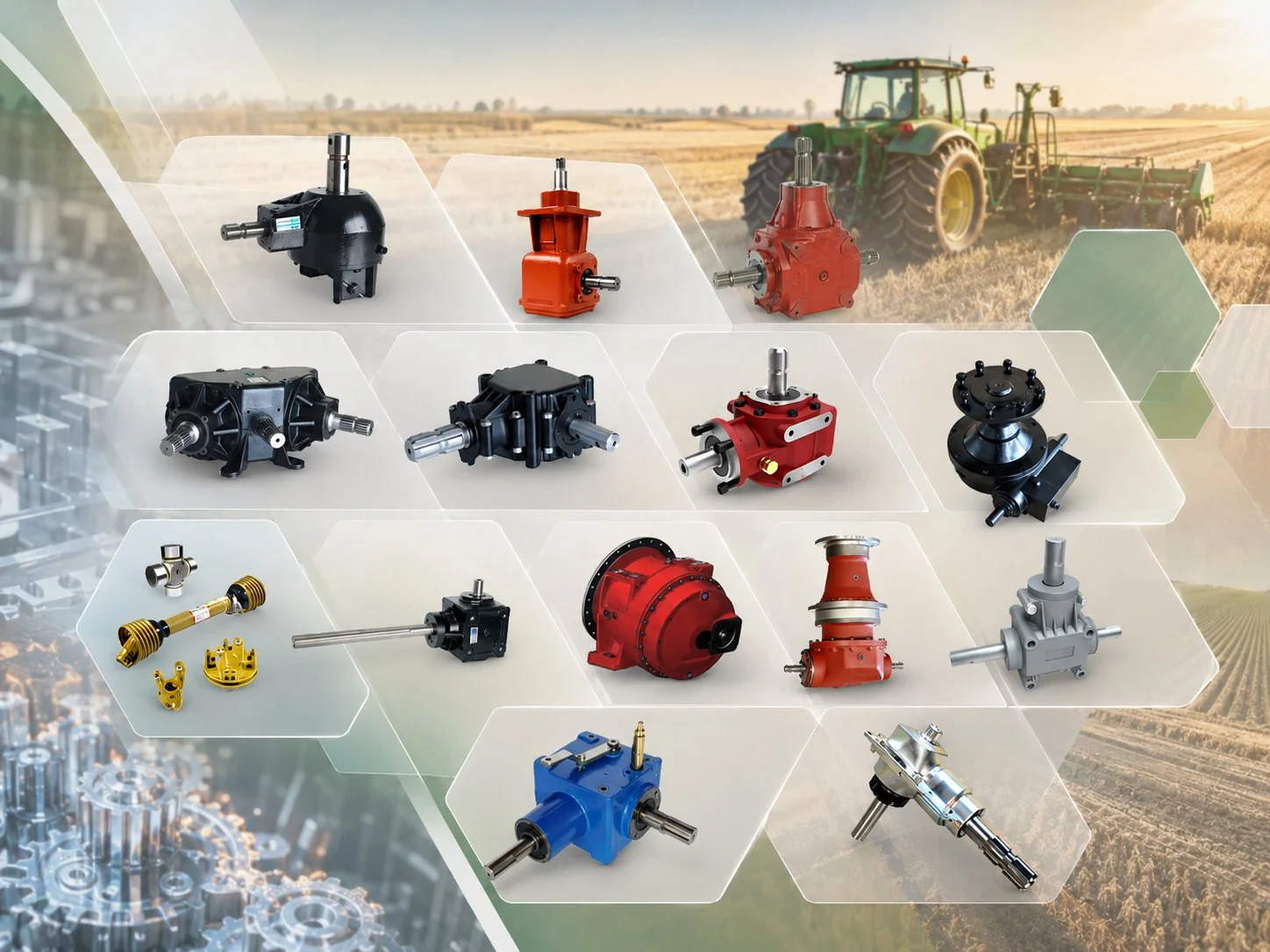
PTO gearbox configurations — spiral bevel designs dominate in high-power, noise-sensitive, and continuous-duty applications across the agricultural sector
Efficiency Comparison: Sliding Velocity and Power Loss
Spiral bevel gears achieve 96–98% mesh efficiency — 3 to 10 percentage points higher than straight bevel gears operating at equivalent loads. The difference arises from two factors: the smoother force transmission of progressive engagement (less energy lost as impact-induced vibration) and the more favorable sliding velocity pattern across the tooth face.
However, spiral bevel gears introduce an axial thrust force that straight bevel gears do not generate. The spiral tooth angle creates a force component along the shaft axis during power transmission — similar to the thrust generated by helical spur gears. This axial thrust must be absorbed by thrust bearings (tapered roller bearings are standard), and the additional bearing friction partially offsets the improved gear mesh efficiency. In practice, the net efficiency advantage of spiral bevel over straight bevel remains 3–8 percentage points after accounting for the additional thrust bearing losses — a meaningful difference that accumulates over thousands of operating hours as reduced fuel consumption and lower gearbox operating temperature.
Manufacturing Cost: Why Straight Bevel Gears Still Exist
If spiral bevel gears are stronger, quieter, and more efficient, why do straight bevel gears persist in the market? The answer is manufacturing cost. Straight bevel gears can be cut on relatively simple planer-type gear generators — machines that use a reciprocating cutting tool to form each tooth in a single pass. These machines are widely available, relatively inexpensive, and can produce straight bevel gears quickly and at low per-piece cost.
Spiral bevel gears require specialized face-milling or face-hobbing machines (Gleason, Klingelnberg, or Oerlikon systems) that are significantly more expensive to purchase, maintain, and operate. The curved tooth form demands precise multi-axis tool positioning, and the gear set (pinion and ring gear) must be developed as a matched pair — the pinion tooth profile is specifically generated to mesh correctly with its mating gear. This pair-matching requirement means spiral bevel gears cannot be mixed between different manufacturers or production batches without verification. The tooling setup cost for each new gear design is also higher, making spiral bevel gears economically challenging for very low production volumes.
✅
Choose Spiral Bevel When:
Power exceeds 30 HP continuous duty. Noise is a concern (residential, near-cab mounting). Implement demands high torque density in a compact package. Operating hours exceed 300 per season. The gearbox is a critical-path component where downtime cost is high.
💰
Choose Straight Bevel When:
Power is under 15 HP. Application is light-duty or seasonal (under 200 hours/year). Noise is not a constraint (field-only operation). Lowest possible purchase cost is the priority. Quick availability from generic stock is more important than optimized performance.

Complete Head-to-Head Comparison
| Parametar | Spiralni zakošenje | Ravna kosina |
|---|---|---|
| Tooth engagement | Progressive (sweeps across face) | Instantaneous (full-face impact) |
| Contact ratio | 1.5–2.5 | 1.0–1.25 |
| Mesh efficiency | 96–98% | 85–93% |
| Noise level | Low (6–10 dB quieter) | High (sharp mesh tone) |
| Torque capacity (same size) | 30–50% higher | Osnovna vrijednost |
| Fatigue life | 3–5× longer | Osnovna vrijednost |
| Axial thrust | Significant (requires thrust bearings) | Minimalno |
| Manufacturing cost | Higher (specialized machines) | Lower (simple planer machines) |
| Best agricultural use | Rotary cutters, tillers, balers, combines, all high-power PTO | Light-duty cutters, post hole diggers, small implements |
For operators choosing between the two, the decision framework is clear: if the application demands reliability, efficiency, and quiet operation — and the operating hours and power level justify the investment — spiral bevel is the correct choice. If the application is light-duty, cost-constrained, and tolerant of noise, straight bevel provides adequate performance at lower initial cost. Most professional agricultural operations have transitioned entirely to spiral bevel gearboxes for all medium-to-heavy-duty PTO applications, reserving straight bevel only for the lightest seasonal implements where total lifetime hours are too low to justify the premium.
Implement-Specific Gear Type Recommendations
Rotary cutters and flail mowers are the most demanding application for bevel gears in agricultural PTO service. Impact loads from rocks, stumps, and frozen debris create instantaneous torque spikes that can exceed normal operating torque by 3 to 5 times. Spiral bevel gears absorb these impacts more effectively because the multi-tooth contact distributes the shock across a wider gear face area, reducing the peak stress on any single tooth. Commercial rotary cutter gearboxes rated above 40 HP almost universally specify carburized spiral bevel gear sets — the combination of spiral geometry and case-hardened surfaces provides the maximum resistance to both impact damage and long-term fatigue.
Tillage implements — rotary tillers, power harrows, and spading machines — generate high sustained torque at relatively low RPM. The continuous heavy loading favors spiral bevel gears for their higher torque density, but the absence of severe impact loading means that induction-hardened straight bevel gears can provide adequate service in lighter soil conditions. In heavy clay or rocky soils where root masses and stones create frequent torque spikes, spiral bevel remains the safer specification. Combine harvester header gearboxes, which operate thousands of hours per season at moderate-to-high power levels, almost exclusively use spiral bevel to maximize fatigue life through the critical harvest window when any gearbox failure means lost crop value.
For small seasonal implements — post hole diggers, small fertilizer spreaders, garden tillers, and light-duty mowers operating fewer than 100 hours per season — straight bevel gears deliver adequate performance at 30 to 50 percent lower cost. The reduced fatigue life of straight bevel geometry is immaterial when the total accumulated stress cycles over the implement’s lifetime are well below the fatigue limit of even the simpler gear design. The economic threshold typically falls at approximately 15 to 20 HP and 200 operating hours per year — below those values, straight bevel provides the best cost-to-performance ratio, and above them, spiral bevel pays for its premium through longer service life and reduced maintenance.
A quality manufacturer like Ever-Power PTO mjenjač offers both spiral and straight bevel configurations, allowing operators to select the gear type that matches their specific application requirements and budget. Kontaktirajte naš inženjerski tim with your implement type, power rating, and duty cycle for a recommendation. For Kardansko vratilo i poljoprivredni mjenjač solutions across all gear types, our product range covers the full spectrum from light-duty residential to heavy-duty commercial and industrial applications.
Često postavljana pitanja
Your PTO Gearbox Solution Starts Here
Whether your application calls for spiral bevel performance or straight bevel economy — our engineering team specifies the correct gear type, ratio, and heat treatment for your implement. 500+ standard models in stock plus custom design capability for unique requirements.