Vacuum Pump Drive: Loading the Tank Through PTO Power
The vacuum pump is the primary PTO-driven component on most slurry tankers. It creates negative pressure inside the sealed tank (typically −0.5 to −0.8 bar gauge), which draws slurry from the storage pit or lagoon through the intake hose and into the tank. The same pump reverses function during discharge, creating positive pressure (+0.3 to +0.5 bar) that pushes the slurry out through the spreading mechanism. This dual-function loading and unloading cycle — vacuum for filling, pressure for emptying — defines the gearbox duty profile: moderate power at relatively constant load during the 3 to 8 minute filling phase, followed by moderate-to-high power during the 5 to 15 minute spreading phase, with brief no-load intervals during transport between the storage pit and the field.
Two vacuum pump types dominate the slurry tanker market. Rotary vane pumps use sliding vanes in an eccentric rotor housing to create the pumping action — they are compact, relatively quiet, and achieve high vacuum levels (down to −0.85 bar), but their vanes wear progressively and require periodic replacement (every 1,000 to 2,000 hours depending on slurry abrasiveness). Rotary lobe (Roots-type) pumps use two intermeshing lobes to trap and displace air — they are more robust, longer-lived, and better suited to handling the corrosive gases in slurry vapour, but they are physically larger and generate more pulsating airflow that creates a characteristic low-frequency rumble during operation. The Скоростна кутия на ВОМ ratio must match the specific pump type: rotary vane pumps typically require 800 to 1,200 RPM (a 1:1.5 to 1:2.2 speed increase from 540 RPM PTO), while lobe pumps require 1,200 to 1,800 RPM (a 1:2.2 to 1:3.3 speed increase).
The power demand for the vacuum pump alone ranges from 15 HP for small tankers (5,000 to 8,000 litres) to 40 HP for large tankers (20,000 to 30,000 litres). However, the gearbox must be rated for the total system power — vacuum pump plus discharge pump (if separate) plus spreading mechanism — because all functions draw from the same PTO input simultaneously during certain operating phases. A 20,000-litre tanker with a vacuum pump, a macerator chopper, and a disc spreader may demand 60 to 100 HP total during the discharge-and-spread phase, even though the filling phase requires only 25 to 35 HP for the vacuum pump alone.

Spreading Mechanism Drive: From Splash Plates to Precision Injectors
The spreading mechanism determines how the slurry is distributed onto or into the soil, and each mechanism type creates a distinct gearbox drive requirement. Understanding these requirements is essential for specifying the correct slurry tanker gearbox configuration — a mismatch between the gearbox output and the spreading mechanism results in uneven application rates, excessive power consumption, or premature component failure.
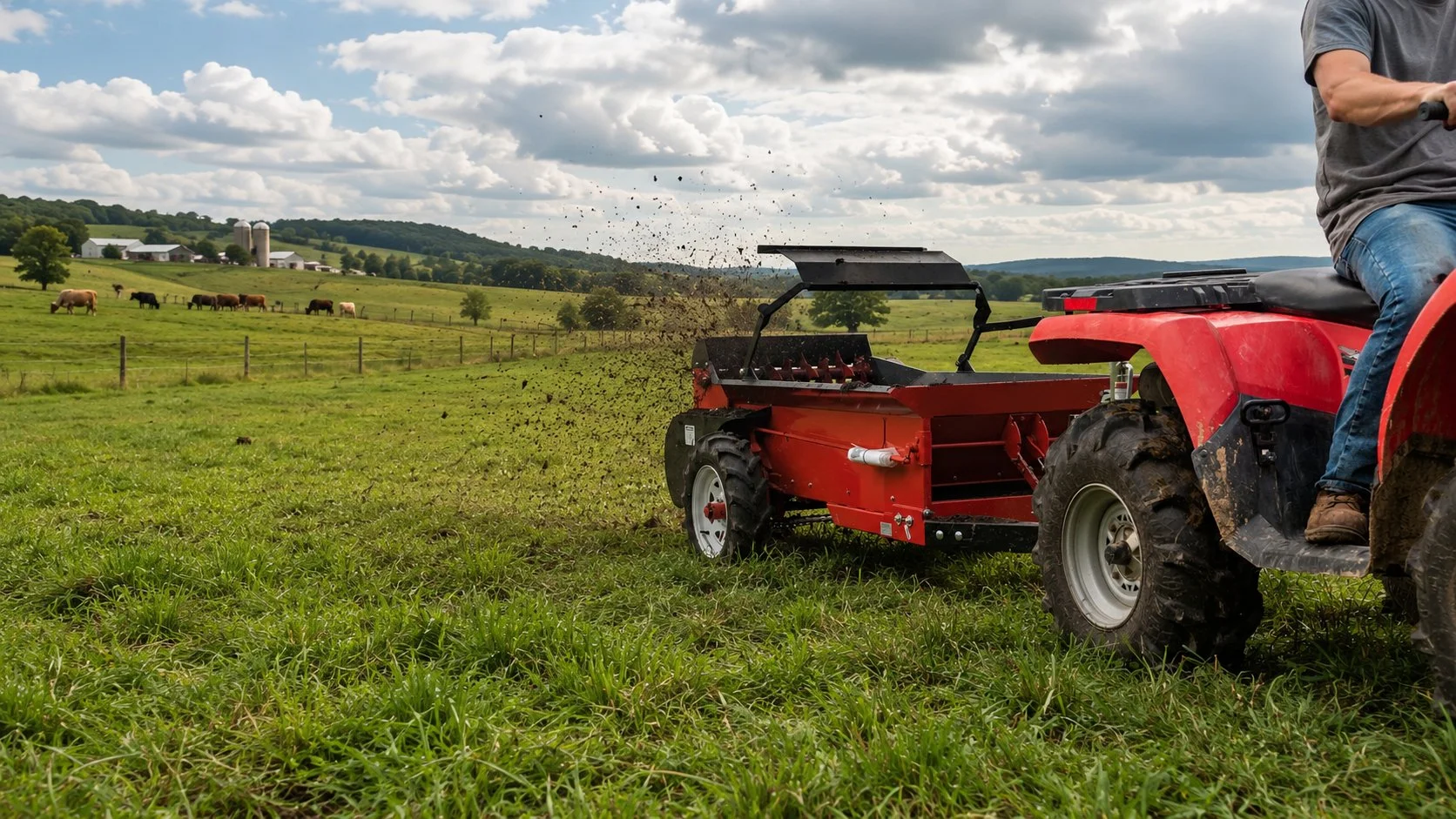
Splash plate spreaders are the simplest distribution method — the slurry exits the tank under gravity or low pressure and hits a deflector plate that fans it across a 10 to 14 metre swath. No dedicated spreading gearbox is needed because the splash plate is a passive component. However, splash plate systems are increasingly restricted by environmental regulations in Europe and parts of Australasia because they generate high ammonia emissions and produce uneven application patterns. For comparison with solid manure spreading systems that use different gearbox architectures, see our technical guide on скоростна кутия за разпръсквачи на тор.
Disc spreaders use one or two centrifugal discs spinning at 500 to 1,000 RPM to fling the slurry outward in a controlled pattern. The discs require a dedicated gearbox drive — typically a right-angle speed reducer (the disc speed is lower than PTO speed) or a direct drive from a secondary gearbox output. The disc speed determines the spreading width and uniformity: too slow produces a narrow, concentrated strip; too fast throws slurry beyond the target zone and increases drift. Variable-speed disc drives (achieved through a hydraulic motor or a mechanical variator gearbox) allow the operator to match the spreading pattern to the application width and field conditions.
Trailing shoe applicators and shallow injectors place the slurry directly onto or into the soil surface through individual hoses and coulter-mounted outlets, virtually eliminating ammonia emissions and producing the most precise application pattern of any slurry distribution method. These systems use a pressurised centrifugal pump (1,500 to 2,500 RPM, driven by a secondary PTO gearbox output or a dedicated speed increaser) to force the slurry through distribution manifolds and individual hose runs. The pump gearbox must deliver consistent, pulsation-free output to ensure uniform flow through all hose outlets — any speed variation causes uneven distribution between the innermost and outermost hoses, producing visible striping in the subsequent crop that indicates nutrient imbalance.
Corrosion-Resistant Gearbox Design for Slurry Environments
The chemical environment surrounding a slurry tanker gearbox is uniquely aggressive in agriculture. Fresh slurry generates ammonia (NH₃) and hydrogen sulphide (H₂S) gases that are corrosive to ferrous metals, degrading to standard NBR rubber seals, and toxic to gear oil additives. The gearbox housing, shaft seals, breather, and fasteners are all exposed to these gases during loading, transport, and spreading — a total exposure time of 6 to 12 hours per operating day during the application season.
Standard NBR (nitrile) shaft seals — the default material on general-purpose agricultural gearboxes — swell and soften in contact with ammonia-rich vapour, losing their sealing effectiveness within one to two seasons of slurry tanker service. The replacement specification for slurry tanker gearboxes is FKM (fluoroelastomer, commonly known by the brand name Viton) shaft seals. FKM resists ammonia, hydrogen sulphide, and the organic acids present in slurry at concentrations that destroy NBR within months. The cost premium for FKM seals over NBR is approximately 3 to 5 times per seal — a modest investment given that a single seal failure allows corrosive slurry vapour into the gearbox oil, contaminating the lubricant and initiating accelerated corrosion of bearing raceways and gear tooth surfaces that ultimately requires a complete gearbox rebuild.
Housing protection requires epoxy or polyester powder coating as a minimum specification — standard acrylic paint is insufficient for slurry tanker service because the ammonia in slurry vapour attacks the paint binder, causing blistering and delamination within 1 to 2 seasons. Exterior fasteners (housing bolts, drain plugs, inspection covers) should be stainless steel or zinc-nickel plated rather than standard zinc-plated mild steel, which corrodes rapidly in the ammonia-rich atmosphere and seizes in the housing threads — making routine maintenance access difficult or impossible without destructive bolt removal. A quality manufacturer like Скоростна кутия Ever-Power PTO offers slurry-specification gearbox packages that include FKM seals, powder-coated housing, sealed breather, and stainless steel external fasteners as a factory-configured option rather than requiring the operator to retrofit these upgrades individually.
Multi-Function Drive: One PTO Input, Multiple Outputs
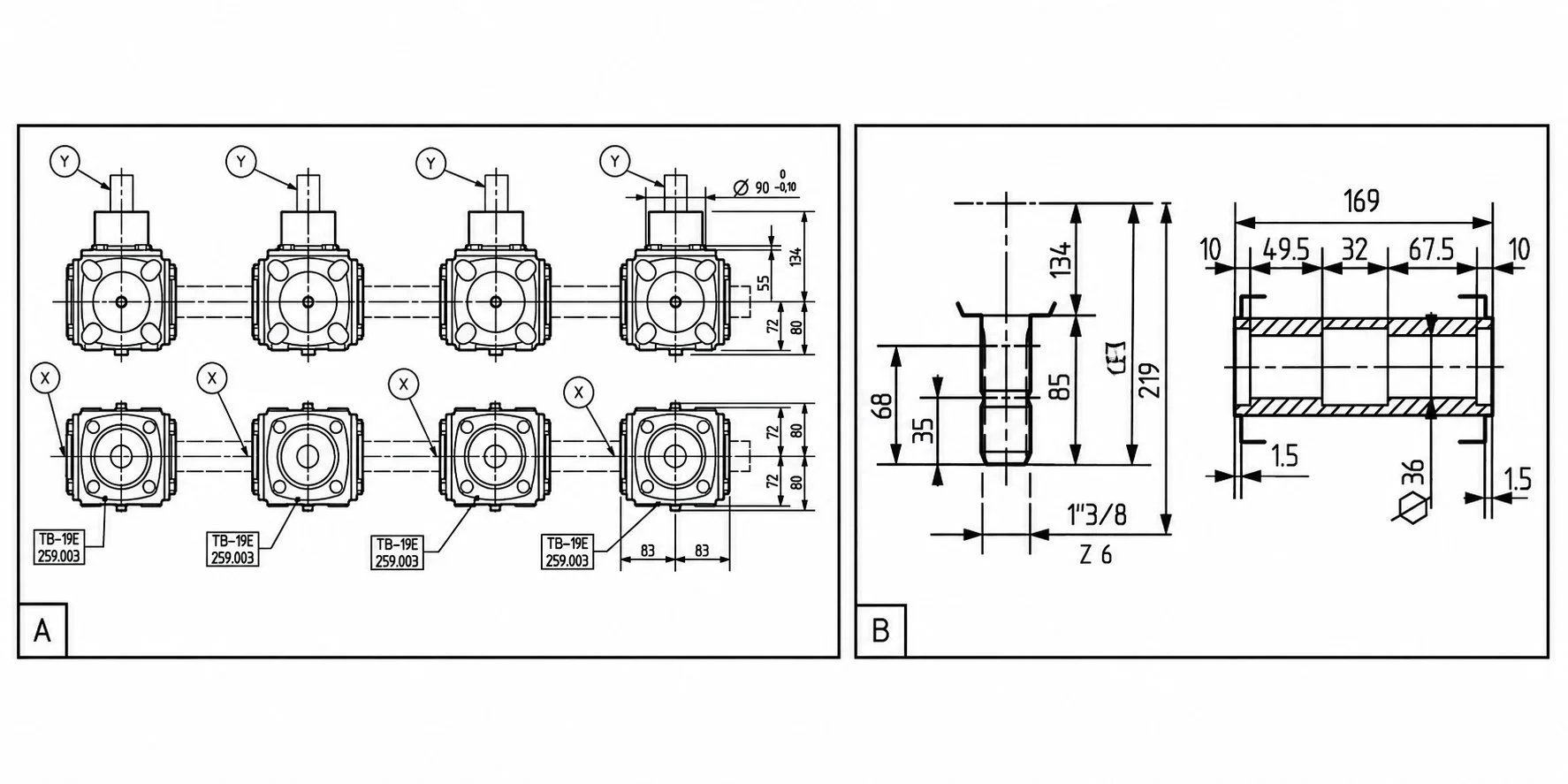
Modern slurry tankers with pressurised distribution systems require the PTO to drive multiple functions simultaneously: the vacuum/pressure pump for tank pressurisation, the macerator or chopper pump for fibrous material processing, and the centrifugal discharge pump or disc spreader for distribution. A single-output gearbox cannot serve all three functions at their different required speeds, so multi-function tankers use one of two drive distribution strategies.
The first strategy uses a multi-output Скоростна кутия на ВОМ with two or three output shafts, each at a different speed and orientation. The main output drives the vacuum pump, a secondary output drives the macerator through a chain or belt drive, and a third output (if present) drives the discharge pump or spreader disc. This approach is mechanically compact and efficient but requires a purpose-designed gearbox with matched output speeds — changing any one function (replacing the pump with a different model that runs at a different speed) may require a new gearbox or internal ratio change.
The second strategy uses a single-output main gearbox combined with secondary auxiliary gearboxes or hydraulic motors for the additional functions. The main gearbox drives the vacuum pump directly, and a belt or chain take-off from the gearbox output shaft drives a secondary speed increaser gearbox for the discharge pump. The macerator may be driven by a hydraulic motor powered by the tractor’s hydraulic system (independent of the PTO) or by a third mechanical drive from the main gearbox output. This modular approach allows individual functions to be upgraded or replaced without modifying the main gearbox, but it adds mechanical complexity, additional maintenance points, and cumulative efficiency losses from the multiple drive stages.
PTO Driveline Challenges on Heavy Slurry Tankers
A loaded 20,000-litre slurry tanker weighs approximately 22 to 24 tonnes — compressing the tractor’s rear suspension and altering the drawbar height by 50 to 100 mm compared to an empty tanker. This height change alters the Карданен вал driveline operating angle between the tractor PTO stub and the tanker gearbox input shaft. If the driveline was set up for the loaded condition, the angle increases when the tanker is empty (during the return trip to the storage pit) and decreases when loaded. Conversely, if set up for the empty condition, the angle worsens under load. The driveline must be specified for the worst-case angle across the full loaded-to-empty range — typically 3 to 7 degrees for well-designed tanker drawbars, but potentially 8 to 12 degrees for older or poorly adjusted equipment.
Excessive driveline angle creates cyclic speed variation (Hooke’s joint effect) that manifests as pulsating torque at the gearbox input — a loading pattern that accelerates input bearing wear and creates pressure fluctuations in the vacuum pump that reduce its volumetric efficiency. For tankers that operate on hilly terrain (requiring tight turns with the tanker articulated at steep angles to the tractor), a constant-velocity (CV) PTO driveline replaces the standard Hooke’s-joint design to eliminate the speed variation at high operating angles. The gearbox input bearing arrangement must also accommodate the higher axial thrust loads generated by CV drivelines under angled operation — an engineering detail that should be verified with the gearbox manufacturer when specifying a CV driveline upgrade on an existing tanker.
Maintenance Strategy for Slurry Tanker Gearboxes
The corrosive environment of slurry tanker operation demands a more aggressive maintenance schedule than standard селскостопанска скоростна кутия applications. Oil change intervals should be 200 hours or annually (whichever comes first) for synthetic gear oil, and 100 hours or every 6 months for mineral oil. The shortened interval accounts for the ammonia and hydrogen sulphide exposure that degrades oil additives faster than clean-air operation — even with effective sealing, trace quantities of corrosive gas permeate through the seal lips over time and gradually deplete the oil’s corrosion inhibitor additives.
Inspect shaft seals at every oil change for signs of chemical degradation: softening, swelling, or discolouration of the seal lip indicates ammonia attack on NBR material and warrants immediate replacement with FKM seals. Check the breather valve for blockage — slurry splash and dried manure can clog even sealed breather valves, preventing the housing from equalising internal pressure during thermal cycling and potentially forcing pressurised oil past the shaft seals during operation.
Post-season, the slurry tanker gearbox deserves particular attention. Wash the exterior thoroughly to remove all slurry residue (which continues to generate corrosive gases as it decomposes during storage), drain and replace the oil (removing any condensation and corrosive gas that dissolved into the oil during the season), and apply a protective oil film to all exposed machined surfaces. Store the tanker under cover if possible — outdoor storage exposes the gearbox to rainfall that carries residual ammonia salts from the tanker surface into every crevice and joint face on the housing.
Често задавани въпроси
Upgrade Your Slurry Application Drive
From single-output vacuum pump drives to multi-output systems for integrated spreading — our slurry-specification gearboxes are engineered for the chemical environment that standard agricultural gearboxes cannot survive. FKM seals, powder coating, and stainless fasteners included as standard on every slurry-rated unit.
Редактор: Cxm