How a Disc Mower Gearbox System Works
A disc mower’s drive system is fundamentally different from the single-output right-angle gearbox used in a rotary cutter or flail mower. Instead of one gearbox driving one blade spindle, a disc mower uses a multi-stage gear train housed inside a flat, sealed cutter bar that distributes power from a single PTO input to multiple cutting discs arranged in a line across the working width. The cutter bar itself is the gearbox — a precision-machined oil bath enclosure containing a series of intermeshing spur gears that transfer rotation from disc to disc along the full length of the bar.
The drive architecture begins at the main input gearbox — a right-angle bevel gearbox that converts the horizontal PTO shaft rotation into vertical rotation aligned with the cutter bar’s gear train. This main gearbox also provides the primary speed increase: a typical ratio of 1:3 to 1:5 steps the 540 RPM PTO input up to 1,600 to 2,700 RPM at the cutter bar input shaft. The cutter bar’s internal spur gear train then distributes this rotation to each disc, with alternating gears reversing the rotation direction of adjacent discs — a design feature that creates overlapping cutting zones between neighboring discs for a clean, gap-free cut.
The final disc speed depends on the spur gear ratio within the cutter bar. Most disc mowers achieve final disc speeds of 2,800 to 3,200 RPM through a combination of the main gearbox step-up and the internal spur gear ratios. At these speeds, the cutting disc peripheral velocity reaches 60 to 80 m/s — comparable to the blade tip speed of a rotary mower — producing the high-impact cutting action that allows disc mowers to cut cleanly through standing hay, grass, and light brush without the tearing and bruising that slower cutting mechanisms produce. For a comparison with single-blade rotary cutting systems, see our engineering guide on علبة تروس لقواطع الدوران.
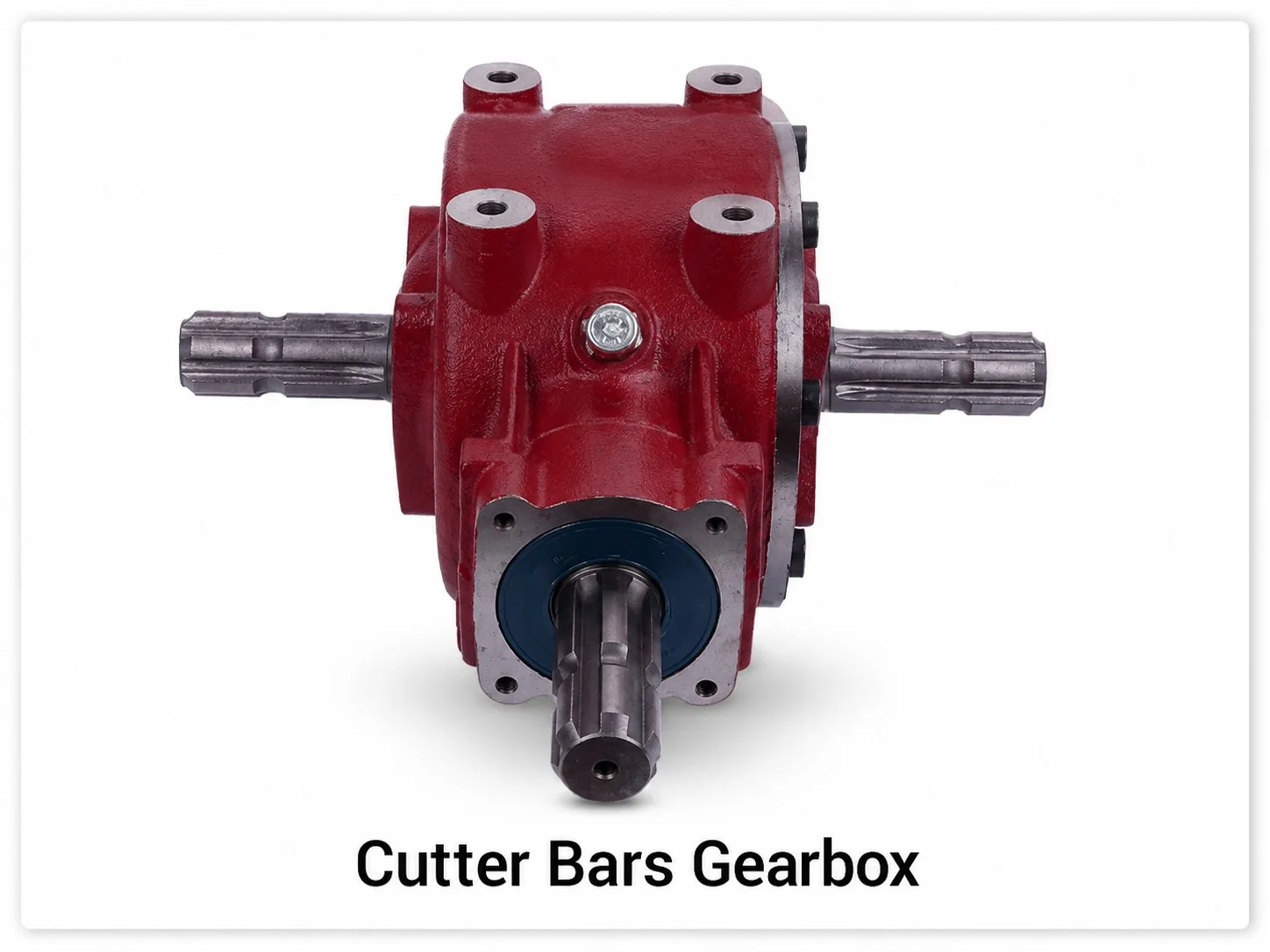
Cutter bar gearbox assembly — multi-disc drive system with intermeshing spur gears for synchronized disc rotation across the full cutting width
Multi-Disc Synchronization: Gear Train Design Inside the Cutter Bar
The spur gear train inside the cutter bar is the engineering heart of every disc mower. Each cutting disc is mounted on a vertical shaft supported by bearings in the cutter bar housing, and each shaft carries a spur gear that meshes with its neighbor. The gear mesh arrangement creates a mechanical linkage that forces all discs to rotate at precisely synchronized speeds — if one disc slows due to a heavy crop load, the gear train distributes the resistance across all discs rather than allowing the overloaded disc to stall independently.
The alternating rotation pattern (clockwise-counterclockwise-clockwise) is inherent in the spur gear mesh — each gear reverses the rotation of its neighbor. This counter-rotation creates an overlap zone between adjacent discs where the cutting edges of neighboring discs pass through the same vertical plane from opposite directions, ensuring that no uncut strip remains between discs. The overlap dimension is typically 50 to 80 mm and is set by the disc diameter, disc spacing, and the blade overhang beyond each disc’s outer diameter.
The number of discs determines the cutting width and the total power requirement. A 7-disc mower with a 2.4-meter cutting width requires approximately 25 to 35 HP at the PTO. A 9-disc mower at 3.2 meters requires 40 to 55 HP. Each additional disc adds both the cutting power for its share of the working width and the parasitic losses from one additional gear mesh in the train. The cumulative gear mesh losses across 7 to 9 stages are significant — typically 8 to 15 percent of the total input power is consumed by the gear train itself as friction heat, which is why cutter bar علبة تروس زراعية thermal management is critical for reliable operation.
Main Input Gearbox: The Critical Right-Angle Drive
The main input gearbox converts horizontal PTO rotation to vertical cutter bar rotation while providing the primary speed increase. This gearbox is a conventional right-angle bevel gear unit — similar in concept to a rotary cutter gearbox but with a speed-increasing ratio rather than a 1:1 or speed-reducing ratio. The pinion (input gear) is the larger gear and the ring gear (output) is smaller, creating the speed multiplication that drives the cutter bar at the required 1,600 to 2,700 RPM.
Because the main gearbox operates as a speed increaser, the output shaft rotates faster than the input — which reverses the torque multiplication relationship. A 1:4 speed increase ratio means the output torque is only one-quarter of the input torque (minus efficiency losses). This lower output torque reduces the gear tooth stress on the high-speed output stage, but the higher speed increases the thermal loading on the bearings and the bearing speed-related dynamic load factor. The main gearbox bearings must be rated for continuous operation at the elevated output speed, which is typically 2 to 5 times the standard 540 RPM PTO speed.
Spiral bevel gears are the standard choice for disc mower main gearboxes because the high operating speed demands the smooth, quiet engagement that spiral geometry provides. Straight bevel gears, which are acceptable in low-speed 1:1 rotary cutter gearboxes, generate excessive noise and vibration at the 2,000+ RPM output speeds required for disc mower drive. The noise and vibration from straight bevel gears at these speeds would be transmitted directly to the cutter bar and the tractor cab, creating unacceptable operator discomfort during the extended mowing sessions that disc mowers are designed for.

High-Speed Thermal Management for Disc Mower Gearboxes
Disc mower cutter bars generate more internal heat per unit of oil volume than almost any other علبة تروس PTO application. The combination of high rotational speed (2,800–3,200 RPM at the discs), multiple gear meshes (7 to 9 stages), and a relatively small, flat oil sump (the cutter bar housing has limited depth for oil volume) creates a thermal environment that pushes conventional gear oil to its limits during extended operation.
A 9-disc cutter bar consuming 45 HP at the PTO loses approximately 4 to 7 HP (3 to 5 kW) as heat in the gear train — power that is absorbed by 2 to 3 liters of gear oil in a housing with limited surface area for heat rejection. Without adequate thermal management, the oil temperature can reach 100 to 120 degrees Celsius within 2 to 3 hours of continuous mowing in warm conditions (25+ degrees Celsius ambient), degrading the oil’s viscosity and accelerating both oxidation and additive depletion.
Disc mower manufacturers address thermal management through several design strategies. Oil volume is maximized within the available cutter bar envelope — wider, deeper oil sumps increase the thermal mass available to absorb heat energy. External cooling fins cast into the cutter bar housing increase the surface area for convective heat transfer to the surrounding air. Some premium disc mowers incorporate oil cooler circuits that pump hot oil from the cutter bar through an external air-cooled heat exchanger before returning it to the sump. For operators, the most important thermal management action is using the correct synthetic gear oil — PAO-based EP 220 or the manufacturer’s specified equivalent — which maintains its protective film strength at temperatures 30 to 40 degrees higher than mineral oil of the same grade.
Disc Mower vs. Rotary Cutter: Gearbox Engineering Comparison
| المعلمة | Disc Mower | Rotary Cutter |
|---|---|---|
| Blade/disc speed | 2,800–3,200 RPM | 200–600 RPM (blade) |
| Gearbox type | Main bevel + cutter bar spur train | Single right-angle bevel |
| Speed ratio (PTO→cutting) | 1:5 to 1:6 increase | من 1:1 إلى 1:1.5 |
| Cutting elements | 4–9 discs, each with 2–3 replaceable blades | 1–3 large fixed or swinging blades |
| Thermal challenge | High (multiple meshes, small oil volume) | Low to moderate (single mesh) |
| أفضل تطبيق | Hay and forage cutting, clean stubble | Brush, weeds, rough vegetation |
Rock Strike Protection and Overload Safety
Disc mower cutting discs spin at peripheral velocities exceeding 60 m/s, and a rock strike at this speed generates an instantaneous torque spike that propagates backward through the entire spur gear train to the main علبة تروس PTO input. Without adequate overload protection, a single severe rock strike can strip teeth from multiple spur gears in the cutter bar — destroying the entire gear train in a fraction of a second. The high rotational inertia of 7 to 9 discs spinning at 3,000 RPM stores substantial kinetic energy that is released into the gear train during a sudden stop event, amplifying the damage beyond what the initial impact alone would cause.
Disc mower manufacturers incorporate overload protection at several points in the drive system. Individual cutting blades are typically mounted with shear bolts or breakaway fasteners that allow the blade to deflect or detach on impact, reducing the shock transmitted to the disc shaft and gear train. The PTO driveline between the tractor and the main gearbox incorporates either a shear bolt or slip clutch that disconnects the drive if the overload exceeds the driveline’s rated capacity. Some premium disc mower models include a torque-limiting coupling between the main علبة تروس PTO output and the cutter bar input that provides an additional protection layer specifically calibrated for the cutter bar’s gear train capacity.
Proper ground clearance adjustment is the most effective operator-controlled measure for minimizing rock strike damage. Running the cutter bar too low increases the probability of disc contact with rocks, soil mounds, and other ground-level obstacles. Most disc mowers allow shoe or skid adjustment to set the minimum cutting height — maintaining the manufacturer’s recommended minimum height (typically 30 to 50 mm above ground level) dramatically reduces the frequency and severity of rock strike events without meaningfully affecting forage crop cutting quality.
Maintenance and Lubrication for Disc Mower Gear Systems
The cutter bar oil level is the most critical maintenance parameter for disc mower reliability. Because the cutter bar housing is shallow and the oil volume is small relative to the heat generated, even a minor oil level drop (100 to 200 ml) can expose the upper gear meshes to inadequate lubrication. Check the cutter bar oil level before every mowing session — this daily 30-second check is the single highest-value maintenance action for disc mower longevity.
Oil change intervals for disc mower cutter bars are typically shorter than for conventional agricultural gearboxes because the high-speed, high-temperature operating environment degrades oil faster. Most manufacturers specify 200-hour oil change intervals for the cutter bar and 500-hour intervals for the main input gearbox. In hot climates or during extended daily mowing sessions (10+ hours), shortening the cutter bar interval to 100 to 150 hours provides additional protection. Use only the oil grade specified by the manufacturer — cutter bars typically require a lighter viscosity (EP 90 or ISO VG 150) than the main gearbox (EP 220 or ISO VG 220) because the high-speed gear meshes need a thinner oil for adequate splash lubrication at 3,000 RPM.
Inspect the cutter bar for oil leaks at the disc shaft seal locations after every mowing session. A disc mower has 4 to 9 shaft seals on the cutting disc shafts plus 2 to 4 seals on the drive input and idler shafts — any one of these seals can develop a leak from vibration damage, rock strike impact, or normal wear. A leaking seal allows oil loss (leading to gear starvation) and contaminant entry (accelerating wear on every internal surface). Replace leaking seals promptly — the cost of a seal is trivial compared to the gear train damage that follows oil starvation. A quality علبة تروس PTO supplier stocks replacement seals, bearings, and spur gears for popular disc mower cutter bar models. Contact our team for cross-reference availability. For عمود نقل الحركة و علبة تروس زراعية solutions matched to disc mower drive requirements, our engineering team provides ratio verification and dimensional compatibility confirmation for every order.
الأسئلة الشائعة
Specify Your Disc Mower Gearbox
From main input gearboxes for disc mower drives to replacement spur gears and bearings for cutter bar rebuild — our engineering team provides cross-reference verification, ratio confirmation, and dimensional compatibility checks for every order. Factory-direct pricing on speed increaser gearboxes for disc mower applications.