Canopy Penetration: Why Airflow Matters in Orchard Spraying
A mature apple tree occupies a canopy volume of 200 to 600 cubic metres — a dense, three-dimensional distribution of leaves and fruit spread across branches that vary from 15 metres apart (outer canopy diameter) to zero separation (interior branch clusters). Conventional boom sprayers deliver liquid through independent nozzles at low velocity (0.5 to 2 m/s at the nozzle tip), following ballistic trajectories that are intercepted by the outer canopy leaves within 1 to 2 metres of the sprayer. The deep interior canopy region — where 60 to 80 percent of the total fruit surface area is located — receives no spray at all under standard boom operation. An advanced air-blast PTO gearbox solves this by driving a high-speed centrifugal fan that generates airflow velocities of 15 to 30 m/s at the fan discharge — fast enough to carry spray mist particles through the entire canopy depth and deposit liquid on all leaf and fruit surfaces regardless of their position within the tree volume.
The air-blast principle requires two separate outputs from the spray equipment: the primary air stream generated by the high-speed fan, and the liquid spray introduced into that airstream at a point where maximum atomization and mist transport occurs. The spray pump unit (typically a centrifugal type identical to a standard boom sprayer pump, operating at 2,500 to 3,500 RPM) injects liquid at 1 to 3 litres per minute into the main fan discharge, where the high-velocity air atomizes the liquid into droplets of 100 to 150 micrometres diameter. This target mist size — much finer than the 200 to 400 micrometre droplets from conventional boom sprayers — penetrates the canopy more effectively and deposits on interior leaf surfaces that are smaller and more deeply nested than the large outer leaves that catch boom spray.
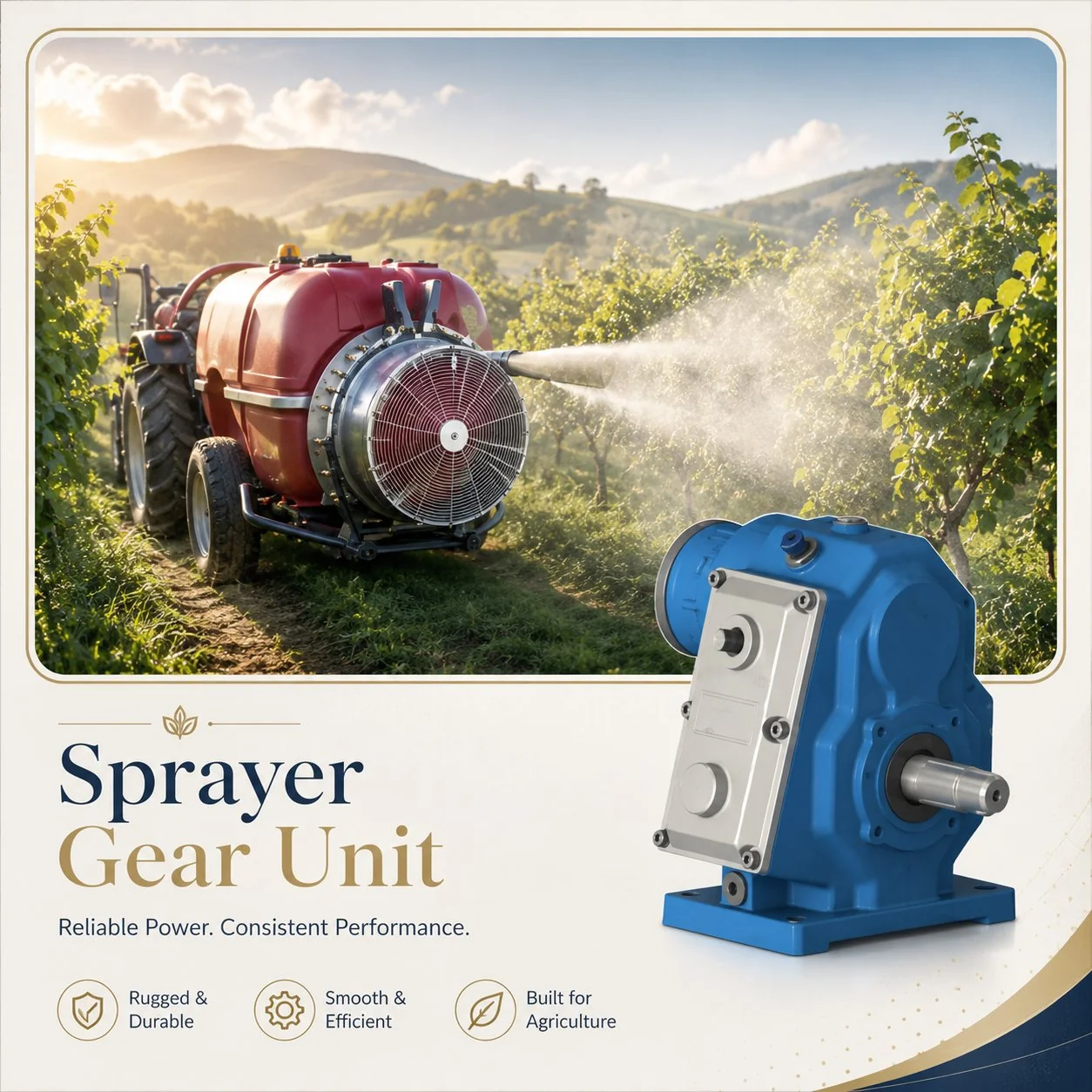
High-Speed Fan Drive: From PTO to Canopy Air Velocity
The air velocity at the fan discharge is a direct function of fan rotational speed (ignoring downstream losses in the ducting): fan rotational speed approximately equals the air velocity divided by the fan blade radius. A centrifugal fan with a 200 millimetre diameter rotor running at 6,000 revolutions per minute produces approximately 20 metres per second air velocity (calculation: 6,000 RPM × 0.2 m radius ÷ 60 s/min = 20 m/s). Higher speed produces higher velocity (affinity law: velocity proportional to speed), allowing the experienced operator to adjust canopy penetration depth by actively controlling the fan speed through the tractor’s adjustable PTO speed control system or through a variable-ratio transmission built into the gearbox itself. From a 540 RPM PTO, achieving 6,000 RPM fan speed requires a 1:11.1 speed-increasing ratio — well beyond single-stage capability and demanding a substantial air-blast sprayer gearbox with either two or three gear stages to distribute the total ratio.
The most common configuration is a two-stage design with a right-angle bevel input stage providing 1:3 to 1:3.5 speed increase, followed by a parallel-shaft helical output stage providing an additional 1:3 to 1:3.8 multiplication — resulting in combined ratios of 1:9 to 1:13.3. This design concentrates the highest-speed gear mesh (the helical output stage) in a compact arrangement and allows both stages to operate within their efficient speed and torque ranges. Alternatively, some premium equipment manufacturers use a parallel-shaft helical two-stage gearbox design (cascade design) with no right-angle bevel, which sacrifices the directional flexibility of a bevel-based input (forcing the PTO shaft to arrive horizontally) but gains mechanical simplicity and slightly higher efficiency by eliminating the bevel mesh loss.
From a 1,000 RPM PTO, the required ratio drops to 1:6 to 1:8 — still beyond single-stage bevel capability (1:5 to 1:6 maximum) but achievable with a simpler two-stage design. Manufacturers like علبة تروس Ever-Power PTO increasingly offer 1,000 RPM-specific air-blast gearbox designs to serve the premium equipment segment where higher PTO speed equipment is standard. The modest reduction in overall ratio requirements translates directly into smaller gearbox envelope, lower cost, and higher efficiency — valuable advantages in the compact fruit-growing regions where high-specification air-blast equipment is concentrated.
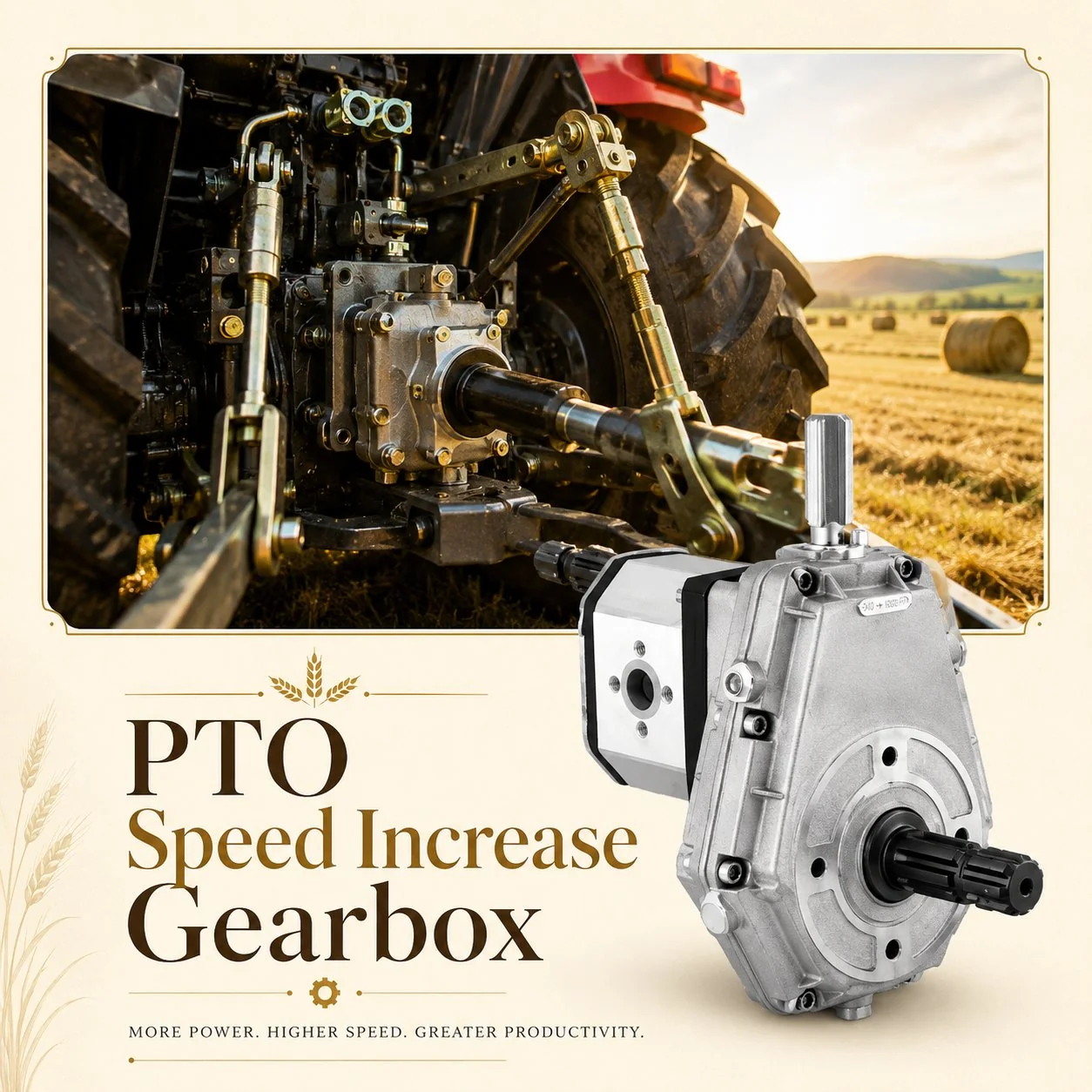
Variable-Speed Control: Matching Airflow to Canopy Conditions
The penetration and deposition of air-blast spray depends critically on the balance between air velocity and liquid flow rate. Operating at very high air velocity (8,000+ RPM fan, 25+ metres per second air speed) with low liquid flow rate, the mist is hyper-finely atomized but may drift downwind before settling on target surfaces — particularly problematic on windy days or in open orchards with poor wind protection. In contrast, at lower air velocity (4,000 RPM fan, 12 metres per second air speed) with higher liquid flow rate, the droplets are larger and settle more readily but the airstream lacks the penetration to carry mist deep into dense canopies. The optimal operating point varies with crop type (dense vs. open canopy), tree size (dwarf vs. full-size), and weather conditions (wind speed, humidity, temperature).
Advanced air-blast sprayers therefore include variable-speed transmission or clutch arrangements that allow the operator to adjust fan speed continuously between 4,000 and 8,000 RPM without changing the main spray pump speed. In modern air-blast equipment, this is accomplished either through a sophisticated secondary speed-varying transmission mounted between the primary gearbox output and the fan drive, or through a multi-ratio gearbox with selectable gear positions that provide fixed discrete speeds (typically three to five speed steps from minimum to maximum). The simplest and most practical approach — and the one most commonly adopted on equipment used by small-scale growers — is adjustable PTO speed control via the tractor’s engine governor, which allows the fan speed to be dialled in to effectively match field conditions while the main spray pump receives power through a separate independent drive circuit.
ال air-blast sprayer gearbox itself must be designed to operate at any point in its speed range without thermal or mechanical distress. This is a more demanding requirement than a fixed-speed pump gearbox, because the bearing and gear design must accommodate both the full-power running condition at maximum speed and the part-load condition at minimum speed, without allowing bearing preload to drop excessively or thermal operation to shift outside acceptable limits. High-speed helical gears generate more efficiency loss (and hence more heat) at partial speeds than at full speed if the gearbox design does not compensate for this characteristic.
Fan Aerodynamic Design and Noise Control
The fan itself is not part of the gearbox (the gearbox supplies only the rotational input to the fan), but the gearbox output speed and delivery torque characteristics profoundly affect the fan’s operating point on the fan curve on its aerodynamic curve. A centrifugal fan has a complex aerodynamic relationship between speed, flow rate, and pressure — moving away from the fan’s design point (the speed and back-pressure at which it was optimized) causes the airflow pattern to become unstable, producing pulsating discharge, noise, and loss of spray atomization quality.
A high-quality gearbox that delivers smooth, stable output speed at all operating conditions and loads allows the fan to remain consistently near its design operating point. Conversely, a gearbox engineering with significant speed variation (more than ±3 percent under changing load conditions) causes the fan to oscillate around its design point, producing audible pulsation (a helicopter-like thumping) that indicates the fan is hunting for stable operation. This characteristic pulsating operation actively reduces spray atomization quality, increases noise disturbance to nearby residents (a significant issue in intensive fruit-growing areas where orchards are adjacent to residential zones), and can accelerate fan bearing and blade wear through the cyclic loading associated with operating off-design.
The sound pressure level measured at 1 metre from a properly well-tuned air-blast sprayer is typically 85 to 92 decibels A-weighted — loud but within the range that operators can tolerate with hearing protection for the 2 to 4 hours per day that this equipment typically operates during the short fruit-coating season. A gearbox experiencing speed oscillation can increase this noise level by 3 to 5 dB(A) — a subjective doubling in perceived loudness that makes operation unpleasant and potentially hazardous. Synthetic gear oil (PAO-based ISO VG 220) and helical gears with high contact ratio and low backlash are the gearbox design features that minimize speed pulsation and noise on high-speed air-blast drives.
Thermal Management at High Rotational Speed
The electrical power dissipated as waste heat in a gearbox is directly proportional to the input torque and inversely proportional to the gearbox efficiency. A high-speed gearbox transmitting 30 HP at an overall efficiency of 92 percent dissipates 30 × 0.08 ÷ 0.92 = 2.6 kW of heat continuously. This heat must be rejected through the gearbox housing surface to prevent the oil temperature from rising above its maximum safe operating temperature (typically 95 to 110 degrees Celsius for mineral gear oil, 105 to 120 degrees for synthetic PAO oil). The surface area available for heat rejection from a compact high-speed gearbox is limited — a gearbox housing that occupies only 0.5 cubic metres of volume has a maximum surface area of approximately 6 square metres. At tropical ambient temperatures of 35 to 40 degrees Celsius, the temperature differential available for convective heat transfer is only 55 to 75 degrees Celsius, and the convective heat transfer coefficient from natural convection is only 5 to 10 W/(m²·K). Under these conditions, the natural convection cooling is insufficient to maintain safe oil temperature without supplementary forced cooling.
Most commercial air-blast علبة تروس زراعية sprayers therefore include an oil cooler — either a fan-cooled aluminum plate-fin cooler or a liquid-cooled unit that exchanges heat with the tractor’s engine coolant circuit. The cooler must be sized for the full power dissipation of the gearbox under the hot-day worst-case condition. A 30 HP air-blast gearbox operating in 40-degree ambient conditions and dissipating 2.6 kW requires a cooler capacity of at least 3 kW to maintain safe operating temperature with margin for fouling and efficiency degradation over the season. Under-sized or incorrectly specified coolers are a well-documented primary cause of gearbox thermal failures and catastrophic failure in commercial air-blast spray equipment, resulting in oil oxidation, bearing distress, and premature gear tooth failure.
Seasonal Maintenance and Off-Season Storage
Air-blast sprayers have sharply seasonal use patterns — typically 30 to 100 operating hours concentrated in a 6 to 12 week window when fruit is at the critical growth stage that determines final size and market value. The characteristic long idle periods between the active spray seasons present unique and demanding maintenance challenges. During storage, the gearbox undergoes thermal cycling that draws moisture into the housing through the breather vent, and any exposure to rain or high humidity can saturate the air trapped inside the housing. This moisture accumulates at the lowest point in the housing (the oil sump bottom) where it initiates corrosion pitting on gear and bearing surfaces. The corrosion pits act as stress concentration points where bearing fatigue cracks initiate earlier than they would in unpitted material.
Pre-season preparation should include an oil change with fresh synthetic PAO gear oil, visual inspection of all bearing positions for discoloration or corrosion, and a complete oil cooler cleaning to remove any accumulated dust or debris. During the operating season, monitor the cooler airflow daily — leaves, fruit dust, and drift from other nearby spray equipment accumulate on the cooler fins and progressively reduce cooling effectiveness. If the oil temperature climbs above 100 degrees Celsius under normal operating conditions, the cooler needs cleaning before continuing operation. Daily check of the عمود نقل الحركة U-joint greasing is essential — the extended high-speed operation generates substantially more friction heat and wear in the U-joint bearings than what low-speed agricultural implements experience, accelerating bearing wear if grease is not maintained at a fresh, protective level. Equipment suppliers that specialize in gearbox technology specify heavier-duty U-joint designs (Series 6 or higher torque rating) for air-blast applications to extend the driveline service life in the high-speed operating environment.

الأسئلة الشائعة
Your Orchard Deserves Better Drive
From compact orchards to wide vineyard applications — our high-speed air-blast gearboxes deliver the smooth, thermally stable fan drive that canopy penetration demands. Variable-speed ready, cooler-compatible designs optimized for thermal management in fruit-growing climates worldwide.
المحرر: Cxm