The Gearbox’s Role in Manure Spreader Operation
A gearbox for manure spreaders performs the mechanical conversion between the tractor’s PTO output and the spreader’s distribution mechanism — beater bars, spinning discs, or impeller rotors depending on the spreader type. The gearbox reduces the PTO speed (typically 540 RPM) to the optimal beater or disc speed (80–250 RPM for box spreaders, 400–800 RPM for spinner-type spreaders) while multiplying torque to handle the heavy, viscous, and often inconsistent material being distributed.
What makes a manure spreader gearbox application uniquely challenging is the combination of four environmental factors that rarely coincide in other PTO gearbox applications: chemical corrosion from organic acids and gases in manure, severe impact loading from frozen material and foreign objects, abrasive contamination from grit and bedding material, and wet operating conditions that undermine seals and promote rust on every exposed metal surface.
This article examines the engineering principles behind gearboxes designed for manure spreader service — from material selection and surface treatment to seal technology, load calculation, and the longstanding debate between chain-drive and gear-drive architectures.

Corrosion Engineering: Surviving the Manure Environment
Manure is one of the most corrosive materials encountered in any agricultural application. The corrosion mechanisms are multiple and synergistic — they reinforce each other, making the combined effect worse than the sum of individual factors.
Organic Acid Attack
Decomposing manure produces acetic acid, propionic acid, and butyric acid — volatile fatty acids (VFAs) that dissolve paint, attack bare steel, and degrade rubber seal compounds. Fresh manure has relatively mild acidity (pH 6.5–7.5), but partially composted material can reach pH 5.0–5.5, accelerating corrosion. The gearbox housing, external fasteners, and shaft seals are all exposed to direct contact with or splash from this acidic environment.
Hydrogen Sulfide and Ammonia Gas Corrosion
Anaerobic decomposition of manure produces hydrogen sulfide (H₂S) gas, which reacts with moisture on metal surfaces to form sulfuric acid — one of the most aggressive corrosive agents. Ammonia gas (NH₃) from urea decomposition attacks copper and brass components. Together, these gases create a micro-atmosphere around the spreader that corrodes any unprotected metal at rates 5–10× faster than normal atmospheric exposure. Even components that are not directly splashed by manure suffer gas-phase corrosion damage.
Galvanic Corrosion Between Dissimilar Metals
When manure moisture bridges two different metals — for example, a steel gearbox bolt threaded into an aluminum housing — galvanic corrosion accelerates destruction of the less noble metal. The manure slurry acts as an electrolyte far more conductive than clean water. Gearboxes designed for manure spreader service use matched-metal fastener systems (all stainless or all zinc-plated steel into cast iron) to minimize galvanic potential.
The primary engineering response to this corrosion environment is multi-layer surface protection. Quality manure spreader gearboxes use cast iron or ductile iron housings (more corrosion-resistant than cast aluminum in acidic conditions) with industrial-grade epoxy or polyester powder coating on all external surfaces. Some manufacturers apply a zinc phosphate primer beneath the topcoat for additional barrier protection. Exposed shaft sections are either stainless steel or chrome-plated to resist pitting.
Frozen Manure Impact Loading: The Winter Challenge
In cold-climate operations, manure stockpiled or stored over winter freezes into dense, rock-hard blocks. When a box-type manure spreader encounters frozen chunks — sometimes weighing 20–50 kg per piece — the beater bars experience impact forces comparable to striking a solid rock. The gearbox absorbs these impacts through the beater shaft, output bearings, and gear teeth.
The compressive strength of frozen manure varies with moisture content and temperature, but at -15°C, frozen dairy manure with 70% moisture can reach 3–5 MPa compressive strength — similar to weak concrete. When the spreader’s beater bar strikes a frozen block at 150–200 RPM, the instantaneous torque at the gearbox output can spike to 3–6 times the steady-state torque for unfrozen material. If the gearbox is not designed for this impact margin, gear tooth fracture or bearing failure will occur.
Gearboxes designed for manure spreader service in cold climates are specified with a service factor of 2.0–2.5 minimum to account for frozen material impact. The gear teeth should be case-hardened (carburized to 58–62 HRC surface with a tough core) rather than through-hardened, because case-hardened teeth combine surface wear resistance with impact toughness. Through-hardened gears at high hardness (above 350 HB) become brittle and are prone to sudden tooth fracture under impact.
⚠️ Frozen Manure: The Hidden Threat to Gearbox Longevity
Operators often underestimate the damage that frozen manure causes. A single season of cold-weather spreading with a gearbox undersized for impact loading can consume 50–75% of the gearbox’s designed fatigue life. If your operation regularly spreads in freezing conditions, specify the gearbox to the frozen-material impact rating, not the unfrozen average torque. The upfront cost difference between a standard-duty and heavy-duty gearbox is far less than a mid-season gearbox replacement during the critical spring spreading window.
Chain-Drive vs. Gear-Drive: The Architecture Debate
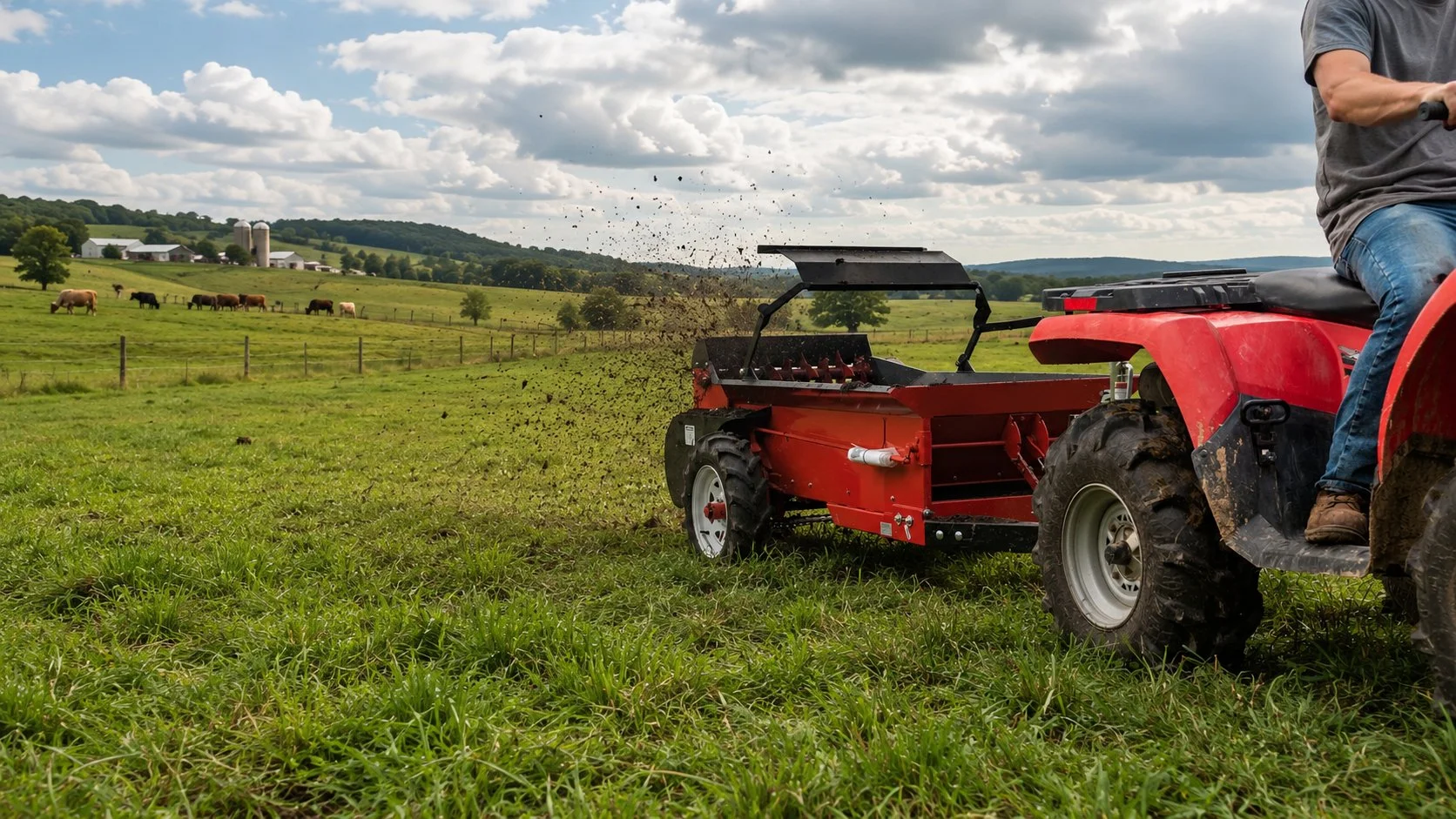
Manure spreaders historically used chain-and-sprocket drives to transfer power from the PTO driveline to the beater bars. Many budget and mid-range spreaders still use this approach. However, gear-driven spreaders using enclosed gearboxes have become the preferred architecture for heavy-duty and commercial operations. Understanding the trade-offs between these two approaches helps operators select the right machine for their scale and duty cycle.
| Factor | Chain Drive | Gear Drive (Enclosed Gearbox) |
|---|---|---|
| Initial cost | Lower | Higher (20–40% more) |
| Corrosion exposure | Fully exposed to manure splash and gas | Enclosed; only seals and housing exposed |
| Lubrication | Manual greasing required (frequently missed) | Bath lubrication — self-lubricating |
| Chain/gear life in manure | 1–3 seasons (corrosion + stretch) | 5–15 years (enclosed from corrosion) |
| Maintenance frequency | High: daily tensioning, frequent replacement | Low: oil changes at 150–200 hours |
| Efficiency | 92–96% when new, degrading as chain wears | 96–98% consistently over service life |
| Total cost of ownership (10 yr) | Higher (multiple chain replacements + labor) | Lower (oil changes only) |
The corrosion issue is decisive for commercial operations. An exposed roller chain operating in manure splash loses 0.5–1.0% of its pitch length per season due to pin and roller wear accelerated by corrosive contamination. When a chain stretches beyond 3% elongation, it no longer engages the sprocket teeth correctly and must be replaced — typically every 1–3 seasons in heavy manure service. A well-maintained enclosed agricultural gearbox will outlast 3–5 chain replacements while requiring only periodic oil changes.
Chain drives do offer one advantage: built-in overload protection. A chain will break before the PTO driveline or tractor components are damaged, acting as a mechanical fuse (similar to the shear pin function in other implements). Gear-driven spreaders must incorporate separate overload protection — typically a shear bolt on the PTO shaft or a slip clutch between the gearbox and the beater shaft.
Seal Technology for Slurry Environments
The output shaft seal on a manure spreader gearbox operates in conditions that would rapidly destroy standard rotary shaft seals. The seal must exclude not just dust and moisture (as in typical agricultural applications) but liquid manure, semi-solid slurry, sand and grit from bedding material, and corrosive gases. Simultaneously, it must retain the gear oil inside the housing.
Standard nitrile rubber (NBR) lip seals have limited chemical resistance to the organic acids and ammonia present in manure. For manure spreader service, seals should be manufactured from FKM (fluoroelastomer, commonly known by the brand name Viton) or HNBR (hydrogenated nitrile), which provide superior chemical resistance and temperature stability. FKM seals cost 3–5 times more than standard NBR seals but last 2–4 times longer in manure environments, making them more economical on a cost-per-hour basis.
Double-lip seals with an external dirt lip and an internal oil-retention lip provide the minimum acceptable protection. More sophisticated designs use a labyrinth seal outboard of the lip seal — a non-contact seal that uses a tortuous path to prevent contaminants from reaching the lip seal. The labyrinth gap is packed with grease that creates a sacrificial barrier between the manure environment and the primary sealing lip. This requires a grease fitting on the bearing housing that the operator should replenish regularly to maintain the grease barrier.
Spreader Types and Their Gearbox Requirements
Different manure spreader configurations place different demands on the gearbox. Understanding these variations ensures correct specification.
Box Spreaders with Beater Bars
The most common configuration. A floor chain conveys material toward spinning beater bars at the rear. The gearbox drives the beater assembly (one or two beaters) at 120–250 RPM. Load profile: high torque with heavy impact spikes, especially from frozen or compacted material. Gearbox requirement: high impact rating, case-hardened gears, service factor ≥2.0.
Vertical Beater Spreaders
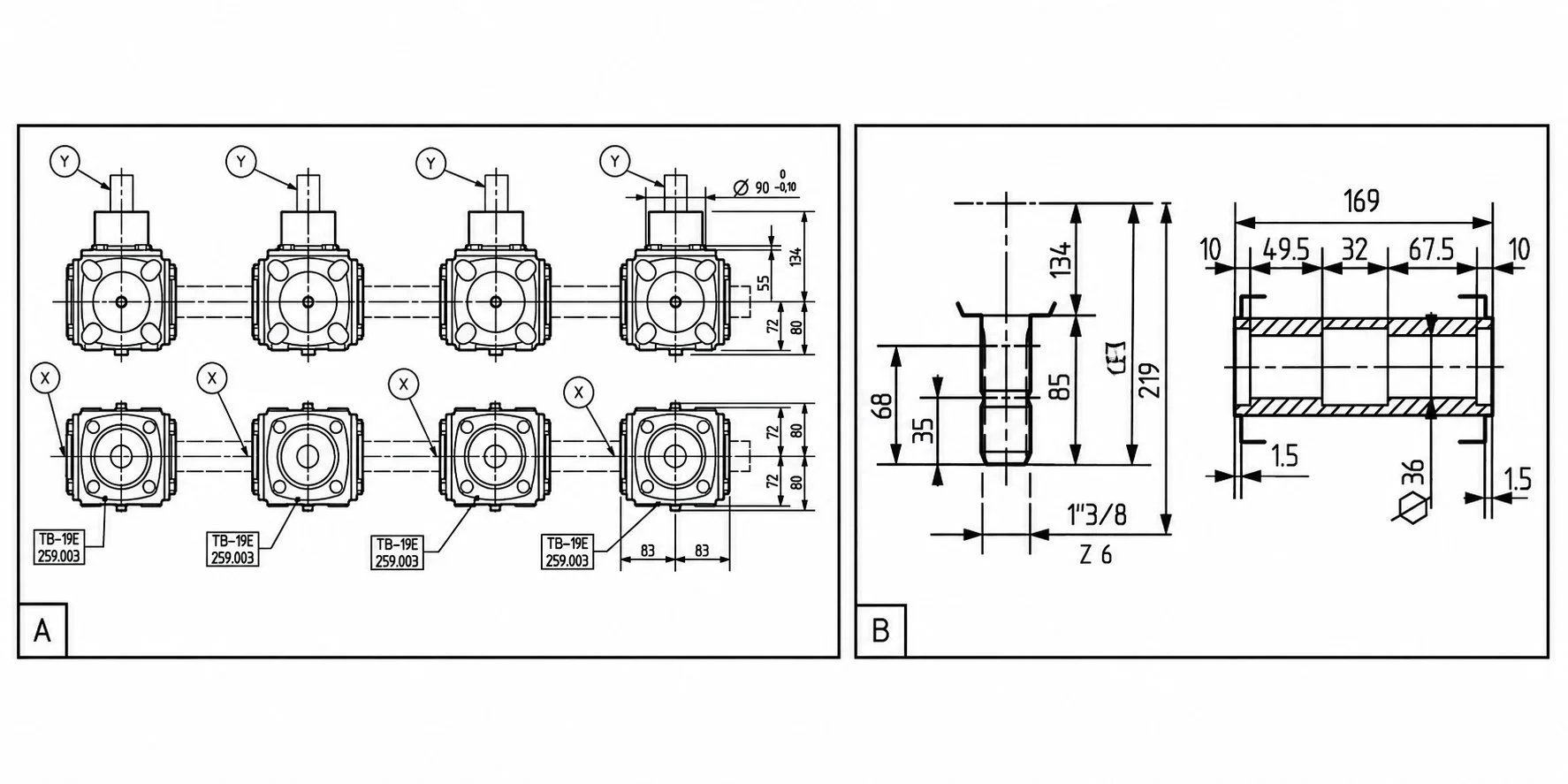
Vertical rotating beaters shred and fling material outward. These designs require the gearbox to redirect the PTO power axis by 90° (from horizontal PTO input to vertical beater shaft output). A right-angle gearbox with bevel or worm gear set is typical. Load profile: sustained moderate torque with lower impact spikes than horizontal beaters. Gearbox requirement: efficient 90° power redirection with good thermal management.
Liquid/Slurry Spreaders
Liquid manure spreaders (vacuum tanks) use the PTO to drive either a vacuum pump for tank filling or a centrifugal impeller for distribution. These gearboxes operate at higher speeds (400–1,000 RPM output) with relatively smooth, continuous loading. The primary challenge is seal integrity — liquid slurry is far more penetrating than solid manure. Gearbox requirement: superior seal system, chemical-resistant materials, moderate torque with continuous duty rating.
Maintenance Practices for Manure Spreader Gearboxes
The hostile chemical environment of manure service demands a more aggressive maintenance schedule than other agricultural applications. A gearbox that survives 2,000+ hours on a rotary mower may fail at 500 hours on a manure spreader if maintained on the same schedule.
Wash After Every Use
Pressure-wash the entire gearbox housing, output shaft, and seal areas after each spreading session. Manure residue that dries on the gearbox traps moisture against the surface and creates a concentrated corrosion cell. Rinsing takes two minutes and can double the service life of the housing coating and seals.
Oil Changes at Shortened Intervals
Change gear oil every 100–150 operating hours, not the 200–300 hours typical for standard agricultural duty. The gas-phase corrosion from H₂S and ammonia can penetrate even intact seals over time, contaminating the gear oil with acidic byproducts that accelerate internal wear. Shortened oil change intervals dilute these contaminants before they reach damaging concentrations.
Seal Inspection and Grease Barrier Maintenance
Inspect the output shaft seal area for manure residue buildup or oil weeping after every 25–50 hours. If the gearbox uses a labyrinth seal with a grease fitting, pump fresh waterproof grease through the fitting until clean grease purges from the labyrinth. This replaces the contaminated grease barrier and ensures the lip seal remains protected. A manure-contaminated grease barrier is worse than no barrier at all — the abrasive particles in manure act as a lapping compound against the seal lip.
Off-Season Storage Preparation
Before storing the spreader for winter or any extended downtime, wash the entire machine thoroughly, change the gearbox oil (corrosive contaminants in old oil attack internal surfaces during storage), fill the gearbox to the top of the sight glass (minimizing the air space reduces moisture condensation inside the housing), and apply a rust-preventive spray to exposed shaft surfaces and fastener heads. In spring, drain the overfilled oil to the correct level before operating.
PTO Driveline Considerations for Manure Spreaders
The PTO driveline connecting the tractor to the manure spreader gearbox faces the same corrosive environment as the gearbox itself. Universal joints, telescoping sections, and the PTO shaft bearings are all exposed to manure splash. Standard PTO drivelines designed for clean-environment implements (mowers, balers) will have significantly shortened life on a manure spreader.
Manure-service PTO drivelines should use sealed-bearing universal joints (rather than greaseable open bearings that allow contaminant ingress between grease intervals), stainless steel or heavy-zinc-plated telescoping tubes, and nylon or composite shield covers that resist corrosion (steel safety shields on standard PTO shafts rust through quickly in manure service). The shear bolt or slip clutch on the driveline — which protects the gearbox and tractor from overload — should be inspected at every oil change, as corrosion can weaken the bolt or seize the clutch mechanism.
Frequently Asked Questions
Corrosion-Resistant PTO Gearboxes for Manure Service
Ever-Power supplies heavy-duty PTO gearboxes with case-hardened gears, FKM seals, and corrosion-resistant housings — purpose-built for the demanding conditions of manure spreading applications.
Editor: Cxm