What Is a Sprayer Gear Unit Gearbox?
A sprayer gear unit gearbox is a PTO-driven speed-changing transmission that converts the tractor PTO speed (540 or 1,000 RPM) into the specific output speed required by the spray pump. Unlike most agricultural gearboxes that reduce speed and multiply torque, the majority of sprayer applications require the opposite: speed increase — boosting 540 RPM to 3,000 or 4,000 RPM for centrifugal pumps. This speed-increasing duty creates a unique engineering profile where the output shaft runs 5 to 7 times faster than the input, the torque at the output is correspondingly lower, and the gear mesh operates in the high-speed regime where noise, heat generation, and bearing fatigue from sustained high RPM become the dominant design challenges.
O sprayer gear unit gearbox also operates in a uniquely aggressive chemical environment. Agricultural chemicals — herbicides, fungicides, insecticides, and tank-mix adjuvants — contain organic solvents, acids, alkalis, and surfactants that attack standard sealing materials and unprotected metal surfaces. While the gearbox itself does not carry chemical fluid, spray drift, tank overflow, and refill spillage routinely deposit chemical on the gearbox exterior. Any chemical that reaches a worn seal lip can migrate along the shaft surface into the bearing compartment, contaminating the oil and initiating corrosion on precision bearing surfaces. Chemical-resistant design is therefore not an option but a fundamental requirement for any spray pump gearbox intended for multi-season crop protection service.
Three Pump Types, Three Gearbox Profiles
Agricultural sprayers use three primary pump types, each demanding a fundamentally different PTO şanzımanı ratio from the sprayer gear unit gearbox. Centrifugal pumps — the workhorses of boom spraying — generate high flow (150 to 500 L/min) at low to moderate pressure (3 to 8 bar) and must spin at 3,000 to 4,000 RPM. From a 540 RPM PTO this requires a speed-increase ratio of 1:5.5 to 1:7.5 — the highest step-up ratio in any standard agricultural gearbox application. From a 1,000 RPM PTO the ratio drops to 1:3 to 1:4, achievable in a simpler single-stage bevel design.
Diaphragm pumps — used for medium-pressure work (8 to 25 bar, 50 to 250 L/min) — run at 400 to 900 RPM, requiring 1:1 direct drive or a modest 1:1.5 to 1:1.7 increase from 540 RPM PTO. Piston pumps for high-pressure specialty applications (25 to 80 bar) run at 300 to 700 RPM, typically using direct drive or slight speed reduction. The sprayer gearbox ratio must be precisely matched to the pump type — using a centrifugal-ratio gearbox on a diaphragm pump would spin it at 4 to 5 times its rated speed, causing immediate mechanical destruction.
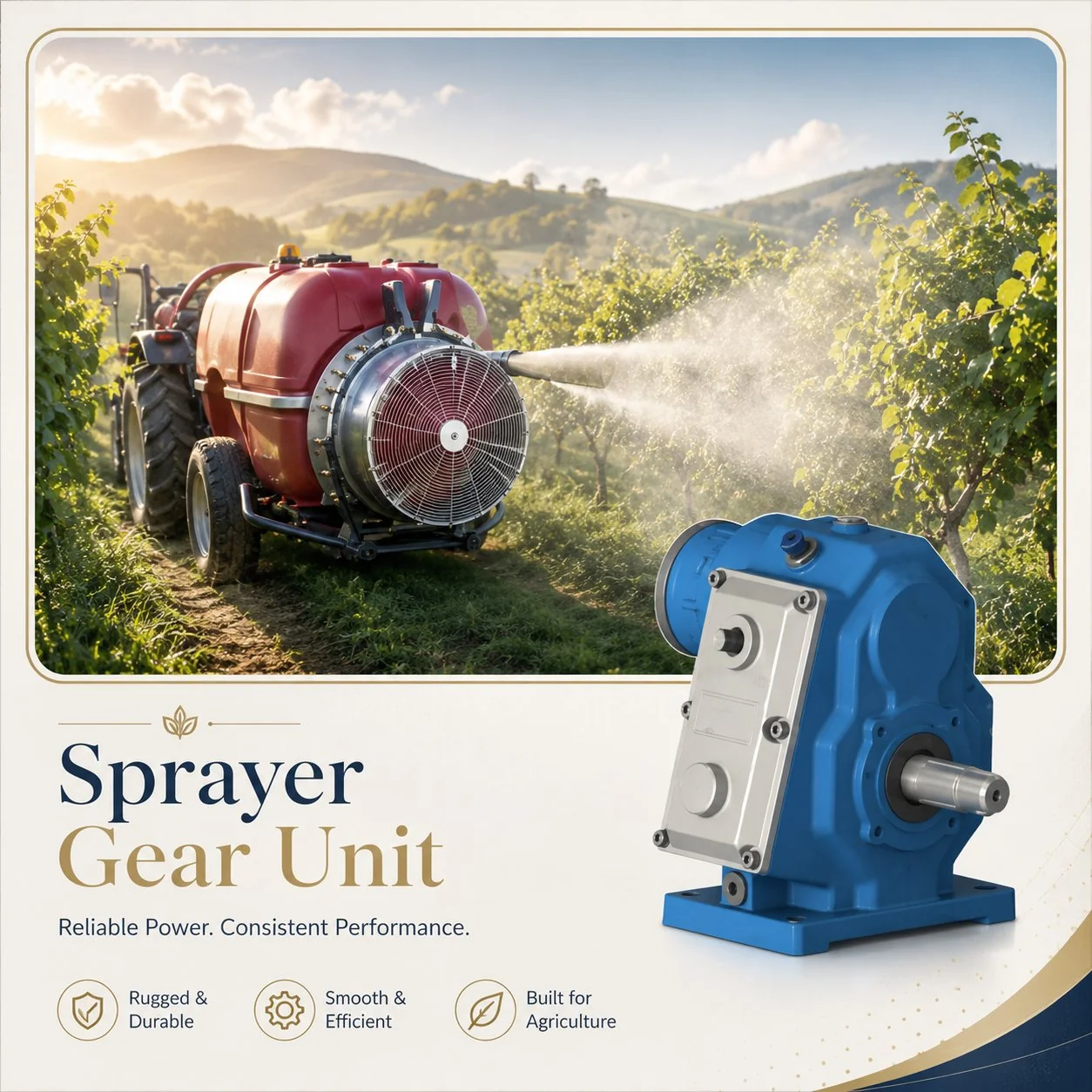
Sprayer gear unit gearbox — speed-increasing right-angle drive for centrifugal pump applications
Speed-Increasing Gearbox Design: Engineering in Reverse
Most agricultural gearboxes are speed reducers — the output turns slower than the input, and torque is multiplied. A PTO speed increase gearbox for sprayer applications reverses this relationship: the output turns faster than the input, and the torque is divided. A 1:6 speed increaser receiving 540 RPM and 795 Nm at the input (60 HP) delivers 3,240 RPM at only 127 Nm — just 16 percent of the input torque. While the lower output torque reduces gear tooth stress compared to a same-ratio reducer, the high output speed introduces engineering challenges that speed reducers do not face.
At 3,000 to 4,000 RPM the output bearings experience significantly higher rotational fatigue cycling than the 15 to 540 RPM bearings in most agricultural gearboxes. The bearing L10 life calculation includes speed as a direct factor — doubling the speed halves the theoretical bearing life at the same load. High-quality deep-groove ball bearings with C3 internal clearance (allowing for thermal expansion at operating temperature) and synthetic grease fill rated for sustained high-speed operation are essential for the output position. Angular contact bearings may be specified for gearboxes that must also resist axial thrust from the pump coupling.
Centrifugal pumps follow the affinity laws: flow is proportional to speed, pressure is proportional to speed squared, and power is proportional to speed cubed. A 5 percent speed error from the sprayer gear unit gearbox produces a 10 percent pressure error at the nozzle and a 16 percent power error at the input. This sensitivity makes output speed stability (target: ±1 percent under all operating conditions) a critical quality parameter for centrifugal spray pump gearbox applications — far more important than in low-speed, high-torque gearboxes where modest speed variation has no downstream consequence.
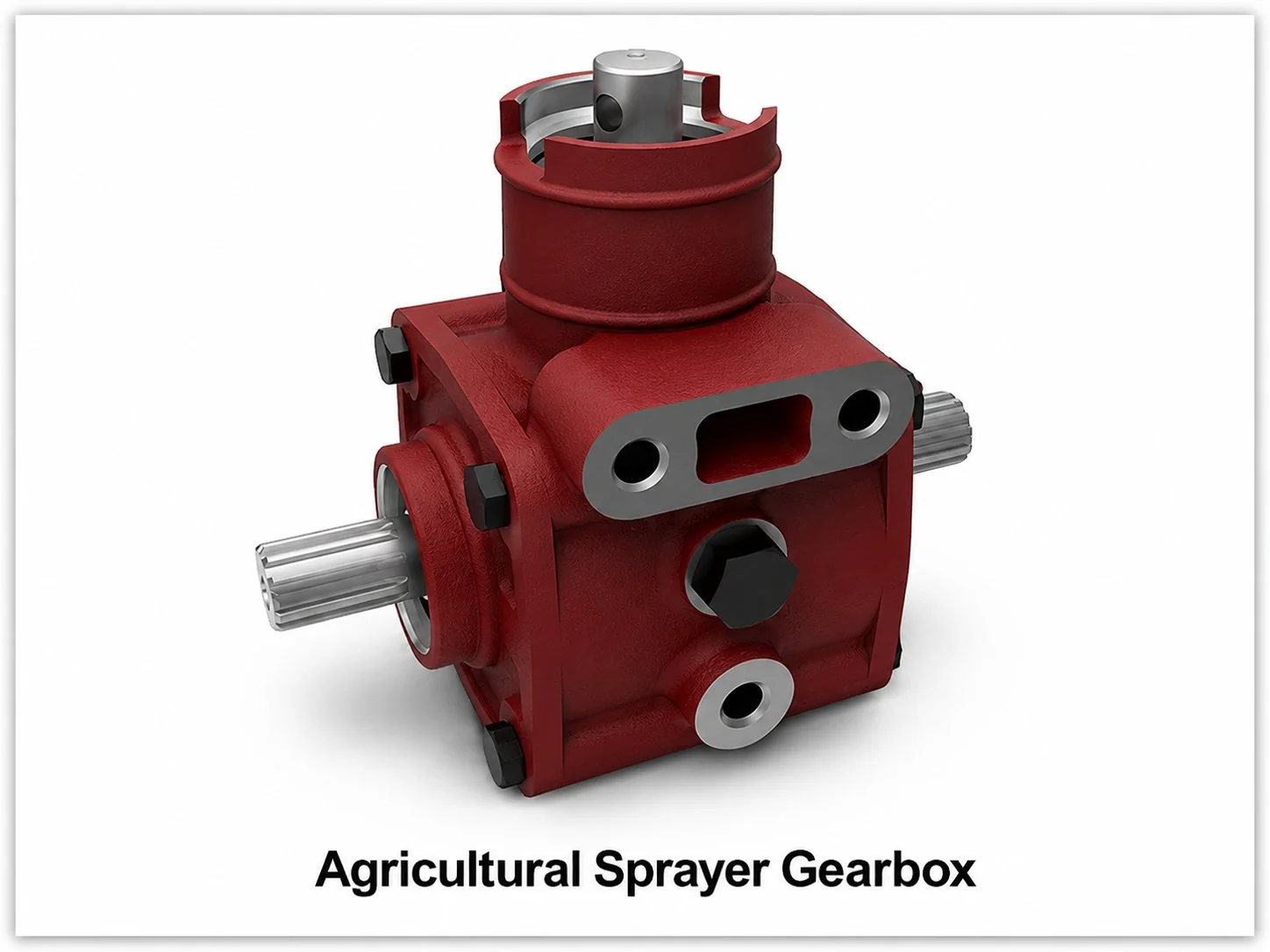
Chemical Resistance: FKM Seals and Corrosion Protection
Agricultural chemical formulations include organic solvents (xylene, hydrocarbon carriers in emulsifiable concentrates), acidic adjuvants (pH 3 to 4), alkaline glyphosate concentrates (pH 10 to 11), and aggressive non-ionic surfactants that attack standard NBR (nitrile) shaft seals within months of exposure. A sprayer gearbox chemical resistant specification must address every external surface and sealing interface that contacts spray drift or spillage.
Sprayer gearbox FKM seals (fluoroelastomer, also marketed under the Viton trade name) resist organic solvents, mineral acids, alkalis, and surfactants at concentrations that destroy NBR rapidly. FKM also provides higher temperature tolerance (continuous rating to 200 degrees Celsius vs. 120 degrees for NBR) — beneficial for the high-speed output bearing position where shaft surface temperatures can reach 80 to 100 degrees during sustained spraying at full pump load. Double-lip FKM seals with a grease-purged intermediate chamber add a secondary barrier: the outer lip deflects spray drift, the pressurised grease layer traps fine chemical mist, and the inner lip maintains oil seal integrity.
FKM double-lip seals at all shaft exits. Grease-purged intermediate chambers re-greased every 50 to 100 hours. Sealed check-valve breather preventing chemical-laden air ingestion. FKM O-rings at all housing split-line joints.
Epoxy powder coating at 80+ micrometres (standard acrylic paint degrades under chemical exposure). Stainless steel or zinc-nickel plated external fasteners. Stainless steel drain plugs and inspection covers. Corrosion-resistant sight glass housing.
Speed Stability and Pressure Pulsation Control
Nozzle pressure pulsation — the enemy of uniform chemical application — originates from two sources: inherent pump pulsation (each diaphragm stroke or piston stroke produces a pressure pulse) and speed pulsation introduced by PTO şanzımanı and driveline dynamics. The sprayer gear unit gearbox can control the second source through low-backlash gears, properly preloaded bearings, and high mesh efficiency that minimise speed variation under changing pump load.
İçin sprayer gearbox for centrifugal pump applications, target speed stability is plus or minus 1 percent under all operating conditions. This allows the spray pressure regulation system to maintain plus or minus 2 percent pressure accuracy at the nozzles — translating into plus or minus 1 percent application rate accuracy, well within the agronomic tolerance for chemical application. Gearbox-induced speed pulsation from Hooke-joint driveline variation (approximately plus or minus 3 percent at 10 degrees operating angle) can be eliminated with a constant-velocity PTO driveline for sprayers operating on undulating terrain where driveline angles regularly exceed 8 to 10 degrees.
Diaphragm and piston pump gearboxes face an additional challenge: the reciprocating pump action generates torsional oscillation in the gearbox output shaft at the pump stroke frequency. A three-diaphragm pump at 600 RPM produces 1,800 pulsations per minute — a high-frequency torsional excitation that can resonate with the gearbox gear mesh frequency if the natural frequencies coincide. Gearbox manufacturers must verify that no torsional resonance exists within the normal operating speed range (plus or minus 15 percent of rated speed) to prevent the amplified vibration, noise, and accelerated bearing wear that resonance produces.
Multi-output boom sprayer gearbox configurations that drive both the spray pump and a hydraulic pump for boom folding and section valve actuation must distribute the available PTO power between both outputs without cross-coupling the speed variations. An intermediate layshaft with separate gear meshes to each output prevents the variable hydraulic pump load from modulating the spray pump speed — maintaining the application rate accuracy that is the primary function of the spraying system.
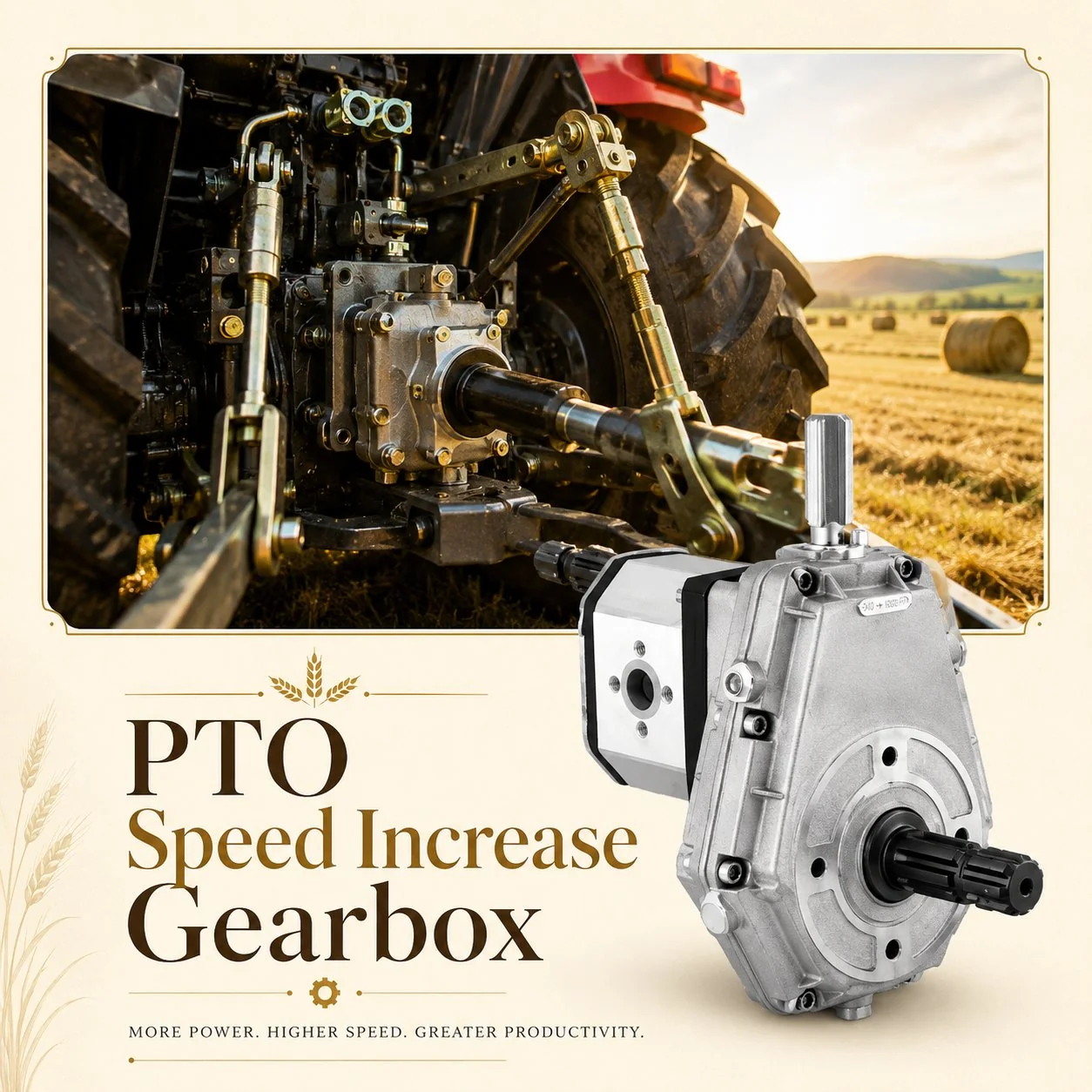
PTO speed increase gearbox — precision output for centrifugal spray pump drive
Technical Specifications at a Glance
PTO Driveline Matching for Sprayer Applications
The PTO driveline connecting the tractor to the sprayer gear unit gearbox must accommodate the specific requirements of speed-increasing duty. At 1:6 ratio the input shaft receives 540 RPM while the output delivers 3,240 RPM — but the U-joints in the PTO driveline operate at input speed only and therefore experience lower rotational fatigue than a same-power high-speed application. However, the driveline operating angle is critical: at angles exceeding 8 to 10 degrees, standard Hooke-joint U-joints generate twice-per-revolution speed variation of approximately plus or minus 3 percent — a pulsation that transmits directly through the gearbox to the pump and produces corresponding pressure fluctuation at the nozzles.
For trailed sprayers operating on undulating terrain where driveline angles regularly exceed 10 degrees, a constant-velocity (CV) PTO driveline eliminates this speed pulsation entirely. The additional cost of a CV joint (typically 30 to 50 percent more than a standard U-joint driveline) is justified by the improved application rate uniformity that results from eliminating speed-pulsation-induced pressure variation. Series 4 PTO drivelines are adequate for most sprayer applications (15 to 50 HP) — the relatively low torque at the gearbox input (compared to tillage or baling applications at the same HP) does not demand the higher Series ratings used for heavy-duty implements. Telescoping spline tube overlap must allow for the full range of drawbar articulation during turning without bottoming out or separating the spline engagement.
Sprayer Gearbox Oil Type and Lubrication
The correct sprayer gearbox oil type for centrifugal pump speed increasers is synthetic PAO EP ISO VG 220 — the same grade used in most right-angle agricultural gearboxes but in synthetic rather than mineral base stock. At 3,000 to 4,000 RPM output speed the gear mesh generates higher oil temperatures (70 to 95 degrees Celsius) than the same gearbox would produce at 540 RPM, and synthetic PAO maintains its viscosity-temperature curve more consistently than mineral oil at these elevated temperatures. The synthetic base stock also resists oxidation degradation at the higher sustained temperatures — extending oil life by 40 to 60 percent compared to mineral equivalents.
For diaphragm and piston pump gearboxes operating at modest output speeds (400 to 900 RPM), mineral ISO VG 220 EP oil is acceptable unless the operating environment requires cold-weather starting capability (below minus 5 degrees Celsius) — in which case synthetic PAO is specified for its superior low-temperature fluidity. Oil volume in sprayer gearboxes is small (typically 0.3 to 1.5 litres), so the cost difference between mineral and synthetic fill is minimal — making synthetic the default recommendation for all sprayer applications regardless of speed or climate.
Seasonal Maintenance Schedule
Oil change with fresh synthetic PAO ISO VG 220. Visual inspection of all FKM seals for chemical-induced hardening or cracking. Output bearing rotation check — spin by hand, feel for roughness or drag. PTO tahrik hattı U-joint greasing and wear assessment. Pump pressure and flow verification under load.
Daily oil level and leak check before first application. Visual seal inspection after each spraying day for chemical-induced degradation. Weekly exterior cleaning with clean water to remove chemical dust accumulation that traps moisture and initiates corrosion. Re-grease seal intermediate chambers every 50 to 100 operating hours.
Thorough exterior wash to remove all chemical residue — dried chemical deposits concentrate corrosive compounds. Top up oil. Apply protective grease to exposed shaft surfaces. Store away from chemical storage areas (vapour exposure degrades seals even without direct liquid contact). Note hours for next-season oil change planning.
Aftermarket Agricultural Sprayer Gearbox Replacement
Agricultural sprayer gearbox replacement is primarily driven by output bearing fatigue from sustained high-speed operation and seal degradation from chemical exposure — rather than the gear tooth wear that limits most lower-speed agricultural gearboxes. A well-maintained sprayer gearbox typically lasts 8 to 15 spraying seasons (1,500 to 4,000 operating hours depending on annual usage intensity). Cross-reference parameters include the input spline profile, the output shaft size and pump coupling type, the speed ratio, the mounting bolt pattern, and — critically — the chemical resistance specification (FKM vs. NBR seals, epoxy vs. acrylic coating).
Our engineering team at Ever-Power Agricultural Gearbox maintains cross-reference compatibility data for major sprayer and pump brands — verifying that the aftermarket gearbox matches the original unit in ratio, coupling dimensions, and chemical-resistance specification. Because sprayer gearboxes are smaller and lighter than most agricultural gearbox types, shipping lead times are typically shorter — often critical when a gearbox failure occurs mid-season and every day of spraying delay risks missing the optimal application window for time-sensitive herbicide or fungicide treatments.
Sıkça Sorulan Sorular
Spray Smarter with the Right Drive
Chemical-resistant sprayer gear unit gearboxes with precision speed output for every pump type — centrifugal, diaphragm, and piston — and every crop protection application.