Why a Speed Increaser Gearbox Is Essential for PTO Generators
A synchronous alternator produces AC electricity at a frequency determined by its rotational speed and the number of magnetic poles. To generate standard 50 Hz power (used in Europe, Asia, Australia, and most of the world outside North America), a 4-pole alternator must spin at exactly 1,500 RPM. For 60 Hz power (North America, parts of South America and Asia), the same 4-pole alternator must spin at exactly 1,800 RPM. A tractor PTO delivers either 540 or 1,000 RPM — neither of which matches the required alternator speed. The PTO мењач speed increaser bridges this gap with a fixed ratio that converts PTO speed to the precise alternator speed needed for stable frequency output.
The ratio calculation is straightforward: for a 540 RPM PTO driving a 50 Hz (1,500 RPM) alternator, the required ratio is 1,500 ÷ 540 = 2.778:1 speed increase. For 60 Hz (1,800 RPM) from 540 RPM, the ratio is 3.333:1. For a 1,000 RPM PTO driving 50 Hz, the ratio is 1.5:1, and for 60 Hz, it is 1.8:1. These ratios must be achieved with high accuracy in the gearbox gear train — a 2% speed error produces a 1 Hz frequency deviation that can cause motors to overheat, clocks to drift, and sensitive electronic equipment to malfunction or shut down.
The practical challenge is that standard gear tooth counts rarely produce these exact ratios. A 2.778:1 ratio requires tooth count combinations like 50:18 (= 2.778) or 75:27 (= 2.778) — specific gear pairs that must be manufactured for the PTO generator application rather than pulled from a standard catalog. This is why PTO generator gearboxes are specialized products rather than generic speed increasers — the ratio precision requirement is much tighter than for most agricultural applications where ±5% output speed is perfectly acceptable. For a broader understanding of speed increaser versus reducer gearbox engineering, see our technical resource on PTO speed increaser gearboxes.
Gearbox Configurations for PTO Generator Drive
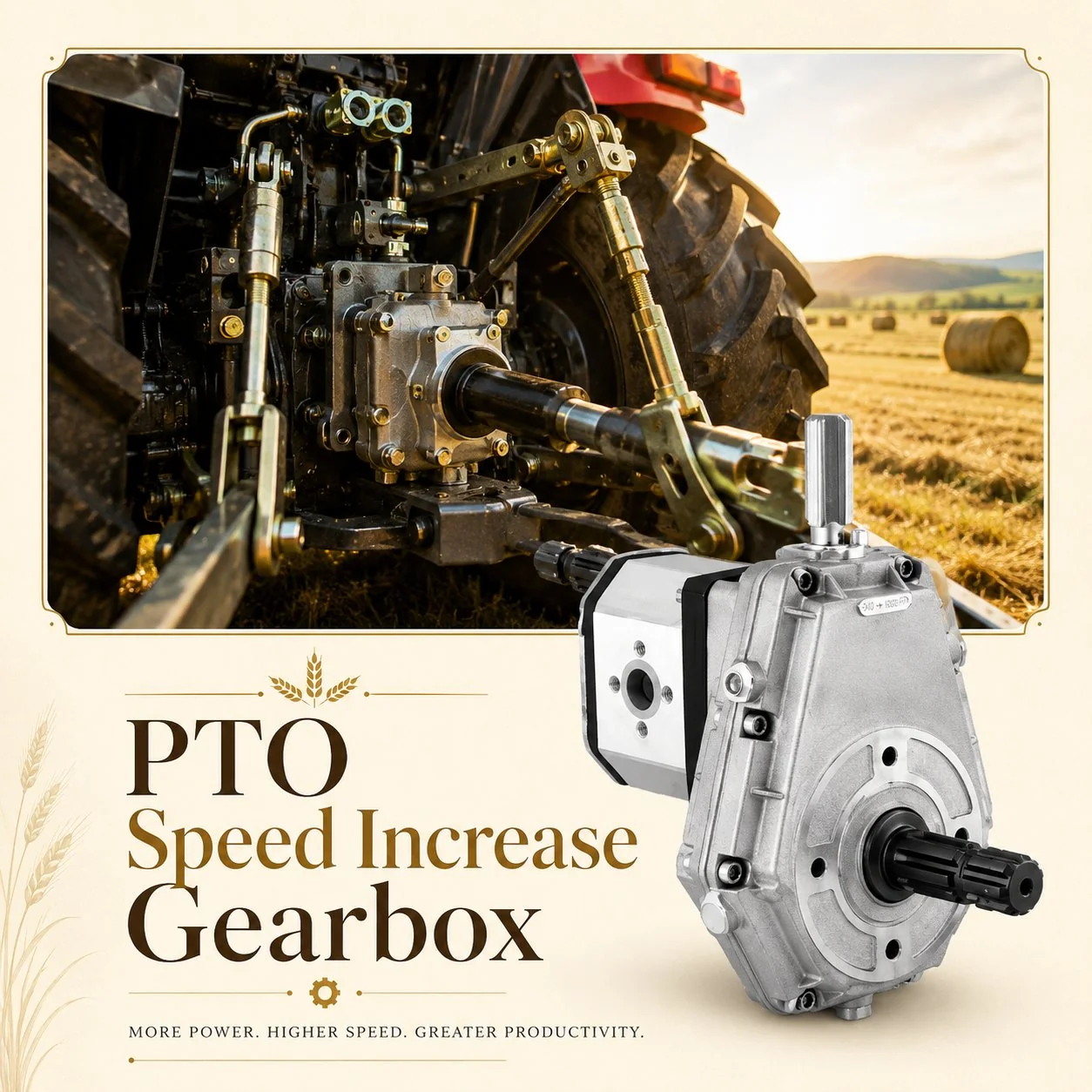
PTO generator gearboxes use two principal configurations: right-angle bevel gear and parallel-shaft helical gear. The right-angle configuration redirects the horizontal PTO shaft rotation 90 degrees into a vertical or angled output that connects to the generator head — useful when the generator is mounted above or beside the tractor drawbar. The parallel-shaft configuration maintains the same rotation axis as the PTO shaft, with the generator mounted inline behind the tractor — a mechanically simpler arrangement that avoids the efficiency losses of a 90-degree direction change.
For the 2.778:1 ratio required for 540-to-1,500 RPM conversion, a single-stage helical gear pair achieves the ratio in one mesh with 96 to 98 percent efficiency. A single-stage bevel gear pair achieves the same ratio with 94 to 97 percent efficiency, with the slight additional loss attributable to the axial sliding inherent in bevel gear mesh. The efficiency difference of 1 to 3 percentage points translates directly into lost electrical output — a 50 kVA PTO generator driven through a 95% efficient gearbox delivers 47.5 kVA at the output terminals, while a 98% efficient gearbox delivers 49 kVA from the same PTO input. For continuous-duty generator applications running 8 to 16 hours per day, this efficiency gap also translates into reduced fuel consumption and lower gearbox operating temperature.
Two-stage gearboxes (combining a bevel stage with a helical stage, or two helical stages) are used when the single-stage ratio exceeds the practical limit for a single gear pair — typically above 4:1 for bevel gears and 6:1 for helical gears. The 540-to-1,800 RPM ratio (3.333:1) can be achieved in a single stage but is at the upper limit where a two-stage approach may deliver better efficiency and lower noise. Manufacturers like Ever-Power PTO мењач offer both single-stage and two-stage configurations, allowing the generator integrator to select the optimal balance of efficiency, compactness, and cost for their specific power output and duty cycle requirements.
Power Sizing: Matching Gearbox to Generator and Tractor
The gearbox must be rated for the full continuous output of the generator — not just the average load. A 50 kVA generator connected to motor-starting loads can draw 150 to 200 percent of rated current for 2 to 5 seconds during each motor start, and the corresponding torque spike passes directly through the gearbox. The PTO мењач must handle these transient overloads without gear tooth damage or bearing distress, while the tractor engine must have sufficient reserve power to maintain PTO speed during the transient (a speed droop during motor starting causes a frequency dip that can trip sensitive electronic loads).
For proper sizing, calculate the mechanical power required at the gearbox input: divide the generator’s rated electrical output (in kW) by the generator efficiency (typically 0.90 to 0.95 for quality alternators) and then by the gearbox efficiency (0.95 to 0.98). A 40 kW generator with 0.92 generator efficiency and 0.96 gearbox efficiency requires 40 ÷ 0.92 ÷ 0.96 = 45.3 kW (approximately 61 HP) at the PTO. The tractor must deliver this power continuously at the rated PTO speed, plus an additional 20 to 30 percent reserve for motor-starting transients — so a 75 to 80 HP tractor is the minimum for reliable operation of a 40 kW PTO generator system.
Oversizing the gearbox by one frame size above the calculated requirement provides a significant reliability margin at modest additional cost. A gearbox rated for 60 kW continuous that is loaded to only 45 kW operates at 75 percent of capacity — reducing gear tooth stress, bearing load, and operating temperature proportionally. This derating extends the gearbox’s expected service life by 2 to 3 times compared to operating continuously at full rated capacity, and provides the thermal headroom needed for sustained operation in hot ambient conditions without risk of oil overheating or accelerated bearing degradation from elevated temperature.
Frequency Stability: Gearbox Backlash and Torsional Vibration
Electrical frequency stability requires rotational speed stability at the alternator shaft, and the gearbox directly influences this through two mechanisms: backlash (angular play between meshing gear teeth) and torsional compliance (the spring-like twisting deflection of the gear train under changing load). Excessive backlash allows the alternator to oscillate slightly in speed as the load changes, producing frequency fluctuations that manifest as flickering lights and audible hum variation. Excessive torsional compliance amplifies load-change oscillations into sustained torsional vibration that causes cyclic frequency hunting — a condition where the frequency oscillates rhythmically around the target value rather than settling to a steady state.
Quality PTO generator gearboxes minimize backlash through precision gear manufacturing (AGMA Quality 10 or better), proper bearing preload (eliminating axial play in the gear mesh), and matched gear set lapping (optimizing the contact pattern for uniform load distribution). The target backlash for a generator-grade gearbox is typically 0.05 to 0.15 mm at the output shaft — significantly tighter than the 0.2 to 0.5 mm backlash acceptable in general-purpose пољопривредни мењач applications where speed precision is not critical.

PTO Generator Applications: Farm, Emergency, and Remote Power
Farm power generation is the largest application for PTO generator gearboxes. Remote properties without grid connection use PTO generators as their primary power source — running irrigation pumps, livestock water systems, shearing shed equipment, grain drying fans, and domestic household power from the farm tractor. The gearbox must deliver reliable continuous-duty operation for 8 to 16 hours daily over seasons measured in thousands of hours, making quality gear materials, bearings, and lubrication essential rather than optional.
Emergency standby power is the second major application. Dairy farms, poultry operations, and livestock facilities with environmental control systems (ventilation, heating, cooling) cannot tolerate extended power outages — animal welfare and product quality depend on continuous environmental control. A PTO generator with a pre-connected gearbox stored in a shed provides backup power within minutes of a grid failure, without the maintenance burden and fuel degradation issues associated with dedicated standby diesel generators that may sit idle for months between outage events.
Construction site and remote worksite power is a growing application for пољопривредни мењач speed increasers adapted for generator drive. A contractor with a tractor already on site for earthworks or vegetation clearing can power arc welders, concrete mixers, and power tools through a PTO generator rather than transporting a separate diesel generator to the site. The key requirement is that the gearbox and generator combination can handle the highly variable and intermittent loads characteristic of construction work — frequent motor starts, arc welder duty cycles, and rapid transitions between no-load and full-load conditions that test both the gearbox’s mechanical resilience and the tractor governor’s speed recovery response.
Tractor Governor Settings for Stable Generator Output
The tractor engine governor is the upstream speed regulator in the PTO generator system — it maintains the engine RPM (and therefore the PTO speed) as the electrical load changes. A well-adjusted governor holds the engine within 3 to 5 percent of the target RPM under all load conditions, which the precision-ratio gearbox then converts to alternator speed within the tight tolerance needed for stable frequency output. A poorly adjusted governor that allows the engine to droop 8 to 10 percent under load produces proportional frequency droop at the alternator — exceeding the 5 percent tolerance that most electrical equipment requires.
Before commissioning a PTO generator system, verify the tractor’s governor response by loading the PTO to full rated capacity and measuring the engine RPM droop from no-load to full-load. Most modern diesel tractors achieve 4 to 6 percent steady-state droop with their factory governor settings. If the droop exceeds 7 percent, the governor spring tension or electronic governor calibration should be adjusted by a qualified mechanic before the generator is placed in service. Transient droop during sudden load application (motor starting) may reach 10 to 15 percent momentarily, which is acceptable for brief events of 1 to 3 seconds as long as the governor recovers quickly.
Single-Phase vs. Three-Phase Generator Selection
The choice between single-phase and three-phase generator output affects the gearbox loading pattern. A single-phase alternator produces a pulsating torque load at twice the output frequency (100 Hz for 50 Hz output, 120 Hz for 60 Hz) because the power delivery in a single-phase system reaches zero twice per cycle. This pulsating torque creates a cyclic torsional loading on the gearbox that is not present in three-phase systems, where the power delivery is constant and the resultant torque on the gearbox is smooth and continuous.
For gearbox longevity, three-phase operation is preferred because the constant torque eliminates the cyclic stress reversals that accelerate gear tooth fatigue in single-phase applications. However, many farm applications require single-phase output for domestic loads and small motors, and the pulsating torque from single-phase operation is well within the design capability of a properly specified gearbox. The key is ensuring that the gearbox is rated for the peak pulsating torque (which is approximately 1.4 times the average torque in single-phase systems), not just the average continuous torque that the electrical output specification implies.
Maintenance for Continuous-Duty Generator Gearboxes
PTO generator gearboxes operate at continuous duty — a more demanding load profile than the intermittent operation typical of most agricultural gearbox applications. Oil change intervals should reflect this continuous duty: every 250 hours for mineral oil or 500 hours for synthetic, with the first oil change at 50 hours to remove break-in wear particles. Check the oil level daily when the generator is in regular use — a slow seal leak that is harmless on a mower used 200 hours per year becomes critical on a generator running 2,000+ hours annually.
Monitor the gearbox operating temperature during the first week of service to establish a baseline. A quality gearbox running at 75 percent of rated capacity should stabilize at 40 to 60 degrees above ambient temperature. If the temperature exceeds 80 degrees above ambient, the gearbox is either overloaded, under-oiled, or has an internal problem (bearing distress, gear mesh misalignment) that requires investigation. Temperature monitoring is particularly important in hot climates where the combination of high ambient temperature and continuous duty can push oil temperatures beyond safe limits for standard mineral gear oil. For generator installations in tropical regions or sustained summer operation above 35 degrees ambient, synthetic gear oil is the minimum specification — the cost premium over mineral oil is recovered many times over through extended oil life and reduced bearing wear at elevated operating temperatures.
Често постављана питања
Power Your Operation — Get a Quote
Tell us your target frequency (50 or 60 Hz), PTO speed (540 or 1,000 RPM), and generator kW rating — our engineering team will specify the correct gearbox ratio, configuration, and frame size for your application. Factory-tested speed accuracy, worldwide shipping, and technical support from enquiry through installation.
Уредник: Cxm