What a Snow Plow Gearbox Does — and Why Cold Changes Everything
A snow plow gearbox transmits power from the vehicle’s PTO, hydraulic motor, or dedicated engine to the snow-clearing mechanism — whether that is a front-mounted blade, a rotary snow blower auger, or a rear-mounted salt spreader drive. In fundamental terms, it performs the same job as any right-angle or inline gearbox: redirects rotational energy, adjusts speed and torque, and supports the driven shaft through its bearings. The difference is that every one of those functions must work reliably at temperatures that can drop below −30 °C, under impact loads from frozen snowpack and hidden obstacles, and in an environment saturated with road salt, de-icing chemicals, and abrasive grit.
Standard agricultural gearbox designs built for temperate-season field work face three specific failure modes in sub-zero snow removal: lubricant viscosity rise that starves bearings during cold startup, seal hardening that opens leak paths within the first winter, and housing embrittlement in materials not rated for low-temperature impact. A purpose-engineered snow plow gearbox addresses each of these through material selection, lubricant specification, and seal technology choices that differ significantly from warm-weather counterparts.

Cold-Weather Lubrication: Why Viscosity Is the First Engineering Decision
Gear oil viscosity doubles approximately every 10 °C drop in temperature. An EP 80W-90 mineral gear oil that flows freely at 20 °C becomes thick enough at −20 °C to resist circulation through the gear mesh, leaving the bearings and tooth surfaces dry during the critical first minutes of cold startup. Those first minutes are when most cold-weather gearbox damage occurs — metal-on-metal contact without an adequate lubricant film produces accelerated surface wear, micro-pitting, and scoring that shortens the gearbox’s effective service life by hundreds of hours.
Snow plow gearboxes require a lubricant with a significantly lower pour point and better low-temperature flow characteristics than standard agricultural gearbox oil. The two primary options are synthetic EP gear oils (PAO-based or PAG-based) rated to pour points of −40 °C or below, and semi-synthetic blends that offer improved cold-flow performance at lower cost than full synthetics. A synthetic 75W-90 EP gear oil provides the cold-start protection of a 75W winter grade while maintaining the film thickness of a 90-weight at normal operating temperature — making it the default recommendation for snow plow gearbox applications.
🌡️ Lubricant Selection Rule for Snow Duty
The pour point of the gear oil must be at least 10 °C below the lowest expected ambient startup temperature. If your equipment starts in −25 °C conditions, the oil’s pour point must be −35 °C or lower. A pour point that merely matches the ambient temperature means the oil is semi-solid at startup and cannot circulate to the gear mesh and bearings.
Oil volume also matters more in cold-weather gearboxes than in temperate applications. A gearbox filled to the correct level ensures the lower bearing is submerged in oil even when the lubricant is cold and contracts slightly in volume. Underfilling by even 50 ml can leave the lower tapered roller bearing partially exposed during cold starts — a condition that would be harmless in warm weather but causes rapid wear when the thick, cold oil cannot splash-feed the bearing from the gear mesh above.
For operations that store equipment outdoors between snow events, a brief pre-warm idle procedure adds significant bearing life. Running the PTO at idle speed for 60 to 90 seconds before engaging full load allows the oil to warm from ambient to approximately −10 °C — enough to reduce viscosity by 40–60% and establish a protective film. This practice is especially important for PTO gearbox configurations where the oil has been stationary for days between storm events.
Seal Technology for Sub-Zero Environments
Standard nitrile (NBR) shaft seals used on most agricultural gearbox applications have a rated operating range of −30 °C to +100 °C. That lower limit sounds adequate for snow plowing, but the rated range describes the temperature at which the rubber retains some flexibility — not the temperature at which it seals effectively under pressure and shaft eccentricity. In practice, NBR seals begin losing conformability to the shaft surface at around −15 °C and become rigid enough to create leak paths at −25 °C. A rigid seal lip cannot follow the minor shaft deflections caused by gear mesh forces, and the gap that opens with each revolution allows oil to weep past the seal face.
Purpose-built snow plow gearboxes use one of two cold-rated seal materials. HNBR (hydrogenated nitrile) extends the effective low-temperature range to −40 °C while retaining good compatibility with EP gear oil additives. FKM (fluoroelastomer / Viton) offers even broader chemical resistance — important when road salt spray and calcium chloride de-icing solutions contact the seal exterior — though its cold flexibility is similar to standard NBR unless a low-temperature compound variant (GFLT or GLT grade) is specified. The optimum solution for snow plow gearboxes operating below −20 °C is a low-temperature FKM compound (rated to −40 °C) with a stainless steel spring garter to maintain consistent lip pressure as the rubber stiffens in the cold.
Beyond the shaft seal material itself, the external environment surrounding a snow plow gearbox is far more aggressive than typical farm conditions. Road salt brine, magnesium chloride, and calcium chloride solutions splash continuously against the gearbox housing, attacking exposed fastener threads, breather vents, and the external surface of the shaft seal. A labyrinth or slinger ring on the output shaft helps deflect salt spray before it reaches the seal face, and a protective boot or rubber bellows over the input shaft connection prevents brine from pooling around the input seal. These external protection measures are not standard on agricultural gearboxes and must be specified or retrofitted for snow duty.
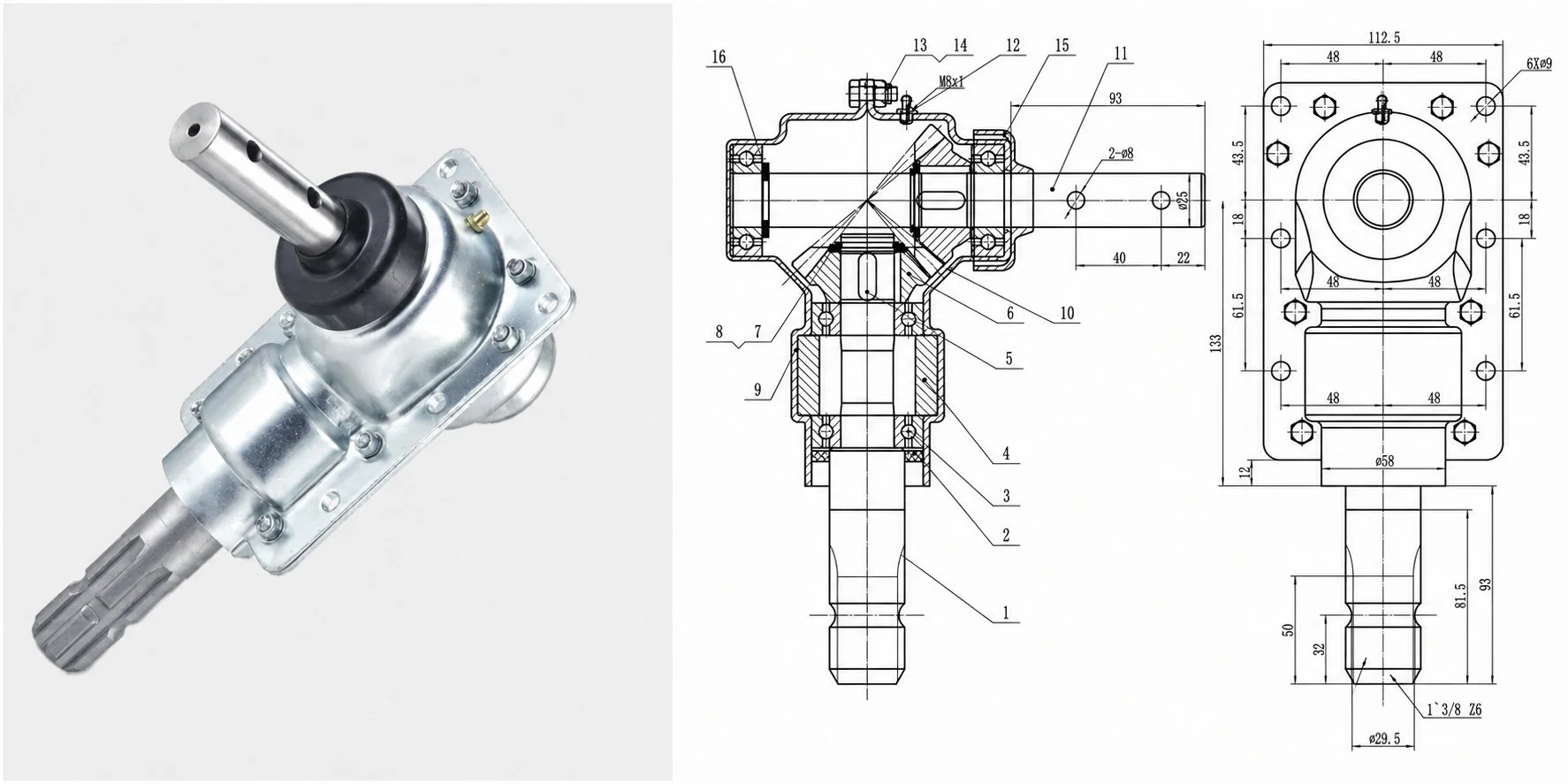
Dimensional reference for standard snow plow gearbox mounting and shaft configurations
Impact Loading from Frozen Material and Hidden Obstacles
Snow plowing generates impact loads that differ fundamentally from agricultural mowing or tilling. A rotary cutter blade strikes a rock and the impact is brief — a single high-energy event lasting milliseconds. A snow plow blade running into a frozen snowbank or ice ridge applies a sustained compressive load that can persist for several seconds as the plow pushes through the obstacle at vehicle speed. This sustained overload condition stresses the gearbox differently: instead of a sharp shock that challenges gear tooth bending strength, the plow generates prolonged high torque that heats the gear mesh, overloads bearings, and can cause thermal expansion of the shafts within tight bearing preload tolerances.
Hidden obstacles — raised manhole covers, curb edges, frozen debris, buried fence posts — create the sudden impact type of loading on top of the sustained snow load. The gearbox must handle both simultaneously. Overload protection is therefore essential: a shear pin or slip clutch on the PTO driveline protects the gearbox from catastrophic gear tooth failure during major impacts, while the gearbox itself must be designed with sufficient tooth root strength and bearing capacity to absorb the continuous medium-level impacts that are part of normal snow clearing operation.
Frozen windrow impact — Compacted roadside snow banks can reach ice-like density (600–900 kg/m³). Striking one at speed generates peak gearbox torque 3–5× the normal plowing load. Reduce vehicle speed when approaching packed windrows.
Raised infrastructure strikes — Manholes, drainage grates, and speed bumps buried under snow are invisible. A blade-down impact at full speed can snap a shear bolt instantly or, without a shear bolt, crack a gear tooth root. Pre-season GPS marking of known obstacles reduces this risk.
Ice dam buildup on blade — Repeated partial melting and refreezing creates a heavy ice mass on the blade assembly that unbalances the rotor and increases bearing side load. Clear accumulated ice from the blade between routes.
Housing Materials: Ductile Iron vs. Cast Steel for Cold Duty
Gray cast iron — the default housing material for many standard-duty agricultural gearboxes — becomes increasingly brittle as temperature drops. Its ductile-to-brittle transition temperature (DBTT) is poorly defined because gray iron has low ductility even at room temperature, but impact toughness drops measurably below −10 °C. A rock strike or curb impact that would merely dent a ductile iron housing at 20 °C can fracture a gray iron housing at −25 °C, cracking the casting and releasing all gear oil in a single event.
Snow plow gearbox housings should be manufactured from ductile iron (SG iron / spheroidal graphite iron) or cast steel, both of which retain significantly higher impact toughness at sub-zero temperatures. Ductile iron (EN-GJS-500-7, for example) offers a good balance of machinability, cost, and cold-temperature toughness. Cast steel provides even higher impact resistance but is more expensive and heavier. For most snow plow applications up to 100 HP, ductile iron is the practical choice. For heavy-duty municipal rotary snow blowers above 100 HP operating in extreme cold (−35 °C and below), cast steel housings provide the additional impact margin that justifies the cost premium.
Corrosion protection on the housing exterior is another cold-climate consideration often overlooked. Road salt attacks unprotected cast iron surfaces aggressively. Quality snow plow gearboxes feature epoxy-coated or powder-coated housings, stainless steel fasteners (or zinc-flake coated grade 10.9 bolts), and sealed breather vents with external splash guards. A housing that looks cosmetically damaged after one winter of unprotected salt exposure is also structurally weakened — surface pitting from corrosion creates stress concentration points that reduce impact resistance further.
Hydraulic-Driven vs. PTO-Driven Snow Removal Gearboxes
Snow removal equipment uses two fundamentally different power sources to drive the gearbox: a tractor-style PTO shaft (common on tractor-mounted rear snow blowers and three-point-hitch spreaders) or a hydraulic motor (common on skid steer attachments, truck-mounted plows, and loader-mounted snow blowers). Each approach imposes different demands on the gearbox design.
| Parameter | PTO-Driven Gearbox | Hydraulic-Driven Gearbox |
|---|---|---|
| Input speed | 540 or 1000 RPM (fixed) | Variable, set by hydraulic flow |
| Speed control | Fixed ratio; speed set by PTO category | Infinitely variable via flow control valve |
| Overload protection | Shear bolt or slip clutch on driveline | Hydraulic relief valve (built-in) |
| Cold-start concern | Gear oil viscosity in gearbox | Hydraulic fluid viscosity in entire circuit + gear oil |
| Typical application | Tractor-mounted rear blower, 3PH spreader | Skid steer blower, truck plow, loader attachment |
| Efficiency | 95–97% (mechanical gear mesh) | 70–85% (hydraulic losses + gear mesh) |
| HP range | 25–200 HP | 15–120 HP equivalent |
PTO-driven systems deliver higher efficiency and are preferred for high-HP rotary snow blowers that need maximum power transfer — municipal two-stage blowers rated at 80+ HP, for example, almost always use PTO drive because the 15–30% hydraulic efficiency loss would require a significantly larger prime mover to achieve the same blowing capacity. Hydraulic drive offers variable speed control and built-in overload protection through the hydraulic relief valve, making it better suited for attachments that need to operate at varying speeds or that mount on machines without a PTO output.
A hybrid approach used in some premium truck-mounted blowers combines a PTO shaft from the truck transmission driving a mechanical gearbox for the auger and impeller, with a separate hydraulic circuit for the chute rotation and deflector cap positioning. This arrangement delivers maximum blowing power through the efficient mechanical path while using hydraulics only for the low-power positioning functions where variable speed control matters and efficiency loss is negligible.
Maintenance Protocols for Salt-Environment Snow Duty
Snow plow gearboxes require a maintenance approach adapted to their unique combination of cold temperatures, intermittent duty cycles, and extreme external corrosion exposure. The standard agricultural gearbox maintenance intervals used for summer implements are not adequate for snow equipment — intervals should be shorter, and several additional inspection points are necessary.
Before Each Snow Event
Check oil level via sight glass or dipstick. Verify the breather vent is clear of ice. Inspect the output shaft seal area for oil weeping that may have frozen into a visible film. Confirm the shear bolt (if applicable) is intact.
Every 25 Operating Hours
Wash salt residue from the housing exterior with fresh water. Inspect all fasteners for corrosion and re-torque if needed. Check belt tension (belt-driven models). Grease any external fittings with cold-rated NLGI #1 grease.
Every 75 Operating Hours
Drain and replace gear oil completely. Inspect the drained oil for water contamination (milky appearance) and metallic particles. If water is present, flush the housing with fresh oil before refilling. Replace the breather filter element.
End of Snow Season
Complete oil change with fresh synthetic gear oil. Full exterior wash to remove all salt residue. Inspect seals for lip wear and hardening. Measure gear backlash and bearing play. Apply anti-corrosion spray to exposed housing surfaces. Store in a dry, sheltered location with the input shaft opening sealed against moisture ingress.
Water intrusion is the most insidious maintenance issue in snow plow gearboxes. Every thermal cycle — from cold outdoor storage to warm operating temperature and back — creates a pressure differential inside the gearbox housing that draws moist air through the breather vent. That moisture condenses on the cold internal surfaces and mixes with the gear oil. Over a full winter season, cumulative water contamination can reach 2–5% of the oil volume, enough to cause rust on gear teeth, bearing race etching, and accelerated additive depletion. Regular oil changes (every 75 hours rather than the 100-hour standard for summer implements) flush this accumulated moisture before it causes permanent damage.
Selection Specifications for Snow Plow Gearboxes
When sourcing a snow plow gearbox — whether for a new equipment build or as a replacement — these specifications must match your application precisely. Mismatching any single parameter risks premature failure in an environment that gives no margin for error.
| Parameter | Light-Duty Plow | Medium-Duty Blower | Heavy-Duty Municipal |
|---|---|---|---|
| HP range | 15–35 HP | 35–80 HP | 80–200+ HP |
| Input type | 540 RPM PTO or hydraulic | 540/1000 RPM PTO | 1000 RPM PTO or truck PTO |
| Gear ratio | 1:1 to 1:1.5 | 1:1 to 1:2 | 1:1.5 to 1:3 |
| Housing material | Ductile iron | Ductile iron | Ductile iron or cast steel |
| Seal material | HNBR | Low-temp FKM | Low-temp FKM + slinger |
| Oil specification | Synthetic 75W-90 EP | Synthetic 75W-90 EP | Full synthetic 75W EP |
| Min. operating temp | −25 °C | −30 °C | −40 °C |
If you need help identifying the correct snow plow gearbox for your specific machine — whether it is a tractor-mounted PTO blower, a truck-mounted rotary unit, or a skid steer attachment — contact our engineering team with the equipment brand, model, mounting pattern, and operating temperature range. We cross-reference dimensions and confirm compatibility before shipping, including verification of cold-rated seal and lubricant specifications.
Quality Indicators: What to Verify Before Purchasing
The cost difference between a standard-grade agricultural gearbox repurposed for snow duty and a purpose-engineered snow plow gearbox is typically 20–35%. The service life difference can be 3× or more. When evaluating a snow plow gearbox from any supplier, verify these specific cold-weather design features:
Housing material certification — Request the casting material specification. Ductile iron (EN-GJS-400-18 or EN-GJS-500-7 minimum) provides the impact toughness needed for cold-weather operation. Gray iron (EN-GJL-250) is inadequate for temperatures below −10 °C.
Seal material specification — Confirm the shaft seal compound is rated for your minimum operating temperature, not just a generic “FKM” label. Request the specific compound grade and its documented low-temperature limit.
Corrosion protection — Verify the housing exterior is coated (epoxy or powder coat), fasteners are corrosion-resistant, and the breather vent includes a splash guard or protective cap against salt spray.
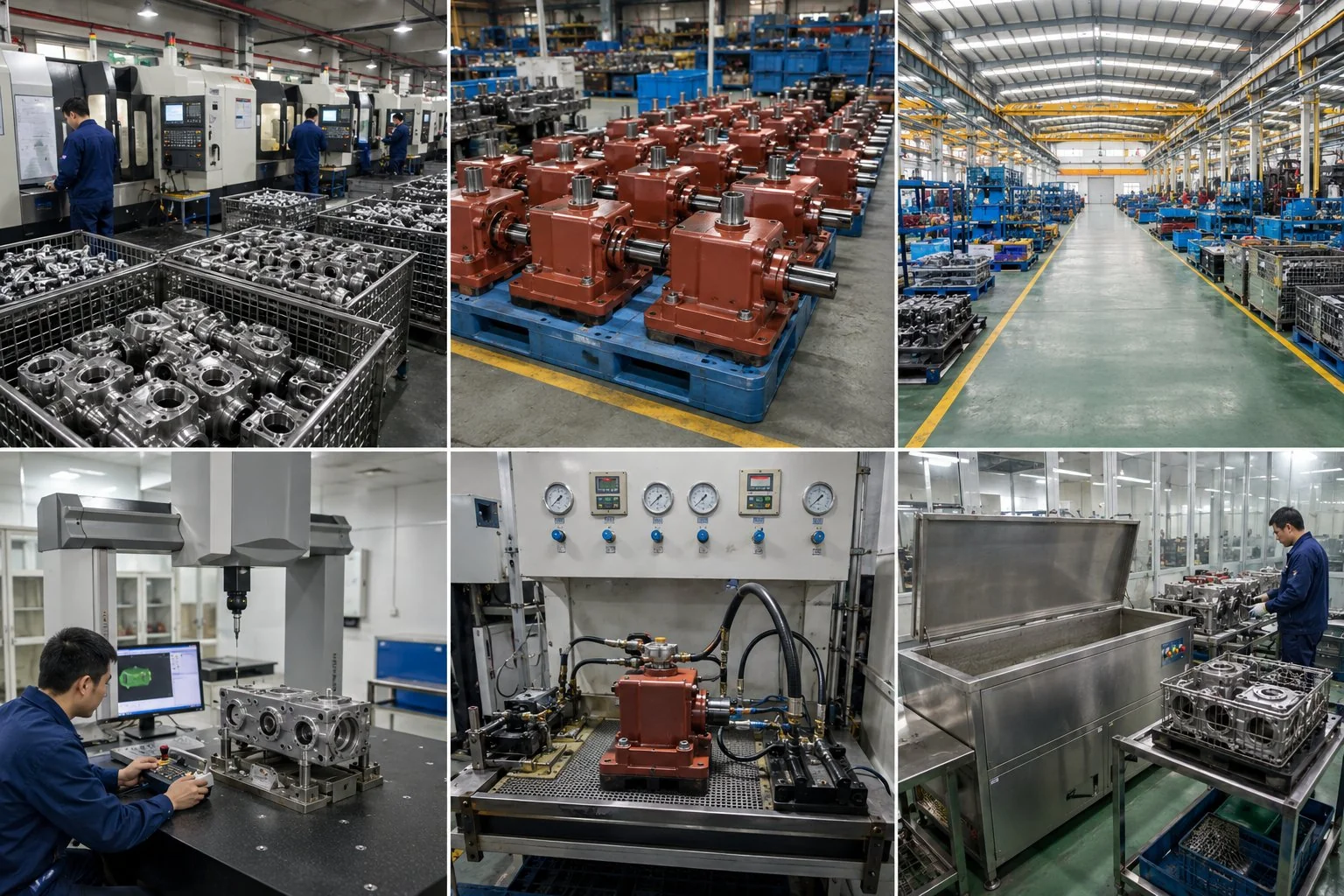
Load testing documentation — A quality manufacturer tests every snow plow gearbox under load before shipment, verifying noise level, vibration, temperature rise, and seal integrity. A responsible supplier like Ever-Power PTO Gearbox provides test documentation with each unit, confirming that the specific gearbox you receive — not just the design — meets its rated performance specifications.
Frequently Asked Questions
Ready to Find Your PTO Gearbox Solution?
From compact tractor PTO blowers to heavy-duty municipal rotary snow removal systems, agricultural gearbox solutions engineered for sub-zero performance — backed by 20+ years of manufacturing expertise and 100% factory load testing on every unit.
Editor: Cxm