Pneumatic Distribution: Why the Fan Gearbox Is the Heart of the Drill
Pneumatic seed drills use a high-speed centrifugal fan to generate the airstream that carries individual seeds from the metering mechanism through a network of distribution tubes to each row opener. The fan must produce sufficient air velocity (typically 25 to 40 m/s in the distribution tubes) to suspend the seed particles in the airstream and deliver them to the furthest row outlet with the same consistency as the nearest. This air velocity requirement dictates the fan speed — typically 3,000 to 5,500 RPM depending on the fan diameter, the number of distribution rows, the total tube length, and the seed weight characteristics of the crop being planted. A PTO gearbox speed increaser converts the tractor’s 540 RPM (or 1,000 RPM) PTO output to the required fan speed through a ratio of 1:5.5 to 1:10 — among the highest speed increase ratios in any agricultural gearbox application.
The fan speed must remain constant regardless of changes in the drill’s metering rate or the tractor’s ground speed. In a pneumatic drill, the metering mechanism is typically driven by a ground wheel (proportional to travel speed, ensuring seed rate per hectare remains constant as the tractor speeds up or slows down), while the fan is driven by the PTO (at constant speed, independent of ground speed). This fundamental separation of metering (ground-speed proportional) and distribution (constant fan speed) means the gearbox output must not vary with changing PTO load — a heavy seed flow through the metering system increases the aerodynamic load on the fan, which increases the torque demand on the gearbox, which can cause a marginal gearbox to slow down slightly under the increased load. That slight slowdown reduces air velocity, which reduces the distribution tube carrying capacity, which causes the heaviest seeds to drop out of the airstream before reaching the furthest rows — producing the classic planting deficiency known as “outer-row starving.”
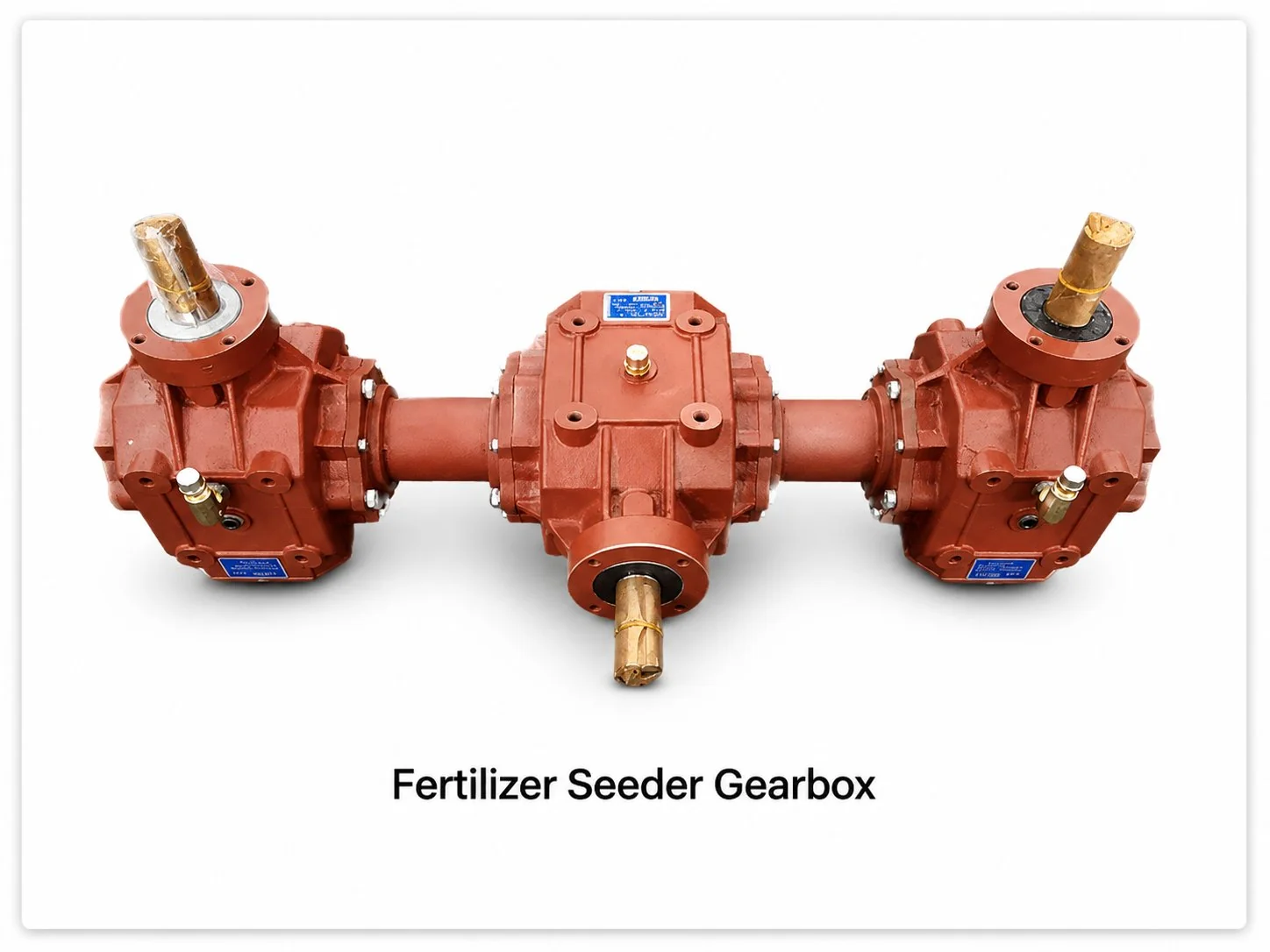
Two-Stage Gearbox Design: Achieving High Speed Ratios Reliably
A speed increase ratio of 1:7 or higher from a single bevel gear stage is impractical — the high-speed output pinion becomes so small that its teeth lack the root strength to transmit the required torque without fatigue cracking, and the tooth contact stress on the small pinion exceeds the surface hardness capacity of even case-carburised gear steel at moderate power levels. The practical maximum for a single-stage spiral bevel speed increaser is approximately 1:5 to 1:6, which covers only the lower end of the seed drill gearbox fan speed range. For fan speeds above 3,000 RPM from a 540 RPM PTO (ratios above 1:5.5), a two-stage gearbox is the engineering solution.
A two-stage seed drill gearbox combines a right-angle bevel first stage with a parallel-shaft helical second stage. The bevel stage converts horizontal PTO rotation to the vertical or angled fan shaft axis while providing a moderate speed increase of 1:2 to 1:3. The helical second stage provides the remaining multiplication of 1:2 to 1:3.5, resulting in a combined ratio of 1:4 to 1:10.5 — covering the full range of pneumatic drill fan speeds from a 540 RPM PTO input. Each individual stage operates within its comfortable ratio range (where gear tooth geometry, bearing loads, and efficiency are all optimised), and the cumulative efficiency of the two stages is 91 to 95 percent — modestly lower than a single-stage unit but still delivering over 90 percent of the PTO input power to the fan shaft.
From a 1,000 RPM PTO, the required total ratio drops to 1:3 to 1:5.5 — achievable in a single-stage bevel gearbox for the lower fan speeds and requiring only a moderate two-stage design for the highest speeds. This ratio reduction is a significant practical advantage of 1,000 RPM PTO operation for pneumatic drills: the gearbox is simpler, more efficient, and more compact — directly benefiting the manufacturer in packaging the gearbox within the drill’s space-constrained distribution head area. Manufacturers like Ever-Power PTO Gearbox offer both single-stage and two-stage configurations with matched ratios for the specific fan speed requirements of major drill brands, eliminating the trial-and-error of adapting a generic gearbox to a precision planting application.
Combined Seed-Fertiliser Drills: Multi-Function Gearbox Requirements
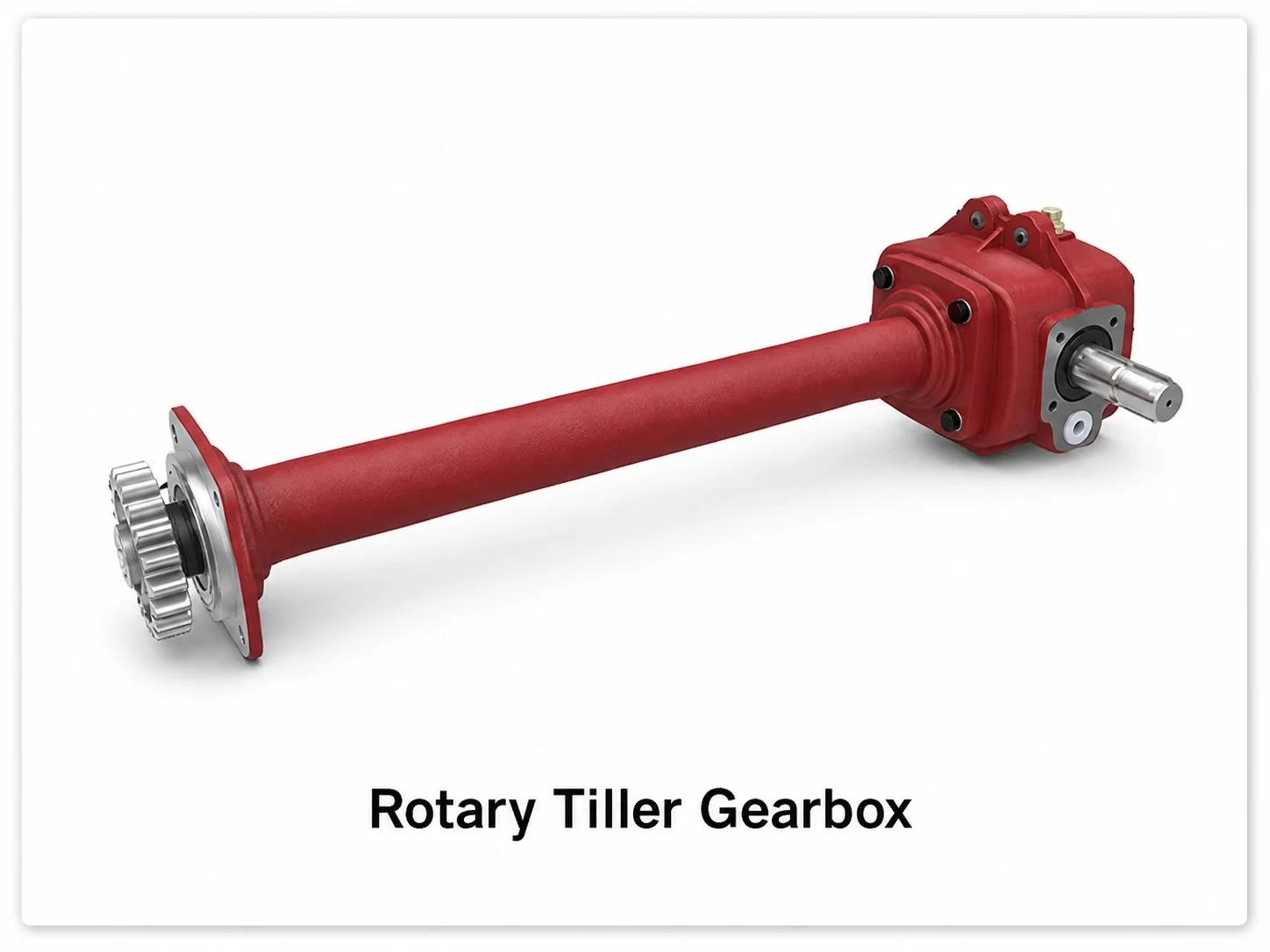
Combined drills that place seed and fertiliser simultaneously in separate rows or at separate depths are the most common configuration in modern arable farming. The PTO gearbox on a combined drill may need to drive two separate functions: the pneumatic fan (for seed and/or fertiliser distribution) and a fertiliser agitator or auger (to prevent granular fertiliser from bridging in the hopper above the metering mechanism). For understanding how seedbed preparation equipment interacts with the planting pass, see our engineering guide on rotary tiller gearbox applications and soil structure requirements.
Some combined drills use a single high-capacity fan to distribute both seed and fertiliser through separate tube networks, while others use two independent fans — one for seed (requiring precise distribution) and one for fertiliser (where ±10 percent distribution uniformity is acceptable). A dual-fan configuration may require two separate PTO gearbox outputs at different speeds, or a single gearbox output that drives both fans at the same speed through individual belt or chain drives. The gearbox power rating must account for the combined fan power demand plus the agitator power plus the drive train losses — typically 20 to 60 HP total for a 3 to 6 metre combined drill, with 70 to 80 percent of the power consumed by the fan(s) and the remainder by the agitator and friction losses.
Fan Speed Stability and Row-to-Row Planting Uniformity
The air velocity in each distribution tube determines whether seeds reach the row opener at full count or whether some seeds drop out of the airstream prematurely. On a wide drill (4 to 6 metres with 24 to 48 row outlets), the outermost tube runs are 2 to 3 times longer than the innermost runs, creating higher aerodynamic resistance on the outer channels. The fan must produce enough total airflow to overcome the resistance of the longest tube run — and because the tubes share a common distribution head, the airflow in shorter tubes must be controlled by individual flow restrictors or calibrated tube diameters to prevent the shorter tubes from stealing airflow from the longer ones.
A 5 percent drop in fan speed reduces air velocity by 5 percent (fan laws: airflow proportional to speed), which reduces the dynamic pressure in the distribution tubes by approximately 10 percent (pressure proportional to speed squared). This 10 percent pressure drop may be sufficient for the innermost tubes (short runs, low resistance) to continue delivering seeds at full count while the outermost tubes (long runs, high resistance) fall below the minimum velocity needed to suspend and carry the seed particles — producing a field emergence pattern where the inner rows are fully populated but the outer rows show progressive thinning toward the edges of the drill. This failure mode is invisible at planting time and only becomes apparent 7 to 14 days later when the crop emerges unevenly — by which point the planting window has closed and no corrective action is possible.
Preventing this failure requires a gearbox that maintains fan speed within ±2 percent of nominal under all operating conditions — load variation (changing seed flow rate), temperature variation (cold morning start to hot afternoon operation), and PTO speed variation (tractor governor droop under changing draft load from the coulter assembly). An agricultural gearbox specified for seed drill fan drive should exhibit less than 1 percent speed droop from no-load to full-load conditions — a specification that demands low-backlash gears, properly preloaded bearings, and high mesh efficiency so that increasing fan load produces minimal speed reduction at the gearbox output.
High-Speed Output Bearings: The Life-Limiting Component
The output shaft bearings on a seed drill fan gearbox operate at the highest sustained speed of any bearing position in mainstream agricultural gearbox applications. A fan running at 4,500 RPM accumulates 270,000 inner-ring revolutions per hour — compared to 32,400 for a standard 540 RPM PTO gearbox output. This 8× speed multiplication accelerates bearing fatigue accumulation proportionally: a bearing with a calculated L10 life of 20,000 hours at 540 RPM reaches the same fatigue damage in approximately 2,500 hours at 4,500 RPM (bearing life is inversely proportional to speed at constant load, per ISO 281). A seed drill gearbox running 400 hours per planting season will reach the bearing’s 50-percent-probability fatigue threshold in 6 to 7 seasons — far shorter than the 20+ year service life that operators expect from a quality agricultural gearbox.
The bearing selection must therefore prioritise fatigue life at high speed over static load capacity. Deep-groove ball bearings (rather than the tapered roller bearings common in low-speed agricultural gearboxes) are the preferred choice for the high-speed output position because they generate less friction heat at speed, tolerate higher rotational velocity without cage instability, and achieve better L10 life under the predominantly radial loads of a fan shaft. The bearing must be specified with C3 or C4 internal clearance (larger than normal) to accommodate the thermal expansion of the inner ring at elevated operating temperature — a bearing installed with standard clearance may develop excessive preload as it heats up during sustained high-speed operation, accelerating wear and reducing the effective fatigue life by 30 to 50 percent.
Lubrication for the high-speed output bearing is critical. At 4,500 RPM, the bearing generates more heat per unit of lubricant contact than it would at 540 RPM, and the oil film between the rolling elements and the raceway must be maintained at the reduced viscosity that corresponds to the elevated bearing temperature. Synthetic gear oil (PAO-based ISO VG 150 or 220) provides the thermal stability and viscosity retention needed for reliable film formation at the temperatures typical of high-speed seed drill gearbox output bearings — 60 to 90 degrees Celsius during sustained planting operation in warm ambient conditions.

Planting-Season Maintenance and Pre-Season Preparation
The planting window is typically the most time-critical period in the entire cropping calendar — every day of delay after the optimal planting date reduces potential yield by 0.5 to 2 percent depending on the crop and region. A gearbox failure during this window costs not only the repair time but the irreplaceable planting days lost while the machine sits idle. Pre-season preparation should include an oil change (fresh oil with full additive strength for the most demanding period), bearing play verification (rotate the output shaft by hand to check for roughness or play), PTO shaft U-joint greasing and wear check, and fan speed verification using a tachometer to confirm that the actual fan speed matches the drill manufacturer’s specification within ±2 percent.
During the planting season, daily maintenance is limited to a visual oil level check and a brief listening assessment during the first minutes of operation each day. Seed treatment chemicals (fungicide and insecticide coatings on treated seed) produce fine dust that settles on the gearbox housing and can be corrosive to standard paint finishes. Clean the gearbox exterior weekly during planting to prevent chemical dust buildup that traps moisture and initiates corrosion. The high-speed output bearings on a seed drill fan gearbox experience more stress cycles per operating hour than almost any other agricultural gearbox bearing — a fan running at 4,500 RPM accumulates 270,000 revolutions per hour, compared to 32,400 for a 540 RPM PTO gearbox output. This accelerated cycle count means that bearing fatigue life is reached in fewer calendar hours of operation, making bearing condition monitoring (listen for noise changes, feel for vibration at the housing) a higher priority during planting than during any other season.
Frequently Asked Questions
Optimize Your Planting Drive System
From compact grain drills to wide-span air seeders — our two-stage speed increaser gearboxes deliver the precise, stable fan speed that pneumatic distribution demands. Pre-season orders receive priority manufacturing to ensure your gearbox is installed and tested before the first planting day.
Editor: Cxm