Three Bearing Types for PTO Gearbox Applications
Agricultural PTO gearboxes use three principal bearing types, each with distinct load-carrying characteristics that suit different positions and loading conditions within the gearbox. Understanding which bearing type belongs where — and why — is essential for both specifying new gearboxes and diagnosing bearing failures in service.
Tapered roller bearings are the dominant choice for bevel gear positions in agricultural PTO gearboxes. Their geometry — conical rollers arranged between inner and outer raceways at an angle to the shaft axis — allows them to carry both radial loads (perpendicular to the shaft) and axial thrust loads (along the shaft axis) simultaneously. This dual-load capability is essential for spiral bevel gears, which generate significant axial thrust forces during power transmission. Tapered roller bearings are always installed in pairs (face-to-face or back-to-back arrangement) with controlled preload — the slight axial compression that eliminates internal clearance and ensures that both bearings share the load predictably.
Deep groove ball bearings are the simplest and most cost-effective bearing type. They carry primarily radial loads with limited axial load capability (typically 25 to 35 percent of their radial rating). In PTO gearboxes, deep groove ball bearings are used for lightly loaded positions — pilot bearings, idler shaft supports, and input shaft positions where the gear geometry produces minimal axial thrust. Their low friction coefficient and high-speed capability make them suitable for high-RPM positions, but their limited axial load capacity makes them unsuitable for spiral bevel gear positions where thrust forces are significant.
Angular contact ball bearings occupy the middle ground between tapered rollers and deep groove bearings. They carry combined radial and axial loads (like tapered rollers) but with lower friction and better high-speed performance. Like tapered rollers, they are installed in pairs with preload. Angular contact bearings are used in some premium PTO gearboxes for positions where moderate axial loads exist but the full load capacity of tapered rollers is not needed — offering a performance-to-cost balance between the other two types.
Bearing Type Comparison for Agricultural Gearbox Applications
| Parameter | Tapered Roller | Deep Groove Ball | Angular Contact Ball |
|---|---|---|---|
| Radial load capacity | Very high | Moderate | Moderate-high |
| Axial load capacity | High (single direction per bearing) | Limited (25–35% of radial) | Moderate-high |
| Impact/shock tolerance | Excellent (line contact) | Limited (point contact) | Good |
| Friction coefficient | Moderate (0.0018) | Low (0.0015) | Low (0.0012) |
| Speed capability | Moderate | High | High |
| Preload required | Yes (paired installation) | No | Yes (paired installation) |
| Best PTO gearbox position | Bevel gear shafts (pinion, ring gear) | Input shaft, idler shafts | Output shafts with moderate thrust |
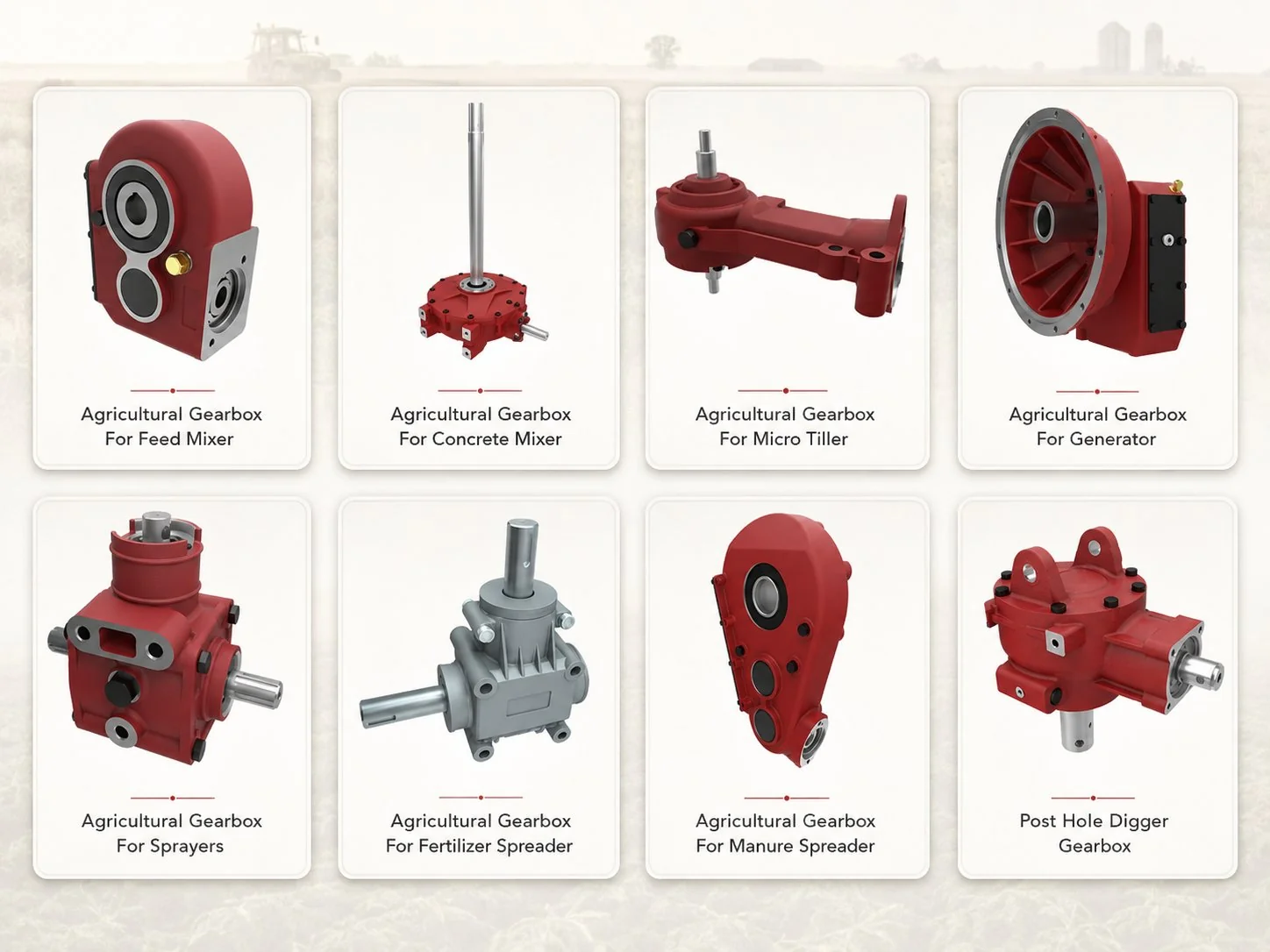
PTO gearbox configurations — each bearing position must be matched to the specific load type (radial, axial, combined) generated by the gear arrangement at that location
L10 Bearing Life Calculation: What the Numbers Mean
Bearing life is expressed as L10 life — the number of operating hours at which 90% of a population of identical bearings under identical conditions will still be functioning. It is a statistical prediction, not a guarantee for any individual bearing. The basic L10 calculation uses the bearing’s dynamic load rating (C), the actual applied load (P), and the speed to estimate the expected life in hours.
Basic L10 Life Formula
L10 = (C/P)^p × 10^6 / (60 × n)
C = dynamic load rating (kN) | P = equivalent dynamic load (kN)
n = speed (RPM) | p = 3 for ball bearings, 10/3 for roller bearings
For a typical medium-duty PTO gearbox operating at 540 RPM input with a properly selected tapered roller bearing on the pinion shaft, a well-designed bearing arrangement achieves an L10 life of 5,000 to 10,000 hours — adequate for 10 to 20 years of agricultural service at 500 hours per year. However, the actual bearing life in the field depends critically on conditions that the basic L10 formula does not account for: contamination (dust and water ingress), lubrication quality (oil viscosity, cleanliness, and change interval), mounting accuracy (bearing preload and housing bore tolerances), and impact loading (shock loads from implement strikes that exceed the calculated steady-state load by 2 to 5 times).
The adjusted L10a life calculation incorporates modification factors for reliability level, lubrication conditions, and contamination. In typical agricultural PTO gearbox conditions (moderate contamination, mineral gear oil, field vibration), the adjusted L10a life may be only 30 to 50 percent of the basic L10 calculation. This real-world derating explains why bearing quality matters so much — a tier-one bearing with tighter internal tolerances and cleaner steel achieves a higher percentage of its calculated L10 life under adverse conditions than a commodity bearing with wider tolerances and more steel inclusions. For comprehensive guidance on recognizing the early signs of bearing distress before they cause catastrophic gearbox failure, see our technical guide on PTO gearbox failure analysis.
Bearing Preload: The Critical Adjustment Most Rebuilders Get Wrong
Tapered roller bearings in a bevel gearbox must be installed with a specific axial preload — a slight compressive force that eliminates internal clearance and ensures both bearings in a pair share the load. Too little preload (loose bearings) allows axial play that lets the gear mesh pattern shift under load, causing concentrated tooth loading, increased noise, and accelerated wear on both gears and bearings. Too much preload (overtightened bearings) creates excessive friction heat, reduces bearing life by overloading the rollers, and can cause bearing seizure during the thermal expansion that occurs as the gearbox warms to operating temperature.
🔧 Proper Preload Verification
Measure bearing preload by the rolling torque method: with the gears removed, rotate the shaft by hand and measure the torque required to maintain rotation with a beam-type torque wrench. For most agricultural gearbox pinion shafts, the target rolling torque is 1 to 3 Nm for new bearings — just enough resistance to feel when turning by hand, but not enough to prevent smooth continuous rotation. Consult the gearbox manufacturer’s specification for the exact preload value for each bearing position.
The preload adjustment mechanism varies by gearbox design. Most agricultural PTO gearboxes use shim packs between the bearing outer race and the housing bore shoulder — adding shims reduces preload (increases clearance) while removing shims increases preload. Some designs use a threaded adjustment nut on the shaft that compresses the bearing inner race to set preload. In either case, the preload must be set with the bearings and housing at ambient temperature — thermal expansion during operation increases preload by a predictable amount that the manufacturer accounts for in their specification.
Sealed vs. Open Bearings: When to Choose Each
Open bearings rely on the gearbox oil bath for lubrication and depend on the housing seals to exclude contaminants. They are the standard choice for gear positions inside oil-filled gearbox housings because the gear oil provides both lubrication and cooling — there is no benefit to using a sealed bearing inside an oil bath, and the sealed bearing’s integrated seals actually restrict oil flow to the rolling elements.
Sealed (or shielded) bearings contain their own grease supply and are protected by integrated contact seals or non-contact shields. They are used in positions outside the main oil bath — external pillow block bearings supporting through-shafts, blade spindle bearings exposed to the environment, and accessory shaft positions where oil splash from the gear train does not reach the bearing. Sealed bearings in exposed positions should be re-greaseable (fitted with a grease nipple) for periodic lubrication replenishment, or specified as sealed-for-life if the design life matches or exceeds the expected bearing life under the application conditions.
Quality PTO gearbox manufacturers specify the correct bearing type, grade, and lubrication method for each position in the gearbox and document these specifications in the assembly drawing. Contact our engineering team for bearing specifications on any gearbox model. For integrated PTO shaft and agricultural gearbox packages with matched bearing specifications throughout the driveline, our engineering team ensures consistent bearing quality from the tractor PTO stub through the gearbox to the implement output.

Bearing Failure Mode Recognition: Reading the Damage
Every bearing failure tells a story about what went wrong, and reading the damage pattern on the failed bearing identifies the root cause so it can be corrected before the replacement bearing suffers the same fate. Four primary failure modes account for over 90 percent of bearing failures in agricultural gearboxes, each with a distinct visual signature.
Fatigue spalling appears as small pits or flakes on the raceway surface, typically starting at subsurface inclusions in the bearing steel and progressing to visible surface damage as material detaches. Spalling is the normal end-of-life failure mode for a correctly specified and properly maintained bearing — it indicates that the bearing reached its calculated fatigue limit. If spalling occurs well before the expected L10 life, the most likely causes are overloading (application exceeds the bearing’s dynamic load rating), contamination (abrasive particles accelerated the subsurface stress damage), or poor steel quality (excess non-metallic inclusions acted as premature fatigue initiation sites).
Brinelling appears as evenly spaced indentations in the raceway corresponding to the roller or ball spacing. It is caused by impact loading while the bearing is stationary or oscillating — the rolling elements are driven into the raceway surface by the shock force, leaving permanent dents that generate noise and vibration during subsequent rotation. In agricultural gearboxes, brinelling typically results from implement impact events (rock strikes, frozen-material encounters) that transmit severe shock loads through the gear train to the bearings. Upgrading to heavier-duty bearings with higher static load ratings is the engineering solution for applications with frequent impact events.
Adhesive wear (also called smearing or scuffing) appears as rough, torn-looking patches on the raceway or roller surfaces. It occurs when the lubricant film breaks down under extreme pressure or high temperature, allowing metal-to-metal contact between the rolling elements and raceways. Causes include insufficient oil level (the most common), wrong oil viscosity (too thin for the operating temperature), or prolonged operation at high temperature without adequate cooling. Adhesive wear progresses rapidly once initiated because the damaged surface generates heat and debris that accelerate further damage.
Corrosion etching appears as reddish-brown discoloration and shallow pitting on the raceway surface. It results from water contamination of the gear oil — even 0.1 percent water content can initiate etching on bearing steel surfaces. In agricultural environments, water enters gearboxes through worn shaft seals during pressure washing, rain exposure, and condensation from temperature cycling (the gearbox heats during operation and cools overnight, drawing moist air through the breather as the oil volume contracts). Preventing corrosion etching requires maintaining effective shaft seals, using sealed or desiccant breathers, and changing oil regularly to remove accumulated water before it reaches damaging concentrations.
Contamination Protection: The Biggest Threat to Bearing Life
Contamination — both particulate (dust, dirt, metal wear debris) and moisture (water from condensation, rain, or pressure washing) — is the single largest cause of premature bearing failure in agricultural gearboxes. Studies by major bearing manufacturers consistently show that 50 to 70 percent of agricultural bearing failures are contamination-related, not load-related. A bearing that would achieve 10,000 hours in a clean laboratory environment may fail in 2,000 hours in a typical agricultural gearbox with moderate contamination levels — and in as few as 500 hours in a severely contaminated gearbox operating in dusty or wet conditions without adequate sealing.
The contamination control strategy for PTO gearbox bearings operates at three levels: exclusion (preventing contaminants from entering the gearbox through effective shaft seals, housing gaskets, and sealed breather valves), removal (changing the oil regularly to remove contaminants that penetrate the seals — every 200 to 500 hours depending on the operating environment), and monitoring (periodic oil sample analysis to measure particle count, water content, and wear metal concentrations, allowing early detection of seal deterioration or abnormal internal wear before bearing damage becomes catastrophic). For any agricultural gearbox operating more than 200 hours per year, implementing all three levels of contamination control is the most cost-effective maintenance investment available — extending bearing life by 2 to 5 times compared to a neglected unit.
Frequently Asked Questions
From Prototype to Production — Talk to Us
Every gearbox we manufacture uses tier-one bearings with documented specifications, precision preload adjustment, and factory verification testing. From standard catalog models to custom OEM designs, our bearing selection and installation practices ensure maximum service life under agricultural operating conditions.