What Is a Post Hole Digger Gearbox?
에이 기둥 구멍 파는 기계 기어박스 is a right-angle PTO-driven speed-reducing gear unit that converts horizontal tractor PTO rotation (540 RPM) into the slow, high-torque vertical rotation (150 to 220 RPM) needed to drill earth augers into the ground. The gearbox is the mechanical heart of the digger — it must multiply the PTO torque by 2.5 to 3.6 times while redirecting the power axis by 90 degrees from horizontal to vertical, and this 토공 드릴 기어박스 must survive the most unpredictable loading profile in any PTO-driven implement: the instantaneous stall events that occur when the auger hits buried rock, dense clay pockets, or tangled root masses.
Post hole diggers are used across agriculture (fencing, vineyard trellis installation), forestry (tree planting), construction (foundation piers, sign posts), and landscaping (deck footings, utility pole bases). In each application, the 기둥 구멍 파는 기계 기어박스 must deliver reliable drilling performance in soil conditions that vary from soft loam (requiring minimal torque) to dense gravel-laden clay (demanding sustained maximum torque) — often within the same drilling site as the auger encounters different soil strata. This loading variability, combined with the ever-present risk of instantaneous stall from hitting an immovable obstruction, makes the auger gearbox one of the most demanding applications in the agricultural gearbox family.
How the Auger Drive System Works
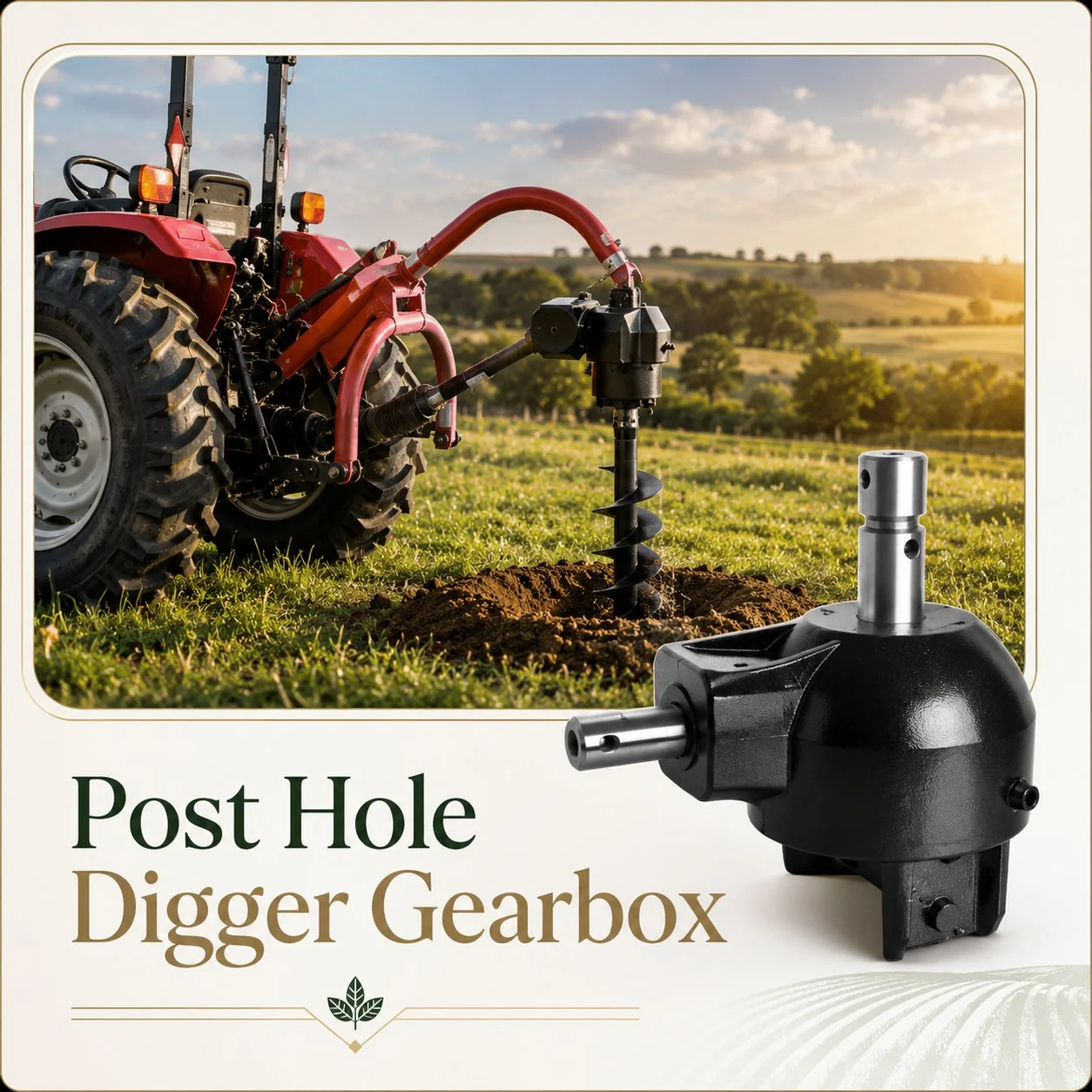
트랙터 유급 휴가 drives the gearbox input shaft at 540 RPM through a driveline equipped with a slip clutch or shear bolt for overload protection. Inside the gearbox, a right-angle spiral bevel gear pair redirects the rotation 90 degrees and simultaneously reduces the speed by the post hole digger gearbox ratio — typically 1:2.5 to 1:3.6, producing an output speed of 150 to 220 RPM. The vertical output shaft connects to the earth auger through a quick-attach hex or round coupling (commonly 2 inch or 2-9/16 inch hex) that allows rapid auger changes for different hole diameters.
The torque multiplication from the speed reduction is substantial. At 1:3 ratio, a 30 HP tractor delivering 398 Nm at the 540 RPM PTO produces approximately 1,100 Nm at the auger output (accounting for 92 percent gearbox efficiency) — nearly three times the input torque. This multiplied torque is what enables a relatively small tractor to drill 150 to 300 mm diameter holes through compacted clay and gravel to depths of 600 to 1,200 mm. The auger drive gearbox torque must be sufficient to maintain auger rotation under the maximum soil resistance expected in the intended application without stalling the tractor engine.

Right-angle bevel gearbox for post hole digger and earth auger applications
Stall Loading: The Defining Engineering Challenge
Unlike mowers, balers, and tillers where the load varies but the output never fully stops rotating, a 기둥 구멍 파는 기계 기어박스 regularly experiences full stall — the auger hits an immovable rock or root mass and the output shaft stops completely while the PTO continues driving the input. In the fraction of a second between the auger stalling and the slip clutch releasing (or the operator disengaging the PTO), the full tractor engine torque is concentrated at the bevel gear mesh and the output bearing — producing an instantaneous overload that can reach 5 to 8 times the continuous rated torque.
During a stall, the rotating energy stored in the PTO driveline, flywheel, and tractor engine (a substantial kinetic energy reservoir at 540 RPM) must be absorbed by either the slip clutch (converting kinetic energy to heat through friction) or the gear mesh and bearings (converting kinetic energy to mechanical stress through deformation). If the slip clutch fails to release — because it is set too tight, has glazed from previous events, or is absent — the full stall energy passes through the 기둥 구멍 파는 기계 기어박스, and tooth fracture, bearing brinelling, or housing cracking can occur within a single event.
The gear and bearing design for a 기둥 구멍 파는 기계 기어박스 must accommodate not just the continuous drilling torque but also these repeated stall events. Case-carburised spiral bevel gears with surface hardness of 58 to 62 HRC and core hardness of 30 to 38 HRC provide the combination of surface wear resistance and core toughness needed to survive stall-level loading without tooth fracture. The gear module is typically 5 to 7 mm — heavy enough to provide the tooth root cross-section that resists the bending stress from a full stall event. Tapered roller bearings at the output position are preloaded to handle the combined radial load from gear mesh forces and the axial thrust from the auger drilling action — a sustained downward force of 5,000 to 15,000 N that standard radial bearings cannot accommodate.
Soil Types and Gearbox Loading Demands
For operations that routinely drill in rocky or frozen ground, a heavy-duty post hole digger gearbox with higher torque capacity, larger gear module, and reinforced housing is essential. Standard-duty gearboxes designed for loam and clay will not survive the sustained high-torque and frequent stall loading of rocky conditions — the result is progressive gear tooth fatigue cracking that leads to tooth breakout and catastrophic failure, typically within one to three seasons of heavy-duty use in conditions that exceed the design rating.

Technical Specifications at a Glance
Overload Protection: Slip Clutch and Shear Bolt Systems
Overload protection is not optional for a 기둥 구멍 파는 기계 기어박스 — it is the most critical safety and equipment-protection feature in the entire auger drive system. Two protection systems are used, either independently or in combination. A slip clutch on the PTO 구동계 provides continuous, self-resetting protection: when the auger torque exceeds the clutch calibration (typically 1.5 to 2.0 times rated continuous torque), the clutch plates slip — converting the excess energy to heat and preventing the overload from reaching the gearbox. The operator hears the clutch slipping (a distinctive chattering noise), reverses the auger to clear the obstruction, and resumes drilling without any parts replacement.
Self-resetting — no parts replacement needed. Continuous protection at calibrated torque level. Requires periodic calibration checks (torque can drift from heat cycling). Higher initial cost. Preferred for commercial operations with high daily hole count.
Sacrificial — bolt must be replaced after each overload event (2 to 5 minutes). Precise, repeatable release torque (each bolt is a fresh calibration). Lower initial cost. Requires carrying spare bolts. Suited to lighter-duty or infrequent use.
PTO Driveline and Mounting Considerations
Post hole diggers are mounted on the tractor three-point hitch and the PTO 기어박스 moves vertically as the hitch raises and lowers the digger into and out of the drilling position. This vertical travel produces continuously varying driveline angles — from near-horizontal when the digger is raised for transport to steeply angled when the auger is fully engaged in the ground. The PTO driveline must accommodate this full angular range (typically 15 to 35 degrees of total travel) without excessive U-joint speed pulsation, binding, or separation of the telescoping spline tube.
Series 4 PTO drivelines are adequate for standard post hole diggers (15 to 35 HP). For heavy-duty post hole digger gearbox applications (40 to 75 HP) used in rocky or frozen ground, Series 6 drivelines provide the higher bearing capacity needed for the frequent stall events and elevated continuous torque levels. The driveline must include a safety shield covering all rotating components — PTO shaft entanglement is a serious injury hazard, and the three-point hitch mounting puts the operator in close proximity to the driveline during drilling operations. Wide-angle U-joints or constant-velocity joints are recommended for applications where the driveline angle exceeds 25 degrees at any point in the hitch travel range.
Auger Size Selection and Gearbox Power Matching
The auger diameter directly determines the torque demand on the 기둥 구멍 파는 기계 기어박스. A 150 mm (6 inch) auger in clay requires approximately 40 to 60 percent of the gearbox continuous torque rating; a 300 mm (12 inch) auger in the same soil demands 80 to 100 percent of the rating — because the drilling torque increases roughly with the cube of the auger diameter (doubling the diameter increases the torque by approximately 8 times). Operators who plan to use multiple auger sizes must match the gearbox and tractor power to the largest auger they intend to use, not the most frequently used size.
Common auger diameters for agricultural fencing are 150 mm (6 inch) and 200 mm (8 inch), requiring 15 to 35 HP depending on soil type. Tree planting augers are typically 200 to 300 mm (8 to 12 inch), requiring 25 to 55 HP. Construction pier augers can reach 450 mm (18 inch) or larger, demanding 50 to 75+ HP and a heavy-duty auger gearbox with reinforced housing and oversized bearings. Drilling depth also matters: deeper holes (over 900 mm) require the auger to lift a heavier column of spoil up the auger flights, progressively increasing the torque demand as depth increases. The maximum practical depth for a standard post hole digger is typically 1,200 mm — deeper drilling requires specialised extension shafts and higher-capacity gearboxes to handle the increased torque from the longer spoil column and greater soil sidewall friction.
Post Hole Digger Gearbox Oil and Lubrication
The standard post hole digger gearbox oil specification is EP gear oil SAE 80W-90 (ISO VG 220 equivalent) — the same multi-purpose specification used across most right-angle 농업용 기어박스 applications. Oil capacity is typically 0.8 to 2.0 litres. The intermittent operating pattern of post hole digging (short drilling bursts of 30 to 120 seconds per hole, separated by repositioning intervals) means the oil temperature rarely reaches the sustained elevated levels seen in continuous-duty gearboxes — typically peaking at 50 to 70 degrees Celsius during an intensive drilling session of 50 to 100 holes.
Oil change intervals for post hole digger gearboxes follow the manufacturer standard of 500 hours — but because the intermittent duty cycle accumulates hours slowly (a typical fencing operation drills 50 to 100 holes per day at 1 to 2 minutes each, accumulating only 1 to 3 gearbox operating hours per day), the annual calendar-based change is usually the binding constraint rather than the hour-based interval. Change the oil at the start of each drilling season regardless of accumulated hours, because condensation moisture from seasonal storage degrades the oil even without operational use. The initial fill should be changed after 50 hours of operation to remove break-in wear particles from the new gear surfaces.
Maintenance Schedule
Oil level check. Visual inspection for leaks. Verify auger coupling is secure and undamaged. Check slip clutch operation (manually test before first hole). Ensure PTO driveline safety shield is in place and intact. Carry spare shear bolts if applicable.
Full oil change with fresh EP 80W-90. PTO driveline U-joint greasing and wear inspection. Output bearing rotation check — spin output shaft by hand, feel for roughness. Inspect output seal for soil contamination. Slip clutch calibration verification.
Clean exterior — remove all soil and debris. Top up oil to maximum level. Apply grease to output shaft hex coupling and any exposed metal surfaces. Store vertically (output down) under cover to prevent moisture accumulation in the housing.
Aftermarket Post Hole Digger Gearbox Replacement
Post hole digger gearbox replacement is driven primarily by bearing fatigue from accumulated stall events and seal degradation from soil and moisture exposure. A well-maintained standard-duty gearbox in loam or clay soil typically lasts 5 to 15 years (depending on annual hole count and stall frequency). Heavy-duty gearboxes in rocky ground may need replacement in 3 to 8 years. Cross-reference parameters include the input shaft spline profile (6-spline 1-3/8 inch is standard), the output coupling type and size (hex or round, 2 inch or 2-9/16 inch), the mounting bolt pattern, the gear ratio, and the power rating.
Our engineering team maintains cross-reference data for major post hole digger brands and can supply dimensionally compatible aftermarket replacements. Both complete gearbox assemblies and individual bearing/seal kits are available for operators who prefer to rebuild rather than replace the complete unit. Contact us with your digger model and intended soil conditions — our auger gearbox selection service ensures accurate specification matching and correct gearbox selection for your soil conditions.
자주 묻는 질문
Drill Deeper, Drill Stronger
From farm fencing in sandy loam to construction piling in frozen gravel — our post hole digger gearboxes deliver the stall-proof torque multiplication that reliable earth drilling demands.
편집자: Cxm