What Is a Baler Gearbox?
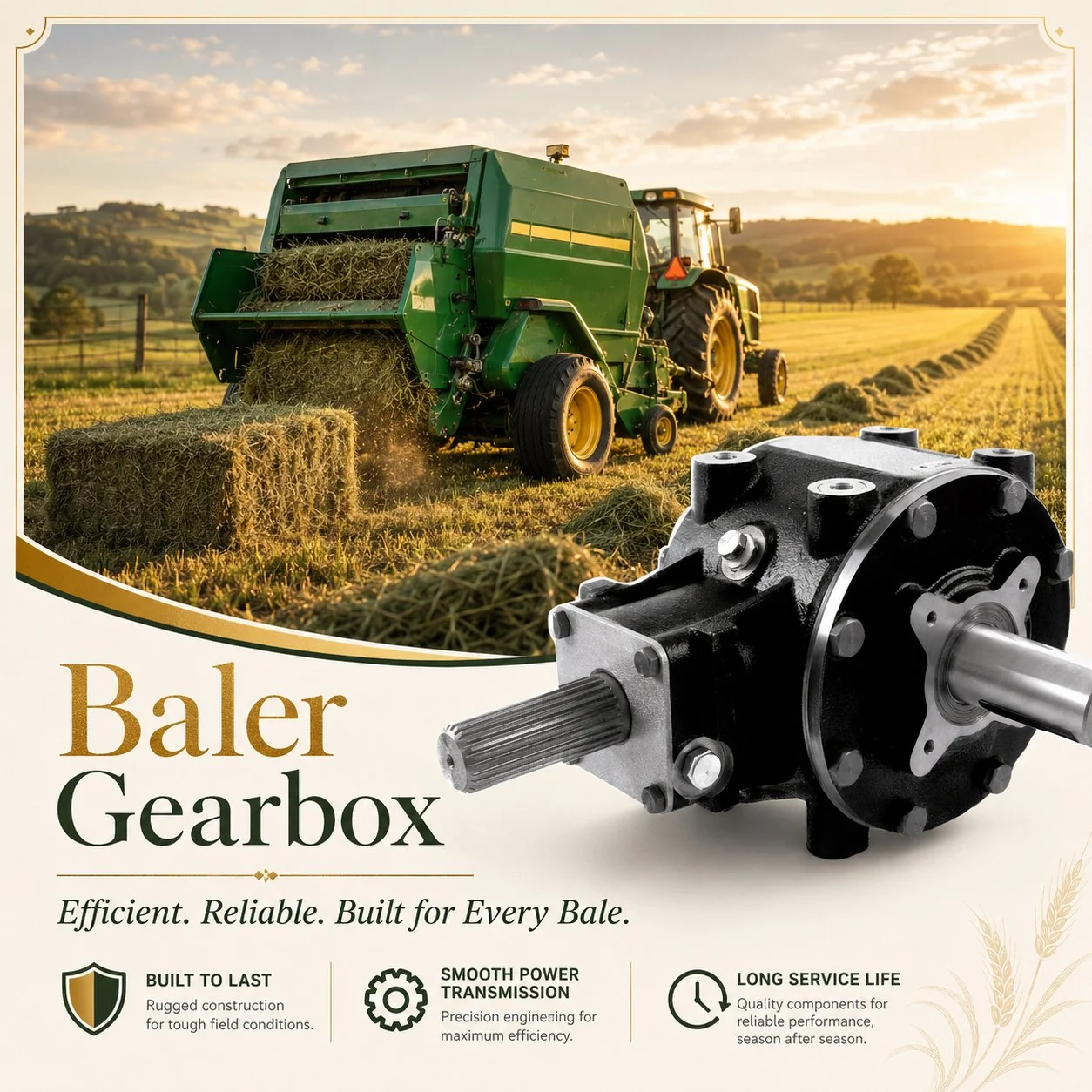
A baler gearbox is the right-angle PTO-driven gear unit that converts horizontal tractor PTO rotation into the specific output speed and torque required by the baling mechanism. Every baler — whether it produces small rectangular bales, large rectangular bales, or round cylindrical bales — depends on a gearbox to redistribute PTO power among the pickup, compression, and tying systems that together form a finished, tied bale ready for handling and storage.
Unlike most agricultural gearboxes that operate under constant or near-constant torque, the baler gearbox experiences a distinctly cyclic loading pattern: torque rises and falls with every bale formation cycle (45 to 120 seconds in a round baler, every plunger stroke in a square baler). This cyclic characteristic drives every engineering decision — from gear tooth hardness and bearing preload to housing stiffness and lubrication viscosity. Understanding how different baler types load their gearboxes is essential for correct specification, reliable operation, and cost-effective baler gearbox replacement.
Round Baler Gearbox: Belt Drive and Progressive Loading
A 丸型ベーラー用ギアボックス drives three simultaneous functions from a single 540 RPM PTO input. First, the pickup mechanism (300 to 500 RPM) lifts the mown windrow from the ground and feeds it into the bale chamber. Second, the belt or roller assembly (200 to 400 RPM) rotates the growing bale, progressively compressing it as more crop is added. Third, the net-wrap or twine-tying mechanism secures the finished bale before the tailgate opens and the completed bale rolls out.
The main gearbox is a right-angle spiral bevel unit operating at 1:1 to 1:1.5 round baler gearbox ratio. Chain-driven or gear-driven secondary take-offs distribute power from the main gearbox output to each subsystem. The progressive loading profile — torque rises from approximately 40 percent of rated at the start of each bale cycle to 100 percent at full bale diameter (1.2 to 1.8 metres) — creates a rising-wave fatigue pattern that repeats every 45 to 120 seconds depending on crop density and forward speed.

Round baler gearbox — right-angle bevel drive for belt, roller, and pickup mechanism
Square Baler Gearbox: Flywheel Plunger and Knotter Timing
A square baler gearbox faces fundamentally different loading from its round-baler counterpart. The plunger — a heavy steel plate that reciprocates inside the bale chamber — compresses each charge of crop against the previously compressed material at 40 to 80 strokes per minute (small square balers producing 14 to 22 kg bales) or 80 to 120 strokes per minute (large square balers producing 200 to 500 kg bales). Each compression stroke demands 3 to 5 times the continuous PTO torque in a pulse lasting only 30 to 50 percent of each crankshaft revolution — a peak that would stall most tractors without the energy-smoothing effect of the square baler flywheel gearbox.
The flywheel (100 to 300 kg mass, 600 to 1,000 mm diameter) stores kinetic energy during the unloaded return stroke and releases it during the compression phase. This energy-storage cycle reduces the peak-to-average torque ratio at the PTO input from 3 to 5× down to approximately 1.3 to 1.5:1 — within the tractor governor droop recovery range. Without this flywheel, the instantaneous torque spike would exceed the PTO clutch capacity and stall the engine on every compression stroke.
の knotter timing gearbox drive is equally critical. The knotter mechanism — the precision cam-driven device that ties twine around each completed bale — must fire at exactly the correct point in the bale-length cycle. A timing error of more than 2 to 3 degrees of crankshaft rotation produces mis-ties: loose or broken knots that cause bales to fall apart during handling, transport, and storage. This is the most common and costly field failure in baling. The gearbox-to-knotter drive train must maintain less than 0.5 degrees of backlash at the knotter cam throughout the service life of the machine — demanding low-backlash gears, properly preloaded bearings, and rigid housing construction.
Round vs. Square Baler Gearbox: Engineering Comparison
Gear Tooth and Bearing Design for Cyclic Baling Loads
The defining engineering challenge for any baler gearbox is that the torque demand varies continuously through each bale cycle rather than remaining constant. In round balers, progressive torque increase during bale growth produces a rising-load fatigue profile. In square balers, plunger reciprocation produces high-frequency torque pulses — 40 to 120 per minute — that accelerate bearing race fatigue through accumulated impact micro-damage. Standard gear fatigue calculations based on constant-amplitude loading significantly overestimate actual service life under these cyclic conditions unless a proper Miner cumulative-damage analysis is applied.
Case-carburised spiral bevel gears with surface hardness of 58 to 62 HRC provide the wear resistance required at each torque reversal. The gear module is typically 4 to 6 mm — intermediate between high-speed mower gearboxes (3 to 4 mm) and deep-tillage PTOギアボックス units (5 to 8 mm). Spiral bevel geometry rather than straight bevel is mandatory for baler applications because the gradual tooth engagement of spiral bevels produces smoother torque transmission with lower noise and vibration — critical when the gearbox is already subjected to the cyclic loading inherent in baling.
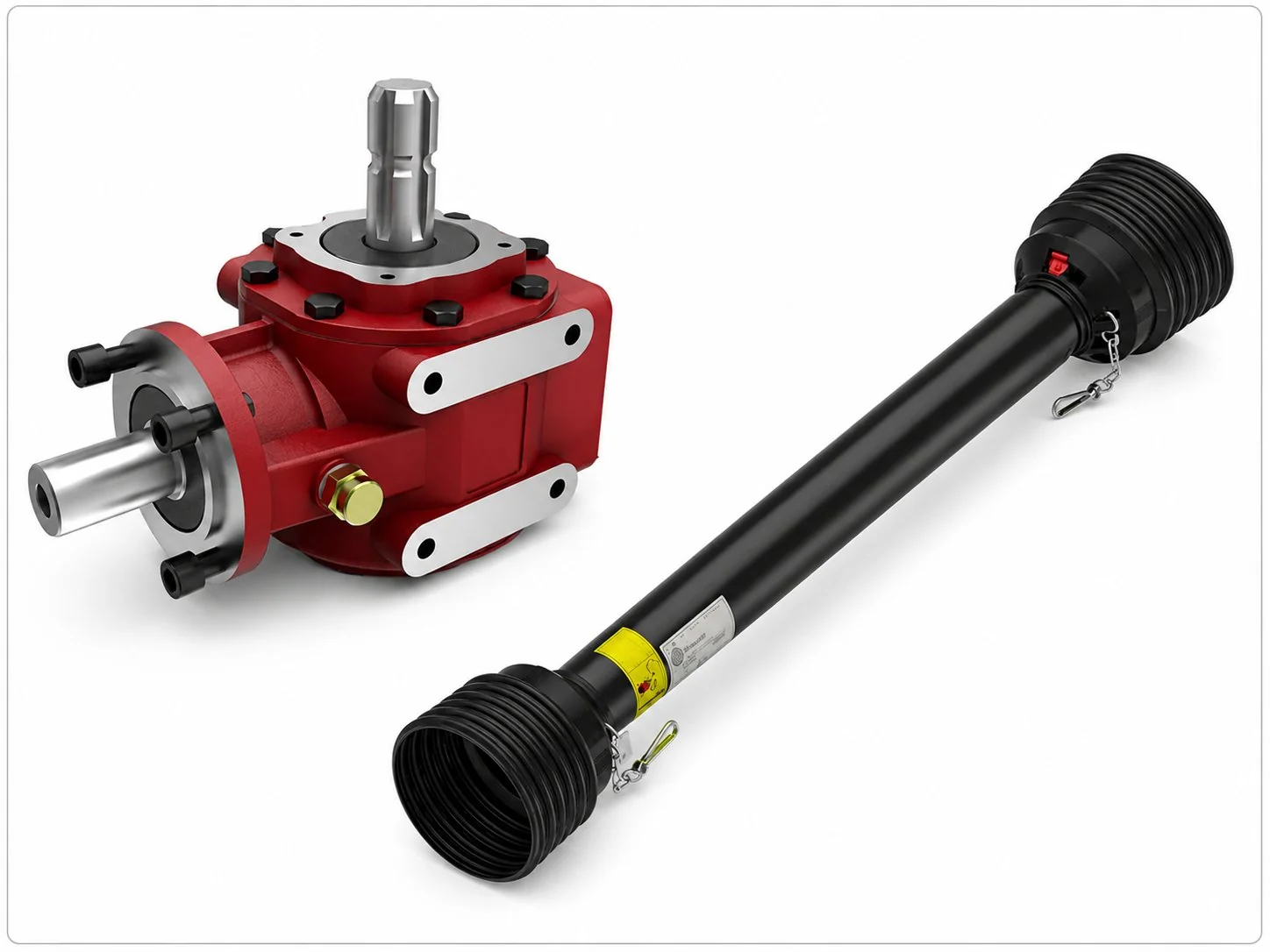
Tapered roller bearings at the main output position handle the combined radial and thrust loads generated by the spiral bevel mesh. Bearing preload is set to 0.05 to 0.10 mm axial compression — tight enough to maintain consistent gear mesh alignment as the load varies, but not so tight that the bearing generates excessive heat under sustained operation. Large square baler gearboxes carry the additional requirement of resisting gyroscopic forces from the heavy flywheel during field turning: a 200 kg flywheel at 540 RPM generates significant gyroscopic precession that applies lateral bearing loads not accounted for in straight-ahead calculations. The housing must be rigid enough (ductile iron EN-GJS-400-15 rather than grey cast iron) to resist this moment without deflecting bearing alignment.
技術仕様の概要
PTO Driveline Integration and Overload Protection
の PTO駆動系 connecting the tractor to the hay baler gearbox must be matched to both the continuous power demand and the cyclic loading characteristics. Square balers generating 80 to 120 plunger strokes per minute produce continuous torque reversals in the driveline — each compression stroke accelerates the shaft, and each return stroke decelerates it. This acceleration-deceleration pattern produces fatigue loading in U-joint bearings and the spline tube that exceeds the loading from a constant-torque application at the same average power level. PTO shaft Series 6 or Series 8 drivelines are the minimum specification for square baler applications.
Slip clutch calibration is the primary defence against catastrophic baler gearbox bearing failure. Foreign objects entering the bale chamber (fence posts, stones, irrigation risers), bale chamber jams from wet crop plugging, and knotter failures that prevent bale ejection all generate instantaneous torque spikes of 3 to 5 times rated continuous. The slip clutch must release at 1.5 to 2.0 times rated continuous PTO torque — high enough to allow normal baling without false triggering, but low enough to protect gearbox gears and bearings from the full overload. A slip clutch that has glazed from heat cycling and no longer releases at the calibrated torque provides no protection — the full jam torque passes through the gearbox, and tooth root cracking or bearing failure follows within seconds.
Baler Gearbox Oil Type and Lubrication Strategy
Cyclic loading creates unique lubrication challenges. During each bale cycle the gear tooth contact stress swings from low (empty chamber or plunger return) to maximum (full bale compression), cyclically stressing the oil film to its load capacity and then relaxing it. This pattern accelerates micropitting — tiny surface fatigue cracks that initiate at the gear contact zone and propagate under repeated loading until they produce visible tooth damage and increased mesh noise. Choosing the correct baler gearbox oil type is therefore a direct investment in gear longevity.
Synthetic PAO EP ISO VG 220. Moderate contact stress at moderate speed suits VG 220 film strength. Change every 300 to 400 operating hours or annually. Operating temperature typically 55 to 75°C during sustained summer baling.
Synthetic PAO EP ISO VG 320. Higher contact stress from plunger pulses demands thicker film. Change every 250 to 350 hours. Operating temperature 60 to 85°C. If surface exceeds hand-touch tolerance (>70°C), investigate before continuing.
Synthetic PAO base stock maintains film strength more consistently under cyclically varying contact pressure than mineral oil — providing 2 to 3 times the micropitting resistance and extending effective oil life by 30 to 50 percent compared to mineral equivalents at the same ISO VG grade. The additional cost of synthetic oil (typically 2 to 3 times mineral per litre) is recovered within 200 to 300 hours through reduced gear wear, extended oil change intervals, and improved cold-start protection in early-morning or autumn baling when ambient temperatures drop below 10 degrees Celsius.
Housing Material and Environmental Sealing
Balers operate in a dusty, chaff-laden environment where fine crop particles penetrate every gap. The housing material choice depends on the baler type: grey cast iron EN-GJL-250 is adequate for round balers (moderate impact loading), while ductile iron EN-GJS-400-15 is required for large square balers to handle flywheel gyroscopic forces and plunger impact loading. Exterior surfaces should carry epoxy powder coating at 60 to 80 micrometres to resist corrosion from accumulated crop dust and moisture during seasonal storage.
Shaft seals must exclude both fine crop dust (5 to 50 micrometre particles) and coarser chaff fragments (1 to 5 mm). Double-lip seals with an intermediate grease chamber provide multi-barrier protection: the outer lip deflects coarse chaff, the grease barrier traps fine dust, and the inner lip maintains oil seal integrity. Sealed breather valves prevent chaff-laden air from being drawn into the gearbox during thermal breathing cycles — a standard open breather cap will ingest crop dust within the first hour of operation. Grease the intermediate seal chambers every 50 to 100 operating hours to maintain the positive-pressure barrier against inward dust migration.
季節ごとのメンテナンススケジュール
Full oil change with fresh synthetic PAO (VG 220 or VG 320). Verify bearing play by rocking the output shaft — perceptible movement indicates bearing fatigue. Check flywheel mounting bolts for torque (square balers). Grease all PTO shaft U-joints and splines. Run a manual crank test on the knotter timing.
Oil change if approaching 300 hours. Re-grease PTO driveline U-joints daily during intensive baling. Monitor gearbox temperature by touch — sustained heat above hand tolerance indicates bearing distress or low oil level. Inspect chain drives for stretch and sprocket wear. Verify slip clutch calibration.
Clean exterior thoroughly — crop dust traps moisture and accelerates corrosion. Top up oil to maximum level (minimises condensation air volume). Apply protective grease to exposed shaft surfaces and coupling interfaces. Store under cover. Note operating hours for next-season oil change planning.
Aftermarket Baler Gearbox Replacement and Cross-Reference
Baler gearbox replacement is among the most frequent gearbox changes in the agricultural aftermarket because cyclic baling loads accelerate wear beyond the rates in continuous-duty gearboxes of equivalent power. A round baler gearbox typically lasts 8 to 15 seasons; a large square baler gearbox — under higher peak loads and flywheel gyroscopic stress — may need replacement in 5 to 10 seasons. An agricultural gearbox supplier must match the input spline profile (ISO 6-spline or 21-spline for 540 RPM, ISO 20-spline for 1,000 RPM), the output shaft dimensions and coupling type, the mounting bolt pattern, and the gear ratio.
Large square baler gearboxes carry the additional cross-reference requirement of flywheel compatibility. The flywheel mounts directly to the gearbox crankshaft output — any dimensional variation in the bolt circle diameter, pilot bore, or keyway orientation prevents proper assembly. The flywheel mass must also match the original: a heavier flywheel reduces peak PTO torque (beneficial) but increases gyroscopic bearing loads during turning (detrimental). The original specification represents the OEM calculation of this balance and should not be changed without recalculating bearing fatigue life under the altered loading. Our engineering team maintains a comprehensive cross-reference database for major baler brands and verifies dimensional and performance compatibility before shipment.
Round baler gearboxes are simpler to cross-reference because they lack flywheel complexity. The primary parameters are input/output shaft configuration, gear ratio, continuous power rating, and mounting bolt pattern. An aftermarket agricultural gearbox that matches these parameters and provides equivalent or superior bearing fatigue life (verified through L10 calculation at the rated cyclic loading) is a functionally equivalent replacement. This straightforward cross-referencing — combined with the high replacement frequency of baler gearboxes — makes round baler units one of the most active segments in the agricultural gearbox aftermarket.
よくある質問
Bale with Confidence
From round baler belt drives to large square baler flywheel-plunger systems — our baler gearboxes deliver the cyclic-load durability and knotter-timing precision that reliable bale formation demands.
編集者: Cxm