Where Tractor Power Originates — The PTO Stub Shaft
Every tractor with a rear PTO has a short splined stub shaft protruding from the back of the transmission housing. This stub is driven by the engine through the transmission or an independent clutch, depending on the PTO type. When you engage the PTO, the engine’s rotational energy is routed to this stub at a standardized speed — either 540 RPM or 1000 RPM for the vast majority of agricultural tractors worldwide.
The stub itself does not power any implement directly. It simply provides a standardized mechanical output point. A Voimanottoakseli connects the tractor stub to the implement’s input — and that input is almost always a PTO drive gearbox. Without the gearbox to translate speed and direction, the raw PTO output cannot match what the implement requires.
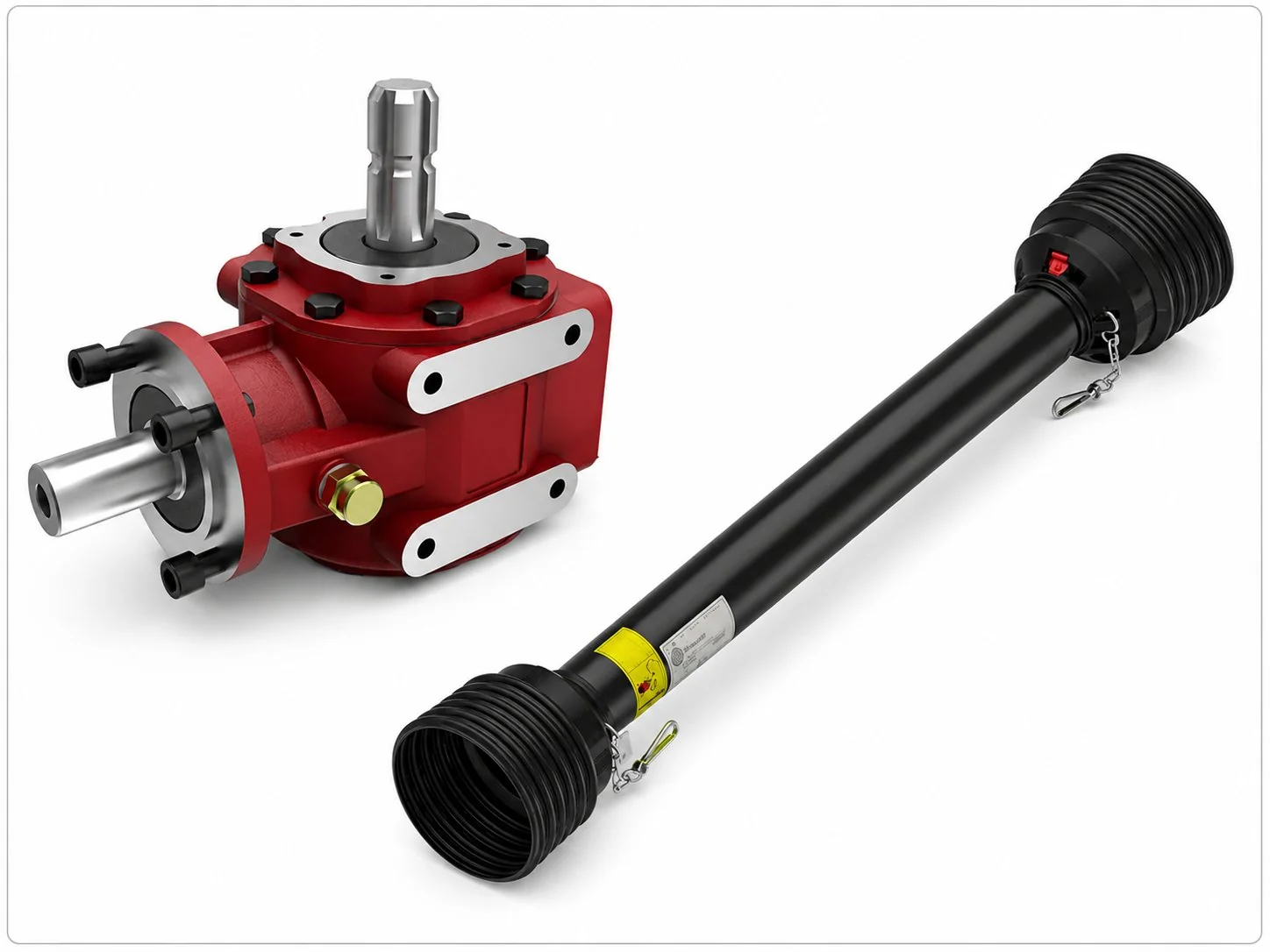
PTO gearbox mounted with driveline shaft — power flows from tractor (right) to implement (left)
Step One: Power Enters the Gearbox Input Shaft
The PTO driveline terminates at the gearbox input shaft, connecting through a splined coupling. The splines (raised ridges machined into both the shaft and the driveline yoke) interlock mechanically, transferring 100% of the torque without slippage. Standard configurations follow agricultural gearbox ISO 500 specifications: 6-spline at 1-3/8 inches for 540 RPM, and 20-spline at 1-3/4 inches for 1000 RPM.
The input shaft extends into the housing, supported by bearings on each side of the input gear. These bearings locate the shaft precisely relative to the mating gear and absorb the radial and axial forces the gear mesh generates. A misaligned or loosely supported input shaft produces uneven tooth contact, which accelerates wear on both gears.
🔑 Key Point
At the inboard end of the input shaft sits the driving gear — either a bevel gear (in right-angle gearboxes) or a spur/helical gear (in parallel-shaft designs). This gear is the first point where power transformation begins.
Step Two: Gear Mesh — Where Speed Becomes Torque
The gear mesh is where the actual conversion happens. Two gears — the input (driving) and output (driven) — engage their teeth in a controlled rolling-and-sliding contact. This contact does three things simultaneously:
🔄
Changes Rotational Axis
In a right-angle PTO gearbox, spiral bevel gears redirect power 90° — from the horizontal PTO line to the vertical plane that most ground-engaging implements require.
⏬
Reduces Speed
When the output gear has more teeth than input, the output shaft spins slower. A 12-tooth input meshing an 18-tooth output produces a 1:1.5 reduction — 540 RPM becomes 360 RPM.
💪
Multiplies Torque
Conservation of energy: if speed decreases, torque increases proportionally. That 1:1.5 ratio delivers 1.5× the input torque — the gearbox trades speed for force at the exact ratio the implement needs.
Spiral bevel gears, used in nearly all modern agricultural gearbox designs, engage progressively — two or three tooth pairs share load at any instant, spreading force across a wider contact area than straight-cut gears. This produces noticeably less noise and vibration during operation.
Step Three: The Output Shaft Delivers Work
The output shaft carries the transformed power — slower speed, higher torque, redirected axis — out of the housing and into the implement. How it connects depends on the equipment type: a rotary cutter takes a downward vertical output to the blade flange; a fertilizer spreader drives spinner discs horizontally; a feed mixer routes through secondary chain or belt drives to the auger system.
Regardless of implement, the output shaft must be supported by bearings designed for the specific combination of radial load, axial thrust from the bevel gear mesh, and impact loading. Tapered roller bearings are the standard choice for PTO drive gearbox output shafts because they handle both radial and axial loads simultaneously.
Gearbox Configurations: Right-Angle, Parallel, and Planetary
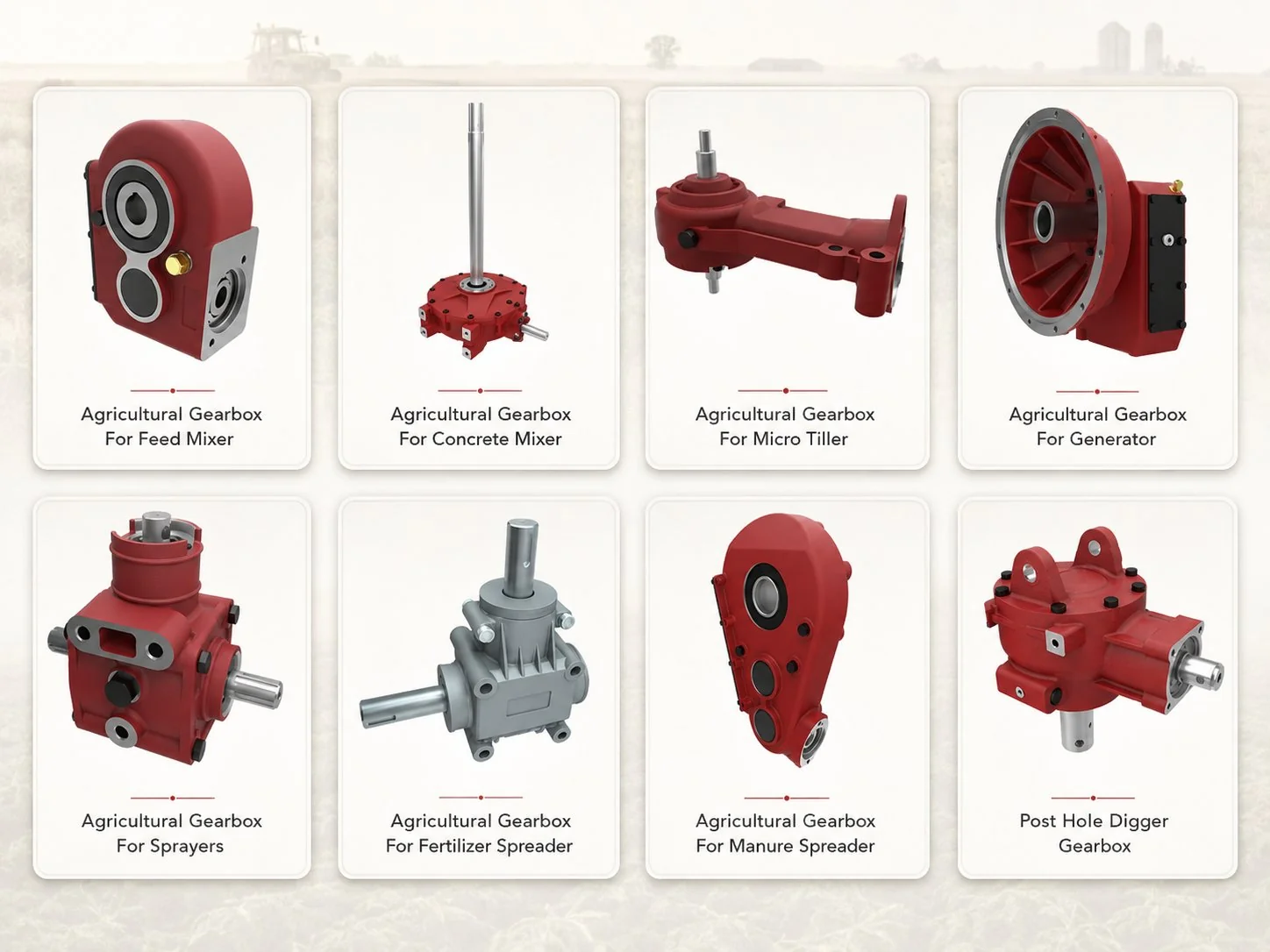
Not every implement needs a 90-degree power turn. The gearbox configuration varies based on the implement’s mechanical layout. Understanding the three primary types helps you match the gearbox to the application.
⚙️ Right-Angle Bevel Gearboxes
The most common in agriculture. Spiral bevel gears redirect power 90° — typically horizontal to vertical. Used in rotary cutters, rotary mowers, rotary tillers, and post hole diggers. The compact housing places input and output shafts perpendicular to each other, fitting naturally into ground-engaging implement geometry.
🔗 Parallel-Shaft Gearboxes
Spur or helical gears with input and output shafts running parallel. Common where no direction change is needed — for example, a voimanottoakselin nopeudenlisäysvaihteisto driving a hydraulic pump inline with the tractor PTO. Helical gears in parallel-shaft units run quieter than spur gears because their angled teeth engage progressively.
🪐 Planetary Gear Trains
Extreme torque multiplication in a compact package. A central sun gear, surrounding planet gears, and an outer ring gear achieve 3:1 to 10:1+ ratios in a single stage. Used in rehunsekoittimien vaihdelaatikot and heavy-duty baler drives where torque capacity relative to physical size is critical.
Speed Reduction vs. Speed Increase: Two Opposite Jobs
Most people assume every PTO gearbox slows things down. In reality, the agricultural equipment world needs both speed reducers and speed increasers — and they work on the same mechanical principle, just reversed.
| Parametri | Voimanottoakselin alennusvaihteisto | Voimanottoakselin nopeuden lisäys |
|---|---|---|
| RPM change | 540 → 270 (2:1 example) | 540 → 1080 (1:2 example) |
| Torque effect | Doubles (2× input) | Halves (0.5× input) |
| Sovellukset | Rotary cutters, balers, feed mixers, tillers | Hydraulic pump drives, generators, blowers |
| Common ratios | 1:1.47, 1:1.92, 1:2.4, 1:3 | 1:1.5, 1:2, 1:2.5, 1:4 |
| Gear mesh | Smaller gear drives larger gear | Larger gear drives smaller gear |
| Thermal concern | Moderate — lower speeds, less heat | Higher — elevated speeds, more friction |
A voimanottoakselin alennusvaihteisto takes 540 or 1000 RPM and delivers lower speed at higher torque — what rotary cutters, balers, and tillers need. A speed increaser for hydraulic pumps does the opposite: it boosts PTO speed to 1500–3000 RPM for pump drives, where torque demand is relatively low. Both use the same gear mesh physics — the only difference is which shaft carries the larger gear.
The Role of Lubrication in Power Transmission
Gear oil is not just a lubricant — it is an active component in the power transmission process. Between 2% and 5% of input power is lost to friction, and nearly all of that converts to heat. The oil absorbs this heat, carries it to the housing walls, and dissipates it to the surrounding air.
🛢️ Lubrication Essentials
EP (extreme pressure) gear oils contain sulfur-phosphorus additives forming a protective chemical layer under high contact pressure — preventing welding and scuffing when oil film gets squeezed thin.
SAE 80W-90 EP provides the right balance of cold-weather flow and high-temperature film strength for most agricultural applications.
Change every 100 operating hours to flush contaminants (water ingress, metallic particles) before they cause measurable damage.
Power Flow Summary: Engine to Implement
Here is the complete power chain from engine to implement output, with typical efficiency at each stage:
| Vaihe | Component | Tehokkuus | HP (from 75 HP engine) |
|---|---|---|---|
| 1 | Engine → PTO stub (transmission) | 82–87% | ~63 HP |
| 2 | PTO driveline (U-joints, slip joint) | 96–98% | ~61 HP |
| 3 | PTO drive gearbox (gear mesh, bearings) | 95–98% | ~59 HP |
| 4 | Implement drive (chains, belts, gears) | 90–95% | ~55 HP at work point |
From a 75 HP engine, roughly 55 HP actually performs work. The PTO drive gearbox is one of the most efficient links — a well-made unit loses only 2–5%. The difference between a 95% and 98% efficient gearbox, compounded over thousands of hours, translates to real fuel savings and reduced thermal stress on every downstream component.
How Gearbox Design Varies by Implement Type
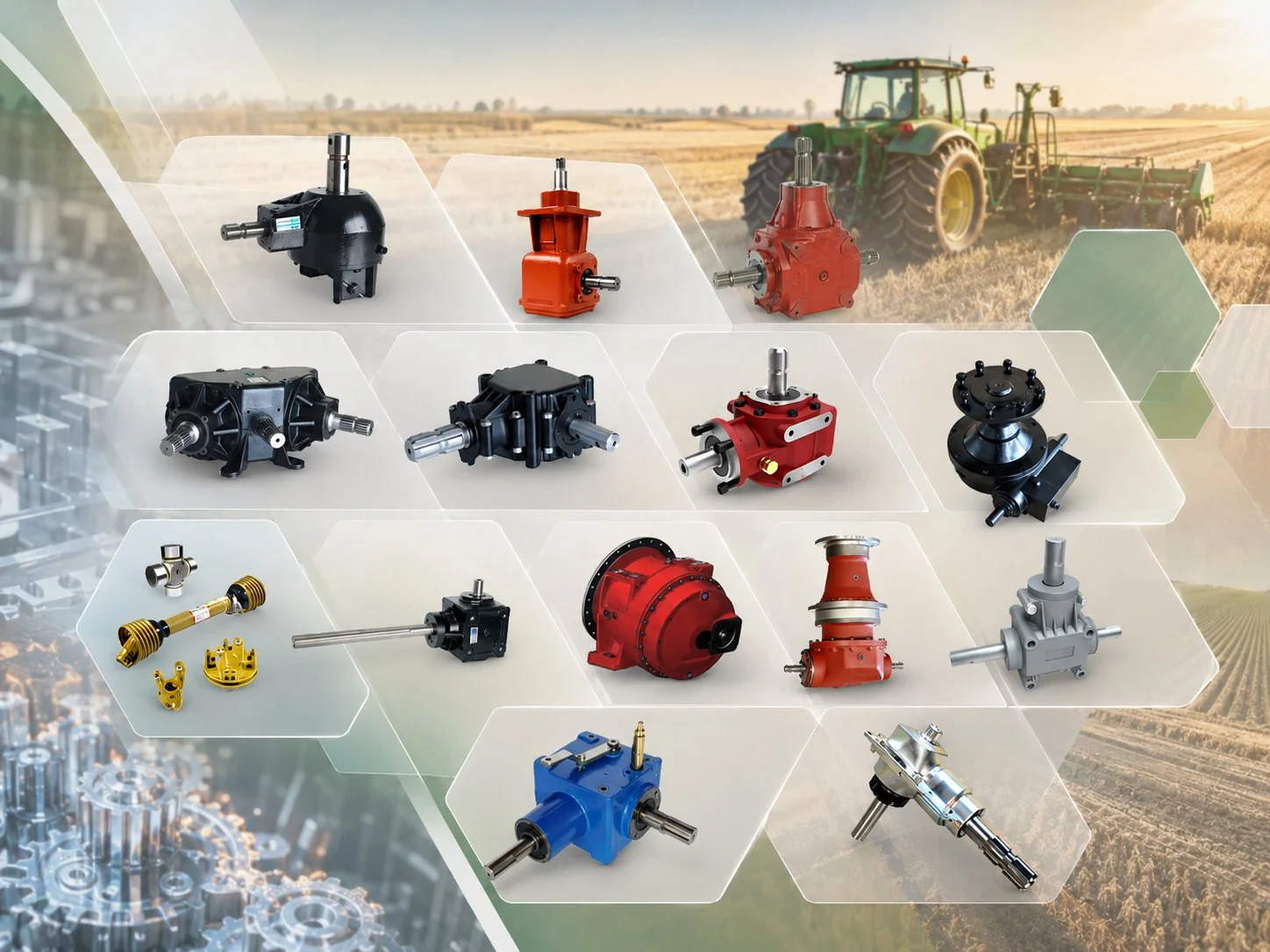
The power-conversion principle stays the same across all PTO-driven equipment, but implement demands shape the gearbox in very different ways:
Rotary Cutters — Impact Resistance
Blade contact with rocks and stumps generates torque spikes 3–5× normal operating load. These gearboxes use shear bolts, slip clutches, and ductile iron housings to absorb shock rather than cracking.
Round Balers — Sustained Cyclic Loading
Torque rises progressively as the bale builds. Multi-stage reductions of 3:1 to 5:1 deliver very high torque at low output speed, with thermal management and bearing endurance prioritized over impact resistance.
Hydraulic Pump Drives — High Speed, Low Torque
The gearbox boosts 540 RPM to 1500–2500 RPM for hydraulic pumps. Thermal management is critical because elevated speed generates more friction heat, and these units often run continuously for hours.
Fertilizer Spreaders — Chemical Resistance
Acidic and salt-based compounds attack steel surfaces. Spreader gearboxes incorporate corrosion-resistant coatings, stainless hardware, and enhanced seal technology. Ratios are moderate (1:1 to 1:1.5) since spinner speed requirements are not extreme.
Signs Your Gearbox Is Losing Efficiency
A gearbox that is losing conversion efficiency gives you several warning signs before it fails completely. Recognizing these early saves your gearbox — and your season:
Unusual noise under load — Grinding, whining, or knocking not present when new. Gear whine indicates surface wear; knocking points to tooth or bearing damage.
Excessive housing temperature — Too hot to touch (above ~180°F / 82°C) during normal operation means excessive friction from degraded oil, worn bearings, or excessive backlash.
Oil leaks at shaft seals — Any visible oil weep also means contaminants are entering the gearbox. The leak may be minor, but the contamination it allows causes accelerating internal damage.
Vibration through the implement frame — Worn gears or bearings transmit cyclic vibration absent when the unit was new. This also accelerates wear on every connected component.
Catching problems at the early symptom stage often means a seal or bearing replacement rather than a full gearbox rebuild.
Choosing the Right PTO Drive Gearbox
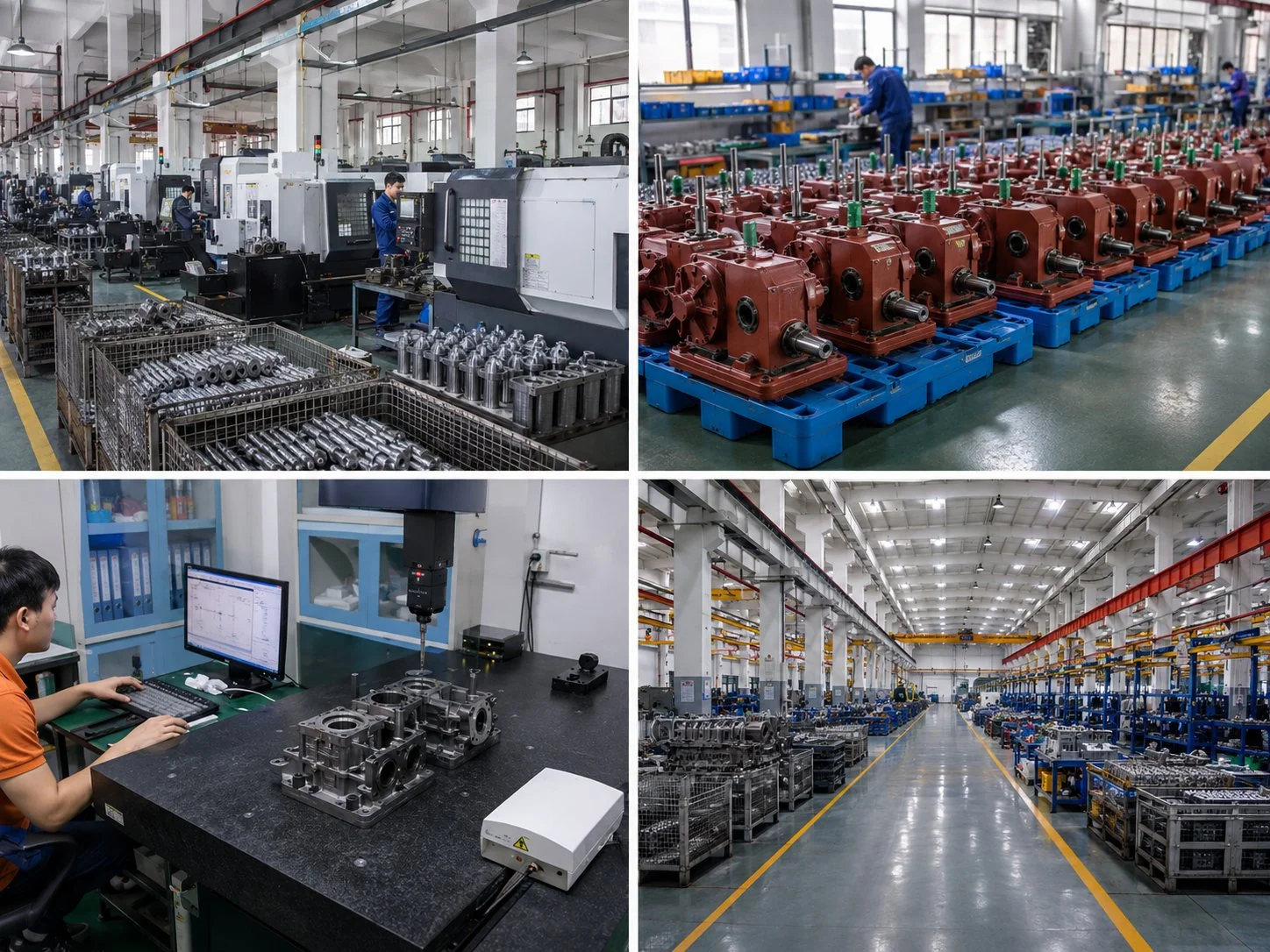
Selecting the right gearbox comes down to matching four parameters to your implement and tractor combination:
PTO speed compatibility — 540 or 1000 RPM input with the correct spline configuration. Never adapt across speed ratings without verifying all internal components are rated for the actual operating speed.
Gear ratio for the intended output — Determine the speed and torque your implement needs, then select the ratio that delivers it from your tractor’s PTO speed.
Torque capacity with safety margin — Impact-prone applications need ≥150% above steady-state. Continuous-duty applications (pumps, generators) can use 125%.
Physical mounting and shaft dimensions — Bolt pattern, housing profile, output shaft diameter, and rotation direction must match. Dimensional mismatch is the single most common reason for returns.
If you are unsure about specifications, ota yhteyttä suunnittelutiimiimme to cross-reference your existing gearbox or calculate requirements from your implement data. You can also explore the complete PTO gearbox catalog to see available configurations by application type and ratio.
Usein kysytyt kysymykset
Need Help Selecting the Right PTO Drive Gearbox?
Ever-Power specializes in matching PTO gearbox configurations to specific agricultural and industrial applications. From single replacement units to full OEM development programs — we deliver precision gearbox solutions backed by rigorous quality testing.
Toimittaja: Cxm