What Is a Power Harrows Gearbox?
A power harrows gearbox is the central PTO-driven distribution gear unit that receives tractor PTO input and distributes torque simultaneously to 6 to 24 vertical rotors arranged across the full working width of the harrow. Each rotor carries a pair of hardened tines that rotate horizontally at 300 to 400 RPM, slicing, crumbling, and mixing the topsoil to produce a fine, level seedbed. Unlike a rotary tiller (which uses L-shaped blades on a single horizontal shaft), the power harrow works the soil with minimal inversion — preserving the soil structure horizon while breaking clods into the fine tilth required for precision seed placement and uniform germination.
See power harrows gearbox is the most mechanically complex gearbox system in the tillage equipment range. The power harrow central gearbox must split the PTO input into multiple parallel output paths — one for each rotor pair — while ensuring that adjacent rotors turn in opposite directions (counter-rotating). This counter-rotation is achieved through a sequence of intermeshing spur or helical gears within the gearbox housing: each gear meshes with its neighbour, and because each mesh reverses the rotation direction, alternating rotors automatically spin in opposite directions. The result is that the soil between every pair of adjacent rotors is sheared from both sides simultaneously, producing the intensive mixing action that creates a uniformly fine seedbed.
Central Gearbox Architecture and Rotor Distribution
See Jõuvõtuvõlli käigukast input stage is typically a right-angle spiral bevel pair that converts horizontal PTO rotation into vertical rotation aligned with the rotor axes. This bevel stage operates at a power harrows gearbox ratio of 1:1 to 1:1.5 from 540 or 1,000 RPM PTO, producing a main layshaft speed of 360 to 540 RPM. From the layshaft, a train of spur gears (one per rotor) distributes power across the full working width. On a 3-metre harrow with 12 rotors spaced at 250 mm centres, the gear train consists of 12 intermeshing spur gears — each one driving a vertical rotor spindle downward through the gearbox base plate into the soil zone.
Wider harrows (4 to 6 metres working width, 16 to 24 rotors) may use a split-drive architecture: the PTO input feeds a central bevel pair, and two horizontal layshafts extend left and right, each driving half the rotor gear train. This split configuration reduces the total gear train length (and the accumulated torsional wind-up) by half, improving torque distribution uniformity across the full working width. The longest single gear trains (24 rotors, 6 metres) experience measurable torsional deflection under heavy load — causing the outermost rotors to lag behind the centre rotors, producing uneven tillage depth at the harrow edges.
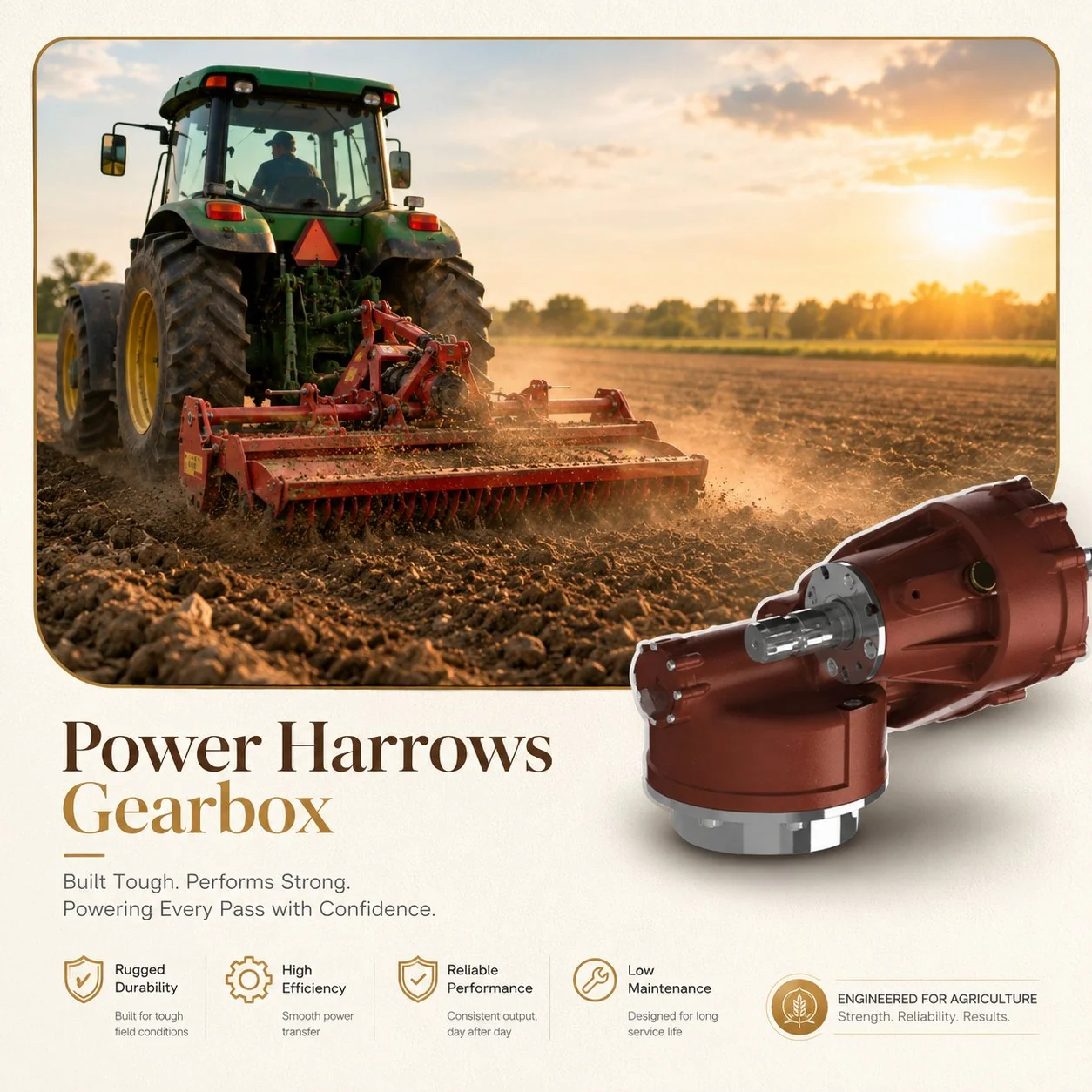
Power harrows gearbox — central distribution unit with multi-rotor spur gear train
Counter-Rotating Rotor Drive: Why Direction Matters
See counter-rotating harrow gearbox design is fundamental to power harrow performance. Each pair of adjacent rotors turns in opposite directions — one clockwise, the next counter-clockwise — so that the tine tips between every pair converge at the centre of the inter-rotor gap. This convergence creates a shearing zone where the soil is simultaneously pulled inward from both sides, producing intensive crumbling and mixing action that breaks even heavy clay clods into fine particles. If all rotors turned in the same direction (as in some rotary tillers), the soil would simply be swept laterally without the intensive shearing that creates a true seedbed-quality tilth.
Counter-rotation requires no additional mechanism — it is an inherent property of the intermeshing spur gear train. Each spur gear mesh reverses the rotation direction: gear 1 turns clockwise, gear 2 (meshing with gear 1) turns counter-clockwise, gear 3 (meshing with gear 2) turns clockwise again, and so on. The power harrows gearbox designer simply ensures that the gear arrangement produces the correct alternating pattern across all rotors — and the counter-rotation follows automatically from the fundamental mechanics of gear meshing.
Power Harrow vs. Rotary Tiller: Gearbox Engineering Comparison
Gear and Bearing Design for Impact Loading
See power harrow gearbox bearing and gear components must withstand the most aggressive impact loading in the tillage gearbox category. When a rotor tine strikes a buried stone, the instantaneous torque spike at that rotor can reach 5 to 10 times the continuous rated torque — a severe impact that transmits through the rotor gear into the adjacent gears in the spur train. The spur gears must have tooth root strength sufficient to absorb these impact loads without cracking, requiring case-carburised alloy steel (20MnCr5 or equivalent) with surface hardness of 58 to 62 HRC and core hardness of 30 to 35 HRC. The hard surface resists wear and pitting; the tough core absorbs impact energy without brittle fracture.
The gear module for the power harrow drive gearbox rotor spur train is typically 5 to 8 mm — among the largest in any Jõuvõtuvõlli käigukast application. This heavy module provides the tooth root cross-section needed to resist the impact bending loads from stone strikes. The input bevel pair uses module 5 to 7 mm with spiral tooth form for smooth power transfer from PTO to layshaft. Each rotor spindle is supported by a pair of tapered roller bearings arranged in X-configuration, preloaded to 0.05 to 0.15 mm to resist the combined radial, thrust, and impact loads generated during soil engagement.
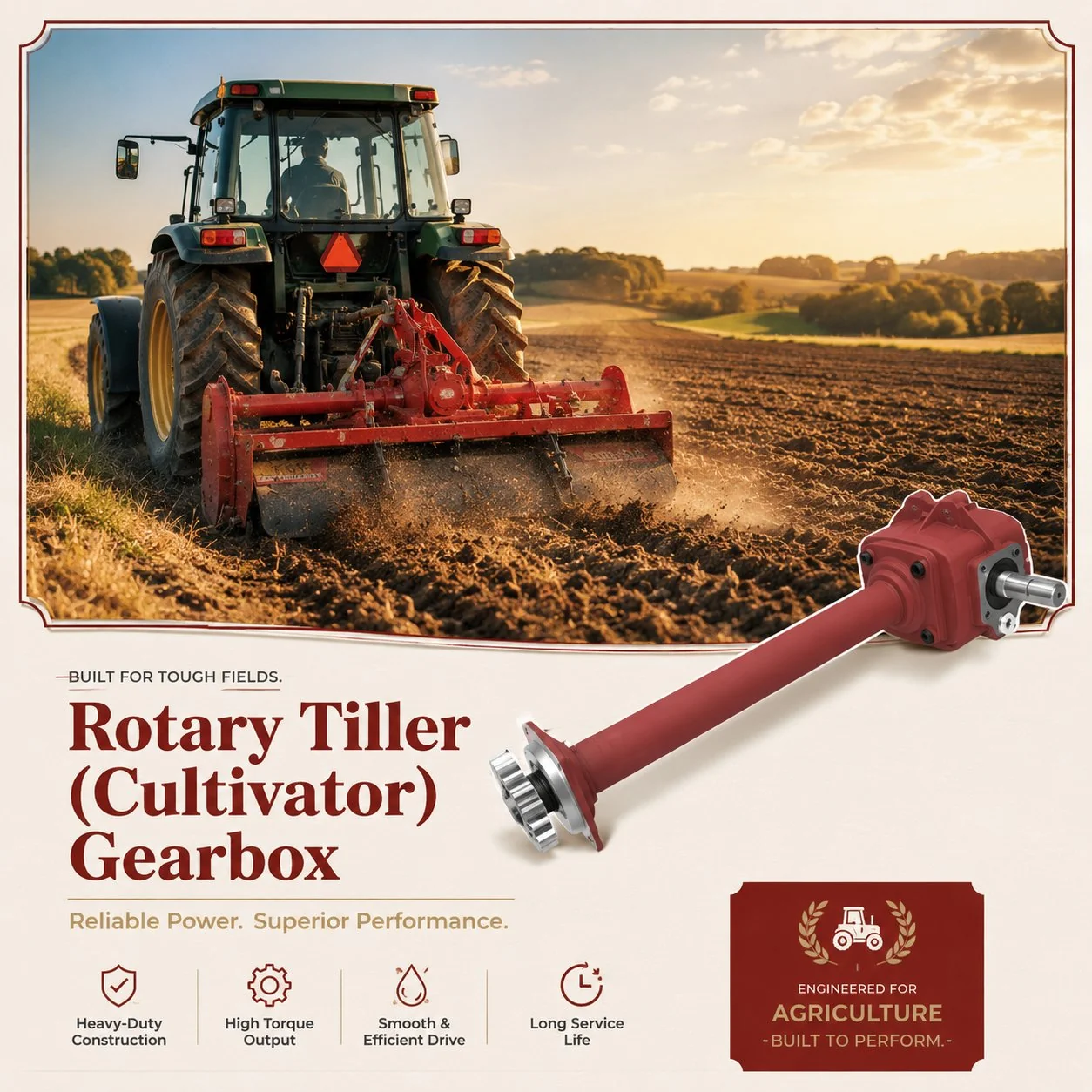
Heavy-duty tillage gearbox — impact-resistant gear and bearing design for soil-engaging applications
Shear Bolt Overload Protection: Saving the Gear Train
Unlike balers and mowers that use a single PTO driveline slip clutch for overload protection, the power harrows gearbox uses individual shear bolts on each rotor spindle. A shear bolt is a precisely calibrated sacrificial fastener — a hardened pin that connects the rotor to its drive gear and is designed to fracture at a predetermined torque (typically 2 to 3 times the continuous rotor torque). When a rotor strikes a large buried stone or root, the shear bolt breaks before the overload torque can propagate through the spur gear train and damage multiple gears and bearings. The broken bolt disconnects only the affected rotor — the remaining rotors continue operating, and the operator replaces the shear bolt (a 2 to 5 minute field repair) before resuming tillage.
This individual rotor protection is essential because the sequential spur gear train means that an overload at any single rotor position transmits through every adjacent gear mesh back to the input bevel pair. Without shear bolt isolation, a single stone strike could damage 4 to 8 gear meshes simultaneously — converting a minor field incident into a catastrophic power harrow gearbox replacement event costing thousands of dollars in parts and several days of downtime during the critical seedbed preparation window. Operators should carry a supply of calibrated shear bolts (at least 10 to 20 spares) during every tillage operation, and must never substitute standard bolts of higher strength — which defeat the overload protection and expose the entire gear train to uncontrolled impact damage.
Technical Specifications at a Glance
Power Harrow Gearbox Oil and Lubrication Under Heavy Load
The correct power harrow gearbox oil is synthetic PAO EP ISO VG 320 — one grade heavier than the VG 220 used in most agricultural gearboxes. The heavier VG 320 grade provides superior film strength at the high contact pressures generated by the large-module spur gears under sustained soil-engaging load and intermittent stone-strike impacts. Oil volume is substantial — typically 5 to 15 litres depending on harrow width — because the extended gear train housing must be filled to a level that submerges all gear meshes and rotor bearing positions simultaneously.
70 to 100 degrees Celsius during sustained heavy tillage — among the highest operating temperatures of any agricultural gearbox. At these temperatures, mineral VG 320 oxidises rapidly (oil life halves for every 10-degree rise above 80 degrees). Synthetic PAO resists oxidation degradation and maintains viscosity stability across the full temperature range.
Rotor spindle seals operate in direct contact with soil, dust, and moisture. Double-lip seals with grease-purged intermediate chambers are essential. Soil particle ingress (even at 10 to 20 micrometre size) accelerates gear and bearing wear exponentially. Inspect magnetic drain plug at every oil change — metal particles indicate developing gear or bearing damage.
Oil change intervals for the power harrows gearbox are 150 to 250 hours for synthetic and 100 to 150 hours for mineral oil — significantly shorter than most põllumajanduslik käigukast applications because the combination of high operating temperature, sustained heavy loading, and soil contamination risk degrades the oil faster than in cleaner, lighter-duty environments. Given the large oil volume (5 to 15 litres), the cost of each oil change is not trivial — but extending intervals beyond the recommended limit risks accelerated wear of the 6 to 24 gear meshes and the corresponding bearing positions, with repair costs that far exceed the saving from delayed oil changes.
PTO Driveline Matching for Power Harrow Applications
Power harrows require heavy-duty PTO drivelines — Series 6 minimum for harrows up to 3.5 metres width (40 to 100 HP), Series 8 for 4 to 5 metre harrows (100 to 160 HP), and wide-angle or constant-velocity drivelines for 5 to 6+ metre folding harrows (150 to 200+ HP) where the driveline angle changes significantly between transport and working positions. The sustained high-torque soil engagement generates continuous PTO torque levels that approach the fatigue limit of lighter-duty driveline series — and the intermittent impact loads from stone strikes add fatigue cycling that further reduces driveline bearing life.
Slip clutch protection on the PTO driveline serves as the secondary overload defence (behind the rotor shear bolts). If a very large obstruction or a simultaneous multi-rotor overload exceeds the combined shear bolt capacity, the slip clutch must release before the accumulated overload torque exceeds the bevel gear root strength in the central gearbox. The clutch should be calibrated at 1.5 to 2.0 times the rated continuous PTO torque and tested before each tillage season.
Seasonal Maintenance Schedule
Full oil change with fresh synthetic VG 320. Inspect all rotor spindle seals — replace any showing soil contamination. Rotate each rotor by hand to verify smooth bearing action. Check shear bolt stock (minimum 10 to 20 spares). Grease PTO driveline U-joints. Test slip clutch calibration.
Oil change mandatory. Inspect magnetic drain plug for metallic particles — fine paste is normal; coarse chips or flakes indicate gear tooth damage or bearing fatigue and require professional investigation. Re-grease all rotor spindle seal chambers. Inspect tines for wear and replace as needed.
Wash exterior to remove all soil accumulation. Top up oil. Apply grease to exposed rotor spindles. Store under cover on flat surface. Record total operating hours for next-season oil change scheduling. Inspect all shear bolt positions for signs of cracking or deformation.
Aftermarket Power Harrow Gearbox Replacement
Power harrow gearbox replacement is more complex than most agricultural gearbox changes because the central gearbox is an integrated multi-output unit with specific rotor count, spacing, and gear arrangement. Cross-reference requires exact matching of rotor count and spacing, input shaft spline profile, housing mounting dimensions, rotor spindle bearing size, and spur gear module and tooth count. The gear arrangement must replicate the original counter-rotation pattern — reversing the rotation sequence would cause incorrect soil engagement and poor seedbed quality.
Individual rotor gears and bearings can often be replaced without changing the complete gearbox — a significant cost advantage over complete replacement when only one or two positions show damage from stone strike events. Our engineering team maintains cross-reference data for major power harrow brands and can supply both complete gearbox assemblies and individual rotor gear and bearing kits. Contact us with your harrow model, working width, and rotor count for accurate specification matching.
Typical service life for a well-maintained power harrows gearbox is 5 to 12 seasons (1,000 to 3,000 operating hours) before comprehensive bearing and gear service is needed — shorter than lighter-duty gearboxes because the sustained soil-engagement loading and intermittent stone-strike impacts produce accelerated wear. Operators working on stony ground may need rotor gear and bearing service within 3 to 5 seasons, while those on clean, stone-free soils can expect the upper end of the service life range.
Korduma kippuvad küsimused
Prepare the Perfect Seedbed
From compact 6-rotor units to heavy-duty 24-rotor systems — our power harrows gearboxes deliver the impact resistance, counter-rotating precision, and multi-season durability that professional seedbed preparation demands.
Toimetaja: Cxm