Why OEM Gearbox Replacement Is More Complex Than Ordering a Part Number
Ein OEM gearbox replacement seems straightforward — find the original part number, order the same unit, bolt it in place. In reality, the process is complicated by several factors that catch operators off-guard when they need a replacement most urgently. Original equipment manufacturers frequently discontinue gearbox models when they redesign implements, leaving operators of older equipment without a direct OEM replacement option. Many OEM part numbers are proprietary identifiers that do not correspond to any industry-standard specification, making cross-referencing to aftermarket alternatives a manual dimensional verification exercise rather than a simple catalog lookup.
Additionally, implement manufacturers often source gearboxes from third-party gearbox producers and relabel them with proprietary part numbers. The same physical gearbox may carry different part numbers from three different implement brands — but none of those part numbers reveals the actual manufacturer or model of the gearbox inside the housing. Understanding how to look past the OEM label and identify the underlying gearbox specification is the key skill for successful aftermarket sourcing. For a comprehensive catalog of available replacements, browse our Zapfwellengetriebe zu verkaufen range covering the most commonly replaced agricultural gearbox configurations.
Critical Dimensions: The Seven Measurements That Determine Compatibility
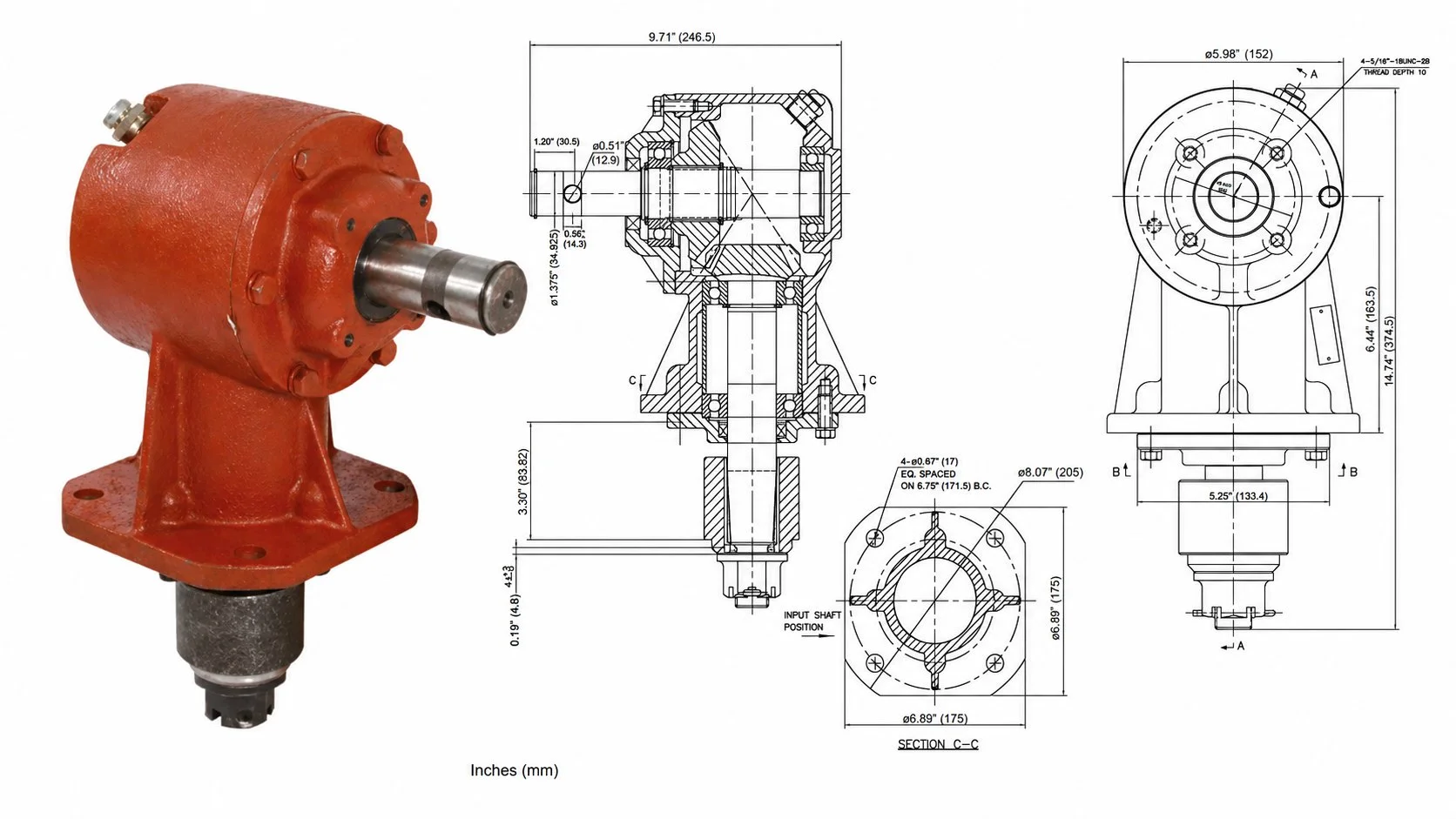
A replacement Zapfwellengetriebe must match the original on seven critical dimensions to ensure direct bolt-on installation without modification. Missing even one of these measurements can result in a gearbox that physically fits the mounting holes but fails to align correctly with the driveline or blade spindle, causing accelerated wear or immediate mechanical interference. Measure the original gearbox (or the mounting surfaces on the implement if the original gearbox is unavailable) and record all seven dimensions before contacting a supplier.
| # | Dimension | How to Measure | Why It Matters |
|---|---|---|---|
| 1 | Mounting bolt pattern | Bolt circle diameter + number of bolts + bolt hole size | Determines physical fitment to the implement deck or frame |
| 2 | Input shaft spline | Spline count, major diameter, minor diameter, and spline length | Must match PTO driveline yoke for proper engagement |
| 3 | Output shaft diameter | Shaft OD, keyway width and depth, shaft length below housing | Must fit the blade hub, pulley, or driven component |
| 4 | Housing height | Distance from mounting flange to top of housing | Clearance within the implement deck or housing enclosure |
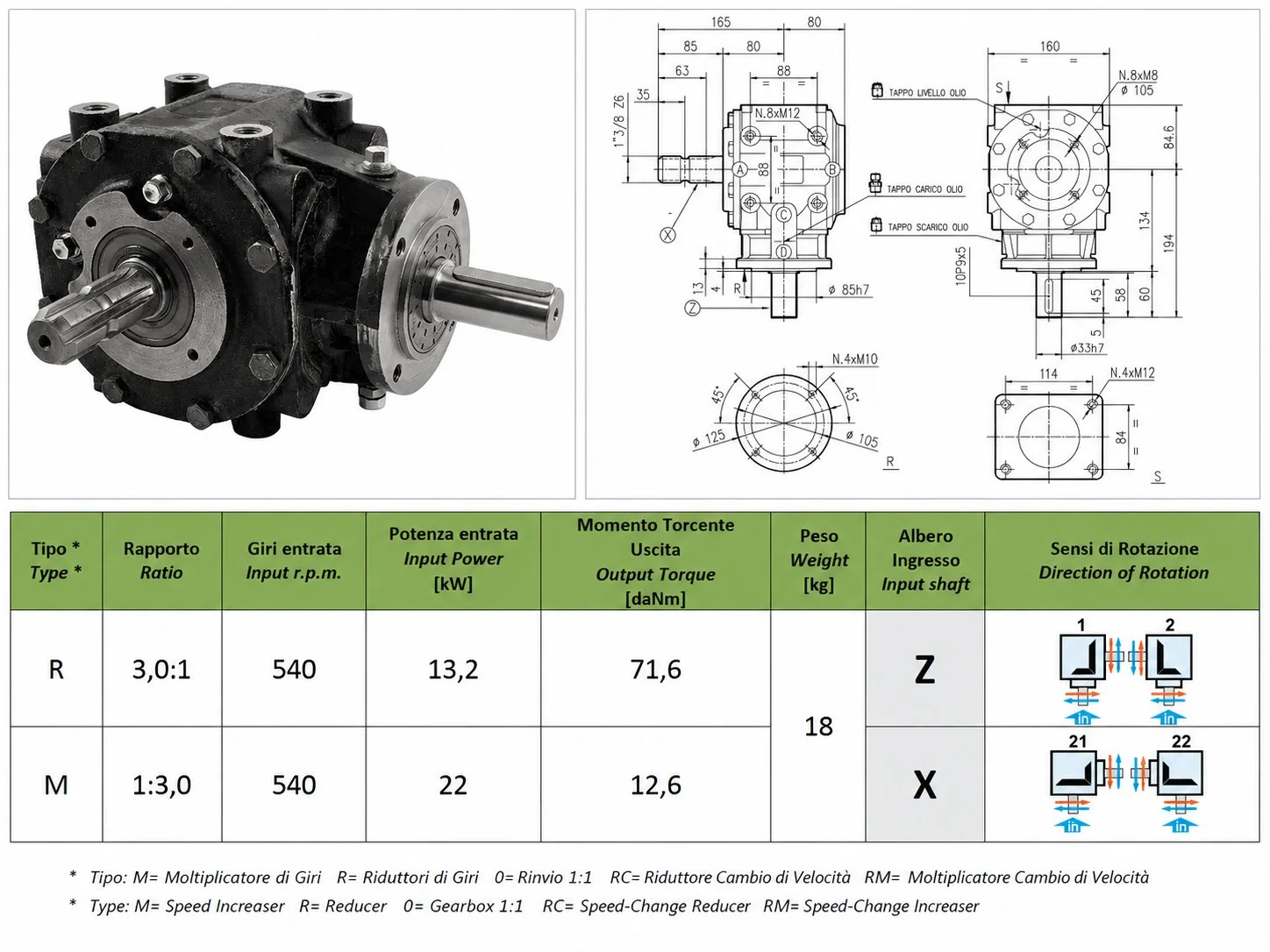
| 5 | Übersetzungsverhältnis | Count input turns per output turn, or read from the nameplate | Wrong ratio changes blade speed, affecting cut quality and safety |
| 6 | Rotation direction | CW or CCW viewed from the output shaft end | Reversed rotation causes blade to spin backward — dangerous |
| 7 | Input shaft orientation | Horizontal, vertical, or angled relative to the mounting flange | Must align with the PTO driveline approach angle on the implement |
The most commonly missed dimension is rotation direction. A gearbox that matches on all six physical dimensions but rotates the output shaft in the wrong direction will spin the blade backward — creating a safety hazard (incorrect projectile trajectory), destroying cut quality, and potentially damaging the implement through reversed loading on one-directional components. Always verify rotation direction by turning the input shaft by hand and observing the output shaft rotation before accepting a replacement gearbox as compatible.
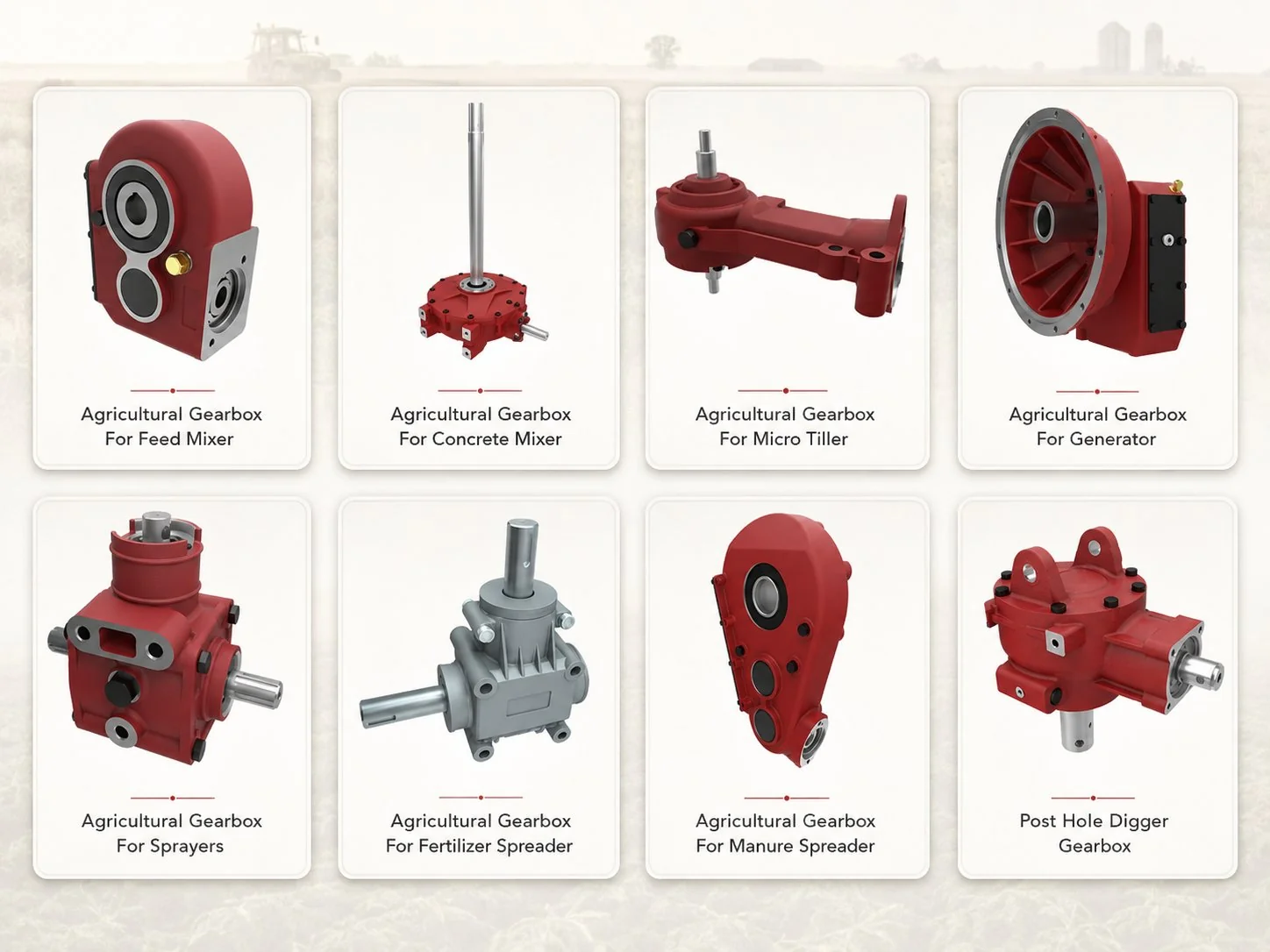
PTO gearbox configurations — matching input shaft orientation, bolt pattern, and output shaft dimensions is essential for direct OEM replacement compatibility
How to Cross-Reference OEM Part Numbers to Aftermarket Replacements
The cross-referencing process starts with collecting every identifier associated with the original gearbox: the implement manufacturer’s part number (usually on the implement parts manual or a label on the gearbox housing), any secondary part numbers stamped or cast into the housing (these often reveal the actual gearbox manufacturer), the implement brand, model, and year of manufacture, and any visible nameplates or data plates showing gear ratio, oil capacity, or country of origin.
A competent aftermarket Landwirtschaftliches Getriebe supplier maintains cross-reference databases that map OEM implement part numbers to their own compatible replacement models. The supplier should be able to accept an OEM part number and return a verified replacement model — or, when the part number is not in their database, accept the seven critical dimensions and recommend the correct replacement from their catalog. The best suppliers provide a written compatibility guarantee: if the replacement does not match the specified dimensions and performance requirements, they accept a return and provide the correct unit at no additional cost.
When no part number information is available (common with very old implements, imported equipment without English documentation, or gearboxes where labels have worn off), the dimensional approach becomes the primary identification method. Photograph the gearbox from all angles, measure all seven critical dimensions, and send this information to the aftermarket supplier. Experienced suppliers can identify the gearbox type and recommend a compatible replacement based on dimensions alone, even without any part number reference. For the Zapfwelle that connects the tractor to the gearbox, confirm that the driveline yoke spline matches the replacement gearbox input shaft — some aftermarket gearboxes offer multiple input shaft options (6-spline, 20-spline, or 21-spline) to match different driveline standards.
Aftermarket Quality Benchmarks: What Separates Good from Bad
Not all aftermarket replacement gearboxes are equivalent. The price range for aftermarket replacements of the same OEM gearbox can vary by 200 to 400 percent, and the quality difference explains most of that price spread. Understanding the engineering specifications that determine aftermarket gearbox quality allows operators to evaluate suppliers objectively rather than relying solely on price or brand reputation.
The three most important quality indicators for an aftermarket PTO gearbox are gear tooth heat treatment (carburized and ground gears at 58–62 HRC versus through-hardened at 28–35 HRC), bearing brand and grade (named bearing manufacturers such as SKF, NSK, or Timken versus unbranded commodity bearings), and housing metallurgy (ductile iron versus gray cast iron — ductile iron absorbs 3 times the impact energy before cracking). A quality aftermarket supplier publishes these specifications openly and can provide material certificates or test reports on request. A supplier that cannot or will not disclose gear hardness, bearing brand, or housing material is typically selling commodity product that may fit dimensionally but will not deliver OEM-equivalent performance or service life. Requesting a hardness test report is the simplest way to verify that the gearbox you receive matches the specification you were quoted — and any reputable manufacturer will provide this documentation as standard practice.
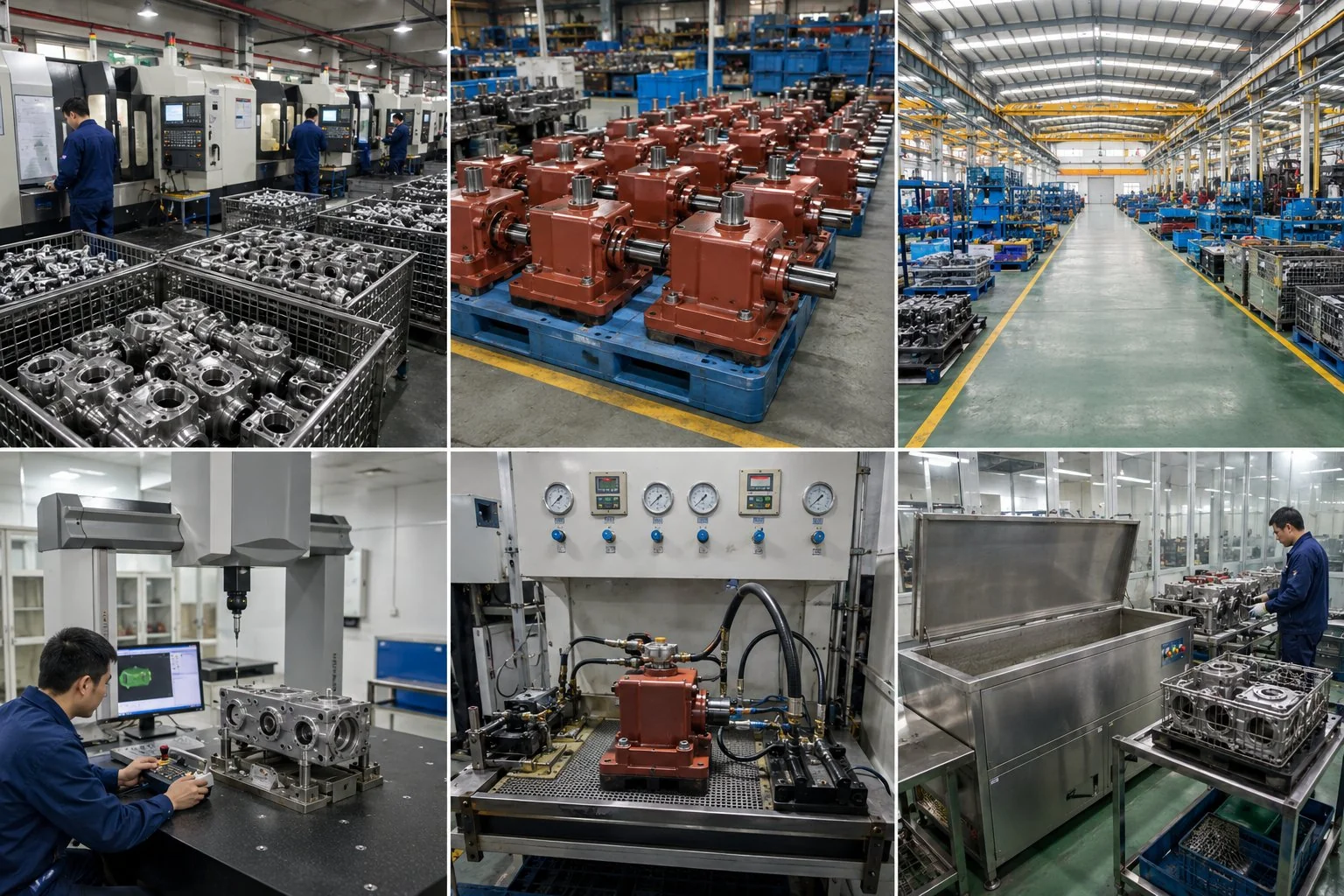
Factory load testing is the final quality benchmark. A quality Zapfwellengetriebe manufacturer runs every assembled unit on a test stand under load before shipping — verifying gear mesh pattern, bearing temperature, noise level, and oil seal integrity. Contact our engineering team to discuss specific cross-reference requirements. We maintain an extensive Landwirtschaftliches Getriebe cross-reference database covering the most popular implement brands worldwide and provide dimensional verification before every shipment.
Common Replacement Scenarios by Implement Type
Rotary cutter gearboxes are the most frequently replaced Landwirtschaftliches Getriebe type because they operate under the most severe conditions — high-speed blade rotation combined with unpredictable impact loads from rocks, stumps, and frozen debris. The most common failure mode is gear tooth fatigue (pitting progressing to tooth fracture) after 500 to 1,500 hours in economy units, or bearing failure caused by contamination or lubrication neglect. When sourcing a rotary cutter replacement, pay particular attention to the output shaft diameter and keyway dimensions — these vary more across manufacturers than any other gearbox type, because blade hub designs differ significantly between implement brands even for the same cutting width class.
Flail mower gearboxes fail differently from rotary cutters. The flail rotor generates more consistent torque (no single-blade impact spikes), but the higher output speeds and continuous duty create thermal fatigue in bearings and seals. Flail mower gearbox replacements require careful attention to the output shaft length and bearing arrangement — some designs use a through-shaft that also serves as the flail rotor axis, while others use a stub shaft with a separate rotor bearing. Confirming the shaft support configuration before ordering prevents the common mistake of installing a stub-shaft gearbox where a through-shaft design is required.
Tiller and power harrow gearboxes experience high sustained torque at relatively low RPM. These replacements are typically straightforward because tiller gearbox configurations are more standardized than cutters — most use a horizontal input, vertical output arrangement with a 1:1 or 1:1.5 ratio and a standard flange mounting pattern. The primary verification point is the output shaft spline — tillers use splined output shafts rather than keyed shafts, and the spline count and diameter must match the tine rotor engagement exactly.
Spreader and mixer gearboxes present unique sourcing challenges because they often use worm gear or planetary gear configurations rather than the bevel gear design common in cutters and tillers. A worm gearbox replacement must match not only the dimensions but also the worm lead angle and thread direction (left-hand or right-hand) — installing a right-hand worm where a left-hand is required reverses the output rotation. These specialized configurations are less likely to have direct aftermarket equivalents, making dimensional verification even more critical.
Installation and Post-Replacement Verification
A correct cross-reference and quality specification are only valuable if the replacement gearbox is installed correctly. Before mounting the new gearbox, clean all mounting surfaces on the implement frame — rust, paint buildup, and residual gasket material from the old gearbox can prevent the new unit from seating flat against the mounting surface. An uneven mounting surface creates a bending preload on the gearbox housing that stresses the housing and misaligns the internal bearings, reducing the new gearbox’s life before it completes its first hour of operation.
After mounting, verify rotation direction by turning the input shaft by hand. Confirm that the output shaft rotates in the correct direction and that the blade or driven component spins freely without mechanical interference from the gearbox housing, mounting hardware, or adjacent implement structure. Fill the gearbox with the correct oil type and volume as specified by the gearbox manufacturer — not the implement manufacturer’s generic oil recommendation, which may not account for the specific gear type and bearing configuration of the replacement unit.
Run the gearbox under no-load conditions for 5 to 10 minutes before engaging the implement in working conditions. Listen for unusual noise (grinding, knocking, or high-pitched whine that differs from the old gearbox’s normal operating sound), check for oil leaks at all seal locations and the housing joint, and verify that the gearbox housing temperature stabilizes at a reasonable level (warm to the touch but not too hot to hold). This no-load break-in allows the gear teeth to establish their initial contact pattern and the bearings to seat before full working load is applied. After the first 10 hours of loaded operation, check the oil level (some initial oil consumption through seal bedding is normal) and re-torque all mounting fasteners to the specified values.
Keep the original gearbox nameplate, part number documentation, and dimensional records even after the replacement is installed. This information simplifies future reorders — if the replacement proves satisfactory, the same aftermarket model can be ordered directly by its own part number rather than repeating the cross-reference process. If the replacement does not perform as expected, the documented original specifications provide the starting point for troubleshooting whether the issue is dimensional mismatch, ratio error, or a quality concern with the replacement unit itself.
For fleet operators managing multiple implements with different gearbox types, maintaining a spare gearbox inventory for the most failure-prone or most critical implements eliminates the urgent sourcing scenario entirely. Purchasing a spare gearbox during the off-season — when pricing pressure is lower and lead times are shorter — and storing it on the shelf means that any mid-season failure can be resolved with a same-day replacement from stock rather than a multi-week wait for a sourced unit. The capital cost of maintaining one or two spare gearboxes is trivial compared to the value of a single day of avoided harvest-window or application-window downtime.
Häufig gestellte Fragen
Get Factory-Direct Gearbox Pricing
Send us your OEM part number or the seven critical dimensions, and our engineering team will return a verified cross-reference with full dimensional documentation, gear specification, and pricing — typically within 24 hours. Factory-direct supply, worldwide shipping, and a compatibility guarantee on every order.