When a Standard Gearbox Is Not Enough
Standard catalog PTO gearboxes cover the most common agricultural configurations — 1:1 to 1:1.5 ratios, standard bolt patterns, 540 or 1,000 RPM input, and limited horsepower ratings in fixed steps. For many implements, a standard gearbox fits adequately and represents the most cost-effective solution. But when the implement design requires a non-standard gear ratio, a unique mounting geometry, a specific output shaft configuration, or a torque rating that falls between standard catalog steps, a custom PTO gearbox becomes the engineering-justified choice.
Implement manufacturers developing a new product line face this decision at the design stage. Designing the implement around an existing standard gearbox constrains the implement’s performance envelope to whatever the nearest catalog gearbox can deliver — which may mean accepting a blade speed that is not optimal, a mounting arrangement that requires adapter brackets, or a torque rating that limits the implement to a smaller tractor class than the market demands. Designing a custom gearbox to match the implement’s engineering requirements eliminates these compromises and allows the implement to achieve its full performance potential. For insights on how PTO drive system architecture connects to implement design, see our engineering resource on PTO drive systems.
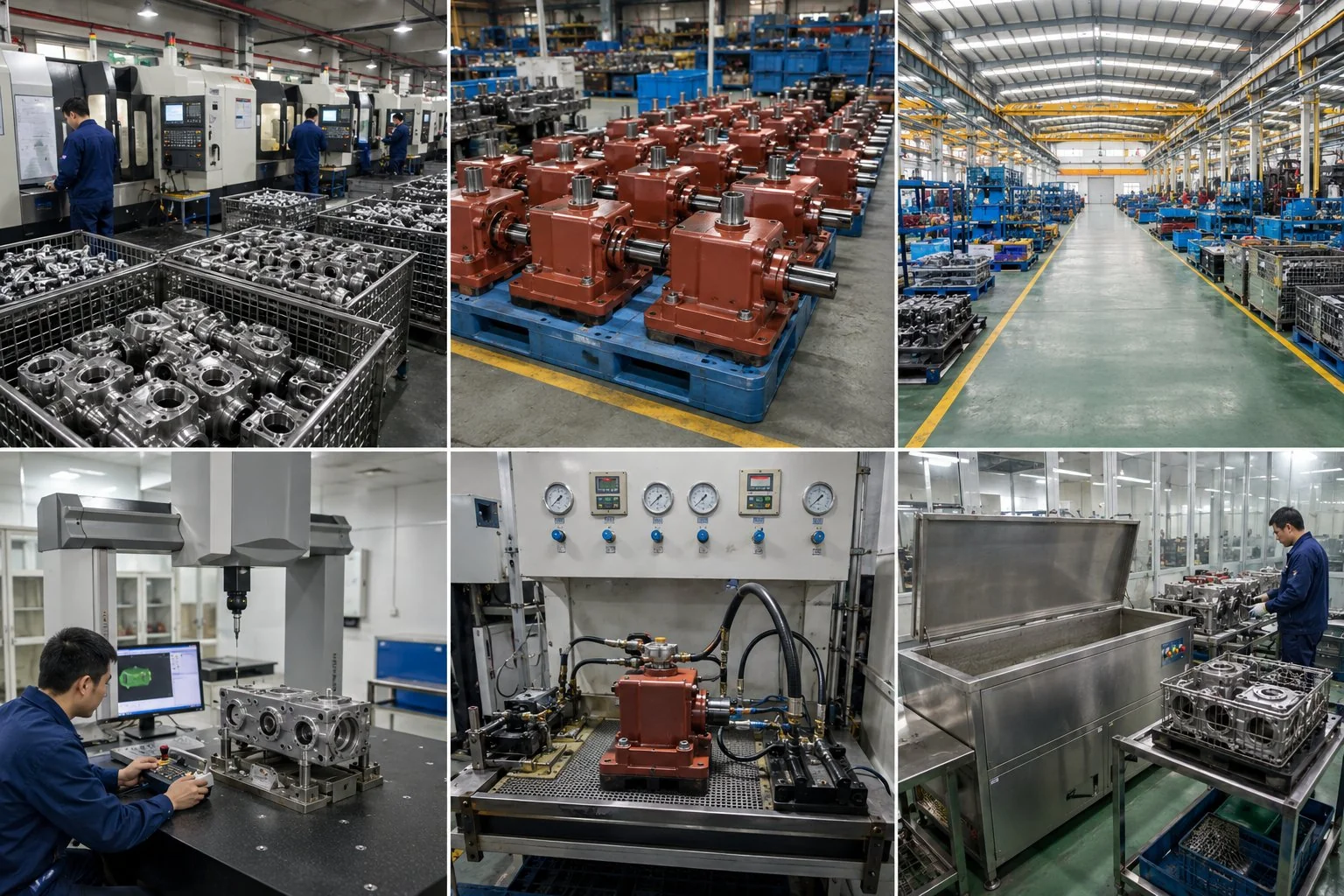
The Custom Gearbox Design Process: From Specification to Production
A well-structured custom gearbox project follows a five-phase process that moves from application specification through engineering design, prototype, validation, and production. Each phase has defined deliverables and approval gates that ensure the final production gearbox meets the implement manufacturer’s requirements without costly mid-stream redesigns.
Application Specification (Week 1)
The implement manufacturer provides the application requirements: input speed (540/1,000 RPM), required output speed or ratio, continuous and peak torque, duty cycle (hours per day, days per season), mounting envelope dimensions, input and output shaft specifications, rotation direction, and any special requirements (chemical exposure, extreme temperature, IP rating). The gearbox manufacturer reviews these requirements for completeness and feasibility.
Engineering Design (Weeks 2–4)
The gearbox engineering team designs the gear set (tooth geometry, material, heat treatment specification), selects bearings, sizes the housing, specifies seals, and produces 3D CAD models and 2D manufacturing drawings. A design review with the implement manufacturer confirms dimensional compatibility with the implement mounting and verifies that the gearbox envelope fits within the available space.
Prototype Manufacturing (Weeks 5–10)
Prototype quantities (typically 2–5 units) are manufactured using production-intent tooling and processes. The prototypes use the same gear steel, heat treatment, bearings, and housing material specified for production — ensuring that prototype test results are representative of production quality. Housing patterns may use soft tooling (sand casting) for the prototype phase, with hard tooling (permanent mold or shell mold) deferred until the design is validated.
Validation Testing (Weeks 10–14)
Prototypes undergo bench testing (rated torque, overload torque, thermal rating, noise measurement) at the gearbox manufacturer and field testing installed in the actual implement at the customer site. Validation confirms that the gearbox meets all specification requirements under real-world operating conditions. Any design modifications identified during testing are implemented before production release.
Production Launch (Week 14+)
Following successful validation, the design is released for production. Hard tooling for the housing is produced (if not already done), production process sheets are finalized, and the first production batch is manufactured. The first production units receive enhanced inspection to verify that series production matches prototype quality — a process equivalent to PPAP (Production Part Approval Process) in the automotive industry.
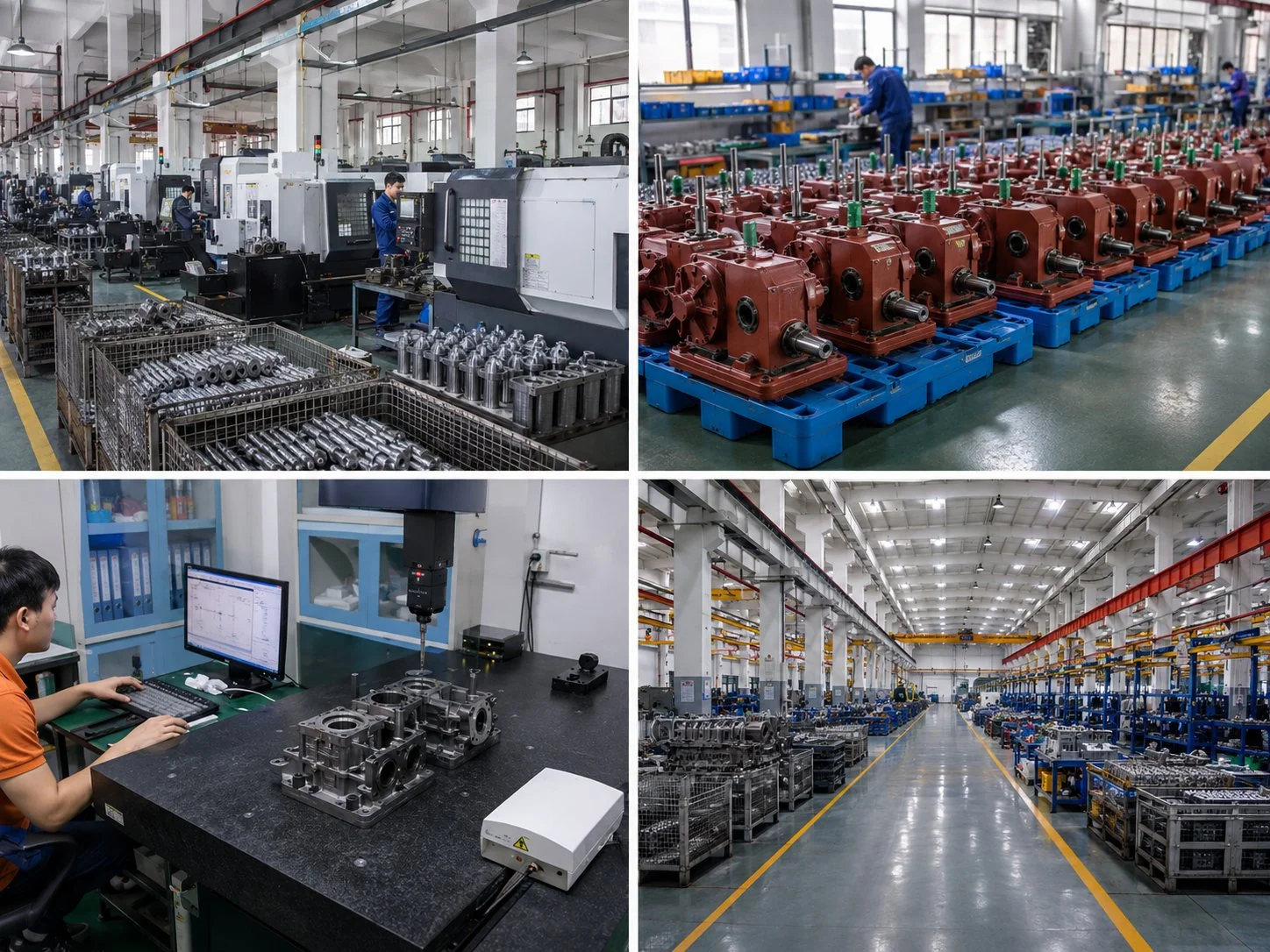
CNC gear cutting and precision assembly — custom gearbox production uses the same machinery and quality processes as standard catalog models
Minimum Order Quantities and Lead Times
Minimum order quantities for custom Landwirtschaftliches Getriebe projects depend on the degree of customization. Modifications to an existing catalog gearbox (different shaft diameter, altered bolt pattern, custom ratio within the same housing) can be produced in quantities as low as 10 to 20 units because the housing tooling and most manufacturing processes are shared with the standard model. A fully custom gearbox with a new housing design typically requires 50 to 100 units minimum for the first order to justify the housing pattern and tooling investment, with subsequent orders possible in smaller batches once tooling exists.
Lead times for a complete custom project — from initial specification through delivered production units — typically range from 14 to 20 weeks for the first order. Subsequent repeat orders against an established design ship in 4 to 8 weeks depending on order quantity and the gearbox manufacturer’s current production schedule. Rush timelines are possible for modifications to existing catalog models, with some configurations achievable in 6 to 8 weeks for the first delivery including engineering and prototype phases. For implement manufacturers with established product lines requiring a gearbox change (supplier switch, performance upgrade, or cost reduction), the modification-based approach typically delivers the fastest path to production because it leverages already-validated housing and gear designs with minimal new tooling investment.

Design-for-Manufacturing: Keeping Custom Gearboxes Cost-Effective
The most cost-effective custom gearboxes leverage existing proven components wherever possible. Using a standard gear set from the manufacturer’s catalog in a modified housing, or a standard housing with a custom gear ratio, eliminates the engineering risk and tooling cost associated with designing every component from scratch. A skilled gearbox manufacturer guides the implement designer toward these hybrid solutions — custom where it matters (mounting geometry, ratio, shaft configuration) and standard where customization adds cost without functional benefit (gear tooth form, bearing type, seal design).
Housing design is typically the largest single cost element in a custom gearbox project because it requires casting tooling (pattern and core box investment of $3,000 to $15,000 depending on size and complexity). Designing the housing to use standard machining setups — parallel or perpendicular bearing bores that can be machined on standard boring mills, flat mounting flanges that can be faced on standard lathes or mills, and standardized oil drain and fill locations — reduces per-unit machining cost throughout the production life of the custom gearbox. A responsible manufacturer like Ever-Power Zapfwellengetriebe provides design-for-manufacturing feedback during the engineering phase to optimize the balance between custom functionality and production cost efficiency. Contact our team to discuss your custom gearbox requirements. For complete Zapfwelle Und Landwirtschaftliches Getriebe integration packages, we offer coordinated driveline system design where the gearbox, driveshaft, and overload protection are engineered as a matched system.
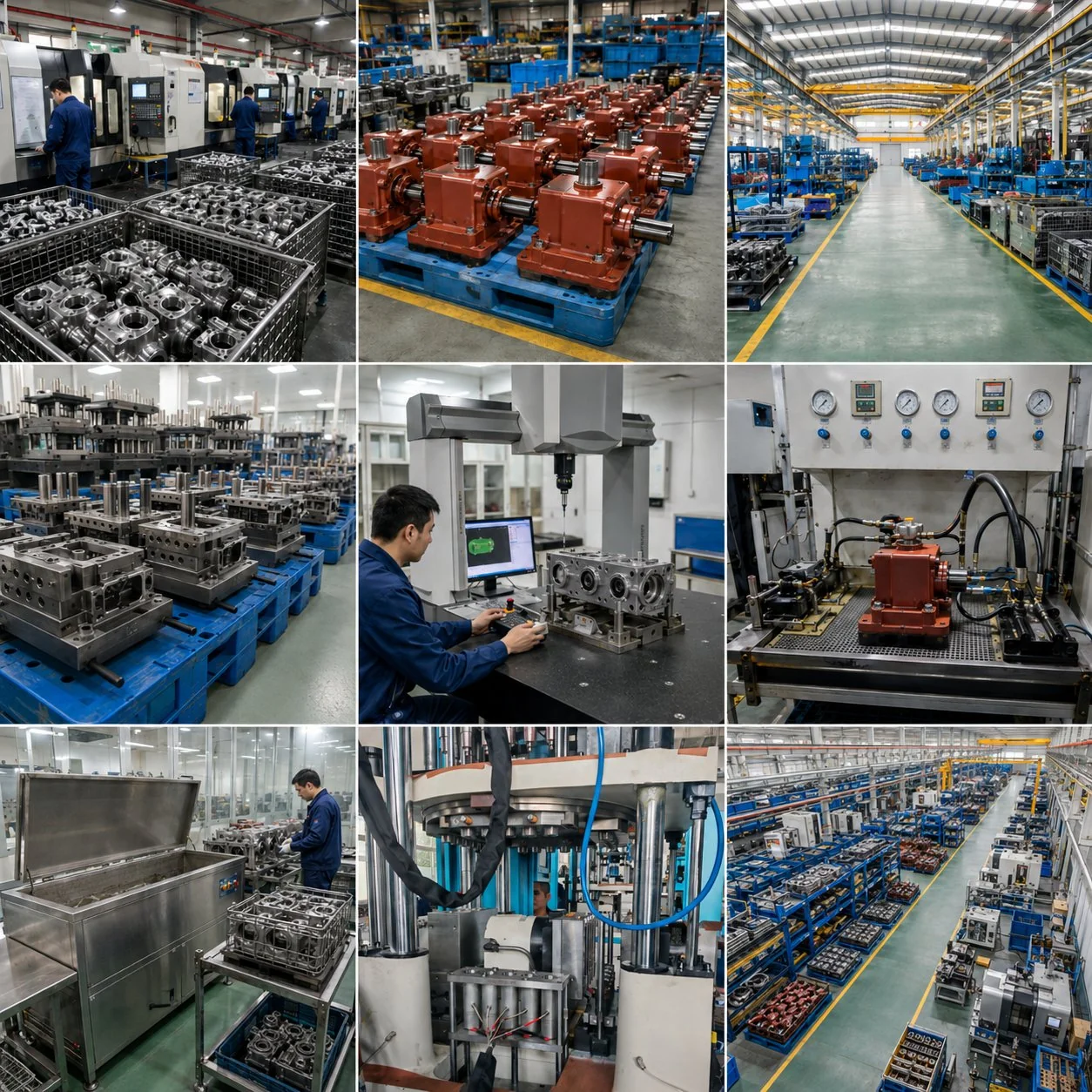
Quality Validation: Ensuring Production Matches the Prototype
The transition from successful prototype to reliable production is where many custom gearbox projects encounter problems. A prototype manufactured with extra attention by senior machinists may perform flawlessly in testing, but the production units — manufactured at higher speed by standard operators — must deliver the same quality consistently across every unit. Quality validation processes equivalent to the automotive industry’s PPAP (Production Part Approval Process) are the mechanism for ensuring this consistency.
A rigorous production validation includes dimensional inspection of the first production batch against all critical dimensions (gear tooth geometry, bore tolerances, mounting flange flatness, shaft runout), hardness verification (surface and core Rockwell readings on production gears versus the prototype specification), contact pattern check (roll test or blue contact check of the gear mesh against the pattern established during prototype validation), and a full load test of each assembled production unit on the test stand. The test stand verifies that production units achieve the same noise level, temperature rise, and vibration signature as the validated prototypes — any deviation indicates a manufacturing process variation that must be identified and corrected before further production proceeds.
For implement manufacturers who supply regulated markets (EU CE marking, Australian safety standards), the gearbox quality documentation becomes part of the implement’s technical file. A Zapfwellengetriebe manufacturer who provides comprehensive quality records — including material certificates for gear steel and housing iron, heat treatment process records with furnace charts, bearing certificates of conformity, dimensional inspection reports, and test stand results — simplifies the implement manufacturer’s compliance documentation significantly. This quality traceability also provides defensible evidence in the event of a warranty claim or incident investigation, protecting both the gearbox manufacturer and the implement builder.
Most Common Custom Gearbox Modifications
Not every custom project requires a ground-up redesign. The majority of custom Landwirtschaftliches Getriebe orders fall into one of several common modification categories that leverage existing proven designs while tailoring specific interfaces to the implement’s requirements. Understanding these categories helps implement builders identify the most cost-effective customization approach for their needs.
Shaft modifications are the most frequent customization. These include changing the output shaft diameter (to match a specific blade hub bore), altering the keyway size (to match an existing coupling), extending or shortening the shaft length (to accommodate different deck depths or mounting heights), or changing from a keyed output to a splined output (for applications requiring torque capacity beyond what a single keyway can transmit safely). Shaft modifications typically add 5 to 15 percent to the standard gearbox price and require no housing tooling changes — the modified shaft is simply installed in the standard housing during assembly.
Ratio changes within an existing housing are the second most common modification. If the standard catalog offers a 1:1 ratio and the application requires 1:1.47, the manufacturer designs a new gear set for the existing housing bore and bearing arrangement. This approach avoids the housing tooling investment entirely while delivering the exact output speed the implement requires. Ratio changes are constrained by the existing housing bore diameters and center distances — the new gear set must fit within the same bearing locations — but most housing designs accommodate a range of ratios spanning 0.7:1 to 2:1 or wider within the same housing shell.
Mounting pattern modifications — changing the bolt circle diameter, adding or relocating bolt holes, or modifying the mounting flange thickness — allow a standard-internal gearbox to fit an implement frame that was designed around a different gearbox brand. These modifications require either a new housing casting (for significant changes) or secondary machining of the standard production housing (for minor bolt pattern adjustments). Secondary machining is significantly cheaper and faster than new tooling, and can often be performed on the standard production housing with only a fixture change on the machining center.
Environmental modifications address specific operating conditions: upgraded seal materials (FKM/Viton for chemical exposure on sprayer gearboxes), epoxy or polyester powder coating (for corrosion resistance in marine, coastal, or chemical environments), sealed breather vents (for dust-intensive applications like grain handling or cement processing), and external cooling fins or oil cooler ports (for continuous-duty applications that exceed the standard housing’s thermal rating). These modifications add modest cost but can dramatically extend gearbox life in harsh operating environments that would rapidly degrade a standard-specification unit.
Multi-output configurations represent a more complex customization where a single PTO input drives two or more output shafts from the same gearbox housing. These are used in multi-blade mower decks, dual-rotor tillers, and split-drive applications where power must be distributed to multiple points simultaneously. Multi-output designs require careful gear train layout to ensure equal torque distribution and synchronous output speeds, and typically involve a more extensive engineering design phase than single-output modifications. The housing is either significantly larger than a single-output equivalent or split into a modular arrangement where standard gear stages are combined in a custom housing assembly.
Regardless of the customization type, the most important factor in a successful custom gearbox project is clear and complete specification at the outset. Changes to requirements after the engineering design phase is complete — adding a shaft extension, changing a ratio, or modifying the mounting pattern — introduce redesign cost and schedule delays that are disproportionate to the apparent simplicity of the change. Investing time in a thorough application specification before the engineering phase begins is the single most effective way to control custom gearbox project cost and timeline.
Häufig gestellte Fragen
Contact Our Agricultural Gearbox Team
From initial concept to validated production — our engineering team guides your custom gearbox project through every phase with full CAD documentation, prototype validation, and factory load testing. Send your application specification and receive a project timeline, budget estimate, and engineering feasibility assessment within 48 hours.