What a Tractor PTO Gearbox Actually Does — Beyond the Simple Definition
Every tractor with a rear power take-off stub delivers rotational energy at a fixed speed — 540 RPM or 1,000 RPM depending on the PTO standard — and at whatever torque the engine can supply through the PTO clutch. That raw output is rarely usable directly by the implement. A rotary cutter needs the input redirected 90 degrees from horizontal to vertical. A feed mixer needs the speed reduced from 540 RPM to 40 RPM while multiplying torque proportionally. A hydraulic pump on a manure spreader needs the PTO speed stepped up from 540 to 1,200 RPM to generate adequate flow at rated pressure. The gearbox sa traktor nga PTO performs this adaptation — changing speed, direction, and torque characteristics to match the specific demands of each implement.
This sounds mechanically trivial until you consider the operating conditions. A tractor PTO gearbox on a rotary tiller absorbs continuous torque reversals as each tine strikes soil, rocks, and roots in rapid succession. A PTO gearbox on a round baler sustains steady high-torque loading for 30 to 60 minutes per bale cycle, with the gear teeth and bearings running at temperatures that can exceed 90°C in summer conditions. A PTO gearbox driving a post hole digger absorbs violent torque spikes — three to six times the steady-state load — every time the auger hits a buried rock. Each application imposes a distinct loading pattern that determines which gearbox features matter most: gear tooth profile, bearing capacity, housing material, seal design, lubrication system, and overload protection.
The tractor PTO gearbox, then, is not just a speed reducer or direction changer. It is an engineered interface between a general-purpose power source (the tractor’s PTO) and a highly specific power consumer (the implement). Selecting the correct gearbox requires understanding both sides of that interface — the tractor’s PTO characteristics and the implement’s torque, speed, and duty-cycle demands — and choosing a gearbox whose internal components are rated to bridge the gap reliably across thousands of operating hours.
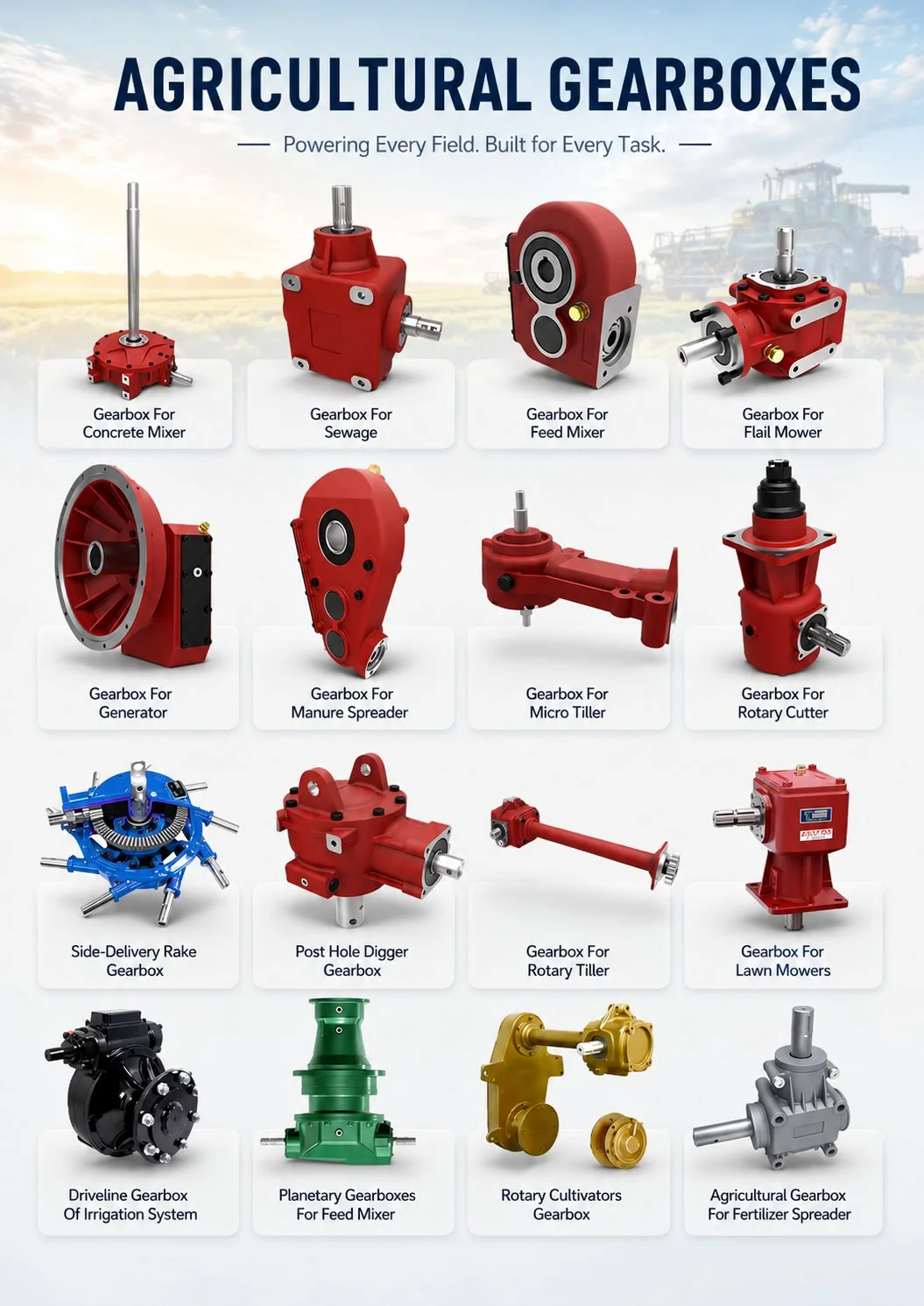
PTO Standards: 540 RPM, 1,000 RPM, and Ground-Speed PTO
The ISO 500 series (ISO 500-1 through ISO 500-3) defines the mechanical specifications for tractor PTO systems worldwide. Understanding these standards is essential because a PTO gearbox must match the tractor’s PTO configuration exactly — a mismatch in spline count, shaft diameter, or design speed creates immediate compatibility problems and can cause catastrophic damage to the gearbox, the driveline, or the tractor itself.
The 540 RPM PTO standard is the most widely used in agriculture. It appears on tractors from approximately 15 HP to 120 HP and uses a 6-spline 1-3/8 inch (34.9 mm) output shaft. At 540 RPM, the relationship between engine power and PTO torque is straightforward: a 50 HP tractor delivers approximately 37 kW at the PTO, which at 540 RPM equals roughly 654 Nm of torque. This is the available input torque for the gearbox — the gearbox must be rated to handle this continuous torque plus a safety factor for transient overloads. Most 540 RPM PTO gearboxes are designed for agricultural implements that require moderate to high torque at relatively low output speeds: mowers, tillers, balers, and spreaders.
The 1,000 RPM PTO standard serves higher-horsepower tractors (typically 75 HP and above) and uses a 21-spline 1-3/8 inch shaft or a 20-spline 1-3/4 inch (44.5 mm) shaft on the largest machines. The higher rotation speed at the same power output means lower torque at the PTO stub — the same 50 HP tractor running a 1,000 RPM PTO delivers only 357 Nm rather than 654 Nm. This lower input torque might seem like a disadvantage, but the 1,000 RPM standard exists specifically for implements that need higher speed rather than higher torque at the input: large hydraulic pumps, high-capacity forage harvesters, and grain carts with high-flow unloading systems. The PTO gearbox in these applications often steps the speed down and multiplies torque internally, but it starts from a higher baseline speed, allowing more flexibility in ratio selection.
Ground-speed PTO is a third standard that ties the PTO shaft rotation to the tractor’s ground speed rather than engine RPM. The ratio is typically set so that the PTO completes a fixed number of revolutions per meter of forward travel — commonly 8 to 10 revolutions per meter. This synchronization is essential for implements where the application rate depends on ground coverage: planters, seeders, and granular applicators. PTO gearboxes for ground-speed PTO applications must tolerate a wide range of input speeds (the PTO speed varies with ground speed) and must maintain lubrication and gear mesh integrity across that entire speed range, including very slow operation during headland turns where splash lubrication may be inadequate.
⚡ PTO Standard Quick Reference
540 RPM / 6-spline / 1-3/8 in.: Standard for tractors 15–120 HP. Most common in agriculture. High torque at moderate speed. Suited for mowers, tillers, balers, spreaders, post hole diggers.
1,000 RPM / 21-spline / 1-3/8 in.: Standard for tractors 75+ HP. Lower torque at higher speed. Suited for hydraulic pumps, forage harvesters, high-capacity grain handling.
1,000 RPM / 20-spline / 1-3/4 in.: Heavy-duty standard for tractors 150+ HP. Maximum torque capacity. Used on large commercial implements.
Ground-speed PTO: Speed proportional to travel. Used for seeding, planting, granular application. Requires gearbox rated for variable-speed input.
Gear Types Inside Tractor PTO Gearboxes: Bevel, Helical, and Planetary
The internal gear configuration of a tractor PTO gearbox determines its torque capacity, efficiency, noise characteristics, and suitability for different implement types. Three gear architectures dominate PTO gearbox design, each with distinct engineering trade-offs that affect performance in the field.
Spiral bevel gears are the standard for right-angle PTO gearboxes — units that redirect the horizontal PTO input 90 degrees to a vertical output shaft. This is the most common configuration in agricultural PTO gearboxes because most ground-engaging implements (rotary cutters, tillers, mowers, post hole diggers) require a vertical drive axis. The spiral tooth form provides gradual mesh engagement: each tooth enters the contact zone progressively across its face width, distributing the load over a wider band than a straight bevel tooth would. This progressive engagement reduces peak contact stress by 15% to 25% and significantly lowers noise and vibration. The trade-off is manufacturing complexity — spiral bevel gears require specialized Gleason or Klingelnberg cutting machines and precise mounting distances to achieve correct tooth contact patterns. A tractor PTO gearbox with poorly set spiral bevel gears will exhibit a distinctive whining noise and accelerated wear on one end of the tooth face.
Helical gear sets appear in inline PTO gearboxes — units where the input and output shafts are parallel rather than perpendicular. Inline gearboxes serve as speed reducers or speed increasers without changing the drive direction. A common example is the PTO speed increaser gearbox that steps up the 540 RPM PTO speed to 1,000 RPM or higher for driving hydraulic pumps. Helical gears offer higher load capacity than spur gears of equivalent size because the angled tooth mesh spreads the contact across multiple teeth simultaneously, and the helix angle creates a smooth, continuous power transfer that produces less vibration. The disadvantage is axial thrust — helical gears generate a force component along the shaft axis that must be absorbed by thrust bearings. In a well-designed gearbox sa agrikultura, the bearing arrangement accounts for this thrust load, but budget gearboxes sometimes use inadequate bearings that fail prematurely under the combined radial and axial loading.
Planetary gear trains provide the highest torque density of any gear configuration — meaning they can transmit the most torque in the smallest physical package. A planetary set consists of a central sun gear, an outer ring gear, and two to four planet gears that orbit between them. The torque is split across all planet gears simultaneously, so a three-planet set distributes the load across three mesh points instead of one. This allows planetary PTO gearboxes to handle extremely high torques in a compact housing, making them the preferred choice for heavy-duty applications where space is limited — truck-mounted PTO systems, crane drives, and high-torque agricultural implements like large-diameter stump grinders. The complexity and cost of planetary sets restrict their use to applications where the torque-density advantage justifies the premium price.
Understanding Torque Ratings: Continuous, Peak, and Application-Specific
Every tractor PTO gearbox carries a torque rating, but that single number conceals critical distinctions that determine whether the gearbox will survive in a specific application. Manufacturers rate gearboxes using different standards and test conditions, and comparing ratings across brands without understanding the rating methodology leads to selection errors that result in premature failures.
The continuous torque rating represents the maximum torque the gearbox can transmit indefinitely without exceeding the thermal limits of the lubricant, the fatigue limits of the gear teeth, or the load limits of the bearings. This rating assumes steady-state operation — a constant torque applied continuously for hours. It is the appropriate rating for implements with smooth, continuous power demands: centrifugal pumps, steady-feed conveyors, and irrigation drives. A PTO gearbox rated for 800 Nm continuous torque can run all day at 800 Nm without damage accumulation.
The peak torque rating describes the maximum momentary torque the gearbox can withstand without permanent deformation of the gear teeth or bearings. Peak ratings are typically 150% to 300% of the continuous rating, depending on the gearbox design and the assumed duration of the peak event. A gearbox rated for 800 Nm continuous might carry a 2,000 Nm peak rating — meaning it can absorb a 2,000 Nm torque spike lasting a few seconds without damage, but sustained operation at 2,000 Nm would destroy the gear teeth through surface fatigue within hours. Implements with shock loading — rotary cutters hitting stumps, balers compressing dense windrows, post hole diggers striking rocks — require PTO gearboxes with high peak-to-continuous torque ratios.
The AGMA (American Gear Manufacturers Association) rating system adds further nuance by defining service factors for different application types. AGMA standard 6013 assigns service factors ranging from 1.0 (uniform load, smooth operation) to 2.5 or higher (heavy shock, intermittent operation). A PTO gearbox destined for a rotary cutter — classified as “moderate shock” — requires a service factor of 1.5 to 1.75, meaning the gearbox’s continuous torque rating must exceed the calculated implement torque by 50% to 75%. For a post hole digger (classified as “heavy shock, intermittent”), the service factor rises to 2.0 to 2.5. Ignoring service factors is the most common engineering error in PTO gearbox selection — the gearbox appears adequate based on raw torque numbers but fails prematurely because the application’s shock and duty-cycle characteristics exceed what those numbers represent.

Agricultural PTO gearbox — built to absorb the demanding torque profiles of field implements
Matching the Tractor PTO Gearbox to the Implement: Application-by-Application Analysis
The relationship between a tractor PTO gearbox and its implement is specific enough that a gearbox perfectly suited for one application can fail catastrophically in another — even at identical torque levels. The loading pattern, duty cycle, environmental exposure, and speed requirements differ so substantially across implement types that each category demands its own gearbox selection criteria.
Rotary cutters and mowers present the most demanding combination of continuous torque and frequent impact loading. The gearbox runs at full load for hours during a mowing session, with the blade assembly striking hidden obstacles — rocks, stumps, fence posts, buried debris — at irregular intervals. Each impact generates a torque spike that propagates through the blade shaft, into the gearbox output, through the gear mesh, and into the PTO driveline. The PTO gearbox for a rotary cutter must therefore combine a high continuous torque rating (to handle the sustained cutting load) with a high peak torque capacity (to survive impacts) and robust housing construction (to resist housing flex and cracking). Cast iron housings with wall thicknesses exceeding 10 mm are standard on commercial-grade rotary cutter gearboxes. Aluminum housings — lighter and cheaper — appear on residential-grade units but lack the impact resistance for professional use.
Balers impose sustained high-torque loading with periodic peaks during the compression and tying cycles. A round baler gearbox might run at 70% to 85% of its continuous torque rating for 30 to 60 minutes while forming a bale, then experience a brief torque spike during the wrapping and ejection sequence. The thermal load is significant because the continuous operation allows the oil temperature to climb steadily — gear oil temperatures of 80°C to 95°C are common in baler gearboxes during summer operation. This sustained heat accelerates lubricant oxidation and requires gearboxes with adequate oil volume and, on larger units, external cooling provisions. Bearing life is the primary life-limiting factor in baler PTO gearboxes because the continuous high-load operation accumulates fatigue damage faster than the intermittent loading in mower or digger applications.
Fertilizer spreaders and manure spreaders place a different kind of demand on the PTO gearbox. The load varies with material feed rate and consistency — a spreader handling dry granular fertilizer runs at light, steady torque, while the same spreader loaded with wet, clumping material experiences erratic torque fluctuations as material bridges form and collapse in the hopper. The Linya sa pagmaneho sa PTO connecting the tractor to the spreader gearbox must also accommodate the articulation angles created by the spreader’s position behind the tractor during turning, which can impose additional bending loads on the gearbox input shaft if the driveline alignment is poor.
| Implement Type | Loading Pattern | AGMA Service Factor | Critical Gearbox Feature |
|---|---|---|---|
| Rotary cutter / mower | Continuous + impact shocks | 1.50–1.75 | Heavy housing, high peak torque |
| Round / square baler | Sustained high torque | 1.25–1.50 | Thermal management, bearing life |
| Post hole digger | Intermittent extreme shock | 2.00–2.50 | Overload protection, ductile housing |
| Rotary tiller | Continuous torque reversals | 1.50–2.00 | Gear tooth fatigue strength |
| Spreader (fertilizer / manure) | Variable, erratic | 1.25–1.75 | Corrosion resistance, seal integrity |
| Feed mixer | High starting torque, sustained | 1.50–2.00 | High ratio (10:1+), low output speed |
Lubrication: The Single Factor That Determines Gearbox Life Expectancy
More tractor PTO gearboxes are destroyed by lubrication failure than by mechanical overload, manufacturing defects, or operator error combined. The reason is that a gear tooth contact in a PTO gearbox operates under extreme conditions — metal surfaces compressed together at pressures exceeding 1,500 MPa, sliding against each other at speeds where the lubricant film must reform within microseconds, and temperatures that climb high enough to degrade the oil’s protective additives over time. If the lubricant fails to maintain a separating film between these surfaces for even a fraction of a second, metal-to-metal contact occurs, and the resulting micro-welding and tearing of the surface creates damage that is both cumulative and self-accelerating.
ISO VG 220 extreme-pressure (EP) gear oil is the industry standard for tractor PTO gearboxes operating in temperate climates. The “220” designates a kinematic viscosity of 220 centistokes at 40°C — thick enough to maintain a load-bearing film under the high contact pressures in spiral bevel and helical gear meshes, but not so thick that it creates excessive churning resistance at startup or at high rotational speeds. The EP additive package (typically sulfur-phosphorus compounds) provides a chemical backup: when the oil film thins to the point where metal surfaces approach contact, the EP additives react with the metal surface to form a sacrificial iron sulfide or iron phosphide layer that prevents direct metal-to-metal adhesion. This chemical protection is what separates gear oil from hydraulic oil or motor oil — using the wrong oil type eliminates this critical last line of defense.
Oil volume matters as much as oil quality. A tractor PTO gearbox is designed with a specific oil capacity that provides two functions: lubrication of the gear mesh and bearings, and heat absorption. The oil acts as a thermal reservoir — it absorbs heat generated at the gear mesh and bearing contacts, distributes that heat through convection and churning, and dissipates it through the housing walls. A gearbox with insufficient oil reaches damaging temperatures faster because the smaller thermal mass heats up more quickly. Conversely, overfilling the gearbox forces the gears to plow through an oil bath deeper than designed, increasing parasitic power losses by 5% to 15% and raising the operating temperature through viscous shearing of the excess oil — defeating the purpose of the additional oil. Fill to the check-plug level, verify with the gearbox in its installed orientation, and check after the first hour of operation because air pockets trapped during filling often release and lower the effective oil level.
In cold-climate operations (ambient temperatures below -10°C), ISO VG 220 oil becomes too viscous at startup to flow adequately to the bearing contact zones. The gearbox may operate for several minutes with bearings running in a starvation condition — the oil is present but too thick to reach the contact zone through splash lubrication. Switching to ISO VG 150 or a synthetic-base oil with a wider viscosity range resolves this problem. Synthetic PAO (polyalphaolefin) gear oils maintain better viscosity consistency across temperature extremes, flowing at -30°C while still providing adequate film thickness at 100°C operating temperatures. The cost premium — roughly double the price of mineral-base gear oil — is justified for PTO gearboxes operating in extreme temperature ranges or in applications where cold-start protection is critical.
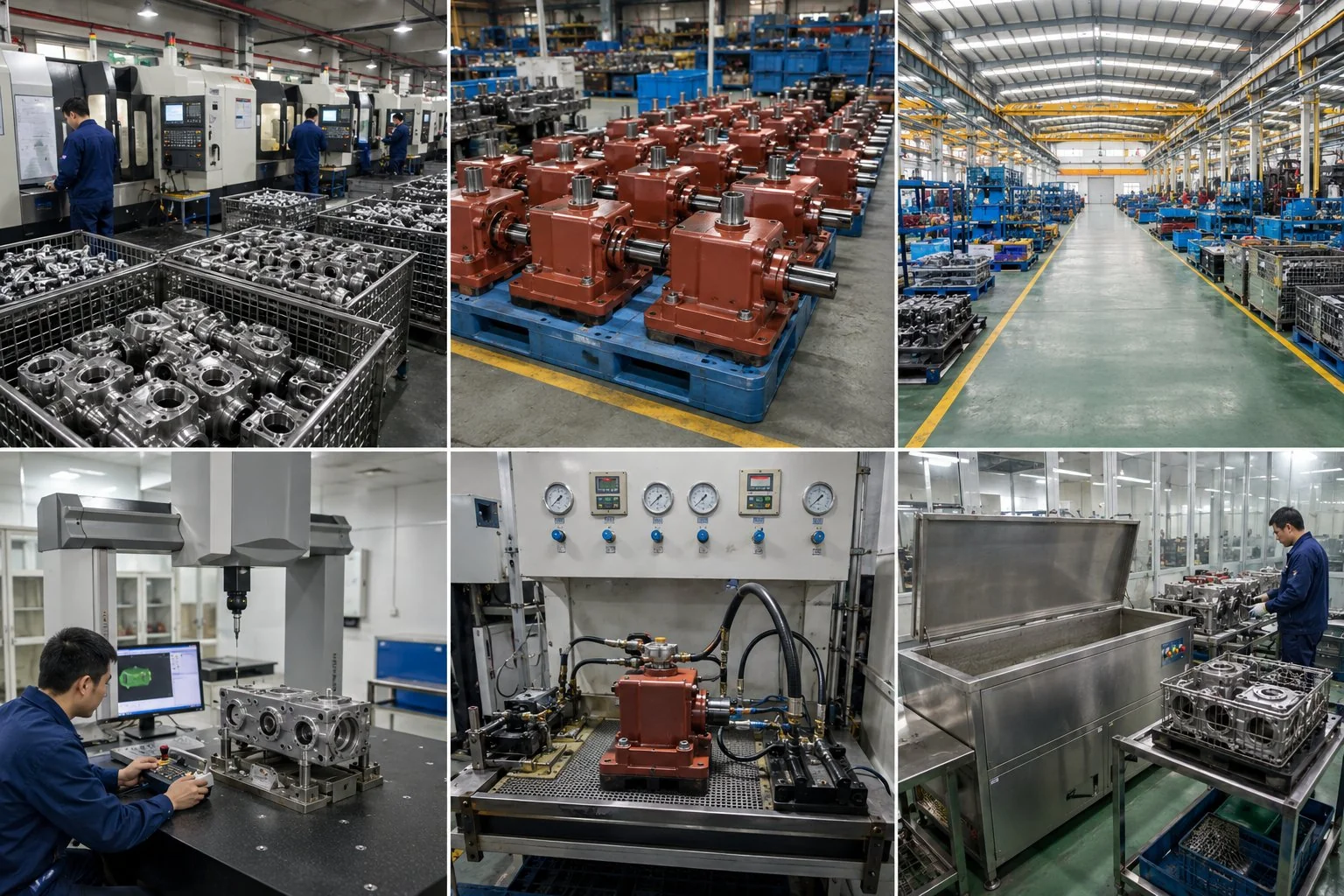
Bearing Systems: The Life-Limiting Component in Most PTO Gearboxes
In a properly maintained tractor PTO gearbox, the bearings — not the gears — are the component most likely to reach the end of their useful life first. This is because bearing life follows a well-characterized statistical distribution (the Weibull distribution, as codified in ISO 281) that relates the applied load to the number of revolutions before fatigue spalling initiates on the bearing raceway. Gear teeth, by contrast, can run essentially indefinitely if the contact stress remains below the material’s endurance limit — a condition that is achievable with proper design and lubrication. Bearings always accumulate fatigue damage because even properly loaded bearings operate above the material’s true endurance limit when the contact stresses from the gear mesh forces are factored in.
Tapered roller bearings are the dominant bearing type in PTO gearboxes because they simultaneously carry radial loads (from gear mesh separation forces) and axial thrust loads (from the helical or spiral bevel gear’s inherent axial force component). A typical right-angle PTO gearbox contains four tapered roller bearings — two supporting the horizontal input shaft and two supporting the vertical output shaft. Each bearing pair is arranged in opposition (face-to-face or back-to-back) to capture thrust loads in both directions and to provide rigid shaft support that maintains the precise gear mesh alignment required for correct tooth contact.
Bearing preload — the axial compression applied to the bearing pair during assembly — is a critical parameter that directly affects both bearing life and gear mesh quality. Correct preload eliminates internal clearance in the bearing, ensuring that the rollers maintain contact with both races under all load conditions. Too little preload allows the shaft to shift axially under varying loads, which changes the gear mesh position and creates a moving contact patch that accelerates tooth wear. Too much preload generates excessive friction, raises bearing temperature, and can reduce bearing life by 50% or more compared to correctly preloaded bearings. Most PTO gearbox manufacturers set bearing preload during assembly using a calibrated torque on the bearing locknut or a specific shim stack thickness — and this preload should be checked during any bearing replacement to ensure the new bearings receive the same pre-compression as the originals.
Contamination-related bearing failure is the most common mode in agricultural PTO gearboxes. Field environments expose the gearbox to dust, moisture, crop debris, and chemical residues (fertilizers, herbicides) that attack the seals and contaminate the lubricant. A single grain of silica sand (typical agricultural dust) trapped between a bearing roller and raceway creates an indentation that acts as a stress concentration point, accelerating fatigue crack initiation by an order of magnitude compared to a clean bearing surface. This is why seal integrity — discussed in the next section — is not a secondary concern but a primary life factor for PTO gearbox bearings.
Seals and Environmental Protection: Keeping the Field Outside the Housing
A tractor PTO gearbox operates in one of the most hostile environments for precision mechanical components. Dust concentrations in agricultural settings can exceed 100 mg/m³ during tillage operations — high enough that a poorly sealed gearbox can ingest enough abrasive particulate in a single season to reduce bearing and gear life by 50%. Moisture from rain, dew, pressure washing, and condensation introduces corrosion risk to the gear and bearing surfaces. Chemical exposure from fertilizers and herbicides attacks rubber seal materials, causing premature hardening, cracking, and leakage.
The primary defense is the shaft seal — a rotating seal that closes the gap between the spinning shaft and the stationary housing at each shaft exit point. PTO gearboxes typically have two shaft seals: one on the input shaft where the PTO driveline connects and one on the output shaft where the implement drive connects. The standard seal type is a single-lip radial shaft seal (commonly called a TC seal), which uses a spring-loaded rubber lip that rides against the polished shaft surface to prevent oil leakage and contamination ingress. On heavy-duty gearboxes, a double-lip seal with an external dust lip provides additional protection — the outer lip prevents debris from reaching the primary sealing lip, extending seal life in dusty conditions by two to three times.
The housing gasket or sealant at the split line is the second critical barrier. Many PTO gearboxes use a two-piece housing (split horizontally or vertically for assembly access), and the mating surface must seal against both oil leakage and contamination ingress under the thermal cycling and vibration of normal operation. RTV silicone sealant has largely replaced cut gaskets on modern PTO gearboxes because it conforms to minor surface irregularities and maintains elasticity through repeated thermal cycles. When resealing a PTO gearbox housing during service, clean both mating surfaces completely, apply a continuous bead of anaerobic or RTV sealant (per the manufacturer’s specification), and torque the housing bolts in the correct sequence to achieve uniform compression. Uneven bolt torque creates localized gaps in the seal line that become leak paths within days of returning the gearbox to service.
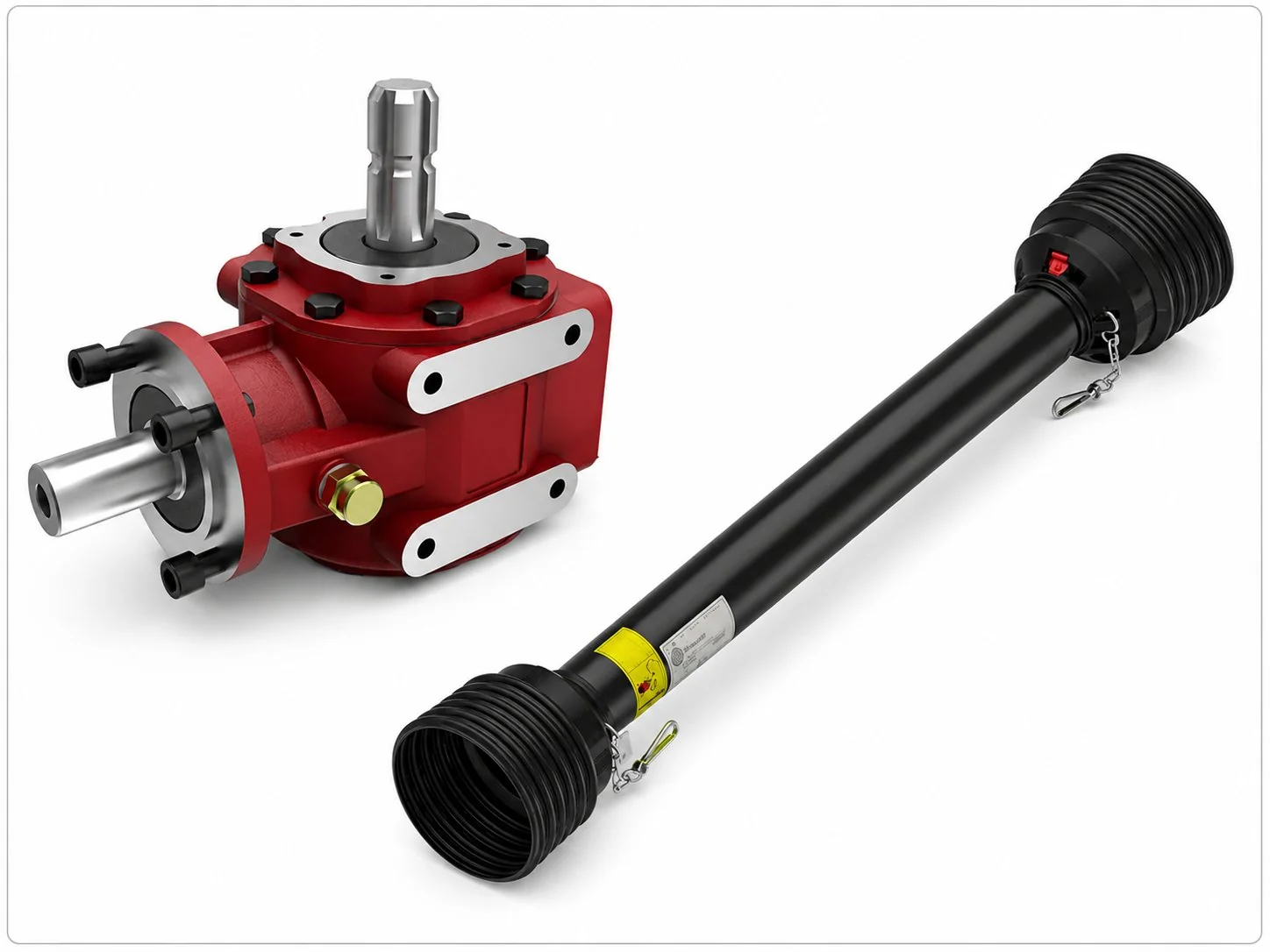
PTO gearbox and PTO shaft assembly — the critical interface between tractor power and implement demand
Maintenance Schedule: Time-Based and Condition-Based Protocols
A tractor PTO gearbox maintenance program should combine time-based service intervals with condition-based inspection criteria. Time-based intervals ensure that lubricant degradation, seal aging, and fastener loosening are addressed on a predictable schedule. Condition-based checks catch developing problems — bearing wear, gear tooth damage, seal leaks — before they progress to catastrophic failure.
🛢️
Every 250 Hours or Annually
Drain and replace gear oil. Inspect drained oil for metallic particles, milky appearance (water contamination), or burnt smell (overheating). Replace input and output shaft seals if any leakage is visible. Re-torque housing bolts to specification.
🔍
Every 50 Hours or Monthly
Check oil level via the sight glass or check plug. Inspect external surfaces for oil leakage patterns. Verify mounting bolt tightness. Listen for abnormal noise (grinding, whining, clicking) during operation. Check driveline U-joints for play.
📋
Every 1,000 Hours or 3 Years
Disassemble and inspect gear teeth for pitting, spalling, or root cracking. Measure bearing clearances and replace if beyond tolerance. Check housing for cracks, particularly around mounting bolt holes and bearing bores. Replace all seals and gaskets.
Oil analysis is the single most informative condition-monitoring tool available for PTO gearboxes. A 100 ml oil sample sent to a commercial analysis lab (typical cost: $25 to $40 per sample) reveals iron and copper particle concentrations (indicating gear and bearing wear rates), silicon content (indicating dust ingress through failing seals), water content (indicating condensation or seal leakage), and acid number (indicating lubricant degradation). Trending these values across successive samples provides early warning of developing problems — a rising iron content over three consecutive samples, for example, indicates accelerating gear or bearing wear that warrants inspection before the next scheduled service interval. This proactive approach catches problems at the “surface pitting” stage rather than the “catastrophic tooth fracture” stage, saving thousands of dollars in emergency repair costs and equipment downtime.
Selecting a Replacement or Upgrade PTO Gearbox
When a tractor PTO gearbox reaches the end of its service life — or when an implement is being upgraded to a higher-capacity tractor — the replacement gearbox must match several dimensional and performance parameters simultaneously. A mismatch in any single parameter can render the replacement unusable or create a failure mode more severe than the original problem.
The first parameters to verify are the input spline configuration (6-spline, 20-spline, or 21-spline), the input shaft rotation direction (clockwise or counter-clockwise as viewed from the input end), and the gear ratio. These must match the original gearbox exactly unless the replacement is a deliberate upgrade to a different ratio for changed operating conditions. The output shaft diameter and spline or keyway dimensions must also match the implement’s drive connection — even a 1 mm deviation in shaft diameter can prevent assembly or create a loose fit that allows destructive vibration.
The mounting bolt pattern is the most commonly overlooked compatibility factor. PTO gearboxes mount to the implement frame through bolt holes on the housing flange, and these patterns vary by manufacturer and model. The bolt circle diameter, bolt hole spacing, bolt size, and housing face orientation (horizontal, vertical, or angled) must all match the implement’s mounting provisions. When an exact replacement from the original manufacturer is unavailable, aftermarket gearboxes with “universal” mounting flanges or adapter plates provide flexibility — but the adapter must not introduce compliance (flexing under load) that alters the gear mesh alignment or allows the gearbox to shift during operation.
Upgrading to a higher-capacity gearbox is a common modification when moving an implement to a more powerful tractor or when the original gearbox has proven inadequate for the actual field conditions. The upgrade gearbox should have the same ratio and rotation direction, a compatible mounting pattern (or adapter), and a torque rating that meets the higher power input with appropriate service factors. Contact ang among grupo sa inhenyeriya for assistance in specifying replacement or upgrade gearboxes — we match the gearbox to your specific tractor PTO configuration, implement requirements, and operating conditions to ensure compatibility and long service life.
Mga Kanunayng Gipangutana nga Pangutana
Find the Right Tractor PTO Gearbox for Your Implement
Whether you need an OEM replacement gearbox, a custom ratio configuration, or engineering guidance on matching a PTO gearbox to a new implement, our team provides expert support backed by over two decades of agricultural gearbox manufacturing experience.
Editor: Cxm