What Is a Side-Delivery Rake Gearbox?
Usa ka side-delivery rake gearbox is the compact right-angle PTO-driven gear unit that converts horizontal tractor PTO rotation into the inclined-axis rotation required by the reel-bar raking mechanism. Among all PTO-driven agricultural gearboxes, the side-delivery rake gearbox is one of the simplest and lightest — typically a single-stage spiral bevel unit weighing just 8 to 20 kg with a 1:1 to 1:1.5 ratio. Yet despite this mechanical simplicity, it carries enormous economic responsibility: raking quality directly determines the nutritional value of the harvested hay, and the gearbox must deliver absolute reliability during the narrow weather window when raking must be completed before rain threatens the crop.
The side-delivery rake has been a cornerstone of haymaking for over a century, valued for its gentle crop handling that preserves leaf attachment on high-value legume crops. While rotary rakes and wheel rakes have gained popularity for their wider working widths and higher forward speeds, the side-delivery rake remains the preferred choice for premium alfalfa, clover, and mixed-grass hay production where leaf retention and windrow quality justify the narrower working width. Every aspect of the hay rake gearbox — from the gear ratio to the bearing selection to the oil specification — is optimised to support this gentle, precision raking function.
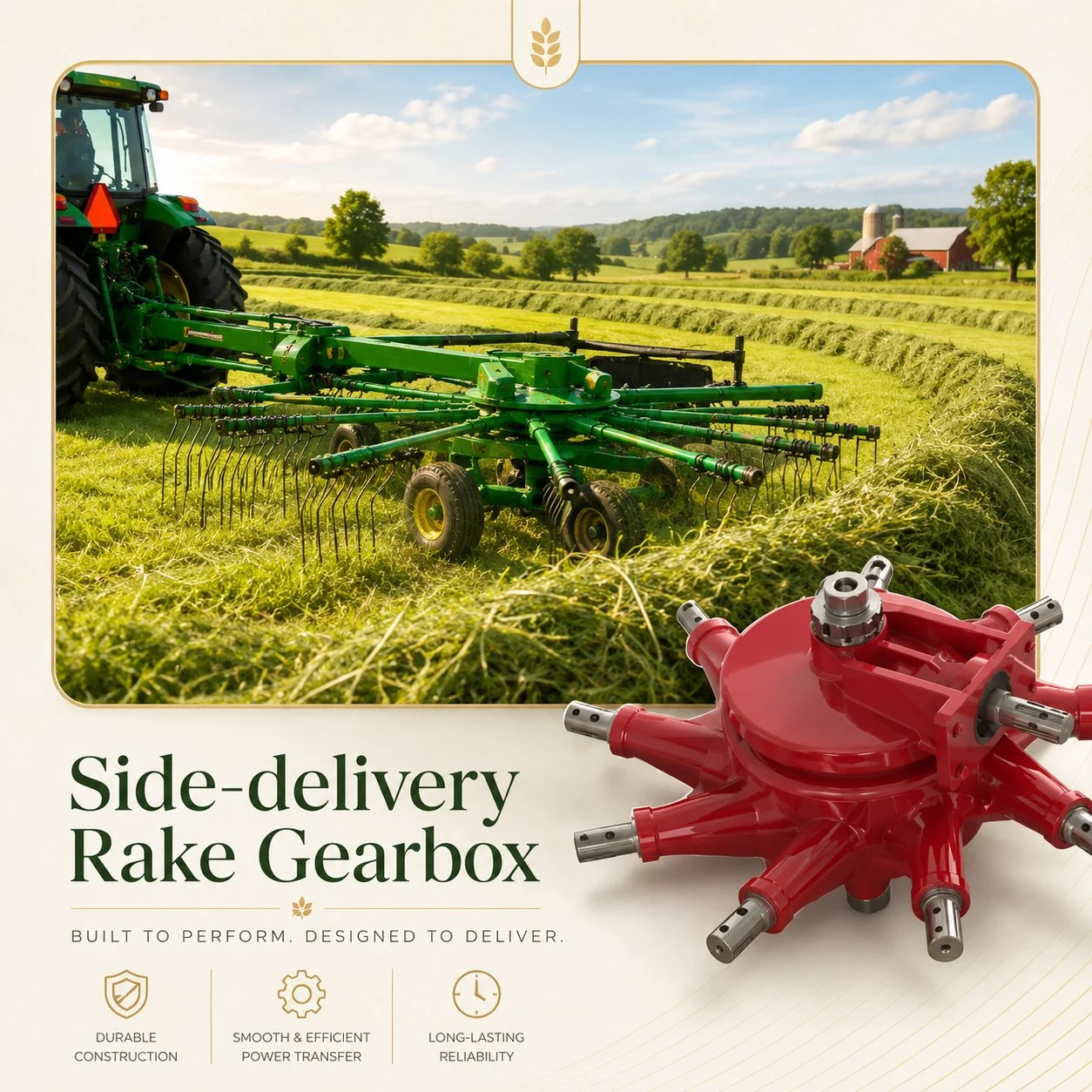
How the Raking Mechanism Works
A side-delivery rake gathers mown hay from a wide swath and rolls it gently into a fluffy, aerated windrow at the side of the machine. The mechanism consists of 3 to 6 horizontal reel bars mounted between two inclined rotating frames, with each bar carrying spring-loaded tines spaced at 100 to 200 mm intervals. As the PTO gearbox drives the reel, each tine sweeps across the crop in an elliptical path — lifting the hay from the stubble, moving it laterally toward the windrow side, and depositing it gently in the growing windrow. The reel angle (typically 15 to 25 degrees from the ground plane) combined with the reel rotation speed determines the lateral displacement rate and the resulting windrow width and density.
The beauty of this mechanism is that the hay is never thrown, beaten, or aggressively accelerated. Instead, the tines lift and roll the crop in a continuous, flowing motion that preserves the natural stem-to-leaf attachment. This gentle action is what makes the side-delivery rake the tool of choice for alfalfa — a crop where the leaves contain 60 to 70 percent of the total nutritional value (crude protein, energy, vitamins, minerals) and where aggressive raking can shatter and strip leaves, reducing feed value by 15 to 30 percent and representing a direct financial loss of hundreds of dollars per field.
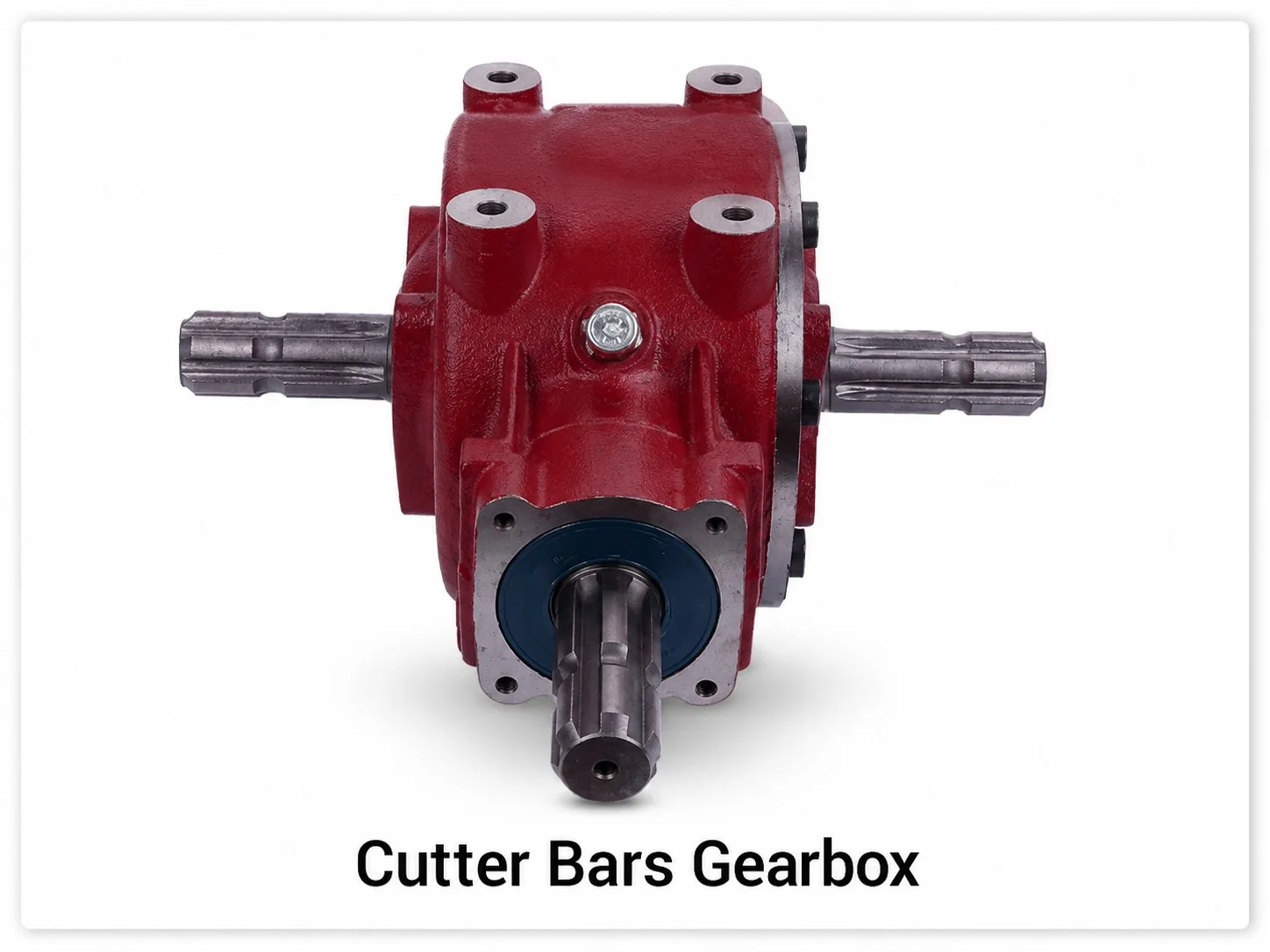
Right-angle bevel gearbox for side-delivery reel-bar rake applications
Reel Speed and Windrow Quality: The Critical Relationship
The relationship between reel speed and forward speed is the single most important factor in windrow formation gearbox performance. At typical forward speeds of 8 to 12 km/h, the reel bar tines must sweep the crop laterally at a rate that produces a continuous, even windrow without gaps, bunches, or excessive compression. When the side-delivery rake gearbox ratio produces a reel speed that is properly matched to the forward speed (the design condition), the tine spacing and reel bar geometry automatically produce the intended windrow width (typically 0.8 to 1.5 metres) and density.
In premium alfalfa production, the leaves account for 60 to 70 percent of the total crude protein and metabolisable energy. A reel speed that is 20 percent too fast produces aggressive tine action that can shatter 10 to 15 percent of the leaves — reducing the hay grade from premium to standard and cutting the market price by 15 to 25 percent. On a typical 200-hectare alfalfa operation producing 8 to 10 tonnes per hectare across three to four cuttings, this grade reduction represents a revenue loss of thousands of dollars per season — all traceable to incorrect reel speed from a mismatched or worn side-delivery rake gearbox.
Operating at significantly higher or lower forward speeds than the design condition shifts the reel-speed-to-ground-speed balance. Increasing forward speed beyond the matched range causes the tines to handle more crop per revolution — producing a denser, wetter-cored windrow that dries more slowly. Decreasing forward speed causes the tines to rake the same crop multiple times in overlapping passes — increasing leaf shatter from repeated tine contact. For operations that vary forward speed significantly between fields or crop types, a two-speed rake gearbox (with selectable ratios of 1:1 and 1:0.7 or 1:1.3) provides the flexibility to optimise reel speed for each condition without compromising leaf retention.
Side-Delivery vs. Rotary and Wheel Rakes: Gearbox Comparison
Gear and Bearing Design: Compact, Light, Reliable
The spiral bevel gear pair in a side-delivery rake gearbox typically uses module 3 to 4 mm with case-carburised tooth surfaces (58 to 62 HRC) — the smallest gear module in the PTO gearbox family. The low torque demand of raking (the mechanism lifts and displaces lightweight dry hay rather than cutting, compressing, or engaging soil) does not require the larger module 4 to 8 mm gears used in mower, baler, and tillage gearboxes. The smaller module allows a more compact housing with thinner walls — contributing to the 8 to 20 kg total weight that keeps the rake frame light and reduces the stress on the mounting brackets during transport over rough ground.
Deep-groove ball bearings (rather than tapered roller bearings) are the standard choice for side rake gearbox bearing positions. The low radial loads and moderate axial thrust from the spiral bevel mesh fall well within the capacity of quality deep-groove ball bearings (6205 to 6208 series) — and ball bearings provide lower friction, lower noise, and longer fatigue life at these modest load levels than roller bearings. Many manufacturers supply the rake gearbox with sealed-for-life bearing arrangements that require no field maintenance beyond periodic oil level verification — an important convenience for an implement that operates intensively for short seasonal periods and then sits idle for months.

Compact right-angle agricultural gearbox — lightweight design for hay rake duty
Mga Teknikal nga Espesipikasyon sa Usa ka Pagtan-aw
Two-Speed Rake Gearbox: Versatility for Multiple Crop Types
Usa ka two-speed rake gearbox provides two selectable ratios — typically 1:1 for standard raking and either 1:0.7 (slower reel for very dry, brittle crops) or 1:1.3 (faster reel for heavy, damp windrows that need more aggressive displacement). The speed selection mechanism is a simple sliding collar on an internal splined shaft, engaged by an external lever — a mechanical shift that provides two discrete operating speeds without the complexity, cost, or weight of a continuously variable transmission. Shifting between speeds takes only seconds and can be performed while the tractor is stationary with the PTO disengaged.
The engineering difference between a single-speed and two-speed rake gearbox is modest: the two-speed unit adds one sliding gear, one spline sleeve, a detent mechanism, and an external shift lever — increasing the gearbox weight by approximately 2 to 4 kg and the cost by 15 to 25 percent. For operations that rake multiple crop types (alfalfa requiring gentle, slow reel speed versus heavy ryegrass or cereal straw that benefits from faster, more aggressive raking), the side-delivery rake gearbox with two-speed capability pays for the additional investment through improved windrow quality and reduced leaf loss across the full range of crop conditions encountered during the season. For single-crop operations that rake the same hay type at consistent moisture content, the standard single-speed 1:1 ratio is sufficient and the two-speed option adds unnecessary complexity.
PTO Driveline Considerations for Rake Operation
Ang Linya sa pagmaneho sa PTO for a side-delivery rake requires only a Series 1 or Series 2 shaft — the lightest PTO driveline classification, appropriate for the 8 to 25 HP continuous power demand. The driveline must be properly phased (both U-joint yokes aligned in the same rotational plane) to prevent the twice-per-revolution speed variation that mis-phased joints produce. While this speed variation is mechanically harmless at rake power levels, it creates a pulsating reel speed that modulates the tine engagement pattern and can produce visible windrow unevenness — particularly noticeable in thin, light crops where every tine pass leaves a distinct mark on the windrow surface.
Overrun clutch (freewheel) protection is recommended on the PTO driveline for side-delivery rakes. When the tractor decelerates or the PTO is disengaged, the rotating mass of the reel bars and tine assemblies continues spinning — and without an overrun clutch, this stored kinetic energy back-drives through the gearbox and driveline into the PTO stub, potentially damaging the tractor PTO bearings. An overrun clutch allows the reel to spin down freely after PTO disengagement without transmitting any reverse torque through the driveline. The modest cost of an overrun clutch (typically 50 to 100 dollars) protects both the side-delivery rake gearbox and the tractor PTO from unnecessary reverse-load wear.
Rake Gearbox Oil Type and Lubrication
The correct rake gearbox oil type is EP (extreme pressure) gear oil at ISO VG 220 viscosity — the same specification used across most right-angle agricultural gearboxes. For rake gearboxes, mineral-based VG 220 is perfectly adequate because the modest power level, moderate speed, and light loading produce oil temperatures of only 40 to 55 degrees Celsius during normal operation — well within the thermal stability range of mineral base stock. Synthetic oil offers no meaningful advantage at these low stress levels unless the rake is operated in early-morning or late-autumn conditions where ambient temperature drops below minus 5 degrees Celsius (where mineral oil thickening could marginally increase starting drag).
Oil volume in a rake gearbox is small — typically 0.3 to 0.8 litres — making oil change a quick, inexpensive operation. The oil change interval for a side-delivery rake gearbox is 300 to 500 operating hours or every 2 to 3 seasons, whichever comes first. Given that most rakes accumulate only 50 to 150 hours per season (raking is a rapid operation — typically 3 to 8 hectares per hour at 8 to 12 km/h forward speed), a single oil fill can last several seasons before the hour-based interval triggers a change. However, an annual oil condition check (colour, smell, clarity) should be performed during pre-season preparation regardless of hours accumulated, because condensation moisture can accumulate during extended storage periods and degrade the oil even without operational use.
Iskedyul sa Pagmentinar sa Panahon
Check oil level and condition — change if dark, milky (water contamination), or over 500 hours old. Rotate reel by hand to verify smooth bearing rotation — roughness or catching indicates bearing wear. Grease PTO driveline U-joints and splines. Inspect tine spring tension and replace any broken tines. Verify overrun clutch operation (reel should spin freely when PTO is stationary).
Clean gearbox exterior thoroughly — hay dust and chaff trap moisture that accelerates corrosion during storage. Top up oil to maximum level (minimises air volume and condensation). Apply protective grease to exposed shaft surfaces and coupling interfaces to prevent fretting corrosion. Store under cover. Record operating hours for next-season oil change planning.
Aftermarket Hay Rake Gearbox Replacement
Hay rake gearbox replacement is one of the most straightforward aftermarket operations in the gearbox sa agrikultura market. Rake gearboxes are compact, standardised, and dimensionally consistent across many brands — making cross-reference matching relatively simple compared to the complex gearboxes used in balers, feed mixers, or tillage equipment. The primary cross-reference parameters are: input shaft spline profile (6-spline for 540 RPM), output shaft dimensions and coupling type (keyed shaft or splined), mounting bolt pattern (typically 3 or 4 bolts on a square or triangular pitch), and gear ratio (1:1, 1:1.3, or 1:1.5).
A well-maintained side-delivery rake gearbox typically lasts 10 to 20 or more seasons before bearing fatigue or gear tooth wear necessitates replacement — among the longest service lives of any PTO-driven agricultural gearbox. The light-duty operation (8 to 25 HP, no impact loading, no cyclic overloads) produces minimal gear and bearing wear compared to the aggressive loading profiles of baler, tillage, and mixer gearboxes operating at the same or higher power levels. When replacement is eventually needed, the modest cost of a rake gearbox (it is the least expensive gearbox in the agricultural implement range) combined with the straightforward bolt-on installation makes the replacement a simple field operation that an experienced operator can complete in 30 to 60 minutes.
Mga Kanunayng Gipangutana nga Pangutana
Rake Right, Every Time
Compact, reliable right-angle gearboxes for gentle windrow formation — preserving leaf quality and maximising the nutritional value of every bale.
Editor: Cxm